[The first part of this paper gave the king’s dream, and his efforts to secure an interpretation. This article continues the narrative.—EDITOR.]
The Dream Interpreted—The First Three Empires.
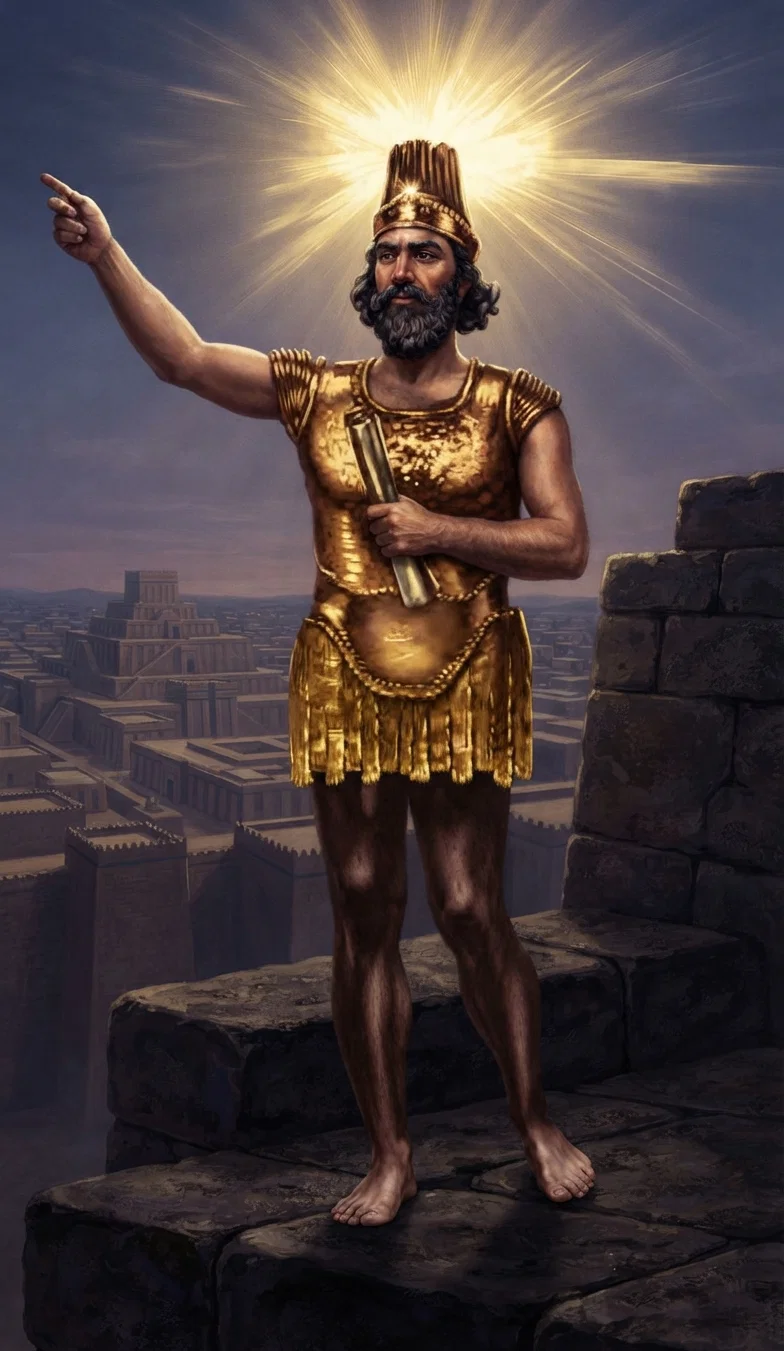
IN astonishment Nebuchadnezzar heard Daniel make the first practical application of the dream to himself and his empire. “Thou, O king,” said the prophet, “art a king of kings: for the God of heaven hath given thee a kingdom, power, and strength, and glory. And wheresoever the children of men dwell, the beasts of the field and the fowls of the heaven hath He given into thine hand, and hath made thee ruler over them all. Thou art this head of gold.” Dan. 2: 37, 38.
First in glory as well as in time was the universal empire of Babylon. To those who lived in the days of its greatness, it appeared as if built to endure permanently. Tho it did not attain its fullest glory until about 625-600 B.C., yet the foundations of the nation were laid immediately after the Flood. We hear much of the tower of Babylon, where God worked the confusion of tongues; but we hear little of the city which was built about the same time. “So the Lord scattered them abroad from thence upon the face of all the earth; and they left off to build the city. Therefore is the name of it called Babel; because the Lord did there confound the language of all the earth.” Gen. 11: 8, 9. The city seems originally to have been one of four which, according to Gen. 10: 9, 10, were built by Nimrod, a great grandson of Noah. The Babylon, therefore, mentioned in connection with the tower of Babel, and the Babylon built by Nimrod can be considered as one and the same city, for Nimrod has usually been reported by Jewish and Arabic literature as the mighty rebel who led on the revolt against God which resulted in the confusion of tongues.
Under Nebuchadnezzar, this city sprang into a commanding position. His nobleness of character and his great ability made this king a suitable instrument in the hand of God to carry out the divine purposes, especially when the Jews had sunk back into lifeless idolatry. “Nebuchadnezzar was the real founder of the Babylonian Empire. The attempt of Pharaoh Necho to win for Egypt the inheritance of Assyria was overthrown at the battle of Carchemish; and when Nebuchadnezzar succeeded his father in B.C. 604, he found himself the undisputed lord of Western Asia. Palestine was coerced in 602 B.C.; and the destruction of Jerusalem in 587 laid a way open for the invasion of Egypt, which took place twenty years later. Tyre also underwent a long siege of thirteen years. . . . Babylon was now enriched with the spoils of foreign conquest.”—A. H. Sayce, “Ancient Empires of the East,” p. 2.
Babylon the City.
With such riches flowing into the capital city through these vast conquests, Daniel declared before the king, “God . . . hath made thee ruler over them all. Thou art this head of gold.” The captive prophet had beheld the splendors of that city of which Nebuchadnezzar said later, “Is not this great Babylon, that I have built for the house of the kingdom by the might of my power, and for the honor of my majesty?” Dan. 4: 30.
Beneath the terraces of his palace, whose remaining walls and piers still rise in their ruins to the height of seventy-five feet, still shimmered in the sunlight the fine streets lined with houses, three and four stories high. Two other structures of unusual beauty and size stood out against the sky. The first was “the great temple of Marduk, or Bel, the head of the Babylonian pantheon. Altho the beginning of this structure goes back to a very ancient period, it was Nebuchadnezzar who restored and enlarged it beyond its former proportions, and within its sacred precinct, in which the temple stood, he erected numerous shrines to various gods and goddesses, who constituted, as it were, the court of the chief god. A feature of the precinct was a high tower eight stories in height, formed by a series of stages, one above another, with a balustrade running around the tower to the top.”—M. Javis, Ph.D., in Harper’s Magazine, April, 1902.
The second edifice standing within the city walls and so wonderful to the ancients, was the hanging gardens. The bride from Media, who shared the throne with Nebuchadnezzar, sighed for the mountains of her native land. To cheer her, the king caused to be constructed successive terraces, rising in stages one above another. Each one of these was covered with earth in which were planted beautiful trees and rare plants, the whole being so arranged as to give the appearance of a natural mountain.
The city walls themselves were of striking dimensions. “A space of more than 130 square miles was enclosed within walls eighty feet in breadth and 300 or 400 feet in height, if we may believe the record.” (George Grote in “Great Events by Famous Authors,” Vol. 2, p. 75). Other writers speak definitely of three massive walls, the outer one being broad enough on top to be made into a great street upon which a four-horsed chariot could be driven. Pierced by 100 gates and flanked by 250 towers, they must have struck with admiration the astonished beholder. To speak nothing of the numerous population within their circuits, nor of the notable bridges which crossed the Euphrates, the prophet could well call it, “Babylon, the glory of kingdoms, the beauty of the Chaldees’ excellency.” Isa. 13: 19.
Medo-Persia.
This glittering empire, however, was not to become permanent. Daniel had noticed that, beginning with the head of gold, the different divisions of the statue declined in worth until the head of gold rested upon the feet of clay. “After thee,” he declared to Nebuchadnezzar, “shall arise another kingdom inferior to thee.” Nebuchadnezzar had no successor able to maintain what he had built up. He reigned forty-three years; from the time of his death in 561 B.C. till the fall of his empire in 538 B.C. five successors reigned in this space of twenty-three years. Only one, Belshazzar, has become famous, or infamous, through his godless feast, the night when the shining hand traced on the palace wall the sentence of Babylon’s doom. The city fell before the skilful attack of the Medes and Persians. “Cyrus,” says George Grote, “caused another reservoir and an5other canal of communication to be dug, by means of which he drew off the water of the Euphrates to such a degree, it became not above the height of a man's thigh. The period chosen was that of a great Babylonian festival, when the whole population were engaged in revelry and amusement. The Persia troops, . . . watching their opportunity, entered from both sides along the bed of the river, and took it by surprise with scarcely any resistance.”
In this manner the second empire, that of Medo-Persia, took the kingdom. The head of gold was replaced by the breast and arms of silver. How rapidly had prophecy become history! Under the Medo-Persian empire, the reign of organized civilization pushed further westward and eastward. As God had used Nebuchadnezzar, so he used, as long as he was able, Cyrus and his successors. Under Cyrus took place the return of the Jews from Babylon to Jerusalem. Under Darius, 521-486 B.C., the empire still continued to aid in the restoration of Jerusalem. His son and successor, Xerxes, named Ahasuerus in the book of Esther, occupied his life with the dreadful campaign against Grecia, so disastrous for Persia. After him, the empire plunged rapidly forward toward its doom. Riches, luxury, selfishness, treason, plots, and revolts undermined confidence and public authority. Cyrus, as the anointed of the Lord, had been held in the hand of God as the Lord led him on to the execution of His designs. But when his successors departed from God, the hand of the Lord was withdrawn. “And now will I return to fight with the king of Persia,” said the angel to Daniel, “and when I am gone forth, lo, the prince of Grecia shall come.” Dan. 10: 20.
Greece.
“And another third kingdom of brass, which shall bear rule over all the earth.” No city or nation of previous time ever secured the prominent hold upon history as did Greece. Long before the days of Alexander the Great, the cities of Greece had given to the world men of imperishable fame. Solon, for his wisdom; Pausanias, for his bravery; Eurepides, for his dramas; and Demosthenes, for his oratory, had left behind immortal records. The heroic resistance of little Greece to the gigantic invasion of Persia molded a people of resistless daring, fit for the use of Alexander. Under the attacks of his commanding genius, the empires of antiquity fell to pieces, and the Grecian race, as foretold by Daniel, assumed the dominion of the earth. This youthful conqueror succeeded his father upon the throne of Macedonia and Greece in 336 B.C. By 333 B.C. Asia Minor, Palestine, and Egypt had yielded to invasions. Three great battles, Granicus, Issus, and Arbela, the last in 331 B.C., laid the Persian Empire at his feet. Then followed the subjection of Babylon, Susa, Persepolis, Ecbatana, and Persia.
His vast undertakings, however, came suddenly to an end. In 323 B.C., in Babylon, in the midst of great plans for the future, he suddenly died. The unity of his empire failed to survive him; the ultimate division of his dominions among his four leading generals, followed his death. Nevertheless God has accomplished His purpose in giving unlimited sway to Greece. The language and civilization of that energetic people were spread abroad throughout the known world. Not only was the Old Testament translated into the Grecian tongue, but the advantages of that speech were secured to the New Testament as well. Grecian arts became the handmaiden of the new truths proclaimed by Christ. And as Solomon employed the workmen of Tyre to build a temple to God, so the Christian church, vitalized by the Holy Spirit, continued its flight to Western worlds on the wings of Grecian knowledge. It remained for the thighs of brass to be replaced by the legs of iron,—only one step more, and then the setting up of the everlasting kingdom which should never be destroyed.