[This article on the great Hyderabad flood was written by Elder Geo. F. Enoch, formerly editor of the Caribbean Watchman, before the great earthquake in Italy. The awful catastrophe at Hyderabad was dismissed with a mere paragraph in our newspapers. We will better know its awful horrors after reading this article.—EDITOR.]
IN the wail of wo arising from great modern disasters, no country is omitted. Even the most distant lands join the sad chorus. On the 27th and 28th of September, the city of Hyderabad, the capital of the native state of the same name, was overtaken by a disaster which is doubtless the greatest of all disasters of recent years in India.
Hyderabad is a Mohammedan state, whose chief ruler, called the Nizam, reigns with all the glory of a Mohammedan Oriental. It has occupied no small place in India's history. When the great Mogul Empire, whose kings ruled at Delhi, began to go to pieces, the territory now occupied by this large native "state" was one of the first to make itself independent. For a long time a three-cornered contest with the Delhi kings on the north, the Mahrattas on the west, and Mysore on the south, was carried on with international alliances, sometimes with England, again with France. Fortunately for their existence as a separate state, the Nizam reigning at the close of the eighteenth century recognized that England was eventually to be supreme in India, and was the first of the great native states to enter voluntarily into the new political system of the Marquis of Wellesley, which has since proven the political salvation of India. In a nutshell, the native states were to surrender their international life to Britain in return for British protection, their internal affairs being left largely to themselves. By entering early into this agreement, the Nizam secured great advantages for his dominions. His young men have been sent abroad and have been well educated.
In order to grasp something of the results of the recent disaster, it is necessary to know the conditions prevailing in a native state outside the direct authority of Britain. In fact, this is one of the first great disasters happening in a state wholly under a native administration.
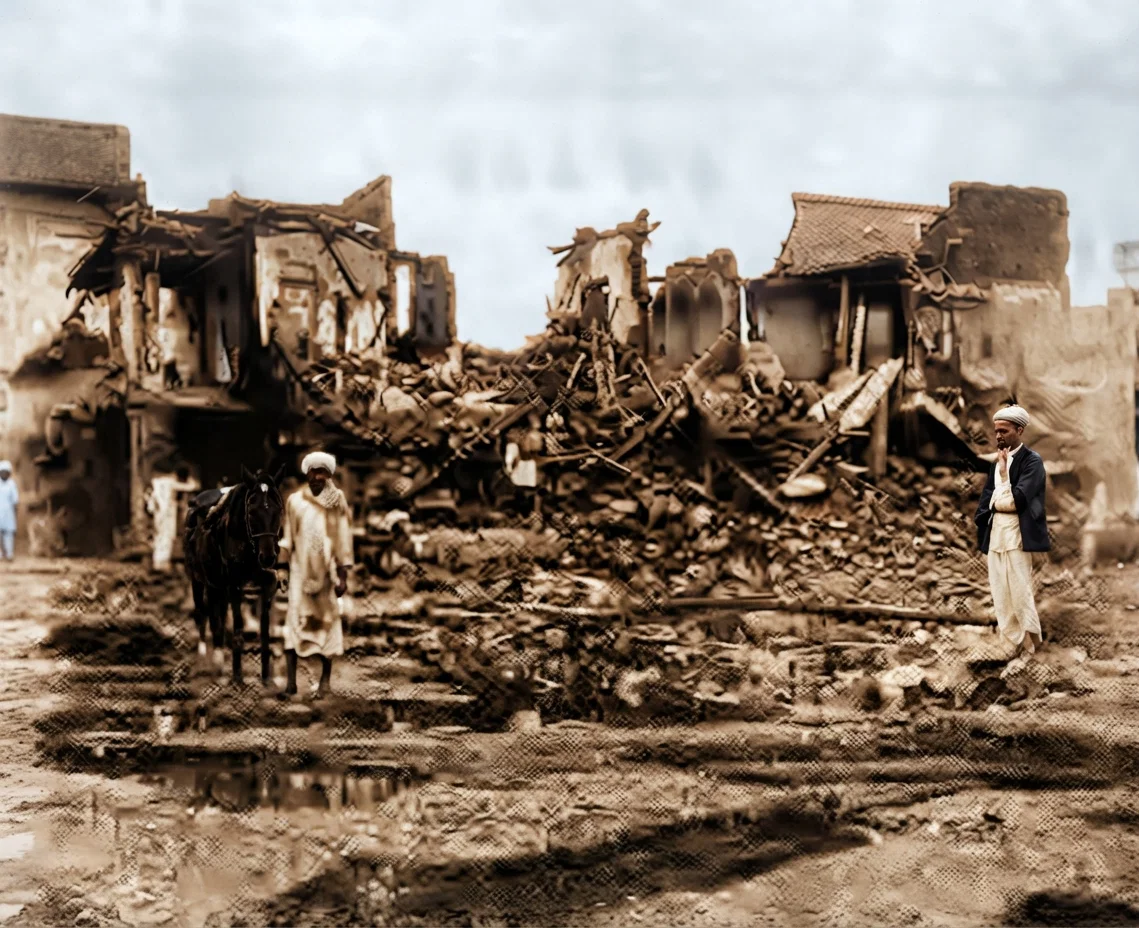
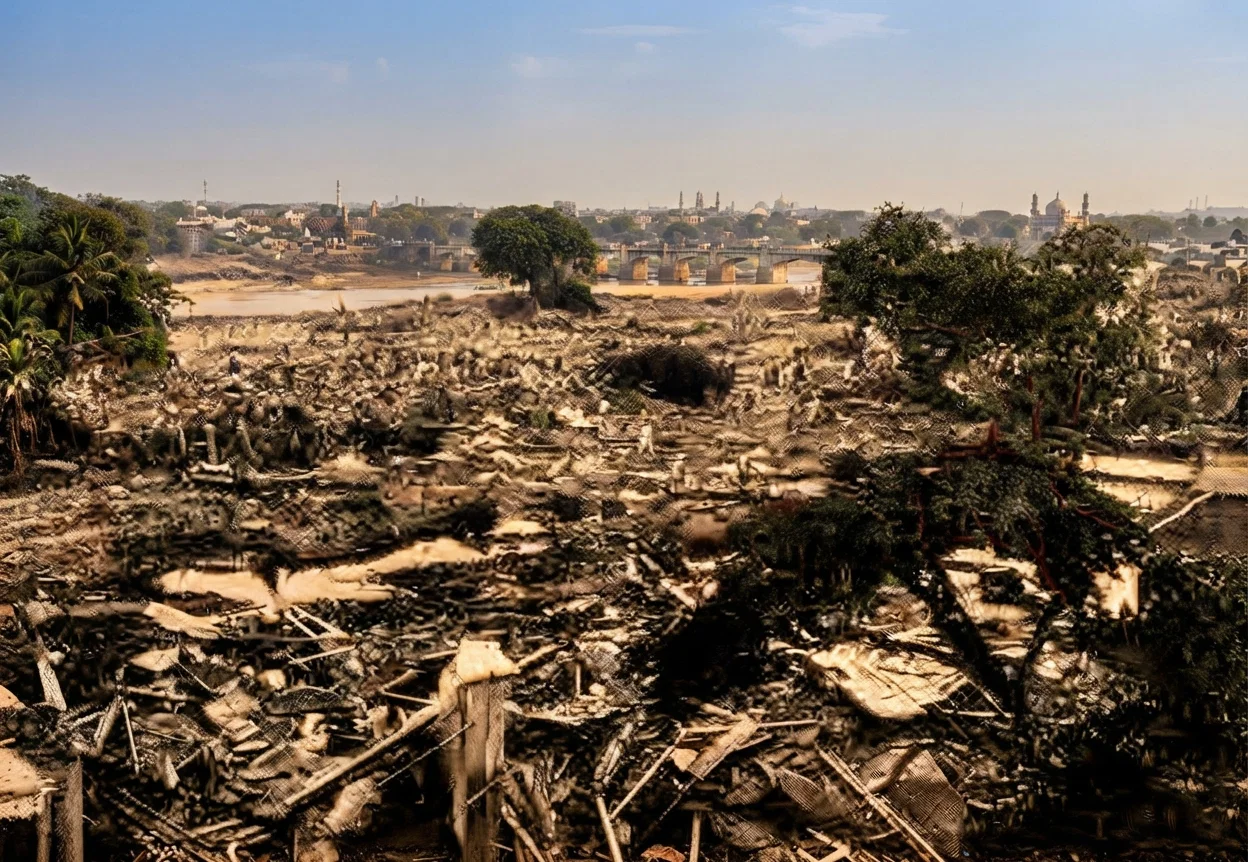
The city of Hyderabad is a city of about 400,000 population. Like all Oriental cities, it has densely populated and congested centers, where the buildings are of the frailest construction. The river Musi, usually quite an insignificant-looking stream, flows through the city. On a peninsular-like portion, around which the river makes a horseshoe bend, were crowded thousands of people. There was an unusually heavy rainfall for a few days, at the end the rain coming down in torrents. Many artificial tanks, or lakes, had been built along the river for irrigation purposes. The river rose rapidly and threateningly, as it had done many times before, but the people paid but little heed. Finally these great tanks overflowed, and some of them burst their dams, and a great four-foot wall of water swept down upon the doomed portion of the city. No sooner had the first great wave carried desolation as far as it could reach, than it was followed by one after another. The great bridges that lay between the people and safety one after another gave way. Over one bridge had passed the traffic of centuries. One great army after another had found safety from annihilation by flight over its wide roadway, supported by massive masonry. In fact, as generations came and went, men began to consider it almost eternal. It remained for a modern disaster to ruin it.
Wrecked houses in a better portion of city destroyed by flood, Sept. 28, 1908, at Hyderabad City, Hyderabad, India.
Among all the sufferers who were not destroyed by the overwhelming waters were the zenana women. Thousands of these women from childhood raised behind the "purdah" (curtain), upon whom no man's eyes were to look excepting their husband's, found their "purdah" swept away by the disaster and themselves in a moment exposed to the gaze of the world. Senseless and foolish as the custom is, still they have been reared according to it, and their suffering was very acute.
It is not known how many perished in the floods of waters. It was first reported that 100,000 had lost their lives, but more recent estimates place the dead at 4,000. [The last London "Times" places it at 10,000.] It was not less than this. In other words, more people perished than in both the San Francisco and Jamaica earthquakes. The Nizam's government arose nobly to the situation and relief has been quickly and efficiently rendered to the survivors.
"The black grave," Hyderabad City, Hyderabad, India. The wreck near the Afzul Gangbridge, where thousands of houses filled with humanity were overwhelmed early in the morning, Sept. 28, 1908.
So these nations of the Orient are beginning to see the signs of the fast-approaching end of all things. To the missionary struggling to bring the message of salvation, such a disaster means that a great host have gone beyond the reach of the Gospel he is striving to carry to them, and nerves him to greater efforts and deeper consecration in the sowing of the good seed; for he knows not what evil shall be upon the earth.
Poona, India. GEORGE F. ENOCH.