Fijian Food

7%

Pacific Press Publishing Company · Mountain View, California · Oct 28, 1908

FromSigns of the Times, Vol. 35, No. 13.

Read the full edition

Fijian Food

The Fiji Islands—No. 1

By J. E. Fulton
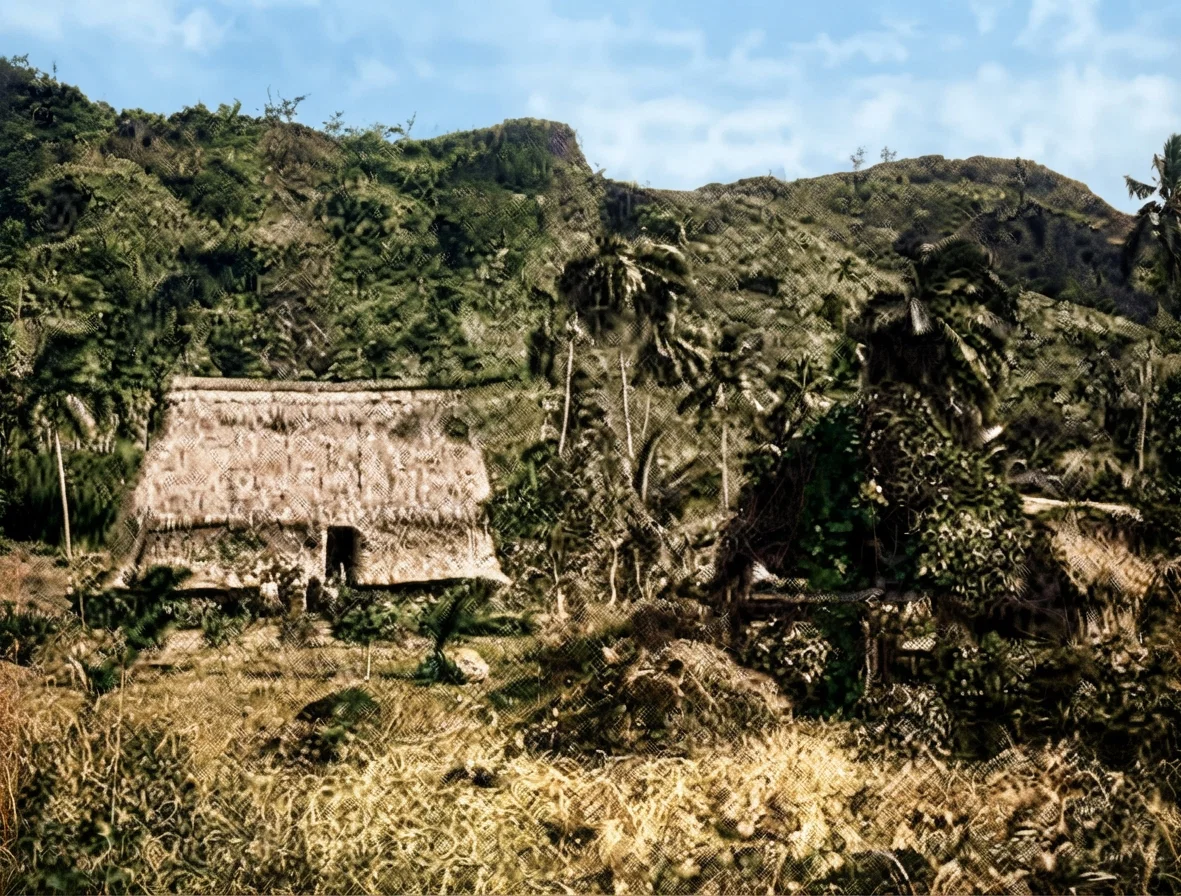
FIJI comprises about 225 islands, eighty of which are inhabited. Two of the islands, Viti Levu (big Fiji) and Vanua Levu (big land) are islands of considerable size, Vanua Levu being as large as Jamaica. Neither Vanua Levu nor Viti Levu is called an island by the natives. To them they correspond to continents, and the outlying smaller bodies of land are called by the name of yanuyanu, or islands. Most of the islands are rough and mountainous, and on Viti Levu there are mountains rising to the height of 4,500 feet. There is abundant evidence of volcanic origin in the many tall, sharp-pointed, conical hills of basaltic formation, which at some remote age were the craters of active volcanoes. In the hot springs of Savu Savu Bay, we still have the present indication of volcanic heat. The accompanying picture will show something of the rugged contour of many of the islands, as well as the dense vegetation which abounds in spite of the forbidding rocks.
A Characteristic Fijian View.
All the islands are surrounded to a great extent by coralline reefs, whose beautiful tints and varied and delicate structure always excite admiration; some of these are covered with a sufficient depth to support vegetation, and others are half concealed by the combing waves that spend their fury in impotent efforts to destroy the little insects that quietly build the mighty barrier. In addition to the reefs there are sunken patches of branching coral, whose brilliant colors, reflecting the rays of the tropical sun, seem like enchanted gardens.
All of the islands are quite well watered, especially the large islands, there being some rivers of considerable size in both Viti Levu and Vanua Levu. There is necessarily a great deal of moisture arising daily which makes the heat sometimes quite oppressive. But the heat is again often tempered by delightful breezes from the sea. The nights are usually cool and pleasant.
The population of Fiji stands at about 122,000. The Fijians are a well-made, stalwart race. The mountaineers show the frizzy hair and dark color of the Melanesian, while the coast tribes betray the strong admixture of Malay and Polynesian blood. They are a kind, hospitable, well-behaved race, there being very little crime among them. Considering the fact that when the Gospel found them in 1835 the Fijians were a race of cannibals, carrying on cruel tribal wars, it is truly a triumph of what God's grace can do for the human heart.

Fijian Food.

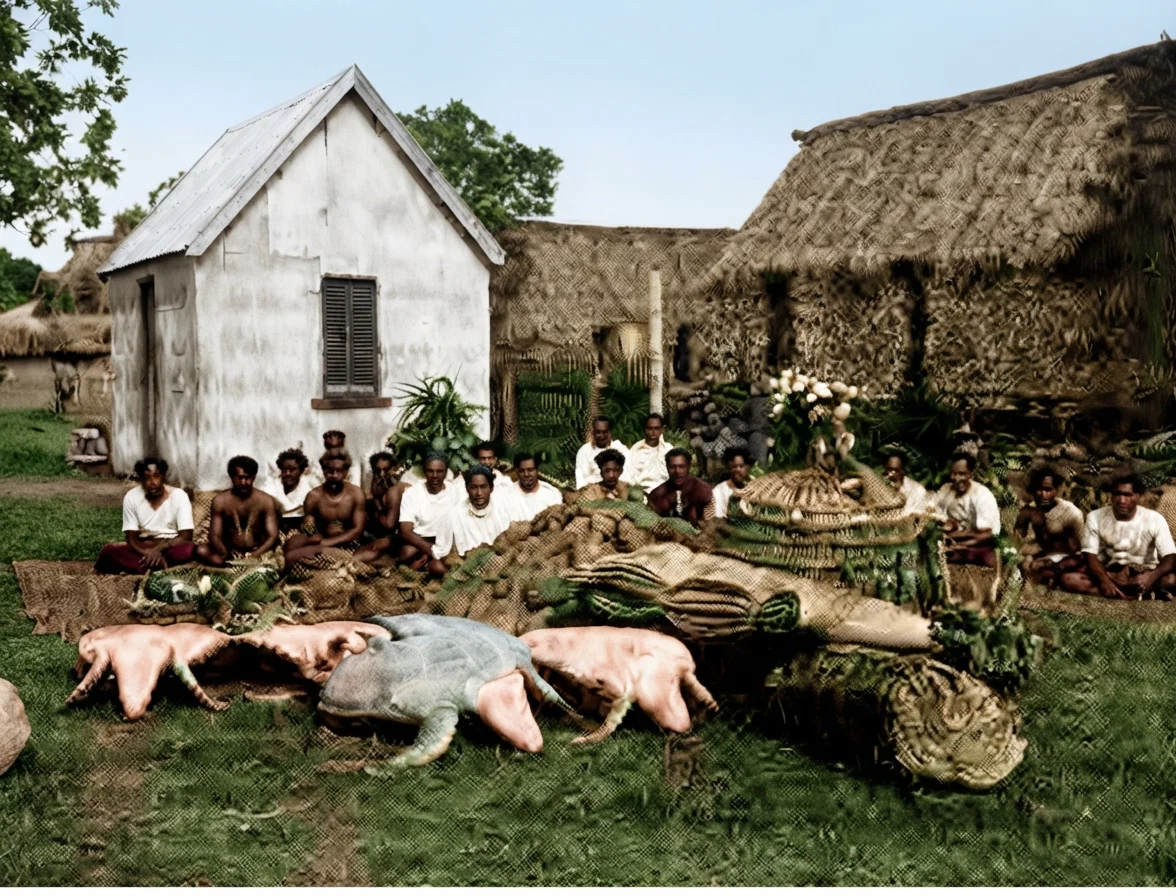
In the cut we have presented before us the preparations for the magiti, or feast. Those large creatures, turned on their backs, in the forefront of the picture, are turtles. These are regarded as a great delicacy, and in former days were supposed to be the food only of the chiefs. The turtles are turned on their backs so that they will not escape, for in this attitude they are helpless. They are often kept for several weeks in this condition, without food, waiting for the feast-day. The turtles are very tenacious of life, and even after they are cut into pieces, each piece of flesh seems alive, and the heart has been known to beat for hours after being separated from the body.
In the center of the picture is a pile of yams, and back against the small house is a pile of taro. These are native vegetables, the staple articles of diet in Fiji and other islands. They are something like potatoes, and are prepared in similar manner.
You notice also bundles of mats and tappa cloth. This is likely a wedding-feast and these are for gifts. The bridegroom must always be well provided with mats, not only for himself, but more especially as presents to the parents or relatives of the bride.
Feast at Bau, Fiji.
Feast at Bau, Fiji.
A large basket shown in the picture encloses a large porker. A feast can hardly be thought complete without the swine. There will likely be baskets of fish and other foods. And when the time arrives to have the food prepared, a large pit is made, and into this are placed logs of wood which are set on fire. Large stones are heated to an intense heat in this fire, after which the burning wood is raked out, and the stones leveled for the food to be put in. Yams, taro, fish, turtle, and pig, all go into this pit, and are covered over with leaves, and then with earth, and left to roast. In ancient times human flesh was prepared for food in this identical way. When pigs or turtles were difficult to obtain, men could easily be procured. Many are living to-day who were witnesses of these things. The forearm was thought to be the best part of the human body. How revolting is the thought! How marvelous has been the change!