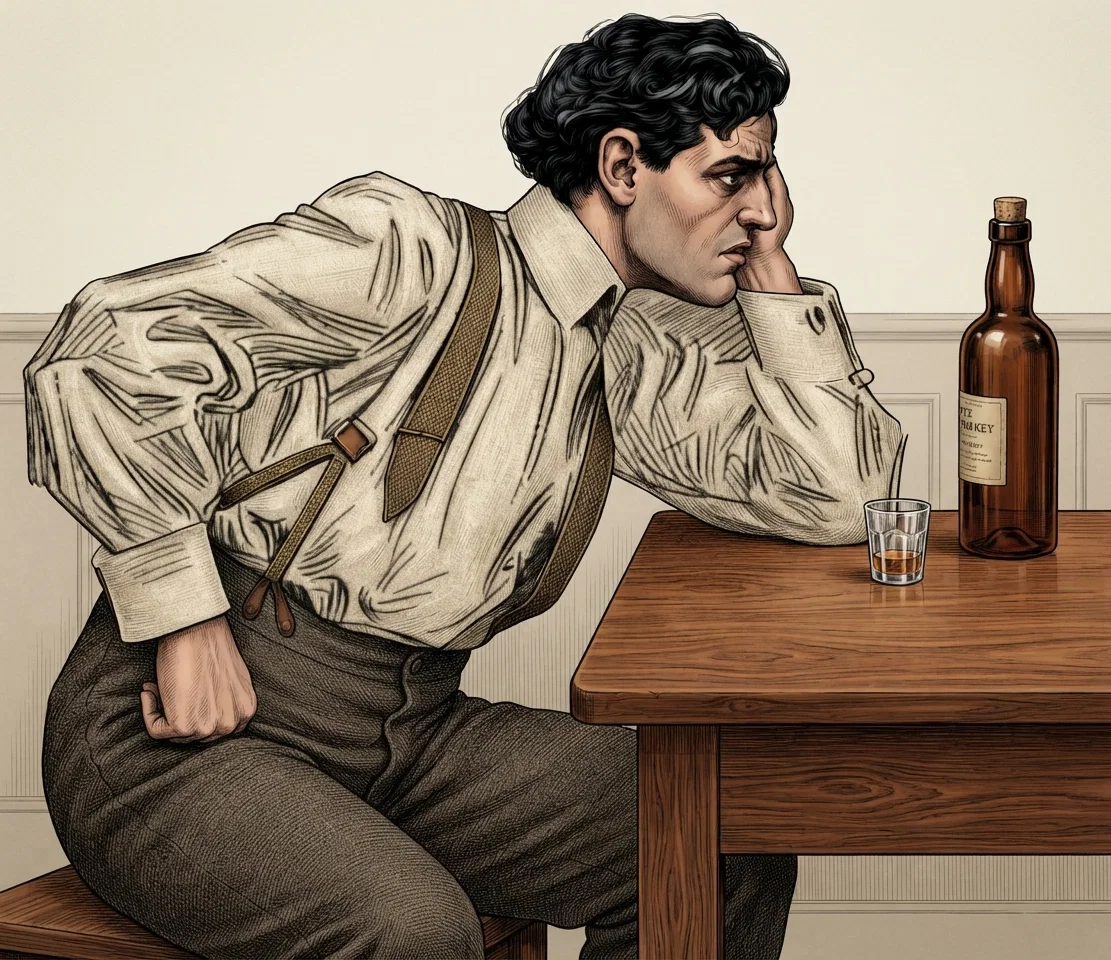
"O God, that men should put an enemy in their mouths to steal away their brains!"
The Enemy of the Workingman
By George W. Rine
THE degree of human progress is largely determined in terms of labor. In both the physical and the intellectual world, there can be no excellence without labor. A progressive society is objectively conditioned upon skill in the cultivation of the soil, in the building of roads and bridges, in the construction of private and public buildings, in the operating of mines, in the multifarious phases of manufacture, in the transportation and distribution of the products of labor, and so on almost indefinitely.
It follows, therefore, that the degree of progress made by civilized society is commensurate with the degree of the efficiency of its individual workers. Hence whatever tends to impair the effectiveness of the toilers, injures society, retards social advancement.
It is a fact of common knowledge that corporations and other employers are everywhere demanding sobriety of not only their office force, but also their manual workers. Captains and other officers of vessels, and even the common sailors, are strictly forbidden to touch alcoholic drink while on duty. Locomotive engineers, firemen, and train conductors can no longer keep their positions if they show the slightest inclination to befog their faculties with grog.
Several months ago, the Delaware, Lackawanna, and Western Railroad made a rule that all its employees must totally abstain from alcoholic drink, not only when on duty, but when off duty as well. This rule was enforced on the ground that it meant life and safety to passengers, and dollars and prestige to the company.
A recent report sent out by the United States Department of Labor informs us that seventy-two per cent of agriculturists, seventy-nine per cent of manufacturers, eighty-eight per cent of "trades" employers, and ninety-eight per cent of transportation companies, rigidly exclude from their employ all persons not known to be habitual abstainers. The Fidelity and Casualty Company testifies concerning the prevention of industrial accidents: "A man whose nerves have been made unsteady by a recent debauch, or by the habitual use of alcohol, should not be permitted to operate dangerous machinery or to carry on dangerous work. He endangers not only his own life, but the lives of others."
It is because drink leads one to be reckless and foolhardy, and because it dulls the senses by which danger is perceived, impairs one's judgment, and lessens motor control, that it so amazingly increases liability to accident.
Alcohol not only unfits a man for labor, but deprives him of nearly all his chance of engaging in remunerative labor. And since alcohol is the enemy of labor, it is the enemy of all social progress and well-being.
Every alcoholic is a candidate for tuberculosis.
RUM conquered Alexander the Great after he had conquered the world.
Fatal Effects of Alcohol
THE alcohol problem is more important than the tuberculosis problem, as (1) it costs more lives and more money; (2) it costs the United States over $2,000,000,000 annually; (3) it probably causes, directly and indirectly, at least ten per cent of all the deaths in the United States; (4) it predisposes to infection, destroys acquired immunity, prevents the occurrence of artificial immunity, at least in rabies, lessens resistance, leads to an increased mortality in all infectious diseases and after surgical operations; (5) it lessens the power of the individual to resist the injurious influences of extreme heat and cold; (6) it causes a deterioration of the quality of mental work; (7) it diminishes the power to withstand fatigue, and lessens the general efficiency of the individual; (8) it is a poison, and should be classified as such, instead of as a food or stimulant; (9) when the physicians take hold of the question in the same spirit as they have shown concerning yellow fever, malaria, and smallpox, instead of treating it as a moral question, and leaving it to clergymen, temperance workers, and enthusiastic reformers, we may expect better results; (10) more may be accomplished by teaching the people the truth in regard to the fatal effects of alcohol upon mental and physical efficiency than by expatiating on the moral wickedness of drinking.
We deserve condemnation as a profession when we assume the attitude of sneering contempt for the efforts of clergymen, laymen, enthusiasts, and reformers in their attempts to stamp out this evil, just as we would deserve it if we would assume the same attitude toward them if they attempted to stamp out yellow fever and malaria. Fortunately, the question is receiving new attention from earnest men who have the courage of their convictions, and who see with clear vision, and who will not be deterred by sneers or criticisms.
Public opinion demands, and has a right to demand, in no uncertain tones, that the action and influence of alcohol be determined and settled by the medical profession, and that we then teach the people the truth fully, conscientiously, and fearlessly.—George W. Webster, M. D.
SCIENTIFIC experiments show that even comparatively small amounts of alcohol decrease the amount of work accomplished, and increase the fatigue therefrom.
Impairs Muscular Power
ALCOHOL does not increase strength for muscle work, but distinctly decreases it. The reason that many persons imagine they are working better and with less weariness after taking alcohol is that the alcohol blurs judgment. Thus one judges that he has accomplished more work than he really has done, while the alcohol temporarily covers the feeling of fatigue. This is soon followed by greater depression; but the drinker seldom realizes that this is due to the alcohol, and sometimes he uses more drinks to overcome it.
The learned Dr. Abel says, "Both science and the experience of life have exploded the pernicious theory that alcohol gives any persistent increase of muscular power."
Careful tests with delicate instruments have shown that even a small quantity of alcohol—no more than that in a bottle of claret wine—caused disturbances of the mental faculties. It slowed reaction time—the response of the mind to signals—or if a choice had to be made, the worker answered the signal more quickly but made more mistakes. With larger quantities of alcohol, the reaction was always slower. The alcohol brings on a condition similar to that of fatigue, so that work done is of a lower order than that of which the mind is naturally capable. It impairs the power to memorize, to add, to judge.—Cora Frances Stoddard.
"THAT drink impairs the scholarship of school children is undeniable. High scholarship decreases, and poor scholarship increases, as the use of alcohol is increased."
The Foe of Efficiency
"SCIENCE has demonstrated that alcohol is a poison to the human system. It weakens man's brawn, impoverishes his blood, and injures his brain. The evil effect is proportionate to the extent to which alcohol is used. It lessens the power of the toiling man to do his labor. It makes the burdens of the miner heavier to be borne, and makes it harder for the mason to lift the stone, for the carpenter to wield his hammer, for the engineer to hold the throttle. It diminishes the logic of the lawyer, dims the genius of the writer, makes unsteady the knife of the surgeon, weakens the grasp of the business man over his affairs, quenches the ambition, cools the courage, and clouds the mind of the statesman."
"SCIENCE has shown alcohol to be responsible for a large part of our insanity, imbecility, disease, and degeneracy. And now comes big business showing us that alcohol is responsible for most of our inefficiency."
Dangerous Drug
IT is clear, in the light of experience and of recent research work, that alcohol ought to be classed in the list of dangerous drugs, along with morphine, cocaine, and chloral, a drug which may so affect the will power as to gain the complete mastery over a patient, and in the end destroy him. English and German physiologists have demonstrated, beyond a question, that the continued use of alcohol in any quantity is not only useless, but positively harmful; and on the basis of experience, I appeal to my colleagues everywhere to abjure its use.
One of the most alarming effects is that observed in the arterial walls and in the heart muscle, which are weakened. The impairment of nutritive processes is another pronounced factor. All rational surgery and treatment of disease takes into serious account the question of the use of alcohol by the patient. This is science, and not sentiment or theory.—Dr. Howard A. Kelly, professor of diseases of women, Johns Hopkins University.
DR. W. F. BOOS says: "The excessive Monday accidents result from the paralyzing effect of the Saturday night and Sunday debauch — the 'hang over,' which may last for twenty-four hours and longer. The victim is . . . not in complete control of his faculties, and is therefore more liable to have an accident."
Between 1901 and 1910, there were 14,411 cases of suicide to which alcohol contributed.
Is Beer Injurious?
MODERN scientific research has shown that, contrary to general belief, beer is proportionately much more noxious than are wines or liquors. The Bremen anti-alcohol congress, a conclave of many of the most famous physicians in Europe, concluded that, while liquor makes a man brutal and dulls his judgment, an adequate amount of beer makes him slow-witted and abolishes judgment. While wine or brandy, in405sufficient quantity, makes a man crazy, beer tends to make him stupid.
As regards the recent claims that lecithin, or "nerve fat," has been discovered in beer, this is interesting, if true. If it has — despite all the painstaking negative analyses of many generations of chemists — it is quite safe to estimate that the total amount contained in four carloads of beer might approximate the quantity concealed about the person of one vigorous fresh egg.—Edwin F. Bowers, M. D.