Alcohol: Does It Pay?

2%

Alcohol: Does It Pay?

A MAN plunged one day into a doctor's office, all excited. "Doctor," he cried, "look down my throat." "Yes," said the doctor. "I don't see anything." "Don't you see, don't you see anything?" cried the man. "No, nothing," said the physician. "What's the matter?" "Doctor, look closer. I've swallowed a house and lot."
We know that gasoline pays. This fluid is sold everywhere, in all countries, is in great demand, and is netting those who control it, some of the greatest fortunes ever amassed in the history of the world. But alcohol, that fluid, does it pay? Let's look at its record and see. It caused that man to swallow his house and lot; it caused Alexander to surrender the scepter of his world empire, just when he had won it; Babylon the great passed away in a night of drunken revelry; and the Roman Empire slowly sank to ruins, the harvest it reaped from its investment in the pleasures of alcohol.
"Between sixty and seventy per cent of all prisoners in penal institutions," says the warden of the Minnesota state penitentiary, "come there as the result of liquor." A high medical authority says, "Drinking mothers lose twice as many babies as those who are sober." But the change in condition produced when alcohol is thrown out the back door, is seen in the fact that at East Tilton, New Hampshire, the jail was sold at auction, because the town went dry, and had had no arrests for two years. The purchaser turned it into a hen house. Hen houses pay.

THE BEAR-HUG PARTNERSHIP

Does the saloon pay?—Yes, it pays; but no man can live on its pay, for "the wages of sin is death." Over fifty years ago, Uncle Sam went into partnership with the saloon. But it was the partnership of the bear-hug. Uncle Sam was the man, the saloon the bear. And now Uncle Sam is striving with all his might to get loose from the firm. The saloon turns him over revenue, as it promised. But for every $500,000 annual tax that the debaucher of man pays the American government as its bribe to live, it takes $2,000,000,000 out of the pockets of the people. Then it turns over to Uncle Sam the criminals it produces, to be cared for; it turns over the paupers it creates, for him to feed; it turns over the insane whose minds it shatters, for him to house. And all this annually costs the man who doesn't drink, $2,000,000,000 more. Yet the National Wholesale Liquor Dealers' Association, in Washington assembled, said: "Tell the American people that if they think that prohibition has won the fight, they are mistaken. The fight is not ended; it has just begun." Evidently the saloon knows that Uncle Sam doesn't have the paying end of the bargain.
When the saloons go, the bank deposits increase.
"Give me," says Senator Lamaselle, of the French Senate, "the sums offered up annually by the workingman to intoxication, and I will, in twenty years, buy all the industries, and deliver the laborer from the capitalist. The four million workingmen of France, who annually spend more than $20 per capita for strong drink, could, if they put that money aside, in sixteen years buy the majority of shares in the great manufacturing and industrial plants, and become the directors thereof." Americans consume 22½ gallons of liquor per capita annually.
Read the following headlines from seven different newspapers—and these are only samples of what are appearing daily—and ask if this kind of business pays: "Drunken Pop Corn Vender Shoots Wife and Sends Bullet into Own Head"; "Drunken Auto Drivers Face Prison Term"; "Mine Boss Wounded by Drunken Employee"; "Motorist Took Four Highballs Before Tragedy"; "Five Stabbed in Riot at 'Beer Keg Jubilee'"; "Touring Car Hits Carriage and Hurls Man from Machine"; "For Assault and Drink—Pays $13 for His Sunday Experience."
It is the loftiest insult imaginable to the intelligence of the American people to tell them that the abolition of alcohol is a violation of personal liberty. The saloon stands indicted before the outraged face of society by every count a jury can summon. England saw herself compelled to strip for this war, and alcohol was the first encumbrance to be cast aside. France turned upon the terrible foe within her own borders, and crushed absinth, the national drink, before she marched to meet the Germans.
Russia astonished the world by abolishing vodka and all intoxicating drinks. Has it paid? Out in the villages, you will now find no policemen, where once they were as thick as the milky way. The newspaper has come to stay, and eager crowds gather around when there is one to read, where once the only reading done was the name on the rum bottle. Schools are springing up, and saving accounts are written up in thousands of rubles to the ordinary pillar of state, whose account was once a blank page. The only thing about alcohol that pays is its abolition.

ARE WE BEING MOCKED?

For the American nation, the problem is soon going to be a more serious one than "Does it pay?" With complacent look and satisfied step, we repeat the story: "About 60,000,000 in the United States living in dry territory, or eighty per cent of American soil. Prohibition gaining. The United States will be dry by 1920."
There is, however, a serious side to this prospect. In 1850, the people under the Stars and Stripes consumed per capita 4.08 gallons of intoxicating liquors; in 1870, twenty years later, this had risen to almost eight gallons; another twenty years, or 1890, saw this per capita consumption rise to 15.53; while in 1910 it was 21.86. Since then it has continued to rise. Are we being mocked? Is there an increase of dry territory, a multiplying of prohibition laws, only to find the drinking of alcohol on the increase? We are under the necessity of eradicating the evil, root and branch, else we shall see a horrible recoil from advance already made. Be not deceived.
A great enthusiasm stretching over a few years is not going to deliver our country from the long reign of this cruel foe. Yet our country must be delivered, if it is to live. We sit, the silent beholders of ghastly ruins, all that remains of noble empires. Our doom is sealed unless we throw this monster in this final struggle.
FROM the year that Columbus discovered America to the present, all the mines of the world have produced about $16,500,000,000 worth of gold. We only have to go back eight years, to the end of 1907, to be able to make up that sum from what America has spent for drink.
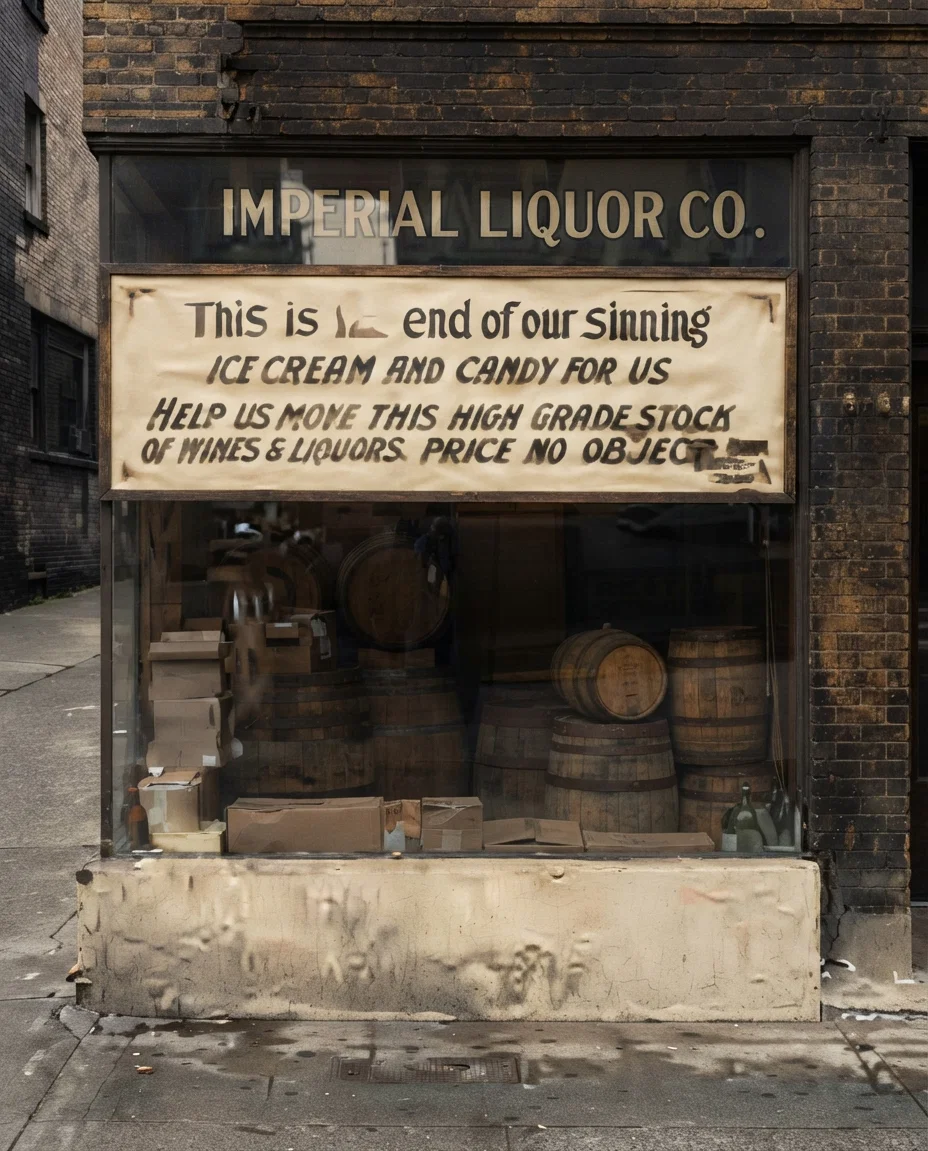
Wholesale liquor store in Seattle, Washington, after the people had voted for state-wide prohibition, and before it had gone into effect. Note the significant sign in the window. See companion picture on next page.

The Price of a Drink

Would the cutting off of the revenues from liquor deplete the treasuries of cities, states, and the federal government? Cities derive great amounts from liquor licenses; but how much of that fund is expended in the vain effort to stop crime incited by liquor? How much of it goes to the support of women and children left destitute by drunken husbands and fathers? How great is the sum spent upon municipal criminal courts and upon policemen who have little to do except catch and punish criminals who become criminals because of drink? What would be the saving to cities in franchises bartered away by city officials who could never have been elected except by the help of the liquor forces?
Would the loss of revenues from liquor ruin our states? It has not ruined Kansas, the state that has the largest per capita of wealth, the greatest per capita of bank deposits, the highest per cent of literacy, and the smallest per cent of crime, of any state in the Union.What effect would the abolishment of the use of liquor have on a state if it lessened crime twenty-five per cent, if it lessened insanity, idiocy, and pauperism a like per cent? How about the savings on jails and the expenses of trials made necessary through inflamed passions, degenerate minds, and criminal tendencies caused, increased, or uncontrolled because of the use of liquor?
It is proper, when discussing the economic side of the liquor question, the price of a drink, to consider the expenditures and all the losses of individuals, communities, municipalities, states, and the federal government; for it is the net rather than the gross profit that makes for wealth or poverty.—Dan M. Smith.
"Few men can afford to support both a family and a saloon."

Prohibition Not Confiscation

"PROHIBITION is not confiscation of property or even of property rights. When prohibition prevails everywhere, every saloon keeper, brewer, distiller, and wholesaler will have all the property and all the rights that anybody else can have. We will not take an inch of ground, or a single building, or equipment from a building. We simply propose to say you shall not use your property to debauch mankind.
"We owed the liquor traffic nothing; for they never had a natural, inherent, or constitutional right to debauch the American people. The liquor traffic has only been tolerated because of our long inertia; and if now we should demand compensation for our losses, there is not enough invested in it of money or of men, if they sold their property, their bodies, and their souls, to pay a millionth part of the bill they owe to modern civilization."
"SINCE the liquor traffic meets no necessity, and adds nothing to humanity, every dollar invested is a dollar taken from legitimate trade."

As to Compensation

WE are now told that society ought to reimburse the liquor dealer if it causes him any financial loss. Superlative impudence! There are two answers to this insolent demand.
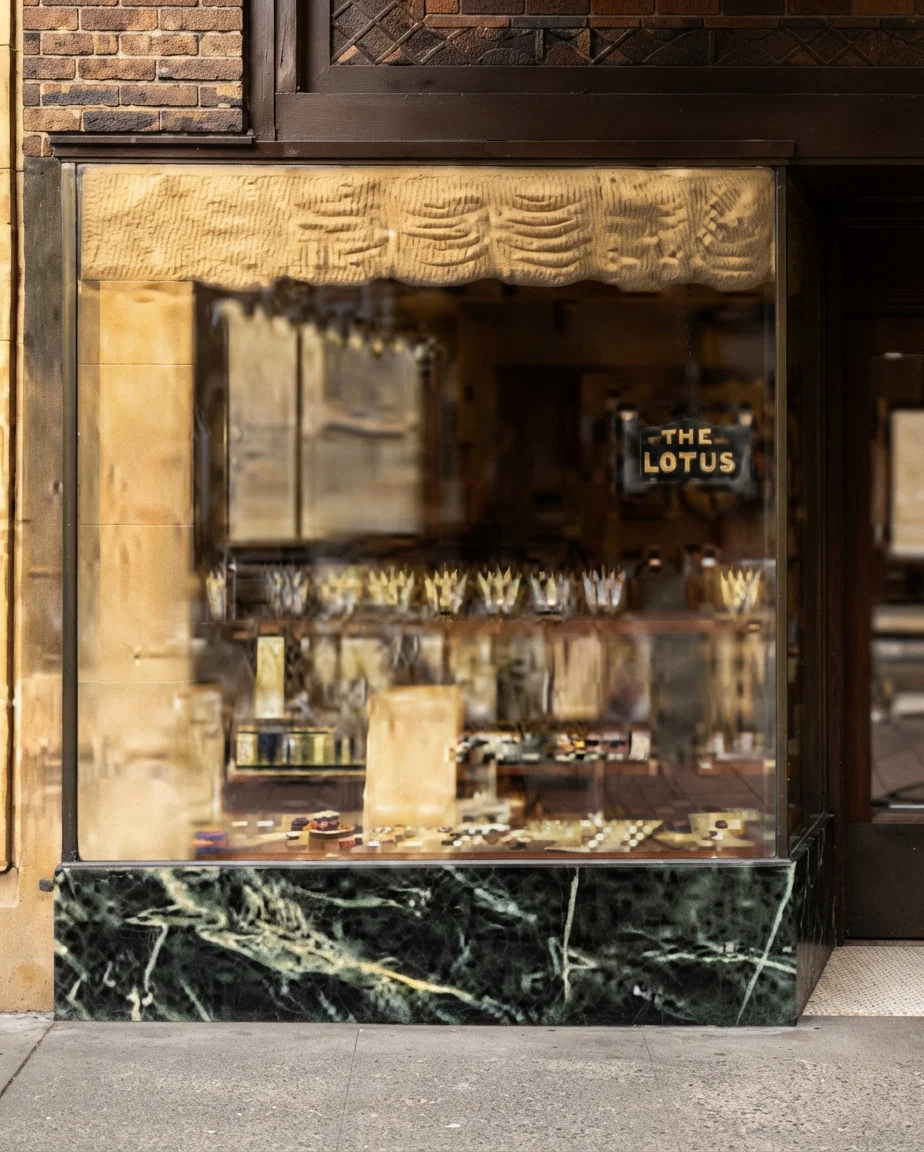
This up-to-date confectionery store has replaced the Imperial Wholesale Liquor Store in Seattle, Washington, and under the same management. See companion picture on preceding page. What an improvement!
One is that prohibition does not take from the liquor dealer one foot of land he now owns; it does not remove one brick from any building he now occupies. It simply requires him to put his hand, his land, and his buildings to a different use. Will any man claim that you lessen the value of his gun because you say that he must use it on game and not on human beings?
If you close a saloon, the building stands there as useful as ever, with the possible exception of the fixtures. Let the saloon keeper turn his building into a bakery, and sell bread to the people who have gone hungry because the money that ought to have gone for bread was used for drink. Will the brewer suffer? His buildings can be used for other purposes. In prohibition states, breweries and distilleries are being used as packing houses, pickle factories, and turned into plants for the manufacture of nonalcoholic drinks.
At Salem, Oregon, a brewery is now being used for the manufacture of loganberry juice, the substitute for grape juice in that state. I believe in conversion, . . . and I know of nothing better than the conversion of an alcohol plant into a factory for the production of something which is helpful and wholesome.—William Jennings Bryan.
"If one hundred dollars is spent for merchandise, the community is built up, and honest labor patronized and encouraged. For every one hundred dollars spent for booze, the community is injured, and the waste of the country is increased."

What Is a License?

THE supreme court has repeatedly decided that there can be no just claim for compensation either for the liquor manufacturer or for the retail dealer. Their trade was conducted under a license, which was a permit granted to do a thing which, without that license, would be illegal. The license was for a year only, subject always to the chance that it might not be renewed. The court practically held that an investment made under it was the taking of a gambler's chance; in effect, a bet that the license would be renewed.
It is worth considering what a license to sell liquor is. Some people speak of it as though it were a restriction put on the liquor traffic. It is a permission extended to one to traffic in liquor. Without this permission, we would be under prohibition now. There is not a saloon which could not be suppressed as a common nuisance should our license provisions all be repealed.
The license is not a restriction; it is not, on the other hand, a vested right. It is acquired with money, but with certain well-known provisions. It extends its privileges for one year. It may or may not be renewed. Its renewal is not solely dependent on good behavior. It can be withdrawn for bad conduct, on the ground of lawlessness, or because the people change their mind, and think the trade unprofitable to them. License does not even reach the dignity of a contract.
Every one knows that the courts have repeatedly held that the liquor traffic is so bad that it has no inherent right to exist at all, and no right of compensation when the people prohibit it. The United States Supreme Court, in Beer Company vs. Massachusetts, 97 U. S. 32, says:
"If the public safety or the public morals require the discontinuance of any manufacture or traffic, the hand of the legislature cannot be stayed from proceeding for its discontinuance by any incidental inconvenience which individuals or corporations may suffer."—Clarence True Wilson.
"SAFETY first"—that is why the saloon is going.

Watch Their Methods

THERE is no denying the fact that vast revenues come to the United States government and to various municipalities from the liquor interests. These gentlemen do indeed raise much of the taxes of the country. But if we will watch their methods a little, we will see that they collect these taxes by stripping the children of the drunkard of clothing and robbing them of food. They collect them by driving the wife of the drunkard to the washtub and to other forms of drudgery, in order that she may earn a little pittance to supply the barest necessities to the children that are robbed by their drunken father, so that the saloon and the liquor interests can pay these taxes.
Are men who love women and children willing to have taxes raised in any such cruel fashion? And this is saying nothing about the further fact that even these taxes that are supplied in this way are absorbed many times over in taking care of the drunken, defective, lawless, imbecile product that is coming from the saloon in such great numbers.
THERE is one thing worse than a saloon, and that is another saloon.

The Public Debt Maker

THE last defense of the saloon is that saloon revenue helps to pay the taxes. It does, but at a cost infinitely greater, a cost actually paid in dollars and cents, as well as in blood, bones, and tears. The saloon, however, wherever it exists, is our greatest public debt maker, our greatest public burden. After the saloons were driven out of Kansas City, Kansas, the state's largest city, that municipality, for the first time in twenty years, made no debt for current expenses, and this without the saloon revenue, as its mayor, U. S. Guyer, has recorded in a signed statement.—Hon. Arthur Capper.
"It doesn't pay to give one man, for $15 a quarter, a license to sell liquor, and then spend $5,000 on the trial of another man for buying that liquor and committing murder under its influence."

Six Panama Canals

THE cost of the Panama Canal, the most gigantic engineering feat in history, was about $400,000,000. Is it not appalling to think that an enlightened people will spend for drink, each year, something like six times the cost of the Panama Canal? All the agencies employed in administering the federal government are operated at an expense of less than $1,250,000,000. Think, if the mind can comprehend it, of this nation's spending twice that amount for alcoholic liquors!
"In the tug of war between life and death, drink pulls on the graveyard end."