FOR A GREATER FREEDOM

4%

FOR A GREATER FREEDOM

Is it not peculiarly fitting that July 4 should have been selected as the date on which to publish an issue of this journal devoted exclusively to the great prohibition movement that is in progress in this country? The fourth of July stands as a memorial of one of the greatest events in the history of nations. Great leaders in the cause of liberty had been working in England, Holland, Germany, and other countries of Europe; and their sentiments spread to this fair land, and took root strongly.
A nation was born, holding in its bosom the great results of the struggles of centuries. The tyrannies and the despotism of rulers was that against which the work for freedom had been waged; and a great nation emerged from the conflict, standing upon the broad principles of independence, efficiency, progress, and power. Freedom was granted to the individual to develop to the very best of his inherent powers his religious, moral, social, and physical life.
But another struggle is on. A greater freedom is needed for the human race. It is not freedom from tyrannical and despotic rulers; but it is freedom from the worst despot that has ever cursed humanity, and that is old King Alcohol himself.
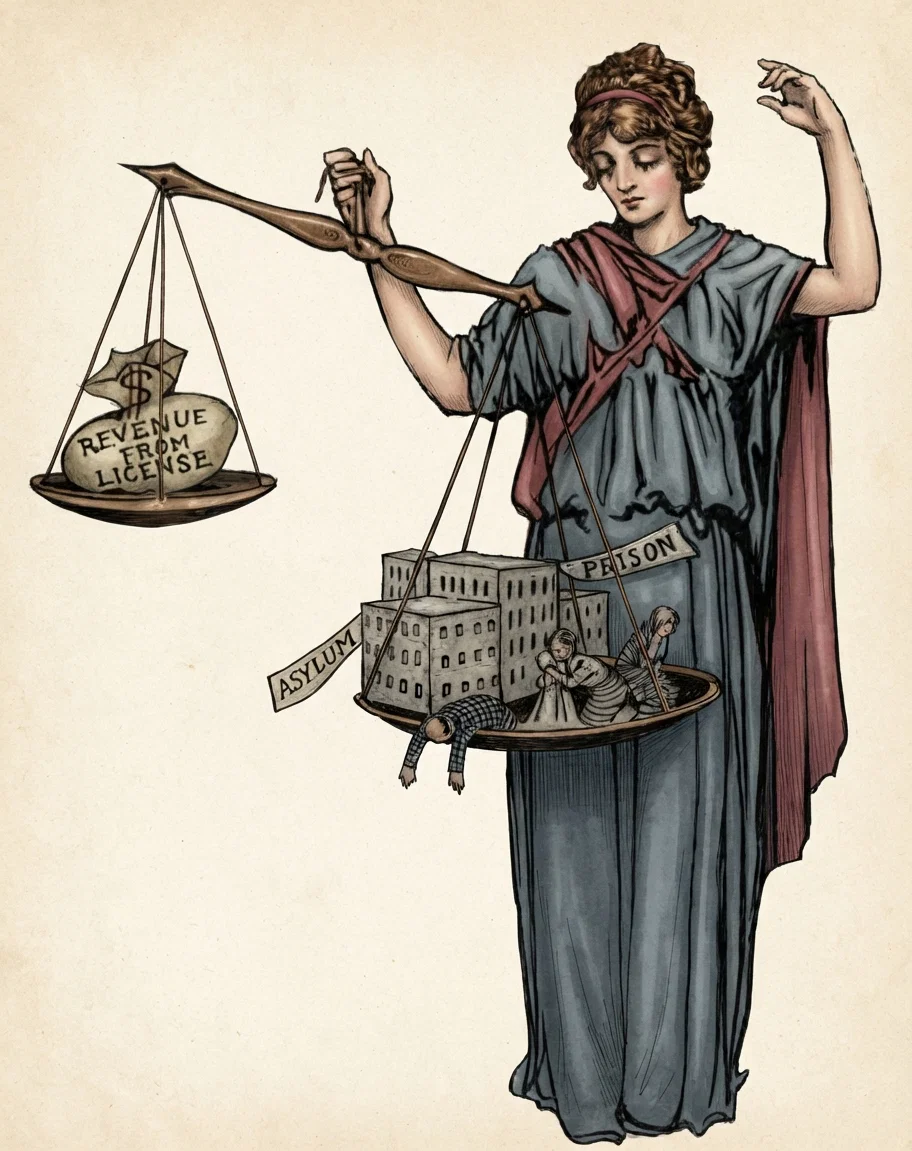
WEIGHED AND WANTING
WEIGHED AND WANTING
The tyrant of rum not only holds the men of to-day over whom it can wield its power, but it reaches out into the future, to curse the children that are yet unborn. On this great Independence Day, let the hearts of all true lovers of liberty be gripped by a determination that will cause them to move forward to the still further liberty which will free our nation from the tyrannies of rum.

LIBERTY OR LICENSE?

PERHAPS one of the strongest appeals made by the liquor interests is on the ground of personal liberty; but really, what they mean by personal liberty is that the drunkard may be at liberty to drink, and that the liquor men may be at liberty to sell strong drink and make great hoards of money, regardless of the personal liberty of others.
In speaking for liberty, they appeal to a very popular sentiment in the mind of man; but true liberty is far broader than they represent it. It will grant the child of the drunkard bread enough to eat, and clothes enough to wear; it will grant that the drunkard's wife have a little rest and recreation from the grinding work of the washtub, and other hardships and perplexities that her drunken husband would impose upon her. Personal liberty implies freedom to receive and enjoy the eternal salvation of Christ, which the divine Book says is denied to "fornicators," "idolaters," "effeminate," "abusers of themselves with mankind," "thieves," "covetous," "drunkards," "revilers," and "extortioners." See 1 Cor. 6: 9, 10.
Note the company this Bible text places the drunkard in; and everybody knows that the text has it right. Drunkenness, adultery, covetousness, extortion, and all the rest of the list, go along with the drunkard. Personal liberty includes the privilege of being free from such things. Prohibition, then, stands for the personal liberty that is denied to a great class of individuals by the liquor interests.
A personal liberty that allows one individual to restrict and override the liberty of another is no personal liberty at all; it is marauding barbarism. It is on the same basis exactly as the personal liberty of the wolf that demands freedom to eat the lamb. The wolf may be at liberty; but what about the poor little sheep? The personal liberty of the liquor interests is on a par with that of the cannibal who demands freedom to eat his neighbor. Such undeniable facts show unmistakably that the liquor men have no argument at all. Every man's personal liberty ends where the other man's rights begin. Personal liberty is not license.

ALCOHOL THE SOUL DESTROYER

THE worst results of the use of alcoholic liquor are not physical or financial, bad as these are; yet either of these should be a decided deterrent or prohibition to its use.
The worst of all is alcohol's effect upon the morals. The narcotizing influence of the poison affects all the finer sensibilities of the moral nature. It benumbs and perverts them. The victim cannot "see straight"; he therefore cannot think straight. His mental and moral vision is corrupted, perverted, debased. His judgment is unbalanced. He may be as poor as poverty; he thinks himself rich. He may be weak; he thinks himself strong. He cannot see truth, and therefore he cannot know right. He has placed his soul in a perverted and perverting medium, and drifts on to destruction.
The holiest of home relations become a thing of naught. His ardent, heartfelt pledges to his wife are forgotten. His love for his children dies. He will sell the clothes off their backs, their beds from under them, their food from the table,—everything, in fact,—that he may feed the accursed demon which holds him enthralled.
How many of the perversions of theology there are to-day are engendered by men who drink wine! God's priests of old offered "strange fire" under the influence of wine drinking. How many of them are doing it to-day! It is useless to enlarge. All whose moral vision is not perverted, know that the moral effects of alcohol upon the soul of man are deceptive, debasing, disintegrating, devilish, destructive.
It is because of the fearful effect of drink on conscience and soul, that God places the drunkard in the category of those without hope, and issues His decided warnings against its use. Read these among many. To His priests He said: "Drink no wine nor strong drink, thou, nor thy sons with thee, . . . that ye may make a distinction between the holy and the common, and between the unclean and the clean; and that ye may teach the children of Israel all the statutes which Jehovah hath spoken unto them." Lev. 10: 8-11.
Through the wise man, who had experienced its evils in his own life, came these warnings:
"Wine is a mocker, strong drink a brawler; and whosoever erreth thereby is not wise." Prov. 20: 1. "Who hath woe? who hath sorrow? who hath contentions? who hath complaining? who hath wounds without cause? who hath redness of eyes? They that tarry long at the wine; they that go to seek out mixed wine. Look not thou upon the wine when it is red, when it sparkleth in the cup, when it goeth down smoothly: at the last it biteth like a serpent, and stingeth like an adder."

HOPE FOR THE DRUNKARD

Yet there is hope—hope in Him who can save from sin, who can create anew those who will die to self, who will yield all to Him, and let Him cleanse and re-create the soul and body which alcohol has wrecked. For thus the apostle says to those whom sin made wrecks in Corinth: "And such were some of you." Some of them were fornicators, some of them were extortioners, some of them were drunkards; but he continues: "But ye were washed, but ye were sanctified, but ye were justified in the name of the Lord Jesus Christ, and in the Spirit of our God." 1 Cor. 6: 11.
Prohibition may compel the soberness of the drunkard—thank God for that!—but it cannot save him. But in that soberness, the drunkard may come to Christ, the drunkard's Friend, and find hope and salvation. "And this, knowing the season, that already it is time for you to awake out of sleep: for now is salvation nearer to us than when we first believed. The night is far spent, and the day is at hand: let us therefore cast off the works of darkness, and let us put on the armor of light. Let us walk becomingly, as in the day; not in reveling and drunkenness, not in chambering and wantonness, not in strife and jealousy. But put ye on the Lord Jesus Christ, and make no provision for the flesh, to fulfill the lusts thereof." Rom. 13: 11-14.
These are the warnings of God, the great Judge, before whose tribunal all must come. These are the gracious God's invitations to us to come to Him while there is hope. He would stoop down and take us by the hand, and lead us to the light, to hope, to salvation from sin, to cleansing from iniquity, to a peace and joy that alcohol cannot give even temporarily, to blessed life and activity in the service of liberty, forevermore. M. C. W.