The Excellence of Labor

6%

Pacific Press Publishing Company · Mountain View, California · Jun 10, 1908

FromSigns of the Times, Vol. 34, No. 24.

Read the full edition

The Excellence of Labor.

[By Kathrina Blossom Wilcox, Read at the Mutual Edification Club].
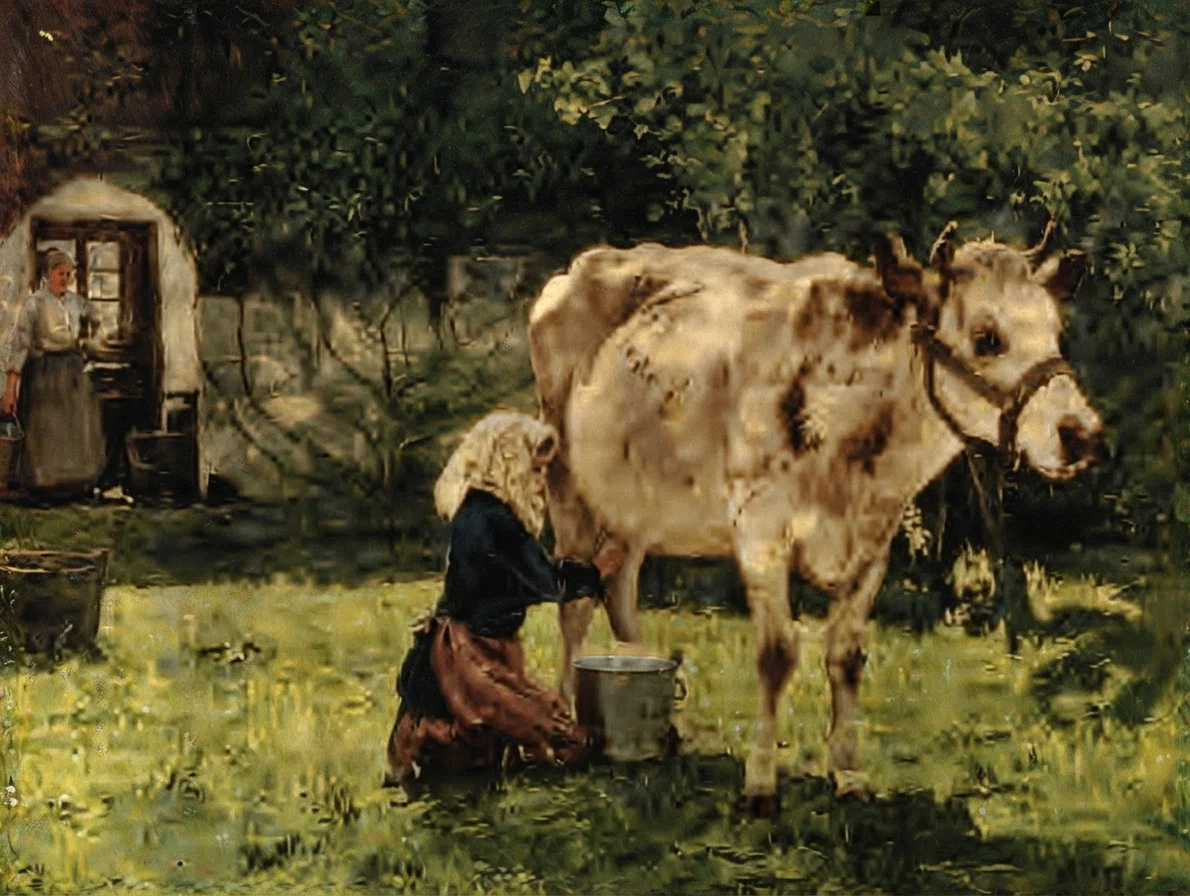
Milking-Time. Julien Dupré
THE subject of labor and its excellencies is one which has been food for thought for poet, artist, and author for ages, for we may trace its existence away back before the creation of the world. It is one of the few subjects which it is much easier to practise than to theorize upon, for we know the true excellence of labor only by actual experience.
It is so easy to think of labor as associated only with sin and weariness, suffering and pain and sorrow—a curse instead of a blessing. But labor is a blessing rather than a curse—one of the greatest blessings ever given to mankind, the means to an end, the panacea for sorrow, "the true alchemist that beats out in patient transmutation the baser metals into gold."
As William M. Punshon says: "Labor is not, as some have erroneously supposed, a penal clause of the original curse. There was labor, bright, healthful, unfatiguing, in unfallen Paradise. By sin labor became drudgery—the earth was restrained from her spontaneous fertility, and the strong arm of the husbandman was required, not to develop, but to 'subdue' it. But labor in itself is noble, and is necessary for the ripe unfolding of the highest life."
According to the Standard Dictionary, labor is physical or mental effort, particularly for some desired or useful end, aside from recreation or pleasure. And we find that in the Garden of Eden man was not left in idleness—he was given work to do. He was to dress and care for his Eden home. That work was to be to him a pleasure, a delight, teaching him of God. By his contact with nature he would learn precious lessons of life and love, and his Creator's wisdom and goodness.
But man fell, and the earth was cursed—it would not henceforth yield of its fulness. In the sweat of his face he was to eat his bread. He must labor for his daily food, but even this curse has proved a blessing. The loving Father saw that His children would not be happy in a life of idleness. They must have work to do to help them to drown, in a measure, their sorrow, to forget their trouble. And so He wisely planned that the highest joy, the truest happiness, should be found in service, in labor for others. Then self would be forgotten, and God would be exalted.
Our bountiful Father in His wonderful system of law and order has made ample provision for all of His creatures—but He has also given to every man his work. As Holland says: "God gives every bird its food, but He does not throw it into its nest. He does not unearth the good that the earth contains, but He puts it in our way, and gives us the means of getting it out of ourselves."
It is our privilege to look upon labor either as a curse or as a blessing. We may be like the man who grumbles and complains at his work, making himself and every one around him uncomfortable at the bitterness of his lot; or we may be like the one who sings at his work, working for work's sake, for the love of the work, and for the love of those for whom he labors, rejoicing in the new life and the new strength which labor gives.
What a picture idleness presents before us!—desolation pervades everything. The idle man is the most miserable of creatures—weak, selfish, morose, good-for-nothing.
But come with me to the home of industry: Up in the morning early, catching the first sweet notes of the song-birds, as bright and happy as they, the glow of health in his face, the light of happiness in his eye, the blood coursing thru his veins, the vigor of life in his footstep—his whole being testifying of the power within to accomplish a desired end, and at night realizing the truth of the promise, "The sleep of the laboring man shall be sweet." 'Tis his to learn from nature lessons of industry from the bird, the bee, the ant—all created things testifying of the beautiful plan of the gospel of labor.
In the legend of Hercules he was given his choice between a life of pleasure, and a life of virtue with promised future immortality. The latter meant a life of labor and toil. This he chose, and imposed upon him were twelve great labors which he must perform, and which he did successfully perform, rejoicing in each victory, and so becoming stronger for the next.
We have not been given the labors of Hercules, but we know that only by the greatest healthful exertion of the physical and mental faculties can we attain the desired end.
Labor is alone noble, true, uplifting, a joy, a blessing, "the grand conqueror, enriching and building up nations more surely than the proudest battles;" and, as Johnson says, "Statues in every public place should record its wonders, oratorios should be composed in its honor, its insignia—the plough, the spade, and the loom—should decorate state carriages and ornament public halls; while its successful votaries should wear the honored decoration of 'The Order of Industry.'"
With Christ the most menial tasks become a blessing, for we are colaborers with Him. Jesus said, "My Father worketh hitherto, and I work." How much more should we,as Christians, be workers together with God, working for the glorious reward of souls saved thru our labors.