THE well-grounded opposition of the American people against a union of church and state, shown in the frequent rebuffs which the advocates of religious legislation have met, has led the Sunday-law agitators to seek for civil and economic reasons for their measures, which were formerly advocated wholly upon religious grounds.
But changing the name of a thing does not alter its character. And transplanting a religious institution onto civil ground does not make it a civil institution, any more than transplanting a peach-tree into an apple orchard will change it into an apple-tree.
Most of the so-called civil and economic reasons for Sunday laws are based upon the parental theory of government, which treats grown-up citizens as if they were infants without any rights, and with no capacity to decide personal matters for themselves.
For example, it is said that "The law of rest is deeply written in man's physical nature." Why, then, should it need to be written on the statute-book? The demand for food, for drink, and for sleep, are also deeply written in man's physical nature; but we do not hear anything about the necessity of a civil statute to compel people to eat11when they are hungry, to drink when they are thirsty, or to sleep when they are sleepy.
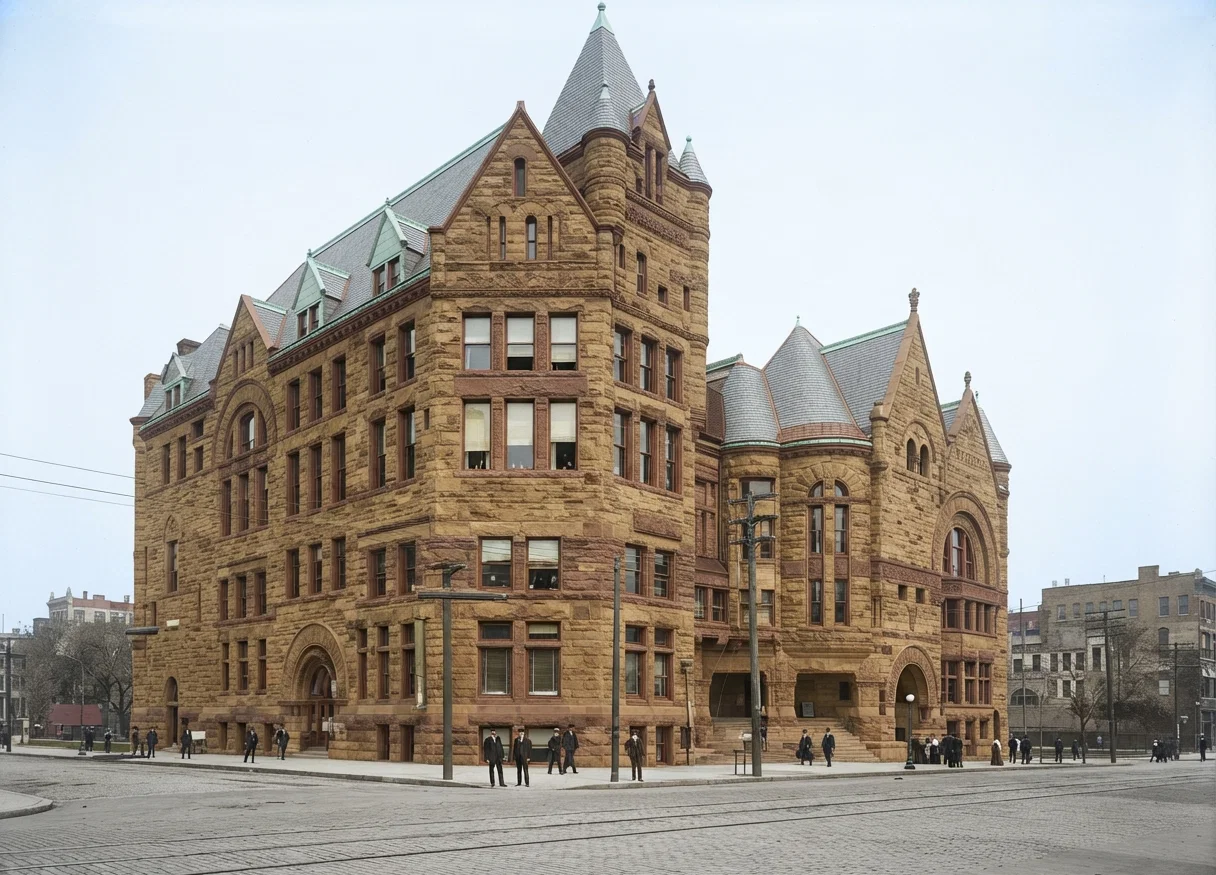
City Hall, Kansas City.
The more you try to compel a man to sleep or to rest, the farther will sleep or rest depart from him. What is rest? Is it not a state of relaxation, of comfortable relief from everything that binds, or chafes, or annoys? How much rest does a child get while he is forced to sit still for one hour? Is that rest, or is it torment? Some people punish their children in that way. And now some of the professed Christian people are asking Congress and the state legislatures to punish all the grown-up people of the nation, and the children, too, in a similar way. I protest that bodily and mental comfort and repose can not be forced upon any one.
Enforced Labor.
But we are told that “many persons who desire to rest on Sunday are forced to labor against their will.” For example, Jones signs a contract to work for Smith. He agrees to work for two dollars a day. He agrees to work on Sunday. He also agrees to work each Wednesday night. He is visited by the pastor of the church, who wants to know why he works on Sunday. Jones says that he can not help it, that he is forced to work on Sunday. Yes, Jones is forced to work on Sunday; he is forced to work on Wednesday night; he is forced to work for two dollars a day; and he is forced to work for a man by the name of Smith. How is he forced?—Why, by his contract, of course. And by the same contract Smith is forced to pay him his wages when the work is done.
But suppose that Jones did not agree to work on Sunday; but after he has worked awhile, his employer says, “I want some work done on Sunday; are you willing to do it? If not, I shall have to dismiss you and find another man.” What shall Jones do? Well, suppose Jones did not agree to work on Wednesday night, and his employer was about to dismiss him because he would not work at night. What, then, shall Jones do? Shall he petition the Legislature for a statute forbidding any one to labor on Wednesday night? And would all the Christian people of the country join him in the petition? Why not?
“But is not a weekly rest-day for the benefit of all?”—Certainly. And retiring early at night is for the benefit of all. A daily bath is for the benefit of all. “Fervent effectual prayer” is for the benefit of all. But that is not a sufficient reason for enforcing these things by law. The right of each individual to decide personal matters for himself is for the benefit of all. Therefore, with the inspired apostle, we say, “Let every man be fully persuaded in his own mind.” See Rom. 14: 4-12.
The assertion that the purpose of Sunday laws is to protect the rights of citizens is exactly the opposite of the fact. Rights are optional, while duties are imperative. To say that a person has a right to do a thing is to admit that he has an equal right not to do that thing. Now if the purpose of a Sunday law is to protect the right of a citizen to rest, then it should also protect his right not to rest in case he desires to work or to play. To compel a person to rest is to treat the matter as a duty and not as a right.
The difficulty in understanding this question arises almost wholly from the fact that few persons have a clear conception of the exact difference between “moral” and “civil,” and between “duties” and “rights.” The fact is that Sabbath observance is a civil right, while at the same time it is a moral duty. The state should treat the matter as a right, protecting each citizen in resting or in working as he may choose. In the final judgment-day, God will punish the Sabbath-breakers as He sees fit for their neglect of a moral duty, but He has not delegated this authority to any human court. “Therefore thou art inexcusable, O man, whosoever thou art that judgest: for wherein thou judgest another thou condemnest thyself; for thou that judgest doest the same things. But we are sure that the judgment of God is according to truth against them which commit such things.” Rom. 2: 1, 2. A. Delos Westcott.