MEXICO

4%

Pacific Press Publishing Company · Mountain View, California · Dec 18, 1907

FromSigns of the Times, Vol. 33, No. 51.

Read the full edition

MEXICO

Its People and Their Customs

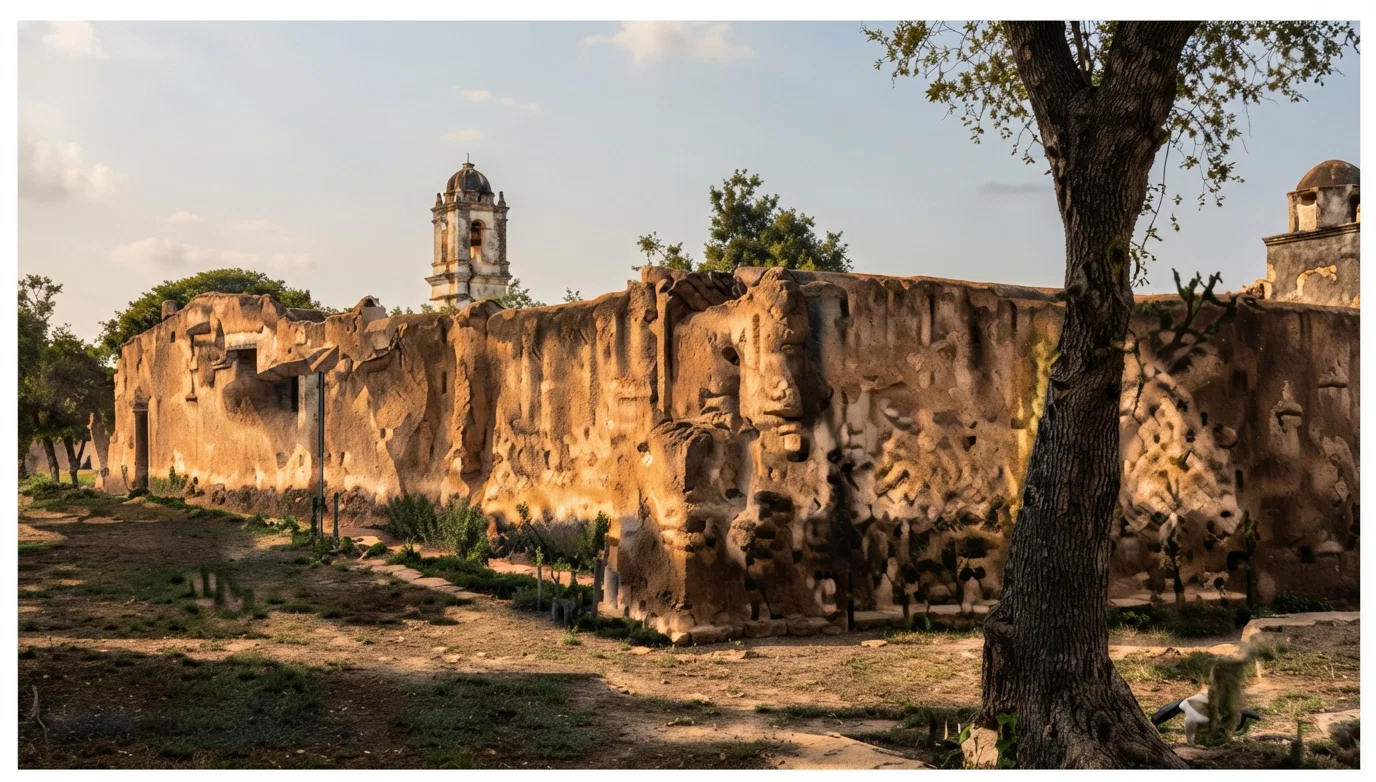
A Beautiful and Interesting Church, Fast Going into Decay.
We have now been in Mexico nearly three months and have fully decided that we like the new field better than the old. Of course there are disagreeable features, but on the whole, “every prospect pleases, and only man is vile.” A few things that puzzled us in the States are perfectly plain here. For examples we will mention two that are likely to puzzle you: In our address you will notice the initials D. F.; these stand for “Districto Federal” which is equivalent to your D. C., or “District of Columbia,” the federal district of the United States. On the envelope address you will notice the initials E. U. A., these are for “Estados Unidos America,” or United States of America.
This past week (September 8) we received our goods which were shipped June 1. They were much damaged by rough handling by the native assistants in the customs house here. The regular duty was 60 pesos (a pesos is equivalent to fifty cents U. S. money), but as settlers we were allowed a discount of one-half, but in order to get this rebate the “red tape” cost us eleven pesos. Well, it is much more homelike to have a few of the old comforts to enjoy and remind of the old days. Everything is so very different hereabouts.
We meet with contrasts here. One of them is found in the street-cars, which are run double, or one class a minute or two behind the other. The front, or first-class, car carries the silk-gowned “Doñas of the patio” and their Señoras, while the car in the rear bears its burden of dwellers from the viviendas—men clad in cotton and broad-brimmed, tall-crowned sombreros, and women barefoot and shoulders wrapped in the inevitable prayer-shawl, which is always plain and black. In the front car are regulation coach seats, while in the second-class the seat follows the perimeter of the car. There are, however, two luxuries common to both cars—cigarets and the conductor. Nowhere have we found better street-car service, and for five cents gold we ride six, eight, and even ten miles. The whole system is owned by the Bank of Montreal, Canada, one of the richest and most liberal corporations in America.
What we would call irreverence toward holy things is everywhere manifested. For instance, in Mexico City we have streets named, “The Street of the Holy Spirit,” “The Street of Providence,” “The Street of Jesus,” “The Street of the Sacred Heart of Jesus,” “The Street of St. John of God,” etc.
Some of the street names are very appropriate. The way to one cemetery is called “The Way of Misery,” another, “The Way of Sorrow,” another, “The Way of the Sad Indian.” Nearly all streets have authentic historic or legendary interest. When you find that a name seldom continues for more than a block, you will understand the need for ample note-book facilities in order to record it all.
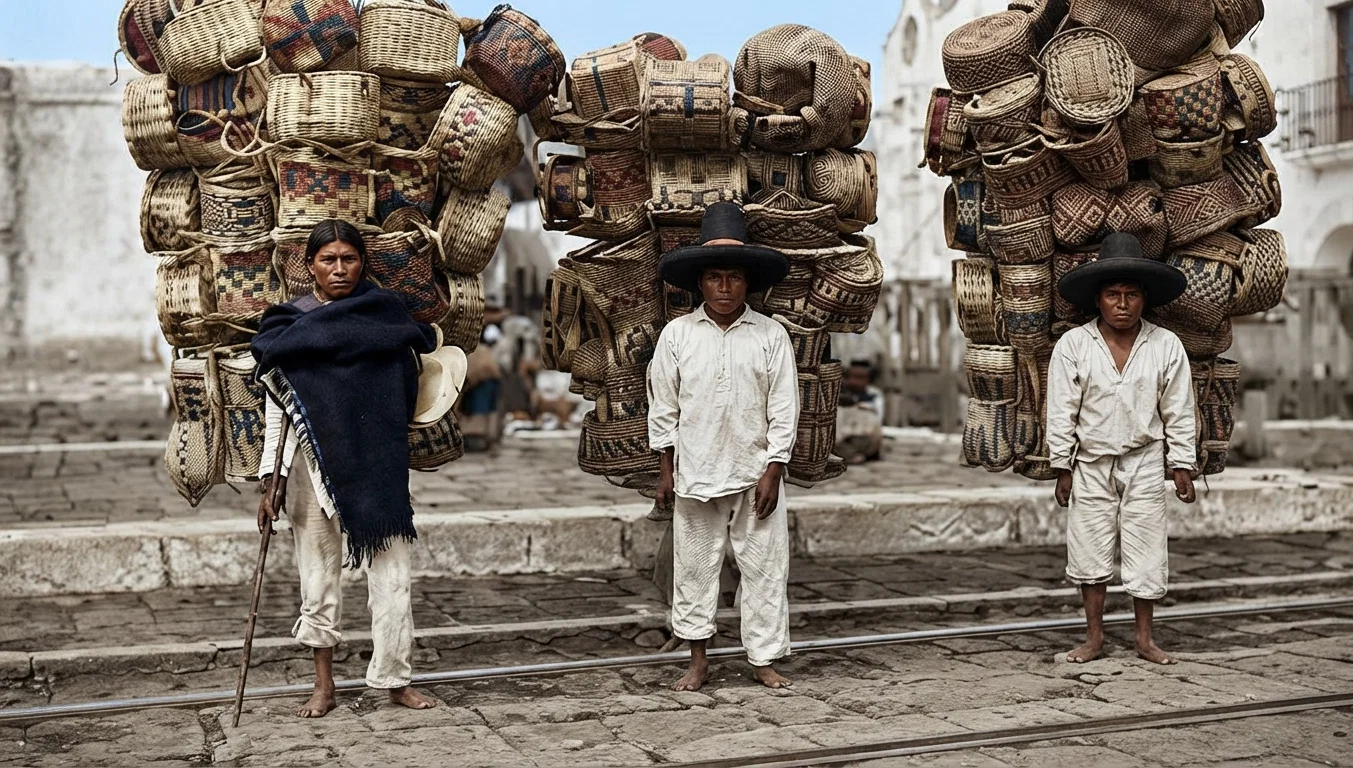
Venders of Baskets, Mexico.
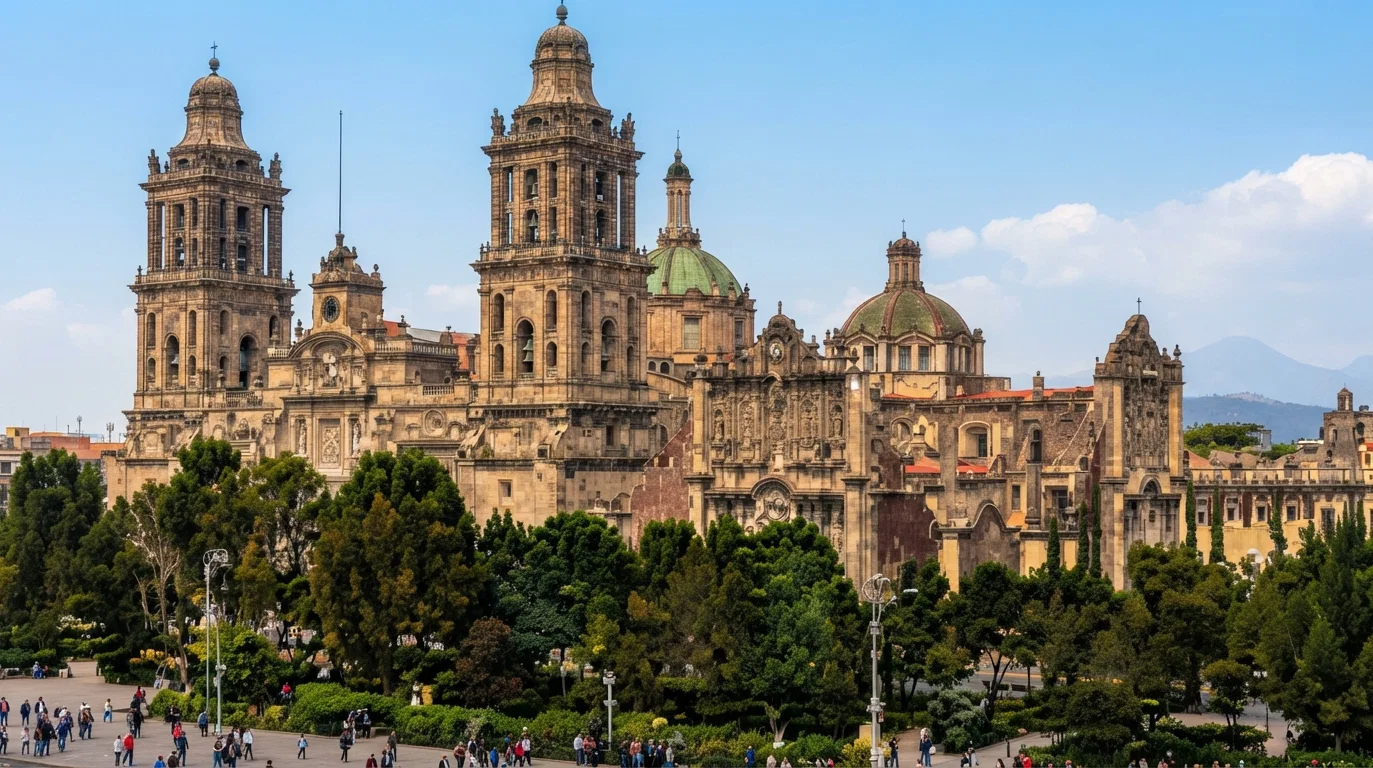
Churches and cathedrals are common to both city and hamlet. They are usually quite large and of costly finish. The fronts fairly bristle with ornamental designs and statuary. The largest we have yet seen stands on the site of the ancient Aztec temple for human sacrifices, and is about 300 years old. It fitly represents the glamour of romance and ignorance which is largely responsible for the power of Rome.
But the churches do not contain all the images.
In a niche of some building on almost every street may be seen the shrine of some intermediary saint or of the virgin. About these are always strewn fresh flowers, and a greater part of the time candles are burning.
Another thing we have noticed here is that almost invariably drug-stores bear the legend, “Sacred Heart of Jesus,” or something equally significant. And that brings to mind the fact that “Pink Pills,” “Cod Liver Oil,” and “Whisky,” are as well or better advertised here than in America. On the door of a saloon we read, “Rheumatism positively cured in forty-eight hours by a liberal use of our special brand of whisky.” No doubt the poor victim thought it an excellent remedy so long as the liquor lasted. So far as we could judge the prescription was very popular with the half-clad patrons of the wretched place. These dens of iniquity are all picturesquely named. Over one door we read “The Emotions,” over others, “The Senses,” “The Fountain of Life,” “Happiness,” and “The Beauties of Mexico,” etc., all more or less eulogistic of the degrading beverages served within. However, some tell the truth in a cynical way by having their signs read, “Hell,” or “Purgatory.”
La Cathedral, Mexico. Built on the Site of an Ancient Aztec Temple for Human Sacrifices.
Signs, however, are quite often misleading, as we learned by experience. On a main street of the city one day we saw a sign-board bearing the legend, “The New Earth.” We immediately hastened to get a glimpse of its harmonies only to find it a rather ill-appointed barber shop.
The outside of a building, especially of the older ones, seldom indicates the character of the interior. We started down what seemed to be a side street to view the displays of a lot of small stores, only to find, after a walk of several blocks, that we had been strolling along the arcades and patios of the Iturbide Hotel.
It is unusual and considered almost a disgrace for a gentleman to carry anything of a load on the street of the city; but it is not unusual at all to see a mozo (native laboring man) jogging along with a trunk and two or three valises hanging to its corners; or it may be a wicker crate containing two dozen chickens and a dozen or more pigeons; or a couple of bails of hay; or 250 pounds of carbon. We have seen these things ourselves quite frequently. In the North we are all familiar with the Chinese and their 300-pound load of vegetables in baskets suspended from a shoulder-pole; here the commodity is fruit, but our Mexican vender carries it in an oblong crate upon his back and holds it up by a strap across his head. This latter convenient member he earnestly contends was graciously furnished by the Creator for this very purpose.
Recently there appeared in the Review of Reviews a picture illustrating the gradual development of corn from the wild state to its present admirable form and flavor. A similar one could well be made to show the remarkable diversity in physical and mental power to be found among the native Mexicans; and these types may all be seen daily in the marts of trade.
Speaking of corn, we have it here in variety, nevertheless, the best is inferior to the most common American varieties. It is called mais and forms the bulk of the food supply of the natives. The chief reason for its usual inferiority lies in the fact that the peons who cultivate it are almost incapable of attempting anything beyond the prehistoric wisdom of their ancestors, whose efforts were much more successful because a virgin soil responded to their crude tillage. Mexican butter and potatoes do not deserve to be mentioned the same day as the American, they are so inferior.
The Spanish language has no exact synonym for our word “home;” to them it is “casa” which is equivalent to our word “house.” So far as our observations have gone this vague idea of homeobtains in the actual family relations. It is seldom more than a house, “for without hearts there is no home.” However, we are much pleased with the patio arrangement of the ideal Mexican dwelling. The house is built around the three sides of a court, while the south side has a high wall, but not so high as to shut out the sun, whose balmy rays are very necessary to comfort and health in a country where no attention is given to stoves or chimneys. In the patio there are a fountain, trellis vines, ornamental shrubs, trees, and rustic seats, statues of famous national patriots, and pretty women. It is indeed an ideal retreat. Not infrequently the walls facing the patio are covered with landscape paintings, which aid greatly to deceive one as to the size of the court. These are the dwellings of the favored wealthy class. There is a wide chasm between these and the homes of the poor. Let us look at them.
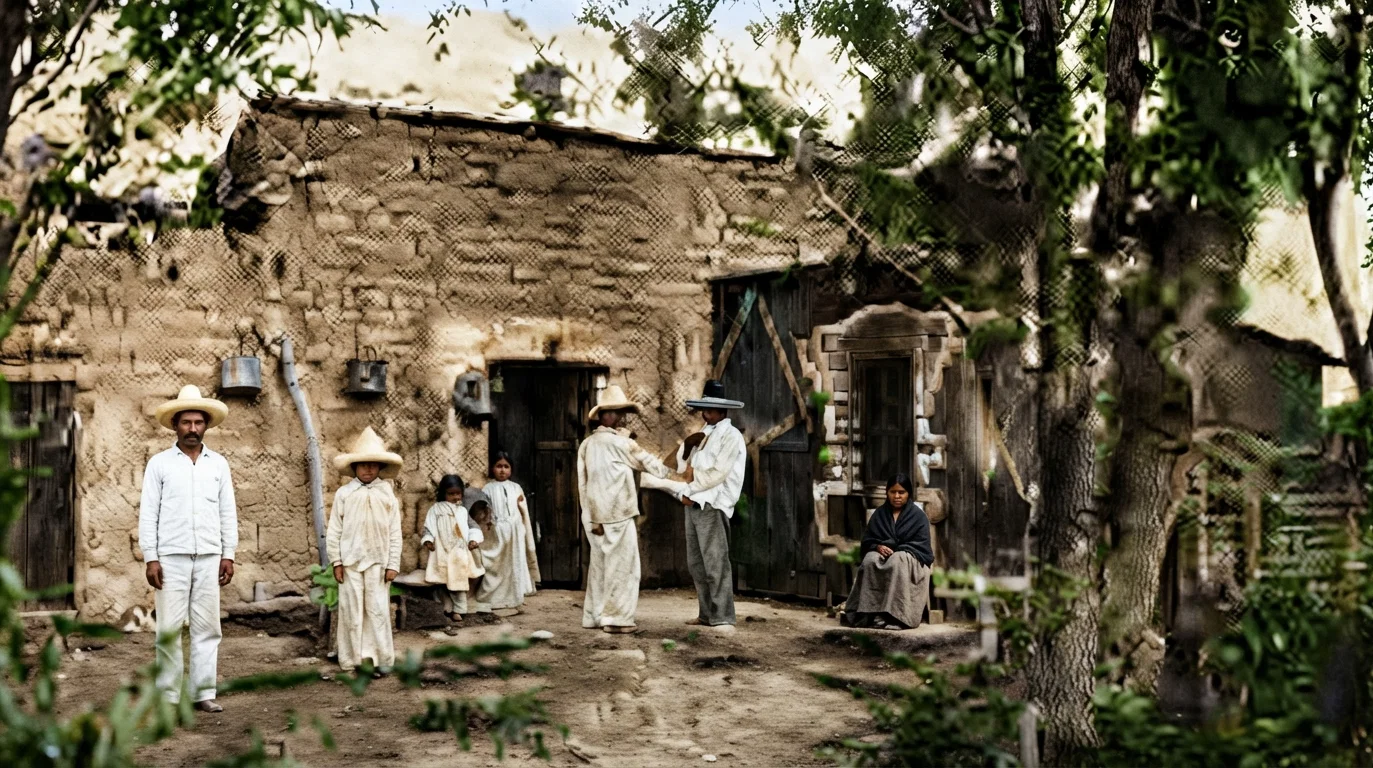
Mexican Family, Adobe House, Mexico.
A plot of land is surrounded by a high wall and to all appearances contains nothing more. But as we enter a large portal we find that this enclosure is a vivienda. The high outer wall is duplicated on the inside, leaving a space between the two of about eight or ten feet, which is divided off by cross walls every eight or ten feet, and this is covered by a flat roof (common to all Mexican dwellings). Each room has a door—no windows—which opens upon the court, where an artesian well furnishes the water for cooking, drinking, washing, etc. Each of these rooms built of adobe and having nothing but an earthen floor, is the home of several persons, and not infrequently of the dogs, chickens, turkeys, and such vermin as is common to the poor. The open street or a vacant lot furnishes the only sanitary convenience, and but for the daily disinfecting rays of the sun they would be, and no doubt are at times, a source of disease and death. On the business streets the viviendas open upon the street and sometimes also into an inner court. The occupants of these rooms tender to the public trade such fruit, vegetables, and edibles as they are able to provide, and thus eke out a precarious existence. The back alleys of New York and Chicago tenement dwellers seldom rival the common condition of the poor Mexicans of the viviendas.
Mexico is almost as truly a virgin soil for the advent message to-day as it was twelve years ago, when it was first entered, and the need is very great. The colporteur will always be the principal medium of reaching the willing ones. This is a field to try the caliber of the Christian and we always need the prayers of the brethren that we be kept faithful and diligent servants.
Yours in the blessed hope, WALTER E. GILLIS.
Tacubaya, D. F., Mexico.