Our London Letter

3%

Pacific Press Publishing Association · Mountain View, California · Mar 14, 1911

FromSigns of the Times, Vol. 38, No. 11.

Read the full edition

Our London Letter

Political Conditions — War Preparations — Commerce — Alien Immigration — Various Reforms — Men's Hearts Failing — Loss in Church-Membership — Fallen Children
From Our Own Correspondent

Conditions Political

THE remarkable figures of the recent general election indicate how close has been the constitutional struggle. Not only is there a tie between the Liberals and the Conservatives, but the new government resumes power with almost exactly the majority that it possessed at the dissolution of Parliament. Then it had a margin of 124 votes, now it has 126. In the new house there are 272 Conservatives, 272 Liberals, 42 Labor members, and 84 Irish Nationalists. So long as the Liberal party can maintain its alliance with the Labor members and the Irish party, it remains in the ascendant; but whenever these turn against it, it will be in the minority.
The first business before the new party will be to dispose of the veto hitherto wielded by the lords. The government proposals provide that any bill which has passed the House of Commons shall become operative, notwithstanding the opposition of the lords, after being twice presented to the Upper House. This means that, no matter how much the House of Lords may disapprove of a certain bill, it can not delay the passage of the measure for a longer period than two years. The question of interest now is, Will the House of Lords and the Conservative party give way on this matter, and consent to the curtailment of the veto, or will they fight for the old privilege to the bitter end?
If they choose the latter alternative, matters will soon come to a deadlock. The Conservative party in the House of Lords will stand out against the will of the Liberal majority in the House of Commons, and there will be only one way out of the difficulty; namely, the King must agree to the creation of a sufficient number of Liberal peers to carry the day against the Conservative lords. The country has been given to understand by Mr. Asquith that the King has pledged himself in advance to agree to such a course if it becomes necessary.
The counsels of the Conservative party are divided over this issue. Some advise that the Veto Bill be adopted by general consent; others urge the policy of "no surrender." The latter say that the Liberal government will only make itself ridiculous by an attempt to create five hundred new peers, and that they will surely shrink from such an extreme course when the moment arrives for putting their threat into execution.
In the Liberal ranks, however, there is considerable jubilation over the possibility that the new peers may have to be created. It is pointed out that if five hundred titles of nobility are conferred upon stalwart Liberals, there will be no difficulty in finding that number of eminently suitable public men, and that it will not be the new peers who will become the butt of ridicule, but rather the old ones — those who owe their rank, not to merit, but to birth. Moreover, if once there is formed in the House of Lords a strong Liberal majority, the golden age will come for Liberalism. For once it will hold the reins in both houses, and may pass whatever measures it pleases. In that case there will be no difficulty about giving Ireland Home Rule, or disestablishing the church in Wales, or carrying through many other important reforms which have hitherto been held up by the certain knowledge that they would not pass the House of Lords.

Reform Waiting

We shall soon know, however, what course events are to take. When the Veto Bill is out of the way, there are many promised reforms to be proceeded with. The government is planning to introduce a bill providing for insurance against unemployment, and another creating a system of insurance against invalidity, to apply to all who earn less than £160 ($800) per annum. On the first of January, 1911, the benefits of the Old Age Pension were extended to persons seventy years old who have been in receipt of poor relief, so that now every person in the country who has reached the age of seventy years, and whose income is below a certain limit, is entitled to the sum of five shillings ($1.25) a week.
Another promised reform is the abolition of plural voting. Three hundred thousand persons in this country have two or more votes in different places on account of property held by them. It is calculated that at least thirty seats in the new Parliament were won for the Conservative party by the aid of these plural votes. The Conservatives will naturally desire to preserve so valuable a reserve of voting power, but the Liberals confidently hope that plural voting will never again figure in a general election.

Men's Hearts Failing

It will be seen, therefore, that the forces of democracy in this kingdom are intent on new victories. The national wealth and the land, which is the national inheritance, are claimed more and more in the name of the people. Those who are leading out in these movements believe and feel that a better day is dawning for the masses. Yet even among the observers of the world there is a conviction that, while we seem to be making progress in one respect, we are losing ground in another. The close of another decade has led to much reflection on the developments it has witnessed; and the latest issue of the "Cambridge Modern History," prepared by a number of well-known scholars, has dealt with the course of events during the last half century. Reviewing this book, a writer in the Birmingham "Post" thus sums up its lessons:
It seems to us that what this record teaches is that our own age is essentially like all other ages, one of transition and inextricable confusion, of magnificent endeavor, of splendid faith in the ultimate victory of man, of harvesting uncertainty, of dismal failure. Apparently there is all-round progress in the arts of life, at least in Europe and America and other parts of the earth where men of European stock have taken root; there is more stability in governments, monarchical and republican; greater security for the individual citizen that the bread he earns may not be taken from him by force or fraud; but, concurrently with these things, there is the paradoxical circumstance that it is only by the maintenance of millions of armed men — of armies and navies of a magnitude and destructive power such as the world has never before known — that the governments stand and the private man goes his way in peace.
Viewing the history of the world during the past fifty years through these pages, remembering the cataclysmic wars Europe has suffered, and the many more from which we have all but narrowly escaped, the dominant thought is that our civilization is jerry-built. If what has been still be again,well may men's hearts fail them for fear of the things that shall come upon the earth. The West is armed from head to foot; the races of the East are arming; in every portion of the globe the story is of military service and armaments for land and sea; humanity, as by a common instinct, is going full force onwards to universal war or insolvency.

Preparing War

It is certainly true of this country that its wealth is poured out lavishly in the erection of great battle-ships. Every little while we hear of the launch of Super-Dreadnoughts of ever increasing tonnage and gun power. At the present time fifty-nine war-ships are being built in the United Kingdom for the British government, with an aggregate displacement of 980,665 tons. During the last twenty years there have been launched for the British navy 103 sea-going armed ships, with a tonnage of 1,876,650. The next two strongest navies, the United States and the German, have launched between them ninety-one sea-going armed ships, with a total tonnage of 1,300,940.
An interesting report has just been published, drawn up by Sir Arthur Wilson, First Sea Lord of the Admiralty, on the possibility of an invasion of England by a hostile force. Admiral Wilson points out that the introduction of wireless telegraphy has greatly increased the risks and difficulties of such an undertaking. "To realize the difficulty that an enemy would have in bringing a fleet of transports to our coast and disembarking an army, it is necessary to remember that all the ships operating in home waters, whether they are in the North Sea, the channel, or elsewhere, are in wireless communication with the Admiralty, and with the commander-in-chief, so that if a fleet of transports is sighted anywhere by a single cruiser, or even by a merchant ship, if she is fitted with wireless, every ship which happened to be in a position to intercept the transports would at once get the order to concentrate as necessary for the purpose, whether she was at sea or in the harbor."

Commercial Matters—Alien Immigration

The last year has witnessed a huge increase in the amount of our exports and imports. These have reached the sum of £1,912,806,088, or a growth over the previous year's returns of £118,579,956. This tremendous increase, however, is mainly accounted for by higher prices of merchandise, not by larger quantities of goods handled.
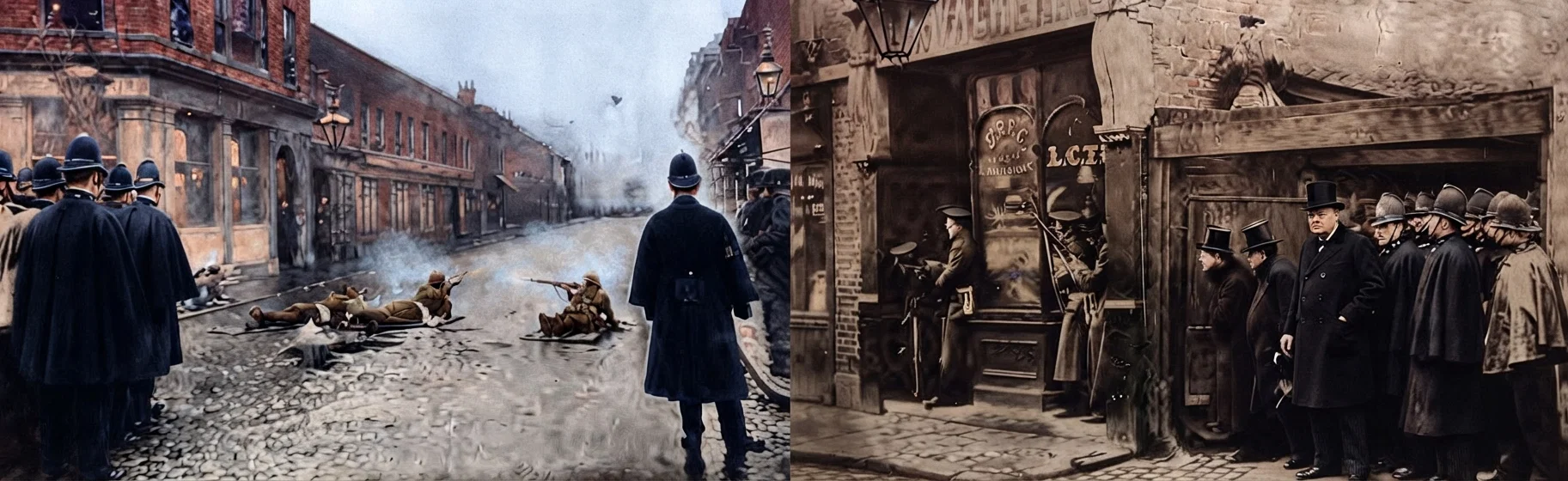
One question which has come very prominently to the front during the past few weeks has been the necessity for putting some more rigorous restrictions upon alien immigration into the United Kingdom. This question has been brought forcibly before the public mind by the extraordinary spectacle of a body of soldiers summoned to the assistance of the police for the capture of desperate foreign criminals armed with powerful weapons. The whole country listened with amazement a few weeks ago to the story of how a company of soldiers poured volley after volley for hours into a private residence, until the house caught fire, and the desperadoes within it perished in the flames. There is sure to arise in the new Parliament an insistent demand that this country shall close its doors against the entrance of dangerous foreign criminals. Unfortunately, such discrimination is bound to work hardship on those who are genuine refugees from religious and civil oppression in other lands. The more objectionable immigrants know how to provide themselves with sufficient means to travel first-class when necessary, and in this way they are able to enter the country with ease.

Loss in Church-Membership

For some years past the statistics of the free churches in this country have shown a continuous decrease. This has been explained by them as due to inflation of their returns at the time of the Welsh revival. It was hoped last year that the losses due to the ebb of the revival would not be felt any further, and that thenceforth there would be a recovery. The present year brings, however, a repetition of the discouraging story. The principal non-conformist bodies all report a diminution in membership.

Fallen Children

A few days ago there appeared in a London paper an appeal from Canon Newbolt, of St. Paul's Cathedral, for funds to provide a home for fallen children between the ages of eight and sixteen. "This," writes the canon, "is a matter on which we would fain keep silent; but in view of the facts which are constantly being brought before the Church Penitentiary Association, it is impossible any longer to do so. More than fifteen hundred cases of children who have become implicated in sin of the grossest kind have been reported to the secretary of that association, and there must be many hundreds more which are never brought to light."
Mrs. Bramwell Booth, of the Salvation Army, bears out the canon's statements. Interviewed the same day that his appeal appeared, she said to a reporter:
"The most startling and most terrible of all the startling and terrible facts connected with this matter is that too often the children are ruined in their own homes, and by those on whose care and protection they have the nearest claim. In the twelve months ending September last we dealt with over three hundred cases of girls under sixteen years of age; some were only ten and eleven years old."
"Much of this evil," says Mrs. Booth, "is due to drunkenness. The man who when sober can be tender and considerate, is cruel when intoxicated, cruel and pitiless. Drink destroys the sense of responsibility in parents. Another fruitful cause is overcrowding. Insufficiency of house room causes terrible degradation."
Mrs. Booth believes that this evil is far more widespread than people in responsible positions have any idea of, not only in England, but in other countries as well. Her own knowledge satisfies her of this.
So painful a disclosure suggests the fearful depths of degradation to which our fallen humanity has sunk, even in lands that lead the world in the paths of civilization and progress. Surely it was none other than an Inspired Word that foretold the conditions of society in these last days, and likened them to the foul corruptions of Sodom and Gomorrah.
The Battle of Stepney in the East End of London. The firing line of the Scots Guards at the left. In the right hand scene the silk-hatted man at the right is the Home Secretary, Winston Spencer Churchill. It was not a noted battle, but it may have notable results in checking criminal anarchists in London.