Progress in China

5%

Pacific Press Publishing Association · Mountain View, California · Apr 4, 1911

FromSigns of the Times, Vol. 38, No. 14.

Read the full edition

Progress in China

National Reform—Cue Cutting
To the student of affairs in the Far East, there is no other country today that presents so many interesting developments as the great Middle Kingdom. In fact the eyes of all nations are watching with various degrees of uneasiness and apprehension, to see what is the meaning of the recent awakening of this oldest of all nations, that for centuries has existed in a hermit-like state, self-satisfied, and not caring to take any part in the drama of the world.
The door is now swinging open to the influences of modern civilization, and refuses to be shut; the great sleeping giant is arising, shaking off the bonds of superstition, breaking the shackles of perverse customs that have held fast for ages, and is preparing to take his place with the great world powers.
It is conceded by all, that in the chapter of modern history which is now writing, and in the important chapters which are soon to be written, a new name has been added; a new kingdom has arisen which must be reckoned with by all the powers of earth. That nation, which can hardly be called a kingdom any more, on account of its proposed reform government, is no other than the great nation, 400,000,000 strong, of new and progressive China.
The opening of the first National Senate, which convened in Peking on Oct. 3, 1910, marked a new era in the affairs of State. This is the first time in the history of the nation that the people have had a voice in the government. It is true that the assembly was not altogether representative, as half of its members were appointed by the throne; and it is likewise true that the people are not entirely prepared to undertake the guiding of the ship of State, having had no experience in this line. But the fact remains that a start has been made; and the people, having once tasted popular government, are now impatiently urging the inauguration of a general parliament, which has been promised for 1913, and may possibly be called at an earlier date.
That these representatives of the people have a keen insight into the problems of vital importance to the national welfare, can be clearly seen from the nature of the subjects that were considered during the sessions of parliament, and that are now carefully studied by the greatest Chinese statesmen of the day. Among these of prime importance is the reform of the currency system, which has been repeatedly promised, but never carried out, being always blocked by officials who were more zealous of their own personal interest than of the good of the nation. Closely associated with this is the reorganization of the administrative government and changing the personnel of many of the provincial offices, as heretofore much of the public money has been misappropriated to private uses.
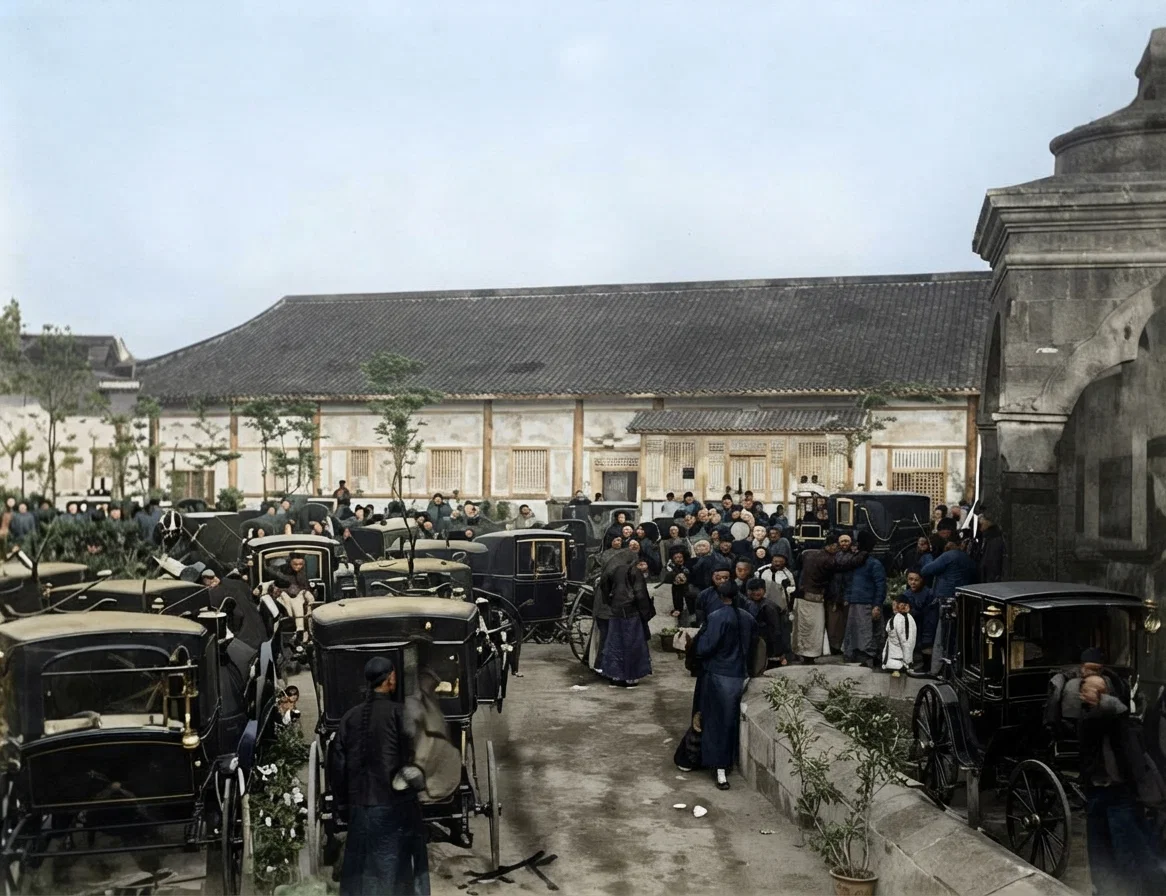
In Chang Su Ho's garden on the day of cue cutting. Note the fine carriages in which the rich merchants drive around the city.
This in turn calls for better educated men; hence the whole system of education will be reconstructed along modern lines, and government schools established that will enable the nation's bright young men to receive a proper training without going to foreign countries as is the practise at the present time.
The program laid down also calls for the organization of a modern army and navy, with equipment of the latest type, including a fleet of air-ships for purposes of war.
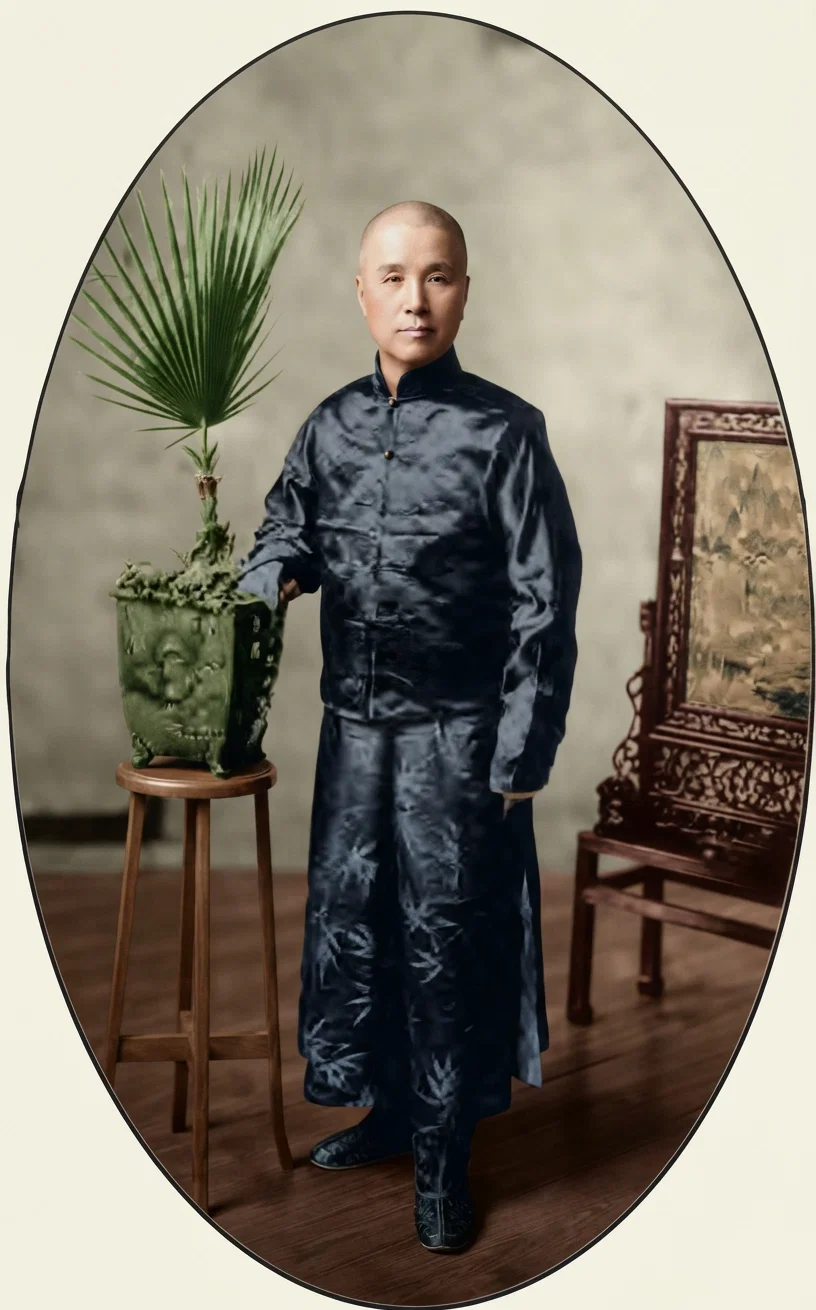
Hon. H. E. Wu Ting Fang, Ex-Minister to the United States, who had his cue cut Jan. 15, 1911
Attention is also directed to proper coast and frontier defenses.
A vigorous campaign is to be conducted against certain evil practises that have long sapped the vitality of the race. The habit of opium smoking is perhaps the worst of these, and the last few years have witnessed great advancement in the eradication of this evil. Anti-opium societies have been founded in all parts of the empire, and the raising of the poppy plant from which opium is made is now prohibited by law. An effective crusade has also been conducted for some time against the practise of foot binding among women, so that at the present time in most of the large cities one sees many women with normal feet.
The last thing to fall before the advance of modern ideas is the style of head-dress that for several centuries past has been peculiar to the Chinese people. Contrary to popular belief, the cue has not been co-existent with the Chinese race, but was adopted so recently as the year 1644.
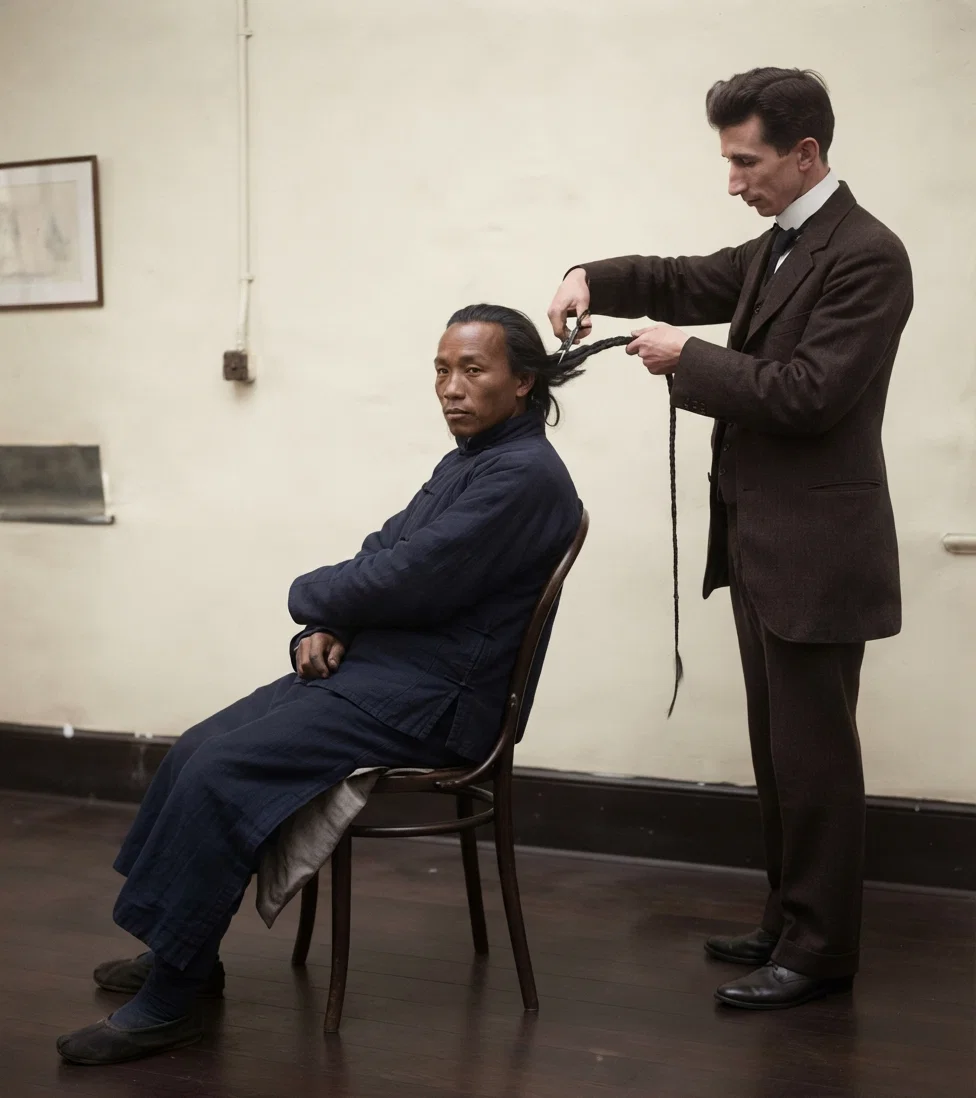
Brother Stafford, who sends us all these photographs, cutting the cue of his zinc etcher. Five boys are now without a cue; and Mr. Bow, the manager of the big Commercial Press, has cut his.
This date marked the downfall of the Ming Dynasty, and the inauguration of the Manchu Dynasty, which still controls the throne. The Manchus are descendants of the Northern Tartar races, and in order to show their superiority, they forced all the Chinese to shave the front of their heads and to adopt the cue as a badge of servitude. This practise, originally a method of humiliation, has grown to be quite the reverse; and for years the source of greatest pride to every loyal Celestial has been his long black braid. Next to life itself, he has prized this above all earthly possessions. It has been said that a Chinese man would part with all he had,—friends, riches, wife, and children, everything but his cue; and to be robbed of that meant everlasting disgrace, and banishment from the fellowship of his race.
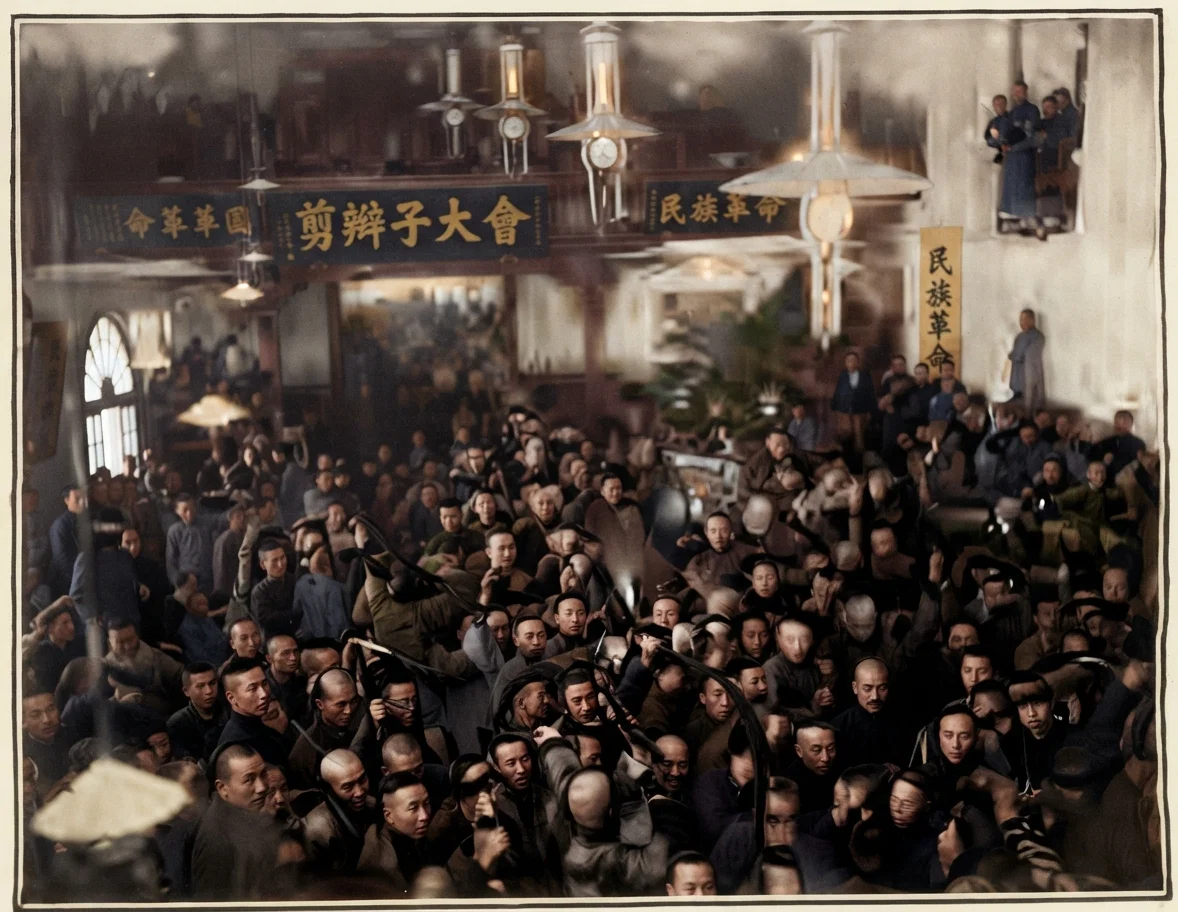
That the cue is rapidly disappearing, and in a few years will be a matter of history, is an astonishment, and is one of the evidences of how deep the reform spirit and impartation of foreign ideas and customs have taken hold of this people. It has been my privilege to have a small part in this reform, and as it is considered very good luck to have a foreigner perform the ceremony, I have several times been asked to officiate. I was also present at the great public cue cutting which took place in Shanghai on Sunday afternoon, January 15. Previous to this a similar occasion had been celebrated in Hongkong at which nearly 5,000 cues fell in one day. Following this lead a cue cutting society was formed in Shanghai, and on the appointed day a large and curious crowd assembled in the spacious hall in Chang Su Ho's garden. Many prominent officials and well-to-do merchants werepresent, and the first one to be shorn of his hirsute appendage was the Hon. H. E. Wu Ting Fang, ex-minister to the United States. Prolonged cheering then ensued as one after another of the crowd came forward to submit to the operation. About twenty-five barbers had stationed themselves in the wings of the hall, and they were kept busy putting on the finishing touches. Speeches were made, and at times the enthusiasm ran very high. One man, after submitting to the barber, mounted the platform, and after speaking earnestly a few moments, seized his severed cue by the end and waving it wildly round and round in the air, called on all his countrymen to come forward and initiate his example. This caused intense excitement, and precipitated a great rush toward the barbers' chairs. It was a day long to be remembered by all who were present; and let us earnestly hope that the reform spirit thus auspiciously inaugurated may continue to grow until many hearts will be opened to receive the true reform of the Gospel as it is preached now in this city.
Showing the crowd inside the hall at the cue cutting in Shanghai
F. E. STAFFORD.