IN the latter part of January there met at Lucknow, India, the Second World Conference of Missionaries to Moslem Lands. The first conference was held at Cairo, Egypt, in 1906; and the plan for these conferences was made owing to the rapid advance of Mohammedanism into all the heathen lands of the world.
The gathering this year was much larger than the one at Cairo, perhaps in that it was held in India, a land in which more Moslems are to be found than in any other single center in the world, 63,000,000 living within its boundaries. The countries represented were Turkey, Syria, Palestine, Egypt, Sudan, Arabia, Persia, China, India, England, the United States, and Canada. There were papers from leading missionaries and Orientalists of Germany, England, the United States, the East Indies, China, North Africa, Russia in Asia, Central Asia, and the other missionary lands previously mentioned.
Men were present who had passed through fire and sword for the sake of the Gospel; and at the beginning of the meeting, as the roll of those who had been laid away was read, there were among them some who had laid down their lives as martyrs in the name of Jesus. Men who had spent the best years of their lives alone on the skirmish-line, away to the front, in the midst of Moslem hostility, recounted the divine providences in their labors.
The Reason for the Conference
The situation in the East at the present time is such as to draw the attention of the entire Christian world to the Moslem peoples. It is an attested fact that the Moslem religion has made such progress during the "mission century" as to outstrip the Christian missionary effort many fold. Where a hundred years ago but a few hundred thousand Mohammedans were to be found in the East Indies, today there are thirty-five million active Mohammedans, all of whom are more or less propagandists of the faith of the false prophet. In India, especially in the province of Bengal, within the last thirty years the Moslem population has doubled, rising from a bare nine million to over 19,500,000. It is rapidly increasing in other sections, gaining most of its converts, as does Christianity, from the depressed or lower castes. Persia is at a standstill. Turkey stands numerically about the same as in the past. Egypt, though making but little progress numerically within its own borders, is the recruiting ground, the educational center and place of publication, from which there are going out into North Central Africa, Abyssinia, Central Africa, and the East Coast, thousands of Moslem missionaries and millions of pages of Mohammedan literature. In Russia 20,000,000 Mohammedans are rapidly becoming stronger and more numerous. China has ten million Moslems in her western provinces; Afghanistan is wholly Moslem; and into cold, barren Tibet the Moslem traders are carrying the religion of the Arabian prophet. Such briefly is the numerical situation. Because of this progress some concerted plan of action was deemed necessary, and hence the conference.
The Vital Point of Attack
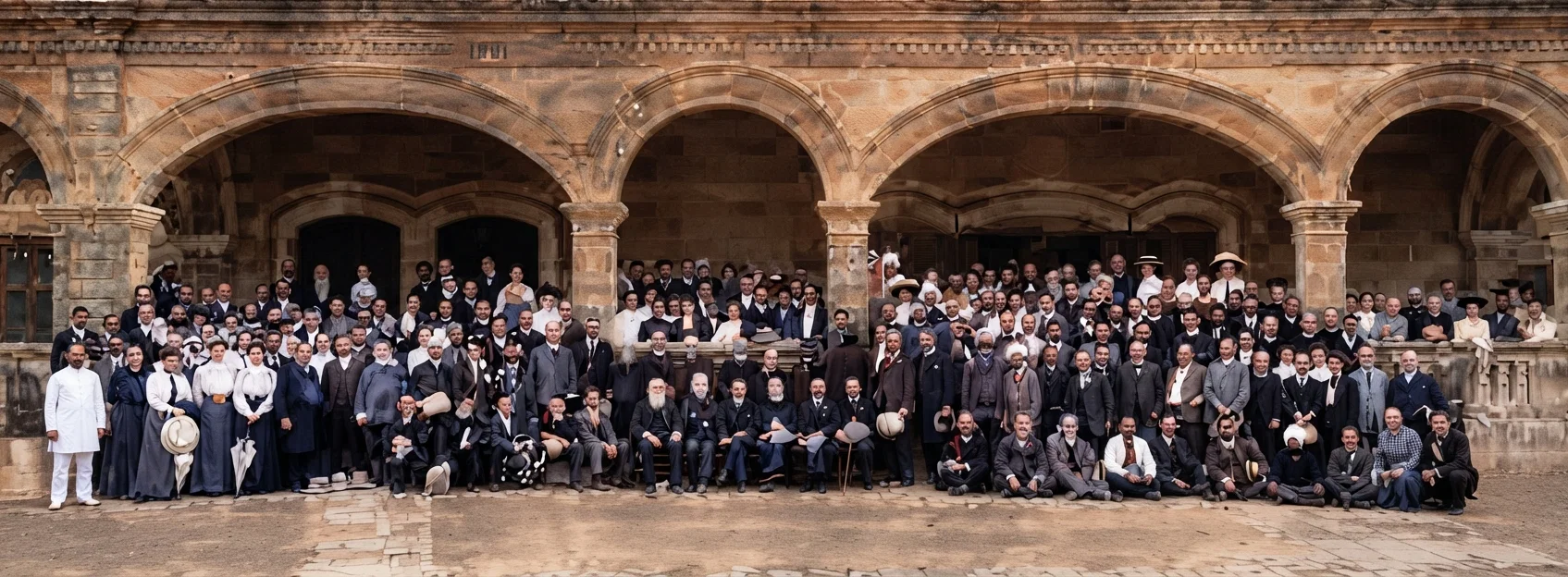
DELEGATES TO THE INTERNATIONAL CONGRESS OF THE SALVATION ARMY IN LONDON.
The unanimous verdict of the assembled delegates was that the greatest danger and the greatest need at the present moment are along the frontier of North Central Africa, where Mohammedanism is rapidly grasping the native tribes and extending its influence into the very heart of the continent.
Several facts stand out prominently in this section. The native tribes are said to find the Moslem faith more within the grasp of their minds. Western civilization, which goes with Western religion in most cases, is so long a step in advance that they are unable to comprehend it. Mohammedanism does not require such great changes in their lives. Their custom of plural wives is left untouched, their home life is unchanged, and their warring among themselves and with their neighbors is permitted if not encouraged, when the neighbor is not a good Moslem. Yet they come to believe in one God, and that one, according to the Mohammedan faith, the same God whom the Christians worship. Mohammedanism but takes them one step in advance of their former position both in civilization and religion; yet they seem to think this a long step, and that it is all they can grasp at one time.
Another factor that plays a large part in the favor with which Mohammedans are received is that the Christian missionary usually is of the same government that is steadily grasping their country; and if not, they class him thus, as he is a European. He is in many cases regarded as the advance agent of that country; and consequently the natural desire is to avoid him and his religion, so that they may not be led into the trap of his government. Mohammedanism offers an opposing force which in their heathen weakness and disunion they do not possess.
Another fact that impressed itself is that at Cairo there are twenty thousand Moslems in training in the various schools for work among their own people and among the native races; that in this same city the press, strongly Mohammedan, is sending forth millions of pages of literature against Christianity, against civilization and Western education, and these, carried by the Egyptian army and the Central African Moslem traders, are circulated and read to large groups of Mohammedans and heathen in Central Africa, thus carrying the violent tirades against Christianity and education among the heathen people, effectually prejudicing their minds against the coming missionary. Gordon College, at Khartum, Egypt, equipped and founded by the liberal donations of the Christian population of England and Scotland, has become a center of Mohammedan learning, and is to-day said to be practically Moslem.
Once the heathen embrace Mohammedanism, it is ten times harder to win them to Christianity, is the verdict of all Moslem missionaries. Yet the Moslems control the points of vantage along the entire frontier of North Central Africa, extending from the Atlantic to the Indian Ocean, and down well into the lake region of Central Africa. It is felt by all missionaries that this situation calls for the united efforts of Christendom to save these tribes from the perils of the Moslem faith, which is so strongly antichristian.
Still, the need and the danger are hardly less elsewhere. In the other regions, where possible, more has been done and a greater force is at work; but even in these places the working body is so lamentably inadequate as to be a poor force to oppose to the overwhelming power of the Moslems, were it not for the assurance of divine guidance and help.11
Conference Deliberations
During the course of the conference proceedings the fact was brought out that at the present time no mission work for Moslems is done in many of the important centers.
Even in India, where one third of the Moslem world lives, and where for a century missions have been operated, but a very few workers have studied the situation and devoted their lives to the work for the Moslem people. But few mission boards have made provision for missionaries especially educated for this work. Bombay, with a Mohammedan population larger than that of Delhi, the ancient capital of the Mogul Empire, has but one Christian worker especially devoting his time to the Mohammedan people. He is an Indian Christian. This record could be duplicated in many of the large cities of India, as well as elsewhere.
In the Russian Empire, with its 20,000,000 Mohammedans, but one society is working. The Swedish mission and the Mennonites and the Seventh-day Adventists were reported as now entering upon such work among the Mohammedans of Turkestan. Afghanistan has not been touched. Tibet is yet unentered; yet Moslem leaders are there before us in large numbers with the message of the false prophet of Arabia, and already twenty thousand have become Mohammedans.
Methods of Labor
The only methods of labor that are found feasible among the Mohammedan peoples are dispensary work, making the giving of the Gospel through the Scripture portion and the word of the living preacher of first importance; school work, enlisting the younger generation in a campaign which dispels the ignorance and bigotry of their parents as well as develops themselves; and evangelical teaching and preaching, with house-to-house work on the part of lady physicians, nurses, and Bible women. It was repeatedly emphasized that in this preaching some things must be avoided, such as controversy, allowing one's temper to become the least upset, and using anything but straightforward argument in the presentation of truth. Special stress was laid upon the necessity of using the Bible and clinging closely to it in the presentation of the Saviour to the Moslem world. One or two speakers mentioned the successful use of Old Testament prophecy and the work of the typical atonement in the presentation of the claims of Christ to the Mussulmans.
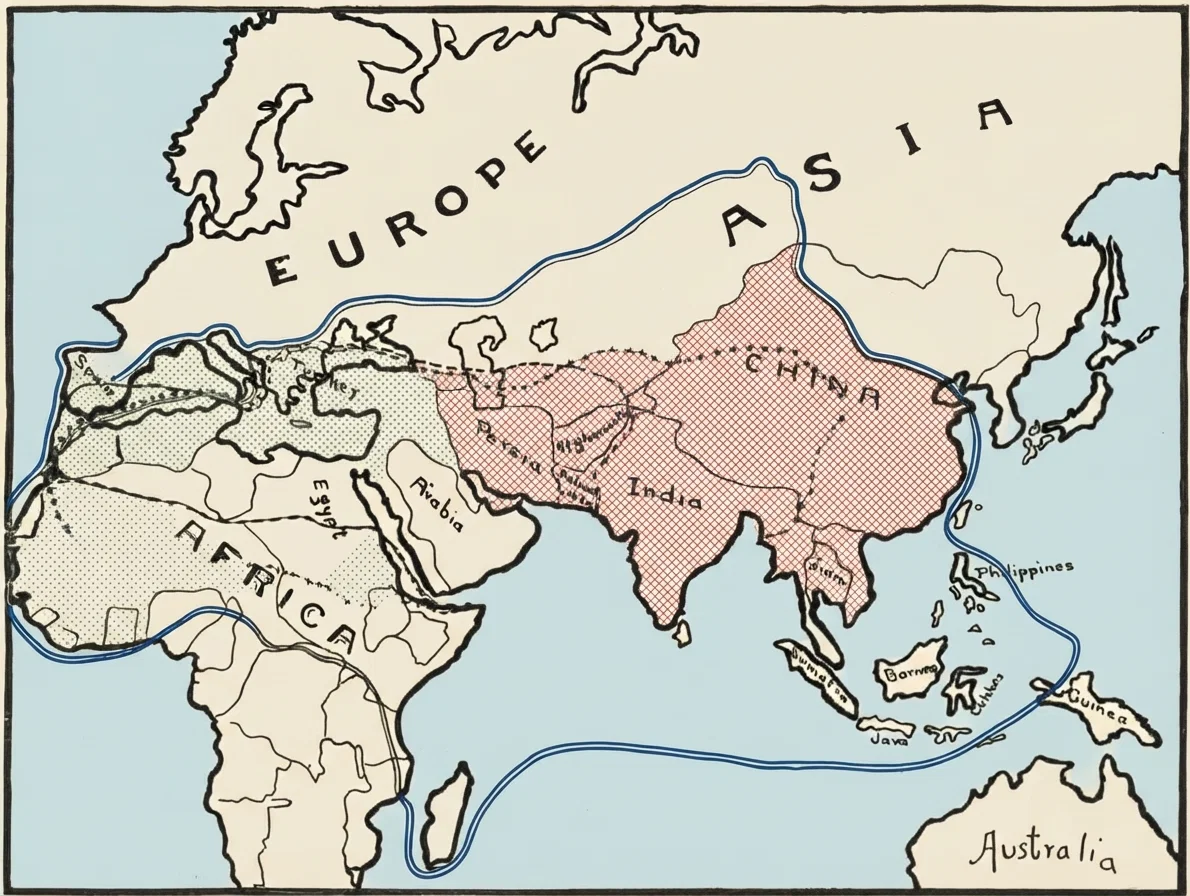
Territory inclosed in dotted line . . . Mohammedan World in 900 Territory inclosed in cross line . . . Mohammedan World in 1500 Territory inclosed in parallel lines = Mohammedan World in 1910
In an eloquent appeal in one of the sessions of the conference, the Rev. S. W. Zwemer, the chairman, besought the delegates to study their Bibles, to pray more, and to lay the burden of the work upon the great Burden Bearer. Some had suggested that the European governments should exercise a benevolent neutrality toward Mohammedan and Christian missions, and that some countries were impossible to enter because protection could not be guaranteed by the governments concerned. Again there was presented that true spirit of missions, which does not rely upon earthly protection and help, but upon God, as the exhortation was given that we must not depend upon our government for assurance of protection, but enter, and in prayer and fulness of faith trust God to care for His work and His people. In these days the missionary is too prone to depend for help upon the protection of some European power. This is not only a source of weakness to his own faith, but he is regarded as the advance agent of the power whose protection he seeks and to whom he appeals. The spirit of Judson, of Carey, of Henry Martin, and a host of other God-fearing and burden-bearing pioneers, is indeed a testimony against the spirit that places its dependence upon man.
The Bible for Moslems
Again and again it was stated in the sessions that the Bible itself was the best book for labor among the Moslem people. The beauties of the book, when put side by side with the Koran, have brought life and light to many. The touching story of the life of Christ as told in the Gospels has melted many a proud heart and brought about its surrender. The importance of standing on the book alone was emphasised, yet it was stated with equal truth that the workers of to-day were spending more time in argument and controversy and less in Bible study and prayer than the men of earlier times.
The Effect of Bible Criticism
The teaching of Moslems for several centuries has been that Mohammed became the prophet of God, and received the Koran as the true revelation of God's will, because the Scriptures, both Old and New Testaments, had become so corrupted in transmission from generation to generation that they no longer expressed the will of God.
As articles on Bible Criticism, published in papers and books, have come into the hands of Moslem leaders, and they have gathered their import, it is small wonder that they declare that the Bible is a corrupted volume and not to be depended upon. Perhaps no one thing has been a stronger weapon in their hands than these homilies of the Bible critics. The only hope for Christianity among Moslems, as elsewhere, is the whole Bible, a living Christ, and the manifestation of Him in the lives of His followers.
Mohammedans and Education
For centuries no more ignorant and superstitious people have lived than the majority of Mohammedans, judged from Western standards. They have been slow to adopt any of the Western ideas of education. Their mollahs have taught that the education of the West is a curse; that the Christian West had advantages that the Moslems did not, but that the Moslems had the promise of the blessings of Paradise and the Christians would be damned forever. But in spite of this, Western faith and Western learning began to eat at the vitals of the Moslem nations. The movements of recent years in Turkey, Persia, and Egypt are evidences of this. Especially did the education of the West lay hold upon the younger men.
Then came the Russo-Japanese War. They saw that Japan had assimilated the learning of the West, and had become a world power without becoming Christian, and the result was obvious. They would take Western learning likewise, but not its faith.
Some years ago there were called to Medina, Arabia, the mollahs of all Moslem lands. The sessions were in secret; but it has since transpired that the meeting was called for the purpose of considering the advance of Christianity and Western education in Moslem lands, and how best to meet it. Their plans to meet the Christian advance was a counter educational movement. It is a remarkable fact that since that time the educational movement among Moslems, the nationalistic tendencies in Egypt, India, Turkey, and Persia, have advanced to be strong factors, and in some cases a predominating influence in their several countries. Since that time the literature circulated by Mohammedans has increased by leaps and bounds. In every city, in every village of any note, their pamphlets are on sale. Every book-stall becomes a school, a center of education for that district. It is said that ten times as much literature is circulated in India by Moslems as by Christians. And it must be remembered that this literature is vitally opposed to everything Christian. The Koran to-day is translated into and circulated in all the tongues of the East, cheaper and better printed than the Christian Scriptures.
One of the weaknesses of the conference was seen in the spirit of compromise on the part of many missionaries. As the spirit of compromise has worked to the downfall of Protestants at home in their attitude toward Catholicism, so here in the relation of the Protestant Christians to Mohammedanism the spirit of compromise is tending to weaken the effort and annul the strength of Christian missions.
By some both at home and in the field Mohammedanism is considered as so much better than heathenism that we can let it alone and confine our efforts to heathenism. Another section favors finding that which is good in Mohammedanism, and adding to this the one essential to their lives, the Christ. But it is a noticeable fact that those who have made no compromise and have stood stiffly for the Bible as the only book of truth, representing the purity of Christianity and the love of Christ in their lives, have been the most successful.
In the words of an Indian Mohammedan soldier, "If a padre sahib tells me that our religions are very much alike (it is often done), I know that he has never read the Koran and does not read his Bible or he would know that they are vitally opposed to each other." No one knows better than an educated Mohammedan the enormous differences that lie between Christianity and Mohammed's teachings.12
Practical Conclusions of the Conference
In presenting the practical conclusions of their study of the situation, the delegates adopted resolutions calling upon the missionary force to devote more time to prayer and Bible study, realizing that the great lack of power in the presentation of Christ to the Moslem world is due to a lack of earnest prayer and communion with God. The call was also an appeal to the churches at home to meet the needs of the hour by a spirit of prayer, of devotion, and of sacrifice.
An appeal was made for men and means to enter those portions of the Moslem lands where it was felt that the gravest danger to missions now presents itself, especial attention being given to the establishment of a chain of stations across Africa in the forefront of the Moslem advance.
The establishment of a college at Cairo, Egypt, with a special purpose in view of educating men and women in Arabic, and Moslem customs and history, methods of labor, in fact for preparation for labor in Moslem lands, was urgently recommended to the home boards. The college was to be made undenominational.
For the immediate needs of the situation in Africa it was recommended to call for the best men available and for an immediate advance movement, as delay was counted dangerous to the cause of Christianity among the heathen and animistic tribes.
One of the strong recommendations was for more and better literature. And in view of the extent and purpose of the present output of the Mohammedan presses this is certainly necessary. Especial mention was made of literature for the women and children of Moslems. This must be illustrated, and with Bible stories of such character as to be understood by the Moslem women with their limited education.
Another recommendation that was full of meaning was that which called for the Indian Christian community to select men to help in the mission work in North Africa. This it was thought would be a source of inspiration and help to the Indian churches as they looked out upon the needs of others beyond their borders.
In two of the last recommendations passed there crept in that spirit of dependence upon the power of the human which some seemed desirous of avoiding. They recommended that a protest be lodged with the Edinburgh World's Missionary Conference Continuation Committee against the marked favor given Mohammedans in the Egyptian government, the use of Gordon College as a Moslem training center, and the use of government funds for the building of mosques, calling for strict neutrality and equal treatment of heathen, Christian, and Mohammedan. In the presentation of the resolutions the bishop of Lahore wisely brought to the attention of the conference that there were always two sides to a question, and that while they were protesting on the one side, Mohammedans might with equal feeling of injustice take the same course. He remarked that when we called for benevolent neutrality we were usually looking for the benevolence to be exercised in one direction.
A request was also made through the same channel as the one preceding for the powers to obtain by any legitimate means equality of treatment for all religions by the government of Turkey.
That the conference as a whole can be but an influence for good there is no doubt. God-fearing men led in the daily sessions, and brought words of kindly council to those who had been but a short time in harness. A feeling of the need of the Moslem world came home to many as never before. There is one thing that all Christians can and should do in view of the situation,— pray, give, and go, till to the Moslem world, so long neglected, is given the message of the Saviour.
The Hope of the Conference
The hope of the conference was expressed in the words of one of its mottos, "The speedy evangelization of the Moslem world." But they looked forward to bring all to Christ. How vain is this hope was voiced by one of the papers of the conference, which, speaking of the so-called Christian nations, said, "There are no Christian nations, properly speaking." But that the knowledge of Jesus, the message for these days, should be given, is a possibility. Every man will have the opportunity to choose either for Christ or against Him; and we must ourselves witness of Him, even to the uttermost parts of the earth. Friends and brethren, let your prayers ascend to God daily that the message of witness may be quickly given to the great, dark, cruel, bigoted Mohammedan portion of the world. Pray for it, work for it, sacrifice for it. The promise is that the message shall be given before the end comes.