THIS lesson closes with the first part of the book of the Apocalypse. We have passed over three series of seven — the churches, the seals, the trumpets — which end with this lesson. We have studied God's message to His church in her sevenfold manifestation, in which the sins and defects of the people are plainly portrayed, as well as their faithfulness, their endurance, their love, their loyalty. The great love and sympathy of the Master spares naught of reproof or admonition or praise or blame, of warning or appeal, which will help in uplifting the purchase of His blood to a character worthy eternal life, in making them overcomers with Him.
In the opening of the seven-sealed book, we have a marvelous revelation of God's will, God's purposes, God's plans for the salvation of man and the putting away of sin. Therein is shown how God reigns and rules above all plagues, wars, famines, pestilences, and deaths of every form. This prophecy is supplemented by an episodial prophecy, the sealing work of Rev. 7: 1-3, a reform on the law of God and the Sabbath, world-wide and of vital importance, then Christ's coming.
The seven trumpets cover practically the same period covered by the seals. This line of prophecy predicts the breaking up of the Roman Empire and the scourge of God upon apostasy. It is God's pointing out and permitting the logical development of wrong principles of government among the nations of men, whether Roman or Greek, whether Goth or Scyth, whether Vandal or Turk, is dominant. All the evils may be traced back to God's law, the subversion of the right principles of true government.
The two episodial prophecies break in after the sounding of the sixth trumpet, both belonging to the time of the sixth trumpet, and both having to do with the Word of God and its opening prophecies for the last days. These done and we enter upon the closing events of the seven trumpets in Rev. 11: 14-19. Let us note first —
The Answer of the Text
[The answers to the questions are from the American Revised Version. Omitting questions, and disregarding sometimes the capital at the beginning and the period at the close of an answer, the text may be read continuously. In notes and comments both versions are used without designation.]
1. What announcement is made at the close of the sounding of the sixth trumpet? The second wo is past: behold, the third wo cometh quickly. Verse 14.
2. What followed the little period indicated by the word "quickly"?
And the seventh angel sounded; and there followed great voices in heaven, and they said, The kingdom of the world is become the kingdom of our Lord, and of His Christ: and He shall reign forever and ever. Verse 15.
3. What representative class was especially affected?
And the four and twenty elders, who sit before God on their thrones, fell upon their faces and worshiped God. Verse 16.
4. For what did they give thanks?
Saying, We give Thee thanks, O Lord God, the Almighty, who art and who wast; because Thou hast taken Thy great power, and didst reign. Verse 17.
5. What five declarations do the elders make?
And the nations were wroth, and Thy wrath came, and the time of the dead to be judged, and the time to give their reward to Thy servants the prophets, and to the saints, and to them that fear Thy name, the small and the great; and to destroy them that destroy the earth. Verse 18.
6. What closing event is next seen?
And there was opened the temple of God that is in heaven; and there was seen in His temple the ark of His covenant; and there followed lightnings, and voices, and thunders, and an earthquake, and great hail. Verse 19.
Note and Comment
1. The second wo.—The long, desolating scourge of Mohammedanism reaches down to 1840. It was indeed a wo upon the world; but a greater is yet to come, the climax of all woes. "Quickly," as before stated in our studies, has been applied to the little period between 1840 and 1844; but may it not include a longer period, even the waiting time of "the days of the voice of the seventh angel, when he is about to sound"? We are sure that if our readers will study carefully verse 7 of chapter 10 they will see that there are days belonging to the seventh trumpet angel before he sounds, days when he is about to sound. So both Revised Versions, Hinds's Interlinear rendering from the Textus Receptus, Alford, Vincent, "Word Studies in the New Testament," similarly books of Rotherham's translations before us, and others. Alford says that the words "when he is about to sound" are used in their strictest propriety, for when the seventh angel does sound the completed time of the fulfilment is simultaneous with his blowing. So that it is properly said that the fulfilment comes in the days when he is about to blow. When "he shall begin to sound" is inadmissible."
Our notes of week before last were written before Alford's comment on the text was read, but it seemed to us that the words were so clear that there was no room for any other conclusion. Alford confirms this. "In the days of the voice of the seventh angel, when he is about to sound, then is finished the mystery of God." The Gospel work will be concluded in these tense, waiting days. Then the trumpet blows.
2. The seventh angel sounded.—Long he waits. Man's patience would have long ago been exhausted. Behold the patience and forbearance of God in order that every soul may be won to His mighty Gospel! Then he sounds; then Christ leaves the throne of His Father, the antitypical Priest for the putting away of sin (Zech. 6:13; Ps. 110:1; Rev. 3:21; 1 Cor. 15:24, 25); and then He shall enter upon the kingdom He has purchased, beginning His reign in the New Jerusalem with His people (Dan. 7:13; Rev. 20:4; 3:21). The people of the kingdom of this world, usurped by Satan, delivered to him by man when man yielded himself (Luke 4:5, 6), will have tried every scheme of government that sinful man could devise to secure the rights of man and stability of rule, and failed in them all. Christ begins His everlasting reign, and the great voices in heaven reveal the fact, and all7the holy ones rejoice in the triumph of our Lord and of His Christ.
PATMOS
3. The four and twenty elders.—Christ glorified human assistants in His priestly work. (See chapter 4:4, issue of Jan. 24, 1911.) They are peculiarly representative of the church of God. In their finite vision they could not see how the great God could work out all that He had promised, or how righteousness could triumph over sin; but they believed, and served on. Now belief is justified in demonstration. The reign of evil and the pleading of persecuted captives are forever consigned to the oblivion of the past. To God give they all the glory.
4. Thy great power.—God's power has been through all the ages manifest through the creation and the upholding of all things in His marvelous universe. When sin entered and man became its slave, God placed that power in His Gospel, on the demand that every believing soul break the power of sin, to set the prisoner free, to enable him to walk in liberty; for "the Gospel . . . is the power of God unto salvation to every one that believeth." Rom. 1:16. Men, singly and in mass, have rejected His power, and counted the message cold, dead, human, inadequate. Some in each age have believed and demonstrated in regenerate, holy life His power. Now at the sounding of the great trumpet comes Christ the Lord in the same power, but manifest in transcendent glory, before which the nations of the earth perish.
5. The nations were wroth.—The elders are speaking still. They sum up events that are connected with Christ's coming. The wrath of the nations is particularly demonstrated in the great battle of Armageddon, set forth in later chapters. Read Jer. 25:15-33, showing how all nations shall drink of the wine of wrath, and as the result the whole earth become convulsed with war, and the slain shall be scattered from one end of the earth to the other. This is the result of human rule without God. And Thy wrath came.—Men in rejecting God's mercy have invited His wrath, His justice, against sin and all identified with it. It must not be allowed to destroy the universe, nor to triumph over the good. Hence the manifestation of God's wrath in justice. The time of the dead to be judged.—This began in the examination of the cases of those whose names had been written in the Book of Life, "in the days of the voice of the seventh angel, when he is about to sound," in the finishing of the mystery of God. Those whose cases are there found, do not come into judgment. John 5:24. Those whose sins are not then found to be blotted out will die. God and His saints will enter upon examination of their cases during a thousand years, at the end of which time their just sentences are meted out. 1 Cor. 6:2, 3; Rev. 20:4, 11-13. Give their reward.—God's children do not enter upon their reward at death. They sleep in their prison-house, and when Christ comes they are called forth to immortality and enter upon their eternal reward. 1 Cor. 15:51-54; Matt. 16:27; Rev. 22:12. Destroy them that destroy the earth.—When the Lord comes it will have been eternally demonstrated that man apart from God has no power to govern himself or others. Man's reign is set forth in the great image of Daniel 2. His kingdom begins with gold, passing through silver, brass, iron, to clay—utterly worthless, brittle clay. Then Christ comes in the stone which smites the image on the feet, and His kingdom fills the whole earth. Man's rule, apart from God's interference and the conservative and preservative power of righteousness from Him, has ever been destructive. Christ destroys at His coming all that is left of Armageddon. Rev. 19:21; 2 Thess. 2:8; Isa. 11:4. Thus far the words of the elders.
6. Opened the temple.—Covering the days of the voice of the seventh angel and revealing the cause of all the wrath. In that temple is seen the ark of God's covenant, a copy of which on earth was placed on tables of stone on which was written the Decalogue and above which was the mercy-seat. See Ex. 25:10-22; 31:18; Deut. 5:22; 10:1-5. To man God gave the copy of ark and law. He left the original in heaven. Man may cleave the gold from the ark, melt the adoring cherubim over the mercy-seat, break in pieces the tablets on which Divinity engraved the law, put to death those upon whose hearts the Spirit has written it, and in whose affection it is enshrined, even as they did Jesus Christ; but they have not touched the foundation of God's government, they have only bruised and broken themselves on the thick bosses of His buckler. "Forever, O Lord, Thy word is settled in heaven." Once more in the end of the Gospel age God's law will be preached in all its fulness of letter and spirit, the law of the Creator, revealed in the precepts of His downtrodden Sabbath. Once more His Gospel will be preached, the Gospel of our Vicarious Sacrifice, our all-sufficient High Priest, in all its fulness. The sadness of it all is that many will have none of either; therefore the wrath to the uttermost symbolized by the lightnings, the voices, the thunders, the earthquake, the mighty hail, of the plagues of chapter 16. Thank God there is shelter now from all these. We can now make God our refuge. To His faithful ones is the word which we have already had: "Because thou didst keep the word of My patience, I also will keep thee."
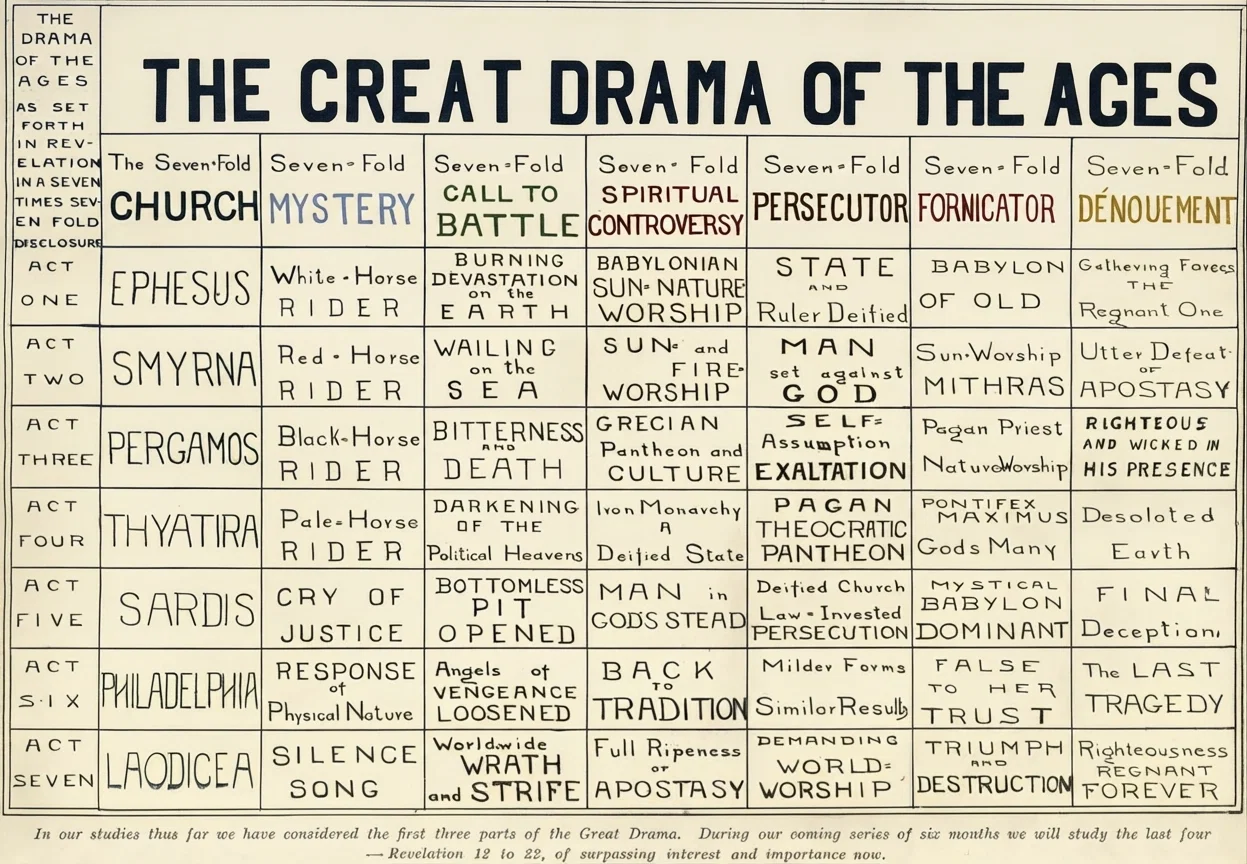
In our studies thus far we have considered the first three parts of the Great Drama. During our coming series of six months we will study the last four - Revelation 12 to 22, of surpassing interest and importance now.