THE tabernacle as pitched in the wilderness was a beautiful structure. Around it was a court enclosed with linen curtains suspended by silver hooks from pillars of brass trimmed with silver. Viewed from any side, the tabernacle was beautiful. The north, south, and west sides were upright boards, ten cubits high, covered with gold within and without, and kept in position by silver sockets underneath and golden rings and bars overlaid with gold extending around the building. The front or east end was a beautiful curtain "of blue, and purple, and scarlet, and fine twined linen, the work of an embroiderer." Ex. 36:37, margin. It was hung upon five pillars of acacia wood overlaid with gold, which added much to the beauty of the entrance. The rich rainbow tints of the curtain with cherubim wrought in it, which formed the door of the building in which God promised to dwell with His people, was a beautiful "shadow" of the entrance to the wondrous heavenly sanctuary, where, with a rainbow of glory encircling His throne, the Father sits, while ten thousand times ten thousand angels pass to and fro at His command. Rev. 4:2-4; 5:11.
The Covering
The roof or covering of the tabernacle consisted of four curtains of cloth and skins. The inside curtain was like the curtain at the entrance of the tabernacle, of blue, purple, and scarlet, and fine twined linen, with golden cherubim wrought in it by a cunning embroiderer. Ex. 26:1, margin. This formed the ceiling of the tabernacle, which was a faint representation of the canopy of glory above the throne of God, filled with myriads of angels ready to fulfil His command. Eze. 1:28. Over this was a curtain of goats' hair, above that a covering of rams' skins dyed red, and over all a covering of badgers' skins, which formed a good protection from the weather. The different colors of the coverings, blending with the golden wall and the beautiful entrance curtain, or veil, as it was called, added much to the beauty of the building.
The Pillar of Cloud and of Fire
Over the tabernacle rested the pillar of cloud by day and the pillar of fire by night which went with Israel in all their wanderings. Ex. 40:38. In the midst of the desert heat, there was a cool, refreshing shelter beneath the shade of the cloudy pillar, for those that served in the tabernacle or worshiped in its court, while without was the scorching heat of the desert. Isa. 32:2. What a beautiful type of the covering God spreads over His people in the midst of this wicked world, so that it is possible to dwell in the secret place of the Most High and abide under the shadow of the Almighty One (Ps. 91:1), while in the midst of the turmoil and strife of this wicked world! At night, when the intense heat abated, and darkness covered the desert, then above the beautiful tabernacle hung the cloud as a great pillar of fire "in the sight of all the house of Israel, throughout all their journeys." Ex. 40:38. God's immediate, visible presence lighted up the entire encampment, so that all could walk safely through the darkness. What a beautiful type was thus given of the Christian's walk! There may be no visible light; but when the light of God's presence surrounds one, his pathway is light. David knew of this when he wrote, "Blessed is the people that know the joyful sound: they shall walk, O Lord, in the light of Thy countenance." Ps. 89:15. The weakest trusting children of God can have the blessed light of God's countenance to guide them safe from the pitfalls of Satan if they will surrender their hearts to His service.
“And they shall make an ark of acacia wood.” Ex. 25:10.
Within the golden walls of the tabernacle, priests of divine appointment performed a work representing in types and symbols the wonderful plan of redemption. The work of Christ has two distinct phases, one performed in the first apartment of the heavenly sanctuary, the other in the second apartment. He offers salvation free to every one. Many accept, and start out on the Christian pathway. Christ reaches down His infinite arm to encircle and support every one that calls upon His name, and no power of earth or Satan can force a child of God out of His protecting care. John 10:28, 29. The only way any can be lost is by their letting go their hold upon the infinite hand. Like Peter, if they take their gaze from Christ, and fix it upon the sea of life, they sink, unless like him they cry out, "Lord, save me," and are rescued by the Saviour. Matt. 14:28-31.
The work of Christ is illustrated by the parable of the marriage of the king's son. All, both bad and good, are gathered as guests at the marriage; but there comes a time when the king comes in to examine the guests, and then all are excluded except those who are clothed with the wedding-garment of Christ's righteousness. "Many are called, but few are chosen." Matt. 22:1-14.
There were two apartments to the sanctuary, or tabernacle. In the first apartment a service was performed throughout the year, which typified the work of inviting and gathering the guests to the marriage. In one day, at the end of the year of service, a work was performed in the second apartment7of the sanctuary, which typified the work of choosing out from among the many that have accepted the call, those who are worthy of eternal life, as illustrated in the parable by the king examining the guests.
The Ark
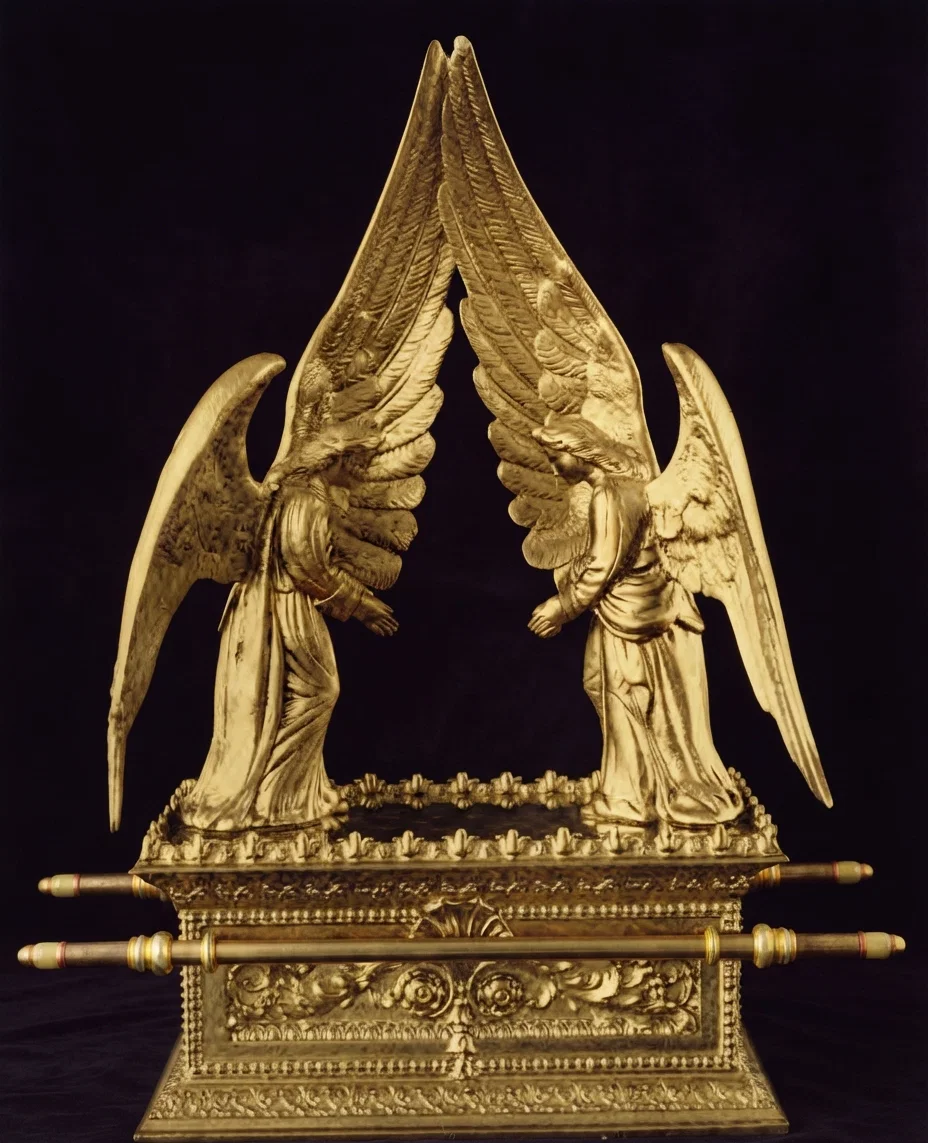
The ark was the central figure of the entire sanctuary. The broken law contained in the ark was the only reason for all the sacrificial service both typical and antitypical. When the Lord gave directions for making the sanctuary, His very first instruction was: "They shall make an ark of shittim [acacia] wood: two cubits and a half shall be the length thereof, and a cubit and a half the breadth thereof, and a cubit and a half the height thereof." Ex. 25:10-22. It was overlaid within and without with pure gold, with a crown of gold around the top. The cover of the ark was called the mercy-seat. This was of pure gold. On either end of the mercy-seat were cherubim of beaten gold, with their wings stretched forth covering the ark, and their faces looking reverently toward the law of God contained in the ark. There is great consolation in the fact that God Himself covered the broken law with a mercy-seat, and then He, the merciful God, took His position upon that seat, and every sinner that comes confessing his sins receives mercy and pardon. That mercy-seat, with the cloud of glory, the visible representation of God's presence, and its covering cherubim, is a wondrous "shadow" of the throne of the great God who proclaims His name as "Merciful and Gracious, Long-suffering, and abundant in goodness and truth." Ex. 34:5-7.
It Contained the Tables of Stone
Within the ark was the Lord's own copy of that holy law given to mankind in the beginning. "Where no law is, there is no transgression." Rom. 4:15. "Sin is not imputed when there is no law." Rom. 5:13. Therefore the Lord could never have driven our first parents from the Garden of Eden (Gen. 3:22-24) on account of their sin, if they had been ignorant of God's holy law. How God proclaimed His law to our first parents, He never revealed in His holy Book; but when it was necessary again to make His law known to His people after their long servitude in Egyptian bondage, He had the account of that wonderful event recorded, so that the generations to come might know that God came from heaven and spoke the Ten Commandments with an audible voice in the hearing of all Israel. Deut. 4:10-13. After God declared the Ten Commandments from the top of Mount Sinai in the hearing of all Israel, He wrote them upon two tables of stone, and gave them to Moses, with the instruction, "Thou shalt put them in the ark." Ex. 31:18; Deut. 10:1-5. The ark was placed in the most holy apartment of the sanctuary, where no mortal eye could gaze upon it except the high priest, and he only one day in the year, when he went in before the Lord to sprinkle the blood of the Lord's goat before and upon the mercy-seat to atone for the broken law within the ark. "The wages of sin is death" (Rom. 6:23), and the broken law demands the death of every sinner. In the typical service, the blood was sprinkled above the law, to show faith in the blood of Christ which would free the righteous from the demands or curse of the law. Gal. 3:13.
God communed with His people from the cloud of glory which rested above the mercy-seat between the cherubim. Ex. 25:21, 22. These golden cherubim with outstretched wings were but a shadow of the covering cherubim that surround the throne of God in heaven. Eze. 28:14, 16.
Government Requires Law
There can be no government without law. The very suggestion of a kingdom is always connected with law. There could be no judgment without a law as a standard of judgment. God declares that "as many as have sinned in the law shall be judged by the law." Rom. 2:12. All God's commandments are righteousness. Ps. 119:172. The establishment or foundation of His throne is righteousness and judgment. Ps. 97:2, margin. "There was nothing in the ark save the two tables of stone" (1 Kings 8:9), is the divine record. The pot of manna was laid up "before the Lord" (Ex. 16:33, 34), and Aaron's rod that budded was laid up "before the testimony" (Num. 17:10). Paul, enumerating all the contents of the most holy place in the order that he has, leads some to suppose that at some time the pot of manna and Aaron's rod might have been placed in the ark; but the ark was made for the one purpose of containing God's holy law. Deut. 10:1, 2.
No profane hands were allowed to touch the ark. Uzzah was smitten for reaching forth his hand to steady the ark when the oxen which were drawing it stumbled (2 Sam. 6:6, 7, margin), while thousands of "the men of Beth-shemesh" were smitten for looking into the ark (1 Sam. 6:19). None but priests were allowed to carry the sacred chest. Deut. 10:8.
Hidden by the Prophet Jeremiah
On account of the wickedness of the two sons of Eli the priest, the ark was carried onto the battle-field, and captured by the Philistines; but God impressed their hearts to return it to Israel with a golden trespass-offering. 1 Sam. 4:3-11; 5:1-12; 6:1-18. When Solomon's temple was built, the ark was placed in the holy of holies (1 Kings 8:1-6), where it remained until taken by the prophet Jeremiah and hid in the mountains, before the Babylonian captivity, lest it should fall into the hands of the Gentiles. 2 Maccabees 2:1-6.
The writer of the Apocrypha states that the ark will again be brought forth in the last times. 2 Maccabees 2:7, 8. Whether that copy of the law which God gave at Sinai will be brought out again or not, there will a copy of that same law be traced as with a pen of fire in the heavens, before the wondering gaze of the inhabitants of earth, in connection with the second coming of Christ to the earth. Ps. 50:6; 97:6; 98:2. That holy law is the standard by which all will be judged. That law will condemn the guilty; for "sin is the transgression of the law." 1 John 3:4; Rom. 7:7; James 1:23, 24; 2:8-12. The same law that condemns the sinner, will witness to the righteousness of those who through faith in Christ have tried to walk in harmony with its righteous precepts, humbly seeking forgiveness for every transgression. Rom. 3:21.
TYPE
Ex. 26:33. The ark was placed in the most holy place. Ex. 25:21, 22. God's visible presence was manifested above the mercy-seat.
ANTITYPE
Rev. 11:19. The ark was seen in the heavenly sanctuary. Ex. 34:5-7. The Lord gives His name as Merciful and Gracious and Long-suffering.