EDITORIAL

9%

Pacific Press Publishing Association · Mountain View, California · Nov 12, 1912

FromSigns of the Times, Vol. 39, No. 44.

Read the full edition

EDITORIAL

Fishers of Men

IN these lessons, we follow the Gospel by Mark. It is not a study of the book,—simply sundry lessons gleaned therefrom of the Master's life and work and teaching. In our last, it was His message and its time. In this, it is the call of His first disciples.
THUS reads the passage: "Now as He walked by the Sea of Galilee, He saw Simon and Andrew his brother casting a net into the sea: for they were fishers. And Jesus said unto them, Come ye after Me, and I will make you to become fishers of men. And straightway they forsook their nets, and followed Him. And when He had gone a little farther thence, He saw James the son of Zebedee, and John his brother, who also were in the ship mending their nets. And straightway He called them: and they left their father Zebedee in the ship with the hired servants, and went after Him."
THE first thing we note is the place where Jesus sought His disciples. Why did He not go to Judea? It was not because He was timid. While He was not bold, or boastful, or self-assertive, He was always brave to do His duty. It was not because He was ignorant, that He did not go to Jerusalem; for at twelve years of age He surprised the great doctors in the temple by His mental acumen and intelligence, and in every after-encounter His superior knowledge and wisdom were more than a match for the casuistry and sophistry of Pharisee and Sadducee, of doctor and priest and scribe. It was not because He did not know that there were men at Jerusalem,—able, devoted, well-balanced men. Surely it would seem that He could have better supplied His cause with directing material from the groups of men revolving around Gamaliel, Annas, Caiaphas, and Nicodemus. But all these He passed by, and came first to the Sea of Galilee. Knowing Him, the reason is obvious. He preferred to gather His disciples from those who were not bound about by truth-perverting or truth-chaining traditions, to gather from those who were not educated to believe that truth could come only through the traditions of the elders, to gather disciples from those who were not wise in their own conceits, from those who were not self-satisfied. Therefore He went to freer Galilee, to the hardy peasants who had seen God's power and wisdom in the stars at night, as their boat rocked on the quiet sea, who had felt their helplessness in the mighty storms which frequently swept down from the mountain gorges and lashed the beautiful lake into a fury, who had learned that God was above men and cared for them all, and whose honest, hungry hearts longed for God and the Deliverer from sin whom God had promised. Therefore Jesus sought the region of Galilee.
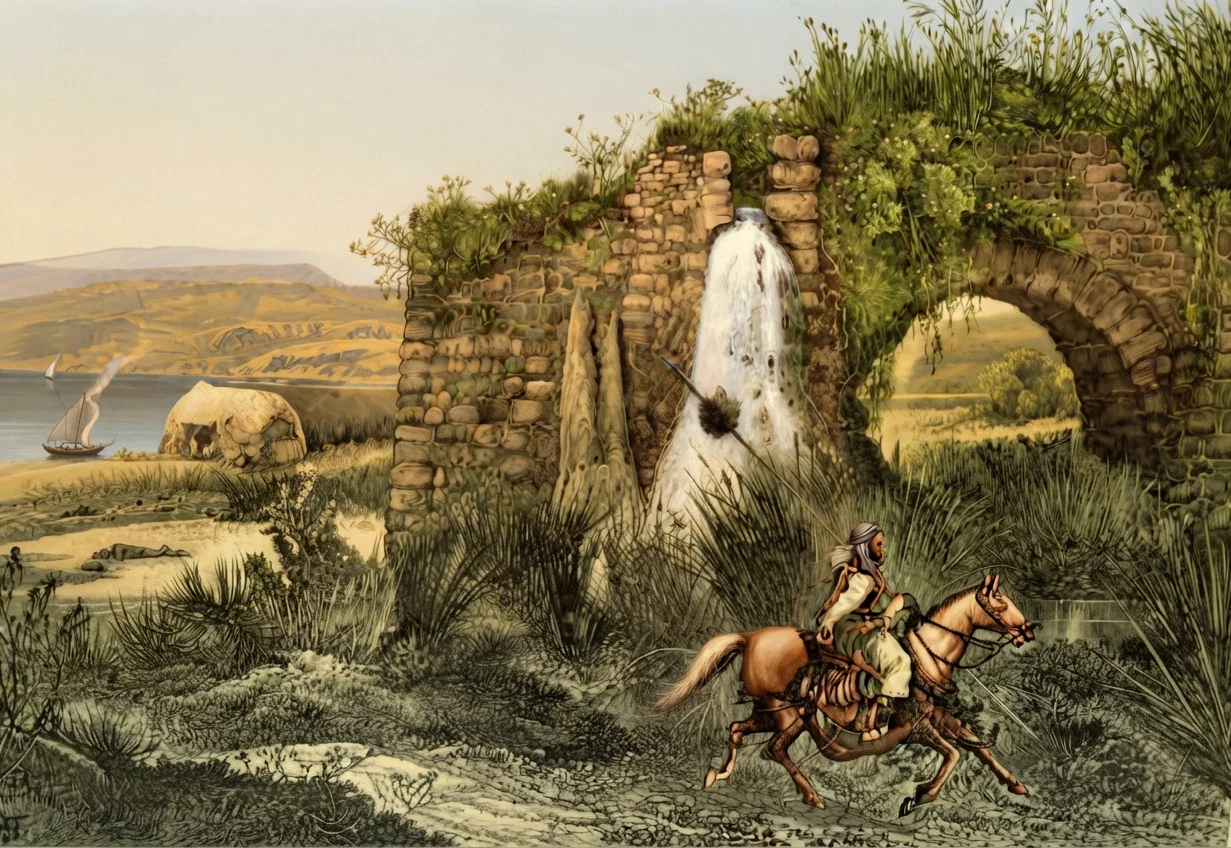
The present site of Bethsaida, "the city of Andrew and Peter," now in ruins. At the time of the calling of the disciples it was a prosperous fishing village. A little bit of the sea may be seen in the left of the picture. Sin never beautifies a land.
THE men He wished to choose were found in Galilee of the Gentiles, where the Jews were mingled with other peoples, until many of them had come to believe that there was salvation for other men. It was among these people that a Roman centurion could find hope, and the Jews say of him, "He loveth our nation, and he hath built us a synagog." Jesus went down among the lowly fishermen by the sea, the men who toiled on the deep under the stars of God. He would choose His disciples, His teachers, His missionaries, from such a class, that the world would not give glory to the missionaries, or to the men chosen. It is God's plan that no flesh shall glory in His presence, and therefore He has not followed the wisdom of the world in His work for souls, because "the foolishness of God is wiser than men; and the weakness of God is stronger than men. For ye see your calling, brethren, how that not many wise men after the flesh, not many mighty, not many noble, are called: but God hath chosen the foolish things of the world to confound the wise; and God hath chosen the weak things of the world to confound the things which are mighty; and base things of the world, and things which are despised, hath God chosen, yea, and things which are not, to bring to naught things that are: that no flesh should glory in His presence." 1 Cor. 1: 25-29. So God chose the Galilean fishermen, bearing with them even to the very close of His ministry the brogue of the Galilean district. But these men were educated by the greatest Teacher that the world ever knew; they learned the great principles of the plan of salvation from the lips of the Master.
"FISHERS of men"—that is what Jesus would make those who would follow Him. He calls, and the call reaches other souls. They had been fishing for fish. They knew all its uncertainties and all its hardships, all its disappointments, all its constitution-breaking experiences. They must have reasoned among themselves that it would be harder to fish for men. They knew the uncertainty and insincerity of men.
THERE are fishers for men. Satan and his agents have fished for them from the time that sin entered this old earth, and he has gathered them in, with all the various nets and hooks and wiles of which he is master,—one in the net of drunkenness, and another in that of lust, and another in that of power,—by all the various ways and means by which men can be attracted from the path of godliness and righteousness to a life of selfishness and ease and dissoluteness. Christ wanted those who would fish for men, and gather them into the great net of God, not for destruction or despoliation, but for salvation eternal. He has had His fishers in all days and in all generations; He has them to-day. But they must fish men out by the straight, clear devices indicated in our Lord's message in our last number. Men are not to be caught by the wiles of evil, they are not to be deceived. They themselves must yield to the fishermen, "repent, and believe." God has declared that in the last days "I will send for many fishers, saith the Lord, and they shall fish them; and after will I send for many hunters, and they shall hunt them from every mountain, and from every hill, and out of the holes of the rocks." Jer. 16: 16. But He does it by the same everlasting gospel that our Lord Jesus Christ died to give to the world. Rev. 14: 6.
THE fishermen responded. Simon and Andrew were just casting their net into the sea for a haul, but "straightway they forsook their nets, and followed Him." James and John were mending their nets preparatory to casting them into the sea, and they left their nets and followed Him. There was instant response to the call of the Master. Straightway He called, and straightway they left their earthly things to respond to the call. There is always blessing in promptness in doing the right thing; there is always weakness and disappointment in delay. There are many souls who would have been stronger had they followed their Lord without hesitation when He first called them. Said the writer of the 119th Psalm, presumably the prophet Daniel: "I thought on my ways, and turned my feet unto Thy testimonies. I made haste, and delayed not to keep Thy commandments." There are many souls in God's cause who would have been far stronger men, far stronger workers, if they had yielded themselves fully, promptly, in the beginning. That full and prompt yielding would have brought such blessing that it would have been the foundation of a habit of just such promptness in all time to come. God does not want rashness, but He does want the soul to decide regarding the thing that is right; and when the right comes, He wishes quick, prompt decision. Why not? Why should we dally and parley when we know what duty is? Why not yield to the duty, do it at once, and stand on the right side of the question forevermore? These four disciples, Peter and James and John and Andrew, whom Jesus met down there by the Sea of Galilee, were among the strongest of the twelve. They were among the first who were really called to the Master's service, and the record indicates that they were among the most prompt to respond to that call. Promptness in yielding to the call of Christ opens the heart to His presence. It forms open channel between the soul and its Saviour. That soul feels free communion with Christ its Lord, and to that prompt response Christ the Lord souls abundant blessings to fortify the soul against the deceptions of the enemy. That prompt response does not mean loitering behind, becoming a straggler in God's army; it means that that soul is at the forefront where the Master leads, prompt to do duty, growing stronger continually in the duties done, learning to bear burdens by bearing them, until life closes. The narrative is a very simple one, but the lessons it contains are of vital importance to success in Christian life.