DURING the active ministry of John the Baptist, Jesus of Nazareth came from Galilee to Jerusalem to attend the Passover. On that occasion He manifested miraculous power in driving bartering priests and tradesmen with their profane traffic from the temple. After cleansing the sacred house, He healed the sick, and so tenderly helped the needy that great numbers of sincere people were made to love Him.
This visit was very soon after the preaching of the Baptist had mightily stirred Jerusalem, and many who had listened to John's strong presentation of the prophecies, believed that the advent of the Messiah was at hand.
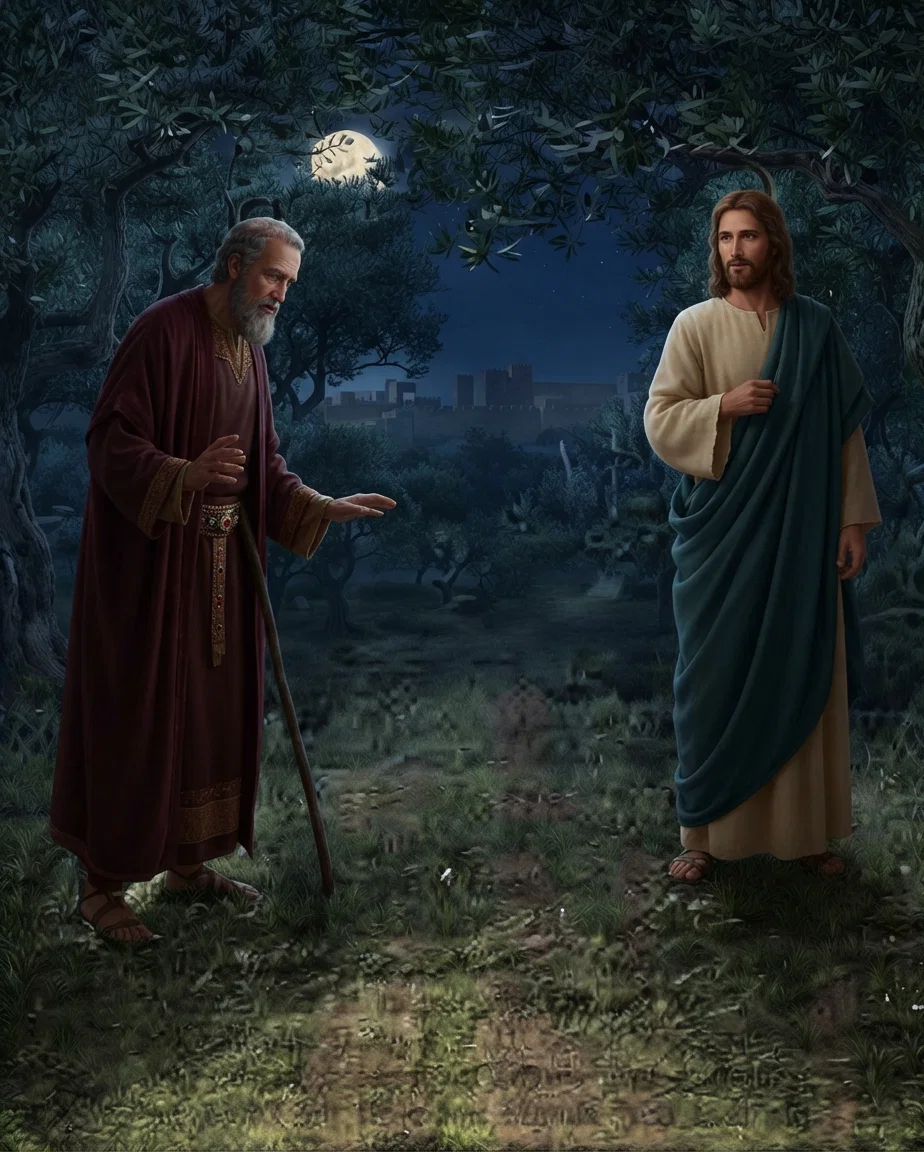
Among the interested ones was an honored teacher in Israel, a member of the Jewish Sanhedrin, named Nicodemus. When he beheld the wonderful power manifested by Jesus and observed His sweet spirit toward the poor and the suffering, he longed to meet and talk with Him alone. Nicodemus evidently thought his own high standing as teacher and officer prohibited him from having public interview with the Nazarene, so he decided to arrange for a secret meeting to be held in the stillness of night. By covertly asking a disciple, he was told where Jesus could be found alone after the shades of evening had fallen upon the earth, and to that place Nicodemus sought, and there he found Him.
The Conversation Opened
When in His presence he opened conversation by saying, "Rabbi, we know that Thou art a teacher come from God: for no man can do these miracles that Thou doest, except God be with him." He evidently supposed that Jesus would follow with the thread of thought he had introduced. But instead of following He immediately introduced another theme by saying, "Verily, verily, I say unto thee, Except a man be born again, he can not see the kingdom of God."
Scarcely comprehending what Jesus meant, Nicodemus asked, How can a man be born when he is old? Can the process of generation be repeated with a mature man? But Jesus reaffirmed His statement, saying, "Except a man be born of water and of the Spirit, he can not enter into the kingdom of God." Jesus then proceeded to speak of the invisible potency of the wind, apart from the ability of man to control it. And as with the wind, so with the operation of God's Spirit. Man does not control God's Spirit, but it operates in an unseen manner, accomplishing its mighty work upon the inner nature even of mature men. The Jewish teacher could doubtless see that there were both beauty and force in the words of Jesus, yet he doubtingly asked, "How can these things be?"
Rabbi, we know that Thou art a teacher come from God.
The Teacher Himself Was Ignorant
In response to this query Jesus kindly questioned Nicodemus and said, "Art thou the teacher of Israel, and understandest not these things?" This question implied that a teacher in Israel should be able to instruct his charge upon the theme of the new birth. But instead, their assignments and recitations pertained to useless forms and many long, tiring ceremonies. To master these rites consumed years of precious time and really injured the mental ability of the youth. By memorizing a thousand ceremonies the young people were made almost incapable of spiritual understanding.
Here was Nicodemus, the first teacher in Israel, almost incapable of grasping the truth relating to eternal life. Here was a noble man hampered by useless ceremonies and kept away from the gospel of God's kingdom, by a theocratic notion that had hindered the nation from doing the evangelistic work which had been entrusted to it.
Jesus, knowing who it was that had come before Him for instruction, and understanding fully the whole situation, improved His opportunity by giving Nicodemus just the lesson which the man and all his people needed. He showed the man that the mission of the Messiah to the world was not to make Israel a ruling nation over all the earth, but to be a sin-atoning Sacrifice and an impartial Redeemer for all who would accept Him by faith.
At one point in the interview, when Nicodemus was manifesting a lack of faith in a statement made, Jesus said, "Verily, verily, I say unto thee, We speak that which we know, and bear witness of that which we have seen; and ye receive not our witness."
Herein was Jesus stating the real difficulty with the man. A want of faith in God's word had brought blindness upon Israel, and instead of faith a useless round of burdensome works were being offered as a means of salvation.
The Serpent in the Wilderness
Then, to impress Nicodemus with the importance of simple, unquestioned faith in God's word, He referred him to how Moses had lifted up a brass serpent on a pole in the wilderness and how every one who had been bitten by fiery serpents simply looked upon that brazen serpent and by looking they were healed.
Nicodemus knew of that bit of wilderness history and believed it to be a true record of what took place. Then said Jesus to him, "As Moses lifted up the serpent in the wilderness, even so must the Son of Man be lifted up: that whosoever believeth in Him should not perish, but have eternal life." Since man poisoned by the bite of a serpent could be saved from dying simply by looking, in obedience to God's word, at the image of a serpent, it was plain that the power to heal was in God's promise of recovery. But the bitten man must have faith enough in the promise to look at the lifted serpent. Perhaps at this point Nicodemus wished to ask if God would save for eternity people out of all the Gentile nations simply by their looking unto Him by faith. The Jews thought there were national distinctions that should be recognized, but anticipating the question, Jesus immediately4said, "God so loved the world, that He gave His only-begotten Son, that whosoever believeth in Him should not perish, but have everlasting life."
This was a marvelous revelation to Nicodemus. Indeed, there can not be found in all the range of Christ’s teaching as recorded in the Gospels, a fuller lesson given on the subject of salvation than this one given in the night to one who sought of Him alone to learn the way of life. How blessed is the thought that God actually loves all the world and that He loves each person in the world with such intensity of love as to give His only-begotten Son in sacrifice to make it possible that all, or any one in the world, can be saved from sin and death and get everlasting life by believing.
This was the substance of the blessed message which Jesus gave to Nicodemus. Jesus said many other things to him, but this verse in John 3: 16 comprehends it all.
Tho Nicodemus did not immediately join himself to the cause of the Redeemer, he never forgot the lesson he heard during that night’s visit.
An Observer for Three Years
For three years at least, he observed the work of Christ and treasured up thoughts spoken by Him, before he saw the great consummation on Calvary. During this period he doubtless studied the predictions of the prophets concerning Him. By careful inquiry concerning His parentage he learned that He was Immanuel, a divine Man, the Son of a virgin in fulfilment of Isaiah 7: 14. He had ample time and a disposition to learn the essential particulars concerning the time, the place, and the manner of Christ’s birth, His bringing up, His baptism, and His successful conflict with Satan in the wilderness. Each one of these things helped him in knowing about the personality and mission of the Messiah. In the predictions made by Isaiah, the fifty-third chapter, and David in the second and the twenty-second psalms, he was enabled to know that an awful tragedy would be enacted by Jews and Gentiles together when the great sacrifice should be made. Among those Old Testament predictions was the lesson of Jesus about the Son of Man being lifted up when He should be made an offering for sin. So when he beheld strong men—after a mock and cruel trial—lay Christ on a great Roman cross of wood, and with a heavy hammer drive long, sharp spikes through His hands and His feet, and then lift Him up to die on that cross in awful agony before an angry, mocking multitude, he knew the great transaction was then taking place, and that God had given His Son in sacrifice to die for the world. There can be no question but Nicodemus was fully apprized of what was taking place on that eventful day, for late in the day when Jesus was dead, he came with Joseph of Arimathea to receive the body from Pilate that they might embalm and bury it. John 19: 38-42.
As High Officials They Observed the Tragedy
These men being high officials in the Jewish nation had without doubt observed the entire tragedy. They felt the earthquake that rent the rocks, and saw the sun darkened at noonday, and in the midst of the darkness and awful commotion they could hear the Roman captain and his men mournfully saying, “Truly this was the Son of God.” Matt. 27: 45-54.
The man who had visited the Master in the night and who helped to place Him in the tomb had seen and studied enough to make him understand what had been done. Yes, he had seen the Messiah die and had buried Him. So when the tidings of His resurrection from the dead reached the ears of Nicodemus, he was prepared to believe the report, and to watch with deepest interest the development of His cause. When Christ met with His disciples and committed unto them the work of preaching the glad news of salvation through His name, Nicodemus doubtless knew it. The Lord’s ascension to heaven and the marvelous ingathering of three thousand souls on the Day of Pentecost could not escape his attention, and so it came to pass as the Christian cause grew, Nicodemus, who visited Him alone in the hush of night, became an avowed and an open-day disciple and stanch defender of the faith. It was through Nicodemus’s cautious visit with Jesus in His place of prayer, perhaps on Mount Olivet, that the world finally got the blessed lesson of John 3: 16. Now, if that ruler of the Jews could by seeking unto Jesus in the dead of night obtain such a wonderful revelation of God’s love for man, what may the disciples of Jesus at this time learn from Him if they spend nights in their secret chambers bowing at His feet?
We need not be as cautious as Nicodemus was in approaching Him, but we should be as anxious to know God’s will and as earnest in going unto Jesus to learn about the way.