The Waldenses, or the Israel of the Alps—What Was Their Faith?—Their Opposition to Saint Worship, Predestination, Purgatory, etc.
By H. H. HALL
FIRST of all, they held tenaciously to the literal interpretation of the Bible unless the text plainly indicated that it was to be taken figuratively. This was shown in an emphatic way in their discussion of the slight differences between themselves and the Reformers on points of faith. For example, notice their questionings upon predestination, then taught by some of the Reformers:
"And as to predestination, we are much troubled about it, having always believed that God created all men for eternal life, and that the reprobate only became so by their own fault; but if all things take place of necessity, so that he who is predestinated to life can not become reprobate, nor those who are destined to condemnation attain salvation, of what use are sermons and exhortations?"—"Israel of the Alps," volume 1, page 95.
THE BIBLE THEIR GUIDE
That the Waldenses had the Bible very early in their history may be shown by various authorities, but perhaps the following will suffice. In that six-day synod in which the Reformers of the sixteenth century for the first time met the men of the valleys, the old manuscripts that they had among them were examined with wonder and amazement. Says one who was there:
"The Reformers . . . were greatly rejoiced to see that people, who had ever proved faithful—that Israel of the Alps, to whose charge God had committed for so many centuries the ark of the new covenant—thus eager in His service. And examining with interest . . . the manuscript copies of the Old and New Testaments in the vulgar tongue which were amongst us, . . . correctly copied with the hand at a date beyond all memory, they marveled at that favor of Heaven which a people so small in numbers had enjoyed, and rendered thanks to the Lord that the Bible had never been taken from them."—Id., page 97.
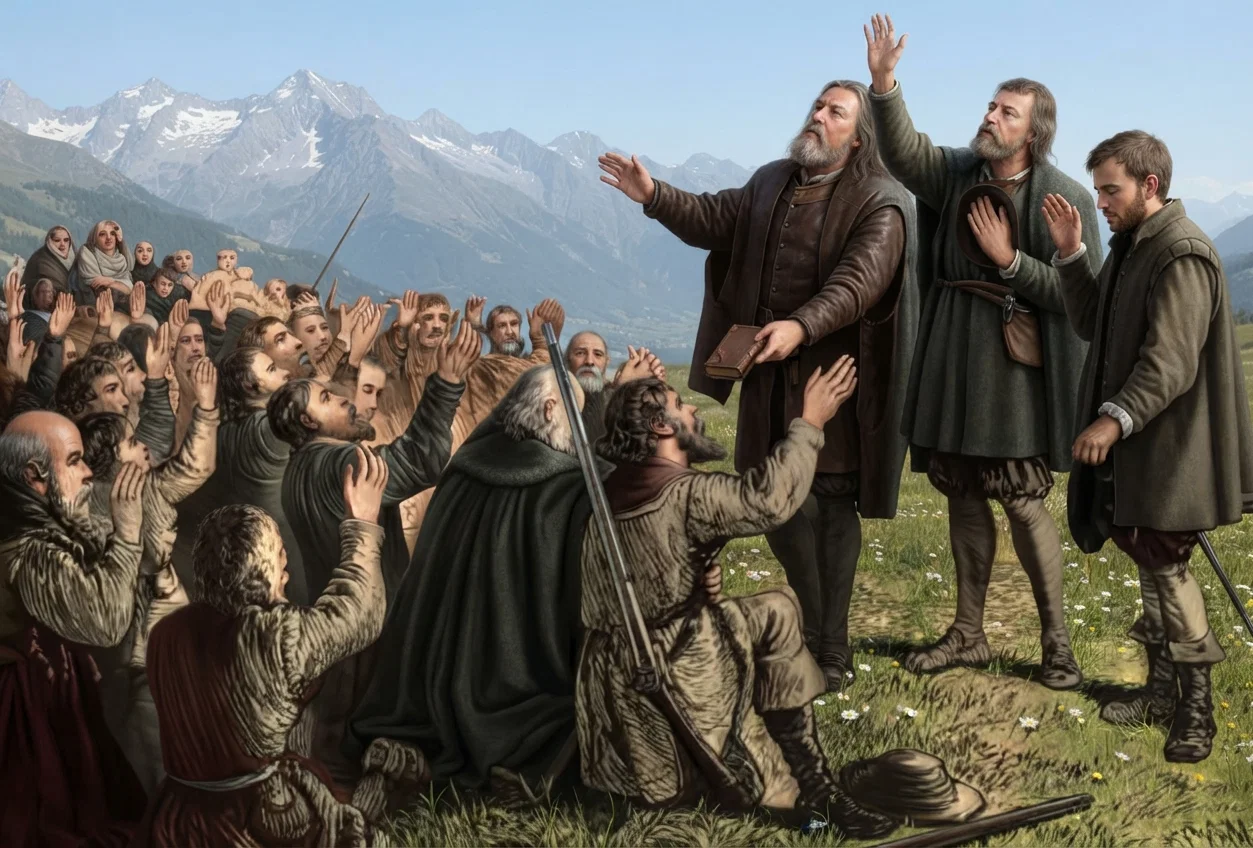
Another remarkable evidence of their reverence for the Bible and its teachings is found in the Campaign of 1561. They had been threatened with extermination if they did not attend the mass. In the face of a numerous army being raised to carry out the edict, representatives of the different valleys met, and standing in the midst of the assembled heads of families declared:
"In the name of the Vaudois churches of the Alps, of Dauphiné, and of Piedmont, which are all here united, and whose representatives we are, we here promise, with our hands upon the Bible and in the presence of God, that all our valleys will courageously stand by one another in what relates to religion without prejudice to the obedience due to their lawful superiors. We promise to maintain the Bible, entire and without admixture, according to the usage of the true apostolic church, steadfastly continuing in this holy religion, although it should be at the peril of our lives, in order that we may be able to leave it to our children intact and pure, as we have received it from our fathers. We promise aid and succor to our persecuted brethren, and not to regard individual interests, but the common cause, and not to wait upon men, but upon God."—Id., page 263.
THE VAUDOIS TAKING THEIR OATH
Strengthened by this trust, and animated by this high resolve, they drove the invaders from their valley in utter disorder.
QUOTATIONS FROM THEIR CATECHISM
But the reader may wish to know more in detail as to what they actually taught, so we give the following quotations from one of their old catechisms. It is found in Perrin's "Waldenses," issued in 1624, part 3, book 1, pages 1-10.
1. They believed in a faith that works by love.
"Q. What is a lively faith?
"A. That which worketh by charity.
"Q. What is a dead faith?
"A. According to St. James, that faith which is without works, is dead. Again, faith is nothing without works; or, a dead faith is to believe there is a God, and to believe those things concerning God, and not to believe in God."
2. They held to the Ten Commandments.
"Q. By what means canst thou know that thou believest in God?
"A. By this: because I know that I have given myself to the observation of the commandments of God.
"Q. How many commandments of God are there?
"A. Ten, as it appeareth in Exodus and Deuteronomy.
"Q. Which are they?
"A. Harken, O Israel, I am the Lord thy God. Thou shalt have no other gods but Me. Thou shalt not make to thyself any graven image, nor the likeness of anything that is in heaven, etc.
"Q. Upon what do all these commandments depend?
"A. Upon the two great commandments, that is to say: Thou shalt love God above all things, and thy neighbor as thyself."
3. They believed in justification by faith.
"Q. By what means do we hope for grace?
"A. By the Mediator Jesus Christ, of whom St. John speaketh, chapter 1:17. Grace came by Jesus Christ. And again, We beheld His glory, full of grace and truth, and we have all received of His fulness.
"Q. What is grace?
"A. It is redemption, remission of sins, justification, adoption, sanctification.
"Q. By what means do we hope for this grace in Christ?
"A. By a lively faith, and true repentance, Jesus Christ saying, Repent and believe the gospel."
4. They taught that worship was due to God alone.
"Q. Dost thou adore and serve any other thing as God?
"A. No.
"Q. Wherefore?
"A. Because of His commandment, whereby He hath straitly commanded, saying, Thou shalt worship the Lord thy God, and Him only shalt thou serve. As also, I will not give My glory to another. Again, I live, saith the Lord; every knee shall bow unto Me. And Christ Jesus saith, There shall be true worshipers, who shall worship the Father in spirit and truth. And the angel would not be adored by St. John, nor St. Peter by Cornelius."
5. They warned against the observance of tradition.
"Q. What are the things that divert a man from this hope?692"A. A dead faith, the seducing of antichrist to any other than Christ, that is to say, to saints, and the power of that antichrist in his authority, words, benedictions, sacraments, relics of the dead. The teaching men to have hope, by those means that directly oppose themselves against the truth, and against the commandments of God, as idolatry after divers manners, and simoniacal wickednesses, etc. Abandoning the fountain of living water given by grace, to run after broken cisterns, adoring, and honoring, and serving the creature, by prayers, and fastings, and sacrifices, donations, offerings, pilgrimages, invocations, etc. Trusting thereby to attain grace, which none can give, but God alone in Christ Jesus. So that in vain they travel, and lose their silver and their life, and doubtless not only this life present, but that which is to come."
6. They did not accept the intercession of saints.
"Q. And what say you of the blessed Virgin Mary? For she is full of grace, as the angel testifieth, Hail Mary full of grace, etc.
"A. The blessed Virgin hath been and is full of grace in herself, but not to communicate unto others, for her Son only is full of grace to bestow on others, as it is said of Him, And we all receive of His fulness grace for grace."
7. They accepted the sacrament as a figure. In one of their old tracts entitled "Our Lord Jesus Christ," found on page 46 of Perrin, we read:
"And therefore to eat the sacramental bread, is to eat the body of Christ in a figure; Jesus Christ Himself saying, Nevertheless, as oft as you do this, you shall do it in remembrance of Me. For if this eating were not in figure, Christ should be always bound to such a thing, for it is necessary that the spiritual eating should be continual. . . . In the celebration of this sacrament, prayer is profitable, and the preaching of the Word in the vulgar tongue, such as may edify, and is agreeable to the evangelical law, to the end that peace and charity might increase amongst the people."
8. They maintained gospel order.
"We choose amongst the people those that are to govern, and of the elders, according to the diversity of their employment, in the unity of Christ. According to that of the apostle, in the first of the epistle to Titus, I have left thee in Crete, that thou shouldest set in order the things that are wanting, and ordain elders in every city, as I have appointed thee." "Our nutriment and apparel are willingly administered unto us, and as it were by way of alms, very sufficiently by the people whom we teach." "The silver that is given for the relief of the people, is by us carried to the aforesaid council, and is there delivered for the common use in the presence of all, and afterwards taken by those that are in authority, and part of that silver is given to those that are to travel any long journeys, to employ as they shall think fittest, and part unto the poor.
"Our pastors do call assemblies once every year, to determine of all affairs in a general council."—Perrin's "Waldenses," part 3, book 2, page 59; part 1, book 1, page 53.
9. They believed in temperance. From another old document, under the head of "Taverns," we read:
"A tavern is the fountain of sin, the school of the devil. . . . It is the custom of God to show His power in His church, and to work miracles; that is to say, to give sight to the blind, to make the lame to go, the dumb to speak, the deaf to hear; but the devil doth quite contrary to all these in a tavern. For when the drunkard goeth to the tavern, he goeth upright; but when he cometh forth, he can not go at all, and he hath lost his sight, his hearing, his speech. The lectures that are read in this school of the devil, are gluttonies, oaths, perjuries, lying, blasphemies, and divers other villainies."—Id., part 3, book 2, pages 62, 63.
10. They vigorously denied purgatory. In an eight-page tract evidently of ancient date, entitled "Of Invented Purgatory," we read the following, which takes an added interest when we consider that its use as a missionary document might mean a martyrdom to the giver:
"The purgatory which divers priests and monks seek to advance and teach . . . is this: They affirm that after this life, . . . the souls especially of those that shall be saved, not having satisfied in this life for their sins, endure sensible pains, and are purged in purgatory after this life, and that after they are purged, they come out of purgatory, some sooner, and some later, and some not until the day of Judgment; which souls all the faithful may and ought to help after they are departed this life, by the hand of charity, by prayers, fastings, alms-deeds, and masses. . . . By this means, and divers other the like dreams, avarice and simony is increased and multiplied, their cloisters advanced, their sumptuous temples are built and enlarged, their altars multiplied beyond measure; and infinite numbers of monks and canons have invented divers other things touching the deliverance and unbinding the said souls, bringing thereby the word of God into contempt. Thus the people are strangely mocked and deceived touching their souls, as also in their substance, inasmuch as they are made to put their trust in things uncertain, whilst in the meantime the faithful hide themselves, for when they refuse to preach and teach the said purgatory, as an article of their faith, they are cruelly condemned to death and martyred.
"First therefore we say, that the souls of those that are to be saved, must in the end be purged from all their pollution, according to the ordinance of God, as it appeareth in the twenty-first of the Revelation; 'There shall in no wise enter into heaven anything that defileth, neither whatsoever worketh abomination, or maketh a lie.' Now we know that the Scriptures have set down many and divers means to purge those that are in this present life, of all their sins. But St. Peter telleth us in the fifteenth of the Acts, 9, that faith purifieth the heart, and that faith is sufficient to purge away the evil, without any outward help, as appeareth by the thief at the right hand of Christ, who, believing and confessing his sins, was made worthy of Paradise. The other manner of purging the spouse of Christ by repentance, is touched in Isaiah, chapter 1:16, 'Wash ye, and make you clean, put away the evil of your doings from before Mine eyes, cease to do evil.' And presently after, 'Though your sins be as scarlet, they shall be as white as snow; though they be red like crimson, they shall be as wool.' In which words the Lord offereth Himself to all that do truly repent."
"In the third place, we think it a great deal the surer way, that every man do so live in this present world, that he may have no need afterwards of any purgation. For it is a great deal better to do good in this present life, than afterwards to hope for an uncertain help. And it is a surer course, that what good a man hopes shall be done unto him by others after his death, he do it himself whilst he liveth.
"And first as touching the Scriptures, no man can prove it by them. For it is manifest, that if a man shall read the whole law, he shall never find therein any one place of Scripture that bindeth a Christian necessarily to believe as an article of his faith, that there is after this life, any place called purgatory, as some do affirm. And there is no place in the whole volume of the book of God which doth so much as name it, neither was there ever any soul found that hath entered the same purgatory and came out again."—Id., part 3, book 3, pages 87-92.
Such testimonies as the foregoing might be multiplied indefinitely; but these are enough to show that the Waldenses turned resolutely from human tradition, and clung to the Word alone. By it they measured every new custom or doctrine that came to them from friend or foe. By it they were accustomed to live, and for it thousands of them willingly died. With the psalmist they said, "Thy word have I hid in mine heart, that I might not sin against Thee." This was the secret of their purity and their constancy.