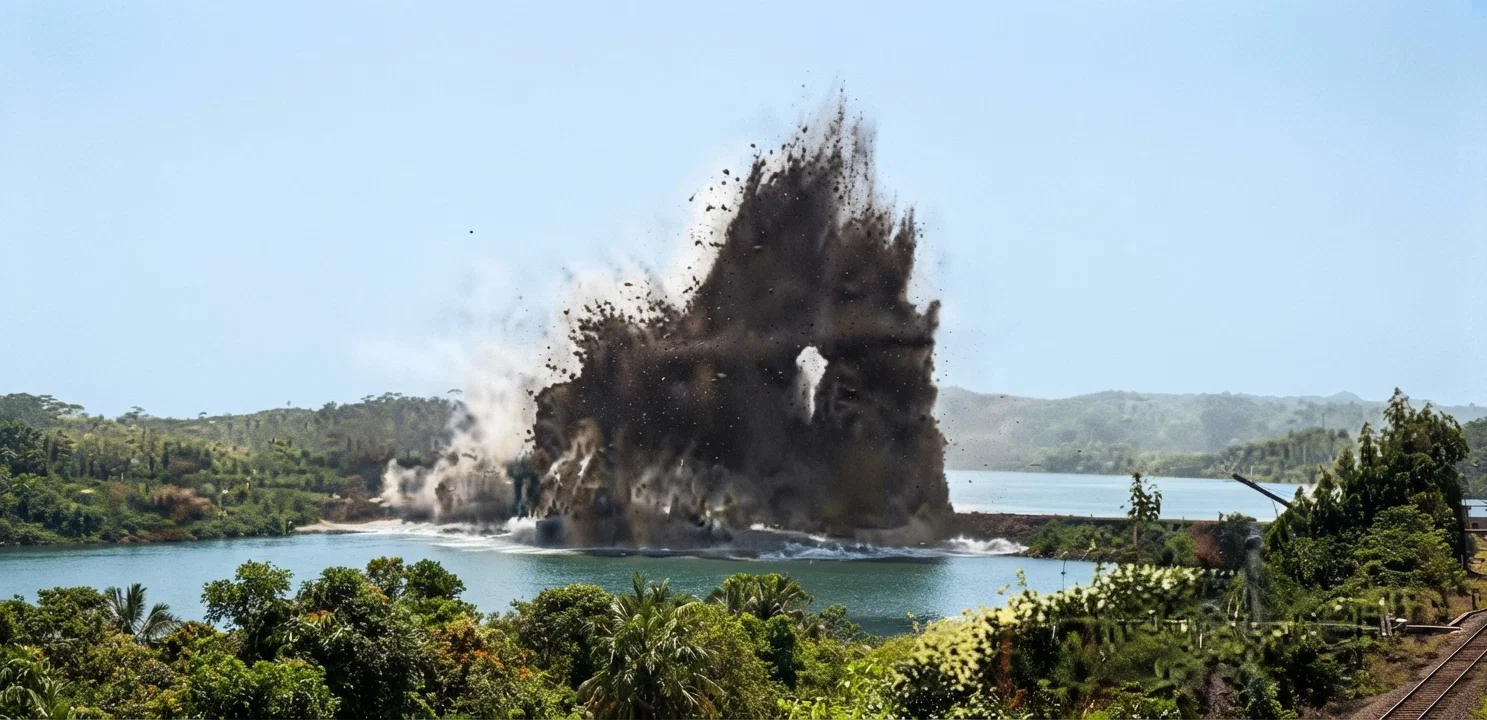
BLOWING UP OF GAMBOA DIKE. Copyright by Underwood & Underwood, N. Y.
World-Wide Industrial Revolution
By Prof. G. W. Rine
Its Causes and Effects — Entirely New Conditions Confront Us — Some of the Resultant Problems
By PROF. G. W. RINE
It was in 1769 that James Watt patented his steam-engine, which was destined to exert an incalculable influence in shaping the world's industrial future. Napoleon gave Europe political democracy; but Watt's invention ultimately gave the world an industrial aristocracy—a new economic civilization. The stupendous change in modes of travel and transportation which has been effected since the beginning of the nineteenth century, is vividly illustrated by the following incident related by Dr. Josiah Strong:
"The late William E. Dodge told me that his grandfather, a resident of New York City, once asked the prayers of his church as he was about to undertake 'the long and perilous journey to Rochester.' An English friend of mine, on his westward way around the world, was overtaken by a business cablegram at Seattle. 'I concluded,' said he, 'that I would just take a run back to London and talk the matter over with my partners.'
"Now this 'run back to London,' including three thousand miles across the mountains, canyons, rivers, and plains of a continent, plus three thousand more across the ocean, involved less of time, less of discomfort, and less of actual danger, than 'the long and perilous' journey from New York to Rochester. The one incident represented the beginning of the nineteenth century, the other that of the twentieth."
This revolutionary change in travel and transportation wrought during the past century aptly represents the prodigious revolution in industry and virtually every aspect of civilization, the bulk of which has taken place within the last half-century.690Down to the nineteenth century there was little or no contact between different peoples. They were separated, not only by almost insuperable distances, but by differences of language, of religion, of mental habit, of costume and custom, of government and social institutions; and isolation tended strongly to accentuate their divergences.
As expressed by a distinguished sociologist:
"Until the nineteenth century, the stream of tendency down all the ages was toward diversity. Then came a profound change, the results of which are, in their magnitude and importance, beyond all calculation. Steam annihilated nine tenths of distance, and electricity has canceled the remainder. Isolation is therefore becoming impossible, for the world is now a neighborhood. This means that differences of environment will, from this time on, become constantly less. The swift ships of commerce are mighty shuttles which are weaving the nations together into one great web of life."
True, there has been commerce since remote antiquity. But caravans and oar-propelled boats could afford to carry only the most costly goods—fine fabrics, rare spices, and gems. As these luxuries did not reach the multitude, they could not appreciably change environment. But the commerce of to-day disperses over all the world the products of every climate in progressively greater quantities. In earlier times, all peoples subsisted on local products, which were as unlike as were the climates producing them.
Similarly, nations were then restricted to the clothing that they were able to produce. To-day all the endless varieties of textile goods are exchanged by the most widely separated peoples. Commerce swelled to immeasurably greater magnitude than it had ever reached before, when, in the nineteenth century, it was so cheapened and extended by steam power that nations began to depend on one another in part for the necessaries of life.
Dr. Strong tells his readers that it would require a fleet of three hundred vessels such as the Greeks and the Phenicians propelled with oars, to carry the cargo of one modern steamer; and it would take from 375,000 to 500,000 camels to transport the wheat which during the busy season passes over any one of our great east and west railways in a single day. This colossal change in transportation facilities and in the volume of trade is not greater than the change which is effected by it in the conditions of national existence and in the creation of an essentially new world-wide social life.
Down to the past century, the work of the world had been done by vital or muscular power. This power was costly. But the supplanting of vital power by mechanical marked the beginning of a revolution in material civilization. The new power could be swiftly produced and cheaply maintained. In an incredibly short time, its application has wrought an utter transformation in agriculture, commerce, and industry. Although each of these three elements is fundamental in the civilization of to-day, the mechanical arts have been so sweepingly revolutionized and their products so prodigiously multiplied that the resultant civilization is aptly called "industrial," and this most profound change in the history of the economic world is known as the industrial revolution—a revolution so far-reaching that it has virtually re-created the western world.
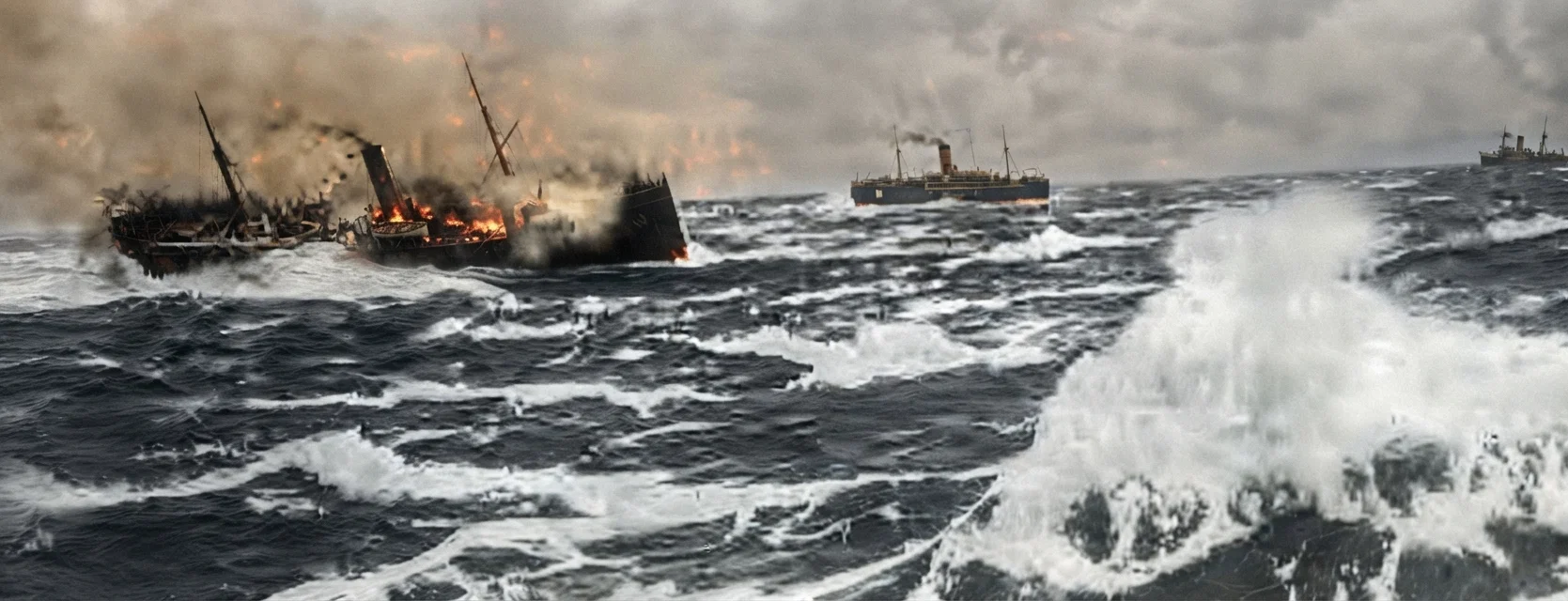
Photo by Paul Thompson. Photograph taken by a passenger on the Grosser Kurferst, of the burning steamship Volturno. When our fathers were young, there were no devices for calling half a score of vessels, within a few hours, to the aid of a ship in distress. The invention of the wireless telegraph was the crowning touch in bringing the whole world, whether on sea or on land, into one neighborhood.
Until mechanical power was substituted for muscular, the world's wealth consisted almost exclusively in land. And land was then nearly as unobtainable as it was immovable. Those who possessed it were the privileged class, not only in respect to wealth but also in respect to power and social prestige. The peasant never dreamed of ever being able to acquire wealth. As it was practically impossible to alienate land, the economic status of society was virtually crystallized. But with the advent of the industrial revolution, an ever-increasing proportion of wealth became portable. As long as the bulk of the world's wealth was practically static and inaccessible, commerce was necessarily confined to narrow limits, and capital for the development of natural resources was not available.
The cheap power, however, resulting from the application of steam, so stimulated invention that the productiveness of labor in the field of manufactures was almost indefinitely multiplied. This fact, in turn, resulted in a vastly augmented creation of movable wealth. As this kind of wealth multiplied, it passed more and more into the hand of such men as possessed exceptional aptitude for commerce. In a relatively short time this class of men succeeded in getting possession of a vastly disproportionate measure of the social wealth, and became gradually the ruling class. This change is commonly referred to by sociologists as the accession to power of the bourgeoisie, as the crowning of bold wealth—a step so momentous in its effects that it marked the downfall of the aristocracy of birth, and the evolution of the aristocracy of wealth.
So long as power remained muscular, every worker was independent in the possession of his own, and all industry was individualistic. But when it was mechanically produced and applied, it became necessarily and even automatically de-individualized and more and more centralized. And just as industry becomes de-individualized, civilization logically becomes de-individualized, and is thereby rendered essentially collective or social.
In the simple age of homespun and of muscular power, each family produced its own food and mostly its own clothing. Every village had its own gristmill, sawmill, stores, craft shops, etc., and was therefore in itself an economic unit. Each shopkeeper and artisan was a small monopolist. Communication between distant places was so difficult as to preclude competition between them. Professor McMaster says:
"Taking the country through, it may be said that to transport goods, wares, or merchandise cost ten dollars per ton per hundred miles. Articles that could not stand these rates were shut from market."
But as transportation facilities improved, the influence of competition began to be felt over vastly greater areas; and the coming of the railway marked the advent of a radically new economic era.
The area of competition was therefore determined by the facilities of transportation. Within this area the trader or manufacturer who commanded the greatest capital or the greatest natural advantages, or possessed the greatest business ability would in time crowd his competitor out of business, and command the trade of his former rivals. Thus this enlarged area of competition, made possible by better means of transportation,3tended irresistibly to centralize and localize the several industries.
When the United States, or any other country, became threaded with railways, the cost of transportation was so greatly reduced and the area of competition so greatly widened that capital was gradually driven out of unprofitable kinds of industry into profitable, and transferred from the less competent to the more competent management. In this way national industries soon became localized in distinct sections of the country.
Hence New England no longer finds it profitable to produce her own food supplies. This inability is owing to the inevitable outworking of economic law. For in the production of wheat, she can no longer compete with the states of the northern Mississippi Valley; and, conversely, the latter states can not compete with vastly better facilities of New England for manufacture. Being thus differentiated and localized, industry, in all its phases, has become organized on a national scale; and as a necessary result, the several sections of the United States have become mutually dependent — each section necessary to all the others. Diversity of climate, and of natural resources, enhanced facilities for communication and transportation, and free competition were the conditions necessary to effect such an outcome. Through the operation of the same inexorable laws, the economic unity of the world is in rapid process of being realized.
The enormously accelerated growth of the facilities essential to a world commerce is attested by the fact that in 1840 the total foreign commerce of the world represented less than three billion dollars; at present that of Germany alone exceeds that amount, and that of our own country is in excess of four billion dollars, while that of Great Britain is to-day greater than was the aggregate commerce of all nations in 1850. Not long ago Dr. Strong wrote:
"The international differentiation of industries, which must take place under economic laws, will be accomplished by the reorganization of national industries, as capital is withdrawn from unprofitable and reinvested in profitable enterprises; and both of these processes, international and national, are now taking place."
This de-individualizing, specializing, and centralizing of industries has the effect of enormously augmenting them. During the latter half of the nineteenth century, the population of the United States increased692three hundredfold, while manufacture increased eighteen hundredfold.
Prof. John B. Clark, of the department of economics at Columbia University, characterizes the old industrial system, which was made obsolete by machine power, as follows:
"The era was one of uneconomical methods of work, of divided and localized production, of large profits and small sales, of little general wealth, but of comparative equality and contentment among the middle class in the community."
This descriptive touch of the old system, by Professor Clark, leads Dr. Strong to say respecting the new:
"It is interesting to observe how precisely opposite at every point are the conditions under organized industry. We see a surprising economy in methods of work, centralized production supplying an ever-extending market, small margins of profit, and large sales, . . . an enormous increase of wealth, and a like increase of inequality between classes and of discontent among working men."
And this is the revolution which is on its way around the globe, transfiguring civilizations, and creating a new industrial world.
Throughout this revolutionary transition from the old industry to the new, "competition compelled concentration, and concentration stimulated competition, until its intensity found relief in practical monopoly." And the massing of capital, through successive stages, led up to the development of that institution so markedly distinctive of our day—the industrial trust.
We see, then, that the civilized world has entered upon a radically new era, the conditions of which have given rise to a number of unique social problems, all clamoring for solution. Among these problems are (1) the reconciliation of an industrial oligarchy with a political democracy; (2) the removing of the enormous disparity between the production and the distribution of wealth.
Will society find and apply a satisfactory solution of these and kindred problems? Or will it fail to solve them, and by such failure precipitate class wars?
These questions will be answered in subsequent articles of this series, by appeal to inspired prophecy and current history.
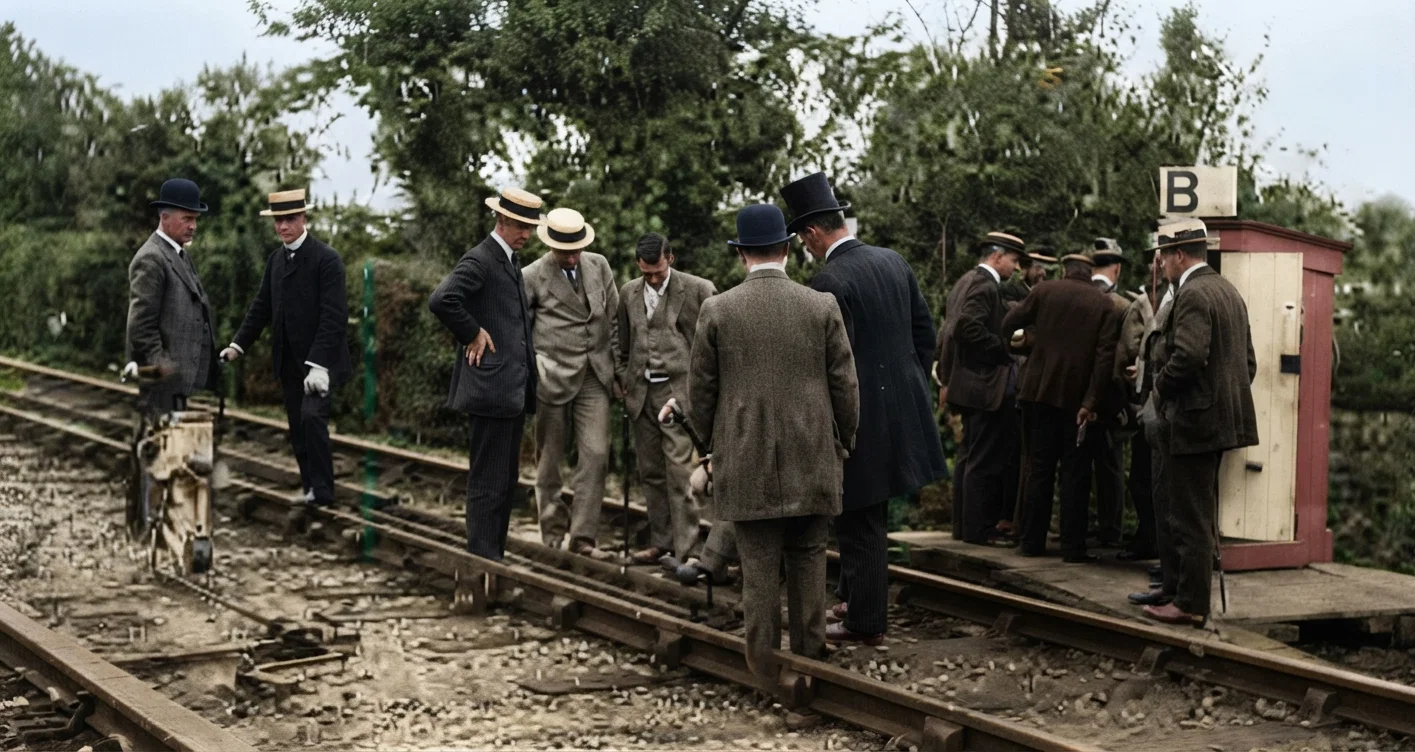
Photo by Paul Thompson. The Prentice system of operating trains by wireless. The "box" is being explained by means of which the engine picks up the wireless waves. Note the central rail by which the waves are transmitted. When the train passes into the "danger zone," it is not only warned, but brought to a standstill.