THEY PREACHED THE OLD TESTAMENT PROPHECIES—THE GENTILES GLADLY HEAR THEIR MESSAGE—OPPOSED BY ENVY AND JEALOUSY OF THE ESTABLISHED JEWISH CHURCH—COURAGEOUS EVEN WHEN STONED TILL APPARENTLY DEAD
By MRS. E. G. WHITE
"SENT forth by the Holy Ghost," Paul and Barnabas, after their ordination by the brethren in Antioch, "departed unto Seleucia; and from thence they sailed to Cyprus." Thus the apostles began their first missionary journey.
ENCOUNTERING HARDSHIP, PRIVATIONS, AND DANGERS
From Cyprus, where "they preached the word of God in the synagogues of the Jews," the apostles continued their journey, going to Perga in Pamphylia. Their way was toilsome; they encountered hardships and privations, and were beset with dangers on every side. In the towns and cities through which they passed, and along the lonely highways, they were surrounded by dangers seen and unseen. But Paul and Barnabas had learned to trust God’s power to deliver. Their hearts were filled with fervent love for perishing souls. As faithful shepherds in search of the lost sheep, they gave no thought to their own ease and convenience. Forgetful of self, they faltered not when weary, hungry, and cold. They had in view but one object,—the salvation of those who had wandered far from the fold.
Paul and Barnabas visited Antioch in Pisidia, and on the Sabbath day went into the Jewish synagogue, and sat down. "After the reading of the law and the prophets the rulers of the synagogue sent unto them, saying, Ye men and brethren, if ye have any word of exhortation for the people, say on." Being thus invited to speak, "Paul stood up, and beckoning with his hand said, Men of Israel, and ye that fear God, give audience." Then followed a wonderful discourse.
APPEAL TO OLD TESTAMENT PROPHECIES
The Spirit of God accompanied the words that were spoken, and hearts were touched. The apostle’s appeal to Old Testament prophecies, and his declaration that these had been fulfilled in the ministry of Jesus of Nazareth, carried conviction to many a soul longing for the advent of the promised Messiah. And the speaker’s words of assurance that the "glad tidings" of salvation were for Jew and Gentile alike, brought hope and joy to those who had not been numbered among the children of Abraham according to the flesh.
The interest aroused in Antioch of Pisidia by Paul’s discourse, brought together, on the next Sabbath day, "almost the whole city . . . to hear the word of God. But when the Jews saw the multitudes, they were filled with envy, and spake against those things which were spoken by Paul, contradicting and blaspheming. Then Paul and Barnabas waxed bold, and said, It was necessary that the word of God should first have been spoken to you: but seeing ye put it from you, and judge yourselves unworthy of everlasting life, lo, we turn to the Gentiles. For so hath the Lord commanded us, saying, I have set thee to be a light of the Gentiles, that thou shouldest be for salvation unto the ends of the earth."
"When the Gentiles heard this, they were glad, and glorified the word of the Lord: and as many as were ordained to eternal life believed." They rejoiced exceedingly that Christ recognized them as the children of God, and with grateful hearts they listened to the word preached. Those who believed were zealous in communicating the gospel message to others, and thus "the word of the Lord was published throughout all the region."
INSPIRATION HAD TRACED IT CENTURIES BEFORE
Centuries before, the pen of inspiration had traced this ingathering of the Gentiles; but those prophetic utterances had been but dimly understood. And the Saviour Himself, during His earthly ministry, foretold the spread of the gospel among the Gentiles. In the parable of the vineyard, He declared to the impenitent Jews, "The kingdom of God shall be taken from you, and given to a nation bringing forth the fruits thereof." And after His resurrection, He commissioned His disciples to go "into all the world," and "teach all nations." They were to leave none unwarned, but were to "preach the gospel to every creature."
In turning to the Gentiles in Antioch of Pisidia, Paul and Barnabas did not cease laboring for the Jews elsewhere, wherever there was a favorable opportunity to gain a hearing. Later, in Thessalonica, in Corinth, in Ephesus, and in other important centers, Paul and his companions in labor preached the gospel to both Jews and Gentiles. But their chief energies were henceforth directed toward the building up of the kingdom of God in heathen territory, among peoples who had but little or no knowledge of the true God and of His Son.
THE GENTILES HEAR THEIR MESSAGE GLADLY
The hearts of Paul and his associate workers were drawn out in behalf of those who were "without Christ, being aliens from the commonwealth of Israel, and strangers from the covenants of promise, having no hope, and without God in the world." Through the untiring ministrations of the apostles to the Gentiles, the "strangers and foreigners," who "sometimes were far off," learned that they had been "made nigh by the blood of Christ," and that through faith in His atoning sacrifice, they might become "fellow citizens with the saints, and of the household of God."
From Antioch in Pisidia, Paul and Barnabas went to Iconium. In this place, as at Antioch, they began their labors in the synagogue of their own people. They met with marked success; "a great multitude both of the Jews and also of the Greeks believed." But in Iconium, as in other places where the apostles labored, "the unbelieving Jews stirred up the Gentiles, and made their minds evil affected against the brethren."
RESOLUTELY FACE OPPOSITION, ENVY, AND PREJUDICE
The apostles, however, were not turned aside from their mission; for many were accepting the gospel of Christ. In the face of opposition, envy, and prejudice they went on with their work, "speaking boldly in the Lord"; and God "gave testimony unto the word of His grace, and granted signs and wonders to be done by their hands." These evidences of divine approval164had a powerful influence on those whose minds were open to conviction, and converts to the gospel multiplied.
"The multitude of the city was divided: and part held with the Jews, and part with the apostles." So enraged were the leaders among the Jews, that they determined to gain their ends by violence. Friends of the apostles, though unbelievers, warned them of the malicious designs of the Jews, and urged them not to expose themselves needlessly, but to escape for their lives. Paul and Barnabas accordingly departed in secret from Iconium, leaving the believers to carry on the work alone for a time. But they by no means took final leave; they purposed to return, after the excitement had abated, and complete the work begun.
Driven by persecution from Iconium, the apostles went to Lystra and Derbe, in Lycaonia. These towns were inhabited largely by a heathen, superstitious people, but among them were some who were willing to hear and accept the gospel message. In these places and in the surrounding country, the apostles decided to labor, hoping to avoid Jewish prejudice and persecution.
HEATHEN SEE GOD
The apostles endeavored to impart to these idolaters a knowledge of God the Creator, and of His Son, the Saviour of the human race. They first directed attention to the wonderful works of God,—the sun, the moon, and the stars, the beautiful order of the recurring seasons, the mighty snow-capped mountains, the lofty trees, and other varied wonders of nature, which showed a skill beyond human comprehension. Through these works of the Almighty, the apostles led the minds of the heathen to a contemplation of the great Ruler of the universe.
Having made plain these fundamental truths concerning the Creator, the apostles told the Lystrians of the Son of God, who came from heaven to our world because He loved the children of men. They spoke of His life and ministry, His rejection by those He came to save, His trial and crucifixion, His resurrection, and His ascension to heaven, there to act as man's advocate. Thus, in the Spirit and power of God, Paul and Barnabas preached the gospel in Lystra.
HEALING OF CRIPPLE
At one time, while Paul was telling the people of Christ's work as a healer of the sick and afflicted, he saw among his hearers a cripple, whose eyes were fastened on him, and who received and believed his words. Paul's heart went out in sympathy toward the afflicted man, in whom he discerned one who "had faith to be healed." In the presence of the idolatrous assembly, Paul commanded the cripple to stand upright on his feet. Heretofore the sufferer had been able to take a sitting posture only; but now he instantly obeyed Paul's command, and for the first time in his life stood on his feet.
Strength came with this effort of faith, and he who had been a cripple "leaped and walked."
SUPPOSED THEY HAD KILLED HIM
The labors of Paul and Barnabas at Lystra were suddenly checked by the malice of "certain Jews from Antioch and Iconium," who, upon learning of the success of the apostles' work among the Lycaonians, had determined to follow them and persecute them. On arriving at Lystra, these Jews soon succeeded in inspiring the people with the same bitterness of spirit that actuated their own minds. Yielding to the influence of evil, the Lystrians became possessed with a satanic fury, and seizing Paul, mercilessly stoned him. Covered with bruises, and faint with pain, he fell to the ground, and the infuriated mob "drew him out of the city, supposing he had been dead."
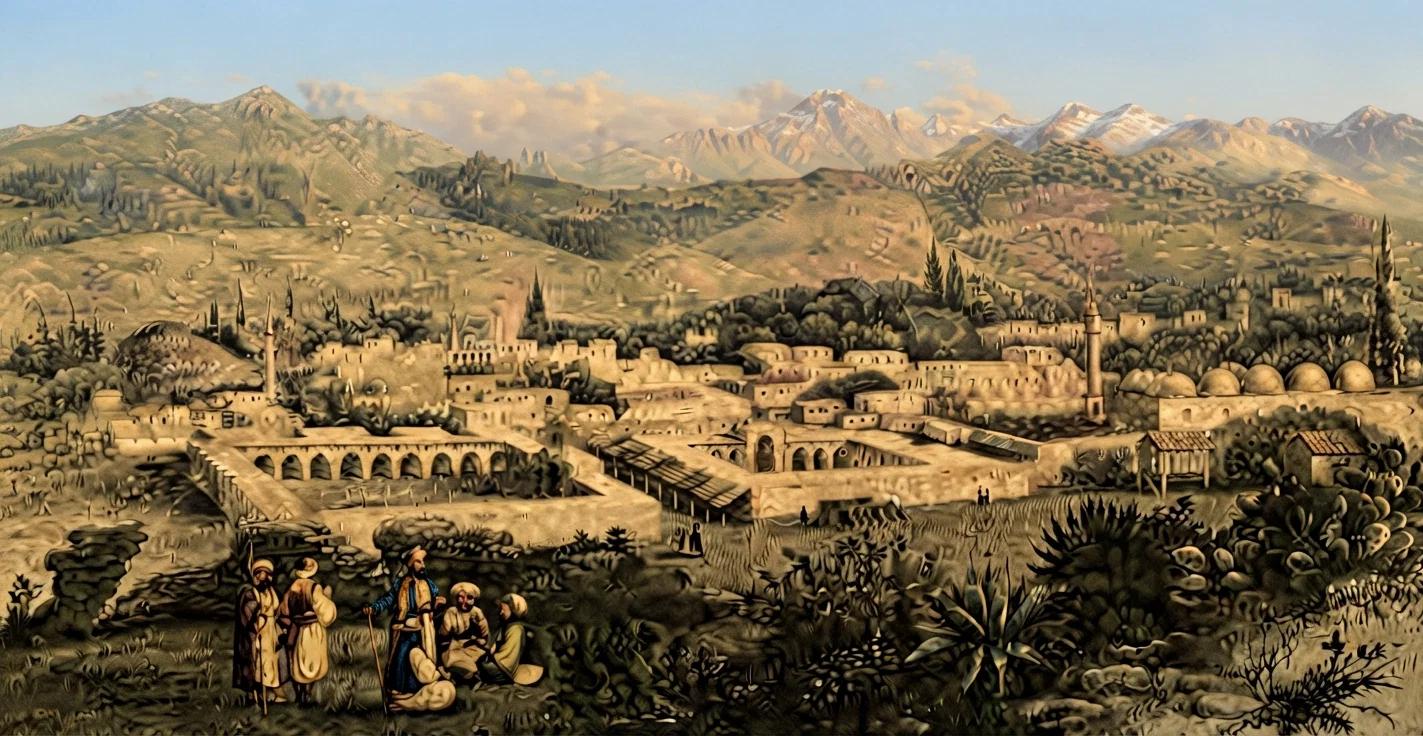
TARSUS, THE BIRTHPLACE OF PAUL
The observer is facing north; Mount Taurus is seen in the background.
In this dark and trying hour, the company of Lystrian believers, who through the ministry of Paul and Barnabas had been converted to the faith of Jesus, remained loyal and true. In the face of danger and scorn, they showed their loyalty by gathering sorrowfully about the form of him whom they believed to be dead.
REGARDED AS DIVINE MIRACLE
What was their surprise when, in the midst of their lamentations, the apostle suddenly lifted up his head, and rose to his feet, with the praise of God upon his lips. To the believers this unexpected restoration of God's servant was regarded as a miracle of divine power, and seemed to set the signet of Heaven upon their change of belief. They rejoiced with inexpressible gladness, and praised God with renewed faith.
Among those who had been converted at Lystra, and who were eye-witnesses of the sufferings of Paul, was one who was afterward to become a prominent worker for Christ, and who was to share with the apostle the trials and the joys of pioneer service in difficult fields. This was a young man named Timothy. When Paul was dragged out of the city, this youthful disciple was among the number who took their stand beside his apparently lifeless body, and who saw him arise, bruised and covered with blood, but with praises upon his lips because he had been permitted to suffer for the sake of Christ.
UNDAUNTED BY DANGER, THEY RETURNED
The day following the stoning of Paul, the apostles departed for Derbe, where their labors were blessed, and many souls were led to receive Christ as the Saviour. But "when they had preached the gospel to that city, and had taught many," neither Paul nor Barnabas was content to take up work elsewhere without confirming the faith of the converts whom they had been compelled to leave alone for a time in the places where they had recently labored. And so, undaunted by danger, "they returned again to Lystra, and to Iconium, and Antioch, confirming the souls of the disciples, and exhorting them to continue in the faith." Churches were duly organized, officers were appointed in each church, and proper order and system was established for the conduct of all the affairs pertaining to the spiritual welfare of the believers.
In all their missionary endeavors, Paul and Barnabas sought to follow Christ's example of willing sacrifice and faithful, earnest labor for souls. Wide-awake, zealous, untiring, they did not consult inclination or personal ease, but with prayerful anxiety and unceasing activity they sowed the seed of truth. And with the sowing of the seed, the apostles were careful to give to all who took their stand for the gospel, practical instruction that was of untold value. This spirit of earnestness and godly fear made upon the minds of the new disciples a lasting impression regarding the importance of the gospel message.
THEY TRAINED OTHERS TO THE WORK
When men of promise and ability were converted, as in the case of Timothy, Paul and Barnabas sought earnestly to show them the necessity of laboring in the vineyard. And when the apostles left for another place, the faith of these men did not fail, but rather increased. They had been faithfully instructed in the way of the Lord, and had been taught how to labor unselfishly, earnestly, perseveringly, for the salvation of their fellow men. This careful training of new converts was an important factor in the remarkable success that attended Paul and Barnabas as they preached the gospel in heathen lands.
The first missionary journey was fast drawing to a close. Commending the newly organized churches to the Lord, the apostles went to Pamphylia, "and when they had preached the word in Perga, they went down into Attalia, and thence sailed to Antioch."