THE British Medical Journal some time ago stated that a parliamentary debate on the bill for Sunday closing of saloons called forth from some of the members remarkable statements concerning tea, which they affirmed to be quite as injurious as beer. Sir James Ferguson, an old Scotch member, went so far as to say that he believed "far more deterioration was caused to the race by the excessive use of tea than by the excessive use of beer." He enlarged upon the evils resulting in Scotland from the substitution of tea and white bread for the old-time breakfast of porridge and milk. Another member referred to tea as a cause of insanity, and Sir William Tomlinson also asserted that tea was doing more harm to the health of the nation than beer.
TEA-DRUNKENNESS AND HEADACHES, ETC.
Dr. James Wood, visiting physician of the Brooklyn Dispensary, New York, several years ago published in the Quarterly Journal of Inebriety an article on the baneful effects of tea-drinking, a subject which he has carefully studied for years. Dr. Wood states that out of one thousand persons who applied for treatment at the Brooklyn Central Dispensary, one hundred gave symptoms pointing directly to tea-drunkenness, while many others were suffering more or less from the same causes.
According to Dr. Wood, tea-drinking is responsible for half the headaches and a large portion of all cases of despondency, anemia, insomnia, and insanity. He says: "Some people are profoundly intoxicated by indulging in two cups of strong tea per day. . . . An ounce of tea-leaves used daily will soon produce poisonous symptoms." Of the one hundred cases mentioned by Dr. Wood, sixty-nine were women and thirty-one were men. Fifty-four drank two pints or less; thirty-seven, four pints or less; and nine, ten pints or less."
NERVOUSLY DISABLED
Dr. Morton, of Brooklyn, told of a disease known as "tea-drinker's disorder." His attention was called to this disease by a tea-taster whose nervous system disabled him for business. The patient confessed that he was afraid of people and of places, was haunted by hallucinations continually, and had no appetite. He gave up his business as a tea-taster, and recovered.
The case of a coffee-taster came under my observation some years ago. He had developed hallucinations and convulsions of an epileptiform character, all of which disappeared after he gave up his work as coffee-taster.
Dr. Bock, of Leipsic, investigated the diseases of the higher classes of German society, and attributed their irritability to the free use of coffee.
The habitual daily indulgence in coffee, even in moderate quantity, leads in time to functional disorders of the nervous system, and ultimately to destructive organic changes of brain and nerve cells.
The after-symptoms of coffee-drinking are characterized by depression of spirits and aversion for labor, with headaches frequently of a periodic nature, and insomnia.
COCOA AND INDIGESTION
Dr. James Fraser, of Scotland, made a series of experiments for the purpose of determining the influence of tea, coffee, and cocoa upon stomach digestion. He found that cocoa, instead of being the least harmful, is the most productive of indigestion of all the common beverages.
DANGERS IN TEA, COFFEE, and COCOA. THEY ARE AS HARMFUL AS SOME ALCOHOLIC BEVERAGES—A PROLIFIC SOURCE OF INSOMNIA, HEADACHE, AND EVEN IMBECILITY. By Daniel H. Kress, M. D.
The principal alkaloid contained in cocoa is theobromin. This is similar in its action to thein and caffein. In addition to theobromin, cocoa contains an astringent similar to the tannin in tea, and also from six to eight per cent of undefined products resulting from the fermentative action to which the cocoa has been subjected. The exact composition of these, or their effect upon the system, is not yet known.
TWO GREAT METHODISTS ON TEA AND COFFEE
John Wesley and Dr. Adam Clarke both labored faithfully to discourage the use of tea. In the "Autobiography of Dr. Adam Clarke" it is stated that "in the year 1782, Dr. A. Clarke read Mr. John Wesley's 'Letter on Tea.' When he had finished it, he said, 'There are arguments here which I can not answer; and till I can answer them to my own satisfaction, I will drink neither tea nor coffee.' He broke off the habit from that hour, and never afterward sought for arguments to overturn those of Mr. Wesley, and from that day to the present never once tasted tea or coffee."
It is not necessary to make a decoction of tea-leaves and use it as a beverage, in order to obtain the exhilaration. The same results may be obtained by smoking tea-leaves. Tea cigarettes are even now used in England, and the habit is said to be spreading.
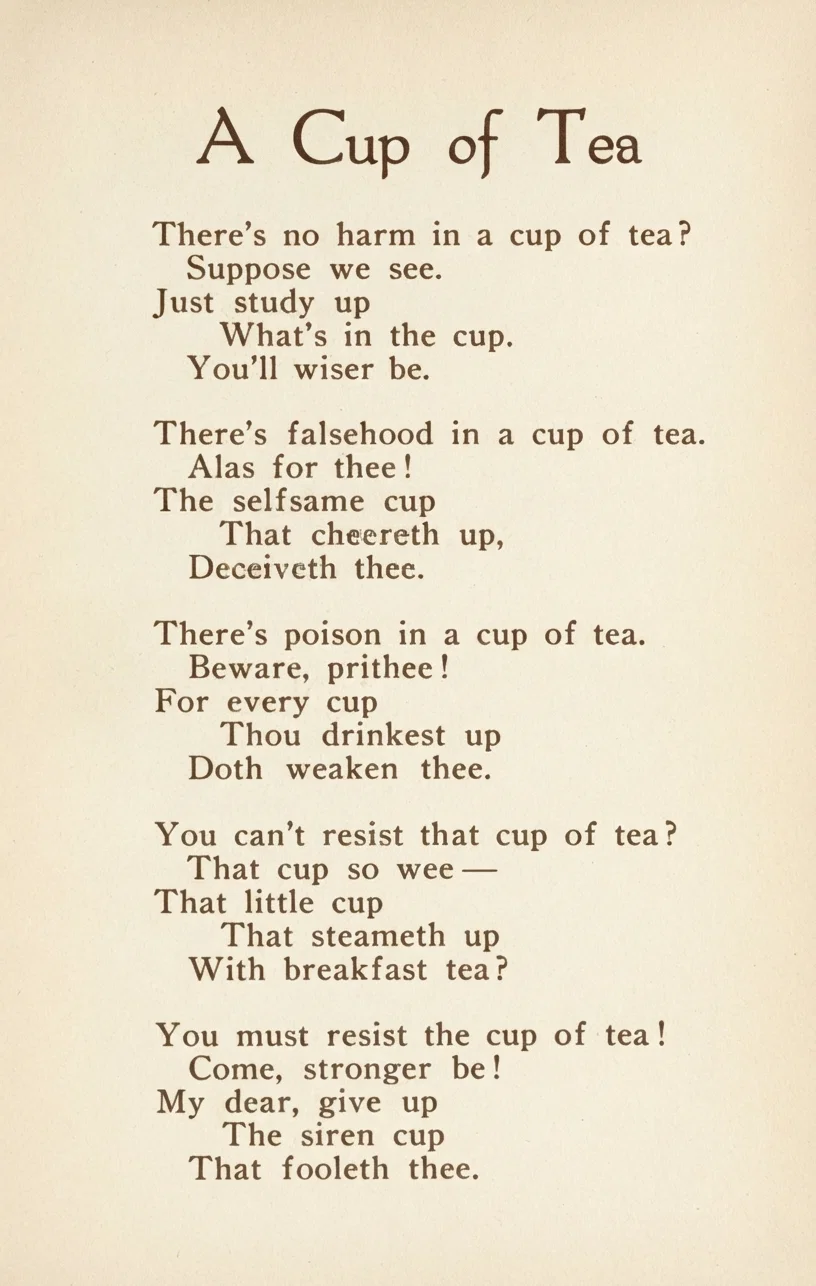
A Cup of Tea
There's no harm in a cup of tea?
Suppose we see.
Just study up
What's in the cup.
You'll wiser be.
There's falsehood in a cup of tea.
Alas for thee!
The selfsame cup
That cheereth up,
Deceiveth thee.
There's poison in a cup of tea.
Beware, prithee!
For every cup
Thou drinkest up
Doth weaken thee.
You can't resist that cup of tea?
That cup so wee —
That little cup
That steameth up
With breakfast tea?
You must resist the cup of tea!
Come, stronger be!
My dear, give up
The siren cup
That fooleth thee.
— Mary Henry Rossiter.
COFFEE STRONGER THAN WINE
Prof. Brillat Savarin, of Paris, in his work "Physiology of the Senses of Taste," published a few years ago, and translated into German, says: "Coffee is a much stronger drink than people usually believe. A strong man can live long, and drink two bottles of wine a day. The same man could not stand the same quantity of coffee for a great while. He would become imbecile or die of consumption."
Professor Virchow says: "We have at last arrived at the truth that caffein, the quintessence of coffee, is nothing more nor less than a strong stimulant, and when taken in large quantities, a poison like brandy."
The one who takes into his system any kind of stimulant, be it tea, coffee, tobacco, opium, arsenic, or alcohol, is intoxicated just in proportion to the dose taken, and all his actions will be more or less unnatural.
Frequently nervous patients who have been advised by me to give up the use of tea or coffee have said: "O, I can easily do that! I take it very weak, you know." But no matter how weak the tea or coffee may previously have been taken, there was experienced a severe headache and other nervous symptoms. The best evidence that these beverages, even in small doses, are harmful, is the fact that such disagreeable symptoms are produced in the attempt to abandon their use.
SUGGESTIONS IN GIVING THEM UP
In giving up the use of these beverages, take a period of rest for two or three days. Hot milk should be drunk for a few days. Well-beaten, fresh, raw eggs may be stirred into fruit juice or milk and used. By the end of the second day, the headache has probably ceased. Periodic headaches usually disappear, never to return; and chronic constipation of years' standing is sometimes entirely relieved by merely discontinuing the use of these beverages.