This school is located fifteen miles to the north of the city of Pyeny Yang, in the northern part of Korea. An ordinary map shows the position of this city, and from it one may gain an idea of where Soonan is located.
The name of our school is Ui Myung Hak Kio. This is the name chosen for it by the Koreans, and by which it is known everywhere. The first word, when literally translated, is what is right. The second word means bright, brilliant. Hak Kio means school. So by the profession of our name, this school is to uphold the "brightness of the truth."
We sincerely hope that it will be true to its name, and by the students it sends out, may cause the brightness of the gospel and this closing message to shine in all dark Korea.
BOYS AND GIRLS TAUGHT SEPARATELY
In these Eastern countries, schools for boys and those for girls are kept quite distinct from each other. The sexes are not permitted to mix as with us Westerners. But as the cost and the work involved in conducting two separate schools is so great, we have boy and girl students together here.
At present they are not in the same classes, but the two schools are carried on in the same building. This makes it possible for one corps of teachers to do the work in both schools. In the west end of the schoolhouse is the boys' school, and in the east end the girls'. There is a chapel between, separating the two schools.
Although the school has been in operation some four or five years, not until last fall have we had suitable quarters in which to work. Through the generosity of our American Sabbath-schools, we obtained the means to erect our present brick schoolhouse, which is situated on high ground and can be seen from afar.
THE TEACHING FORCE AND GRADES OF WORK
We have ten teachers to carry on the work of the school. Miss Scott and I are the foreign teachers; and while we do much teaching, our principal work is to oversee the teaching and administer the funds of the school. We have much also that needs to be done in the way of preparing suitable text-books in Bible, history, and nature study.
One of our teachers is a Japanese. His time is spent in teaching his language to the Koreans. Now that Korea is a Japanese province, much stress is put upon the mastery of the national language. One period a day is given to it. Our other teachers are all Koreans.
We have two grades of work,—the primary course of four years, and the higher common school, which corresponds in many ways to our high school work in America. This course is also four years. Above this grade we will have a teachers' training course and a ministerial course.
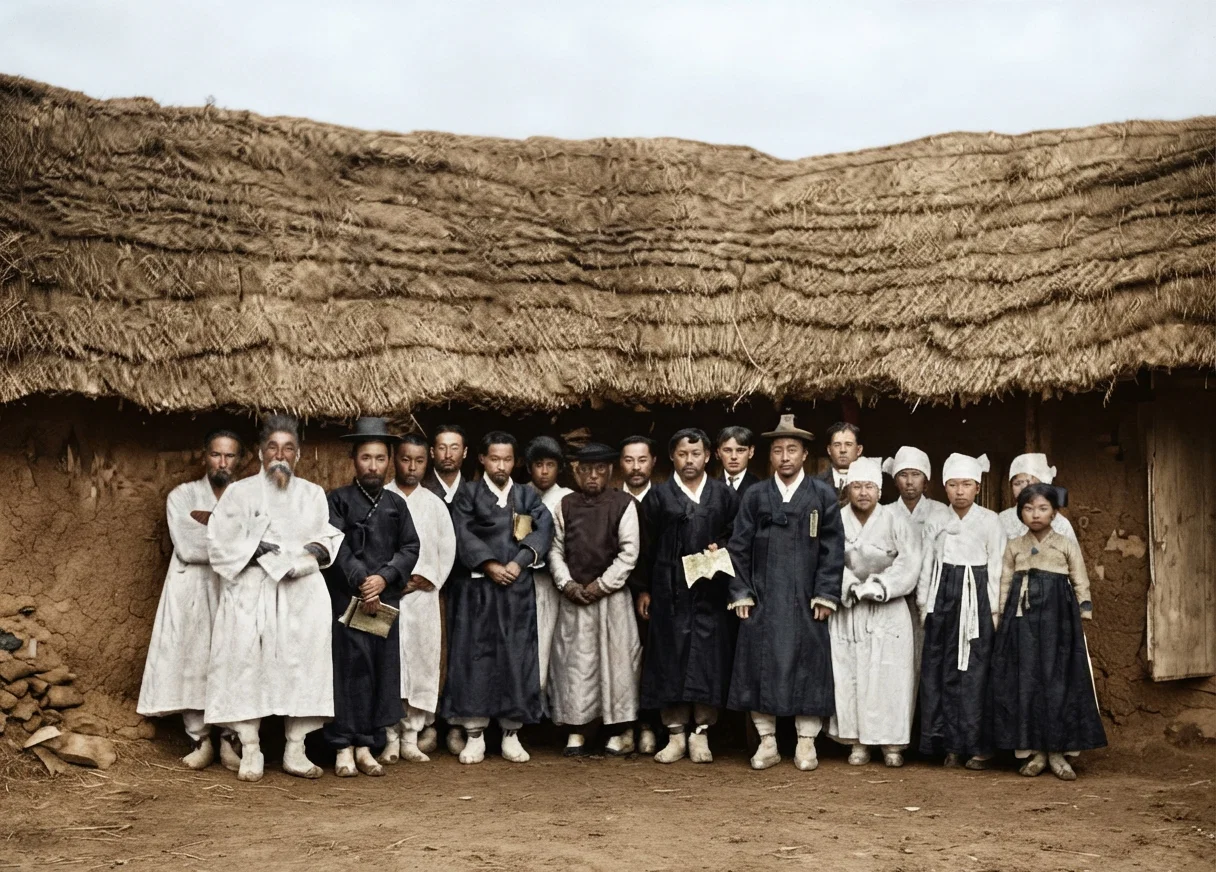
GROUP OF BELIEVERS AT REAR OF OUR CHURCH BUILDING, CHINNAMPO, KOREA
The subjects of study are Bible, Japanese, arithmetic, algebra, geometry, Chinese literature, botany, zoology, physics, chemistry, general history, agriculture, sericulture, geography, drawing, singing, physical culture. This is a pretty full program, you will say; and so it is. Korean young people who have a mind to study, seem to be able to do this amount of work in the eight years given to it.
In March, 1913, we graduated our first class, consisting of five boys and one girl. Four of these are now teaching in our church schools. This spring a good-sized class will finish their work here, and we hope they will become efficient workers in the harvest-field.
THE FARM AND ITS PURPOSE
As very few of our students are able to provide the means to meet their school expenses, we have a farm of some thirty-five acres. This furnishes not only a means of their earning the money they need, but also a most practical line of work for them to learn. We wish to teach them to use their hands and minds in useful labor. The faithful performance of daily duties, and of work necessary to obtain daily food, will help to build character more rapidly than will the study of books.
Our present attendance is seventy-two; but now that we have a more commodious place in which to work, we shall expect to get more students.