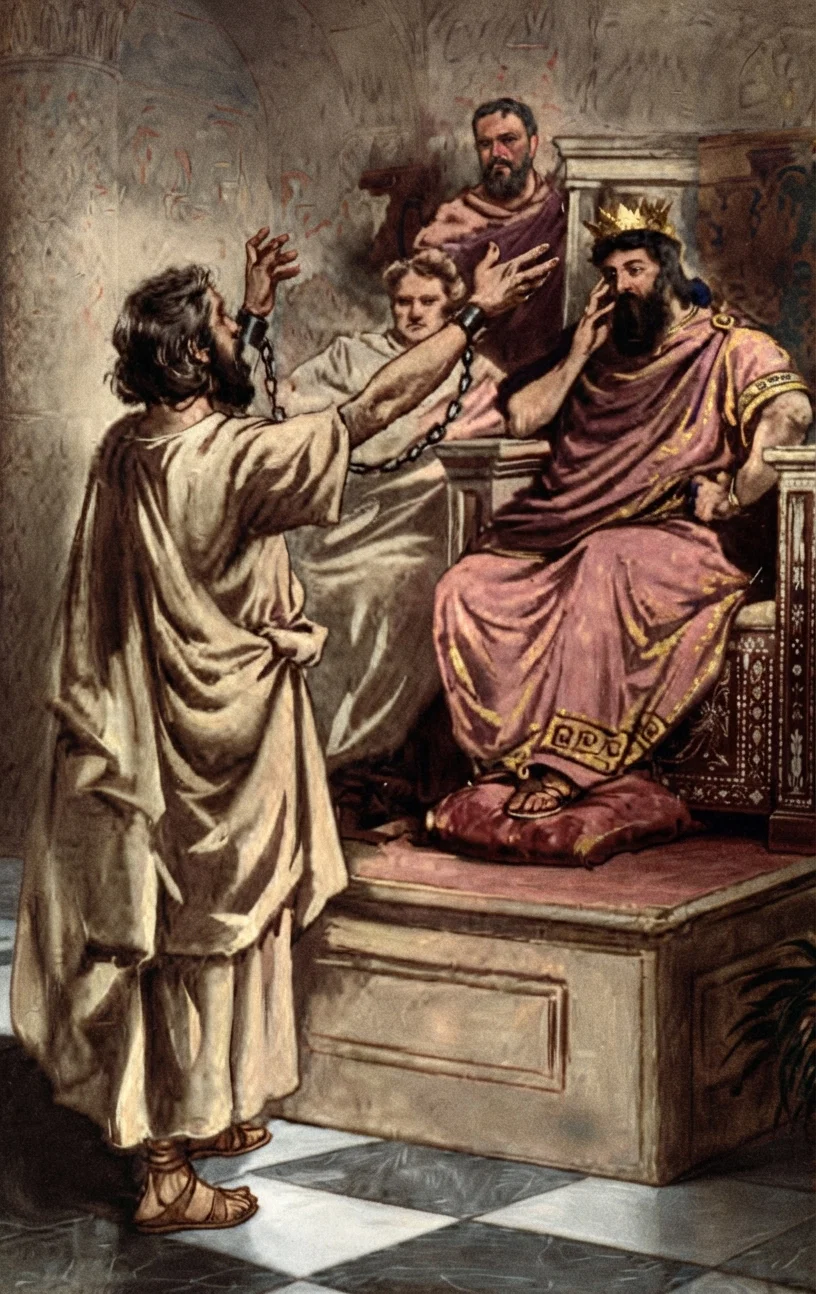
THE HEROIC PRISONER

3%

Pacific Press Publishing Association · Mountain View, California · Apr 28, 1914

FromSigns of the Times, Vol. 41, No. 16.

Read the full edition

THE HEROIC PRISONER

Falsely Imprisoned, Paul Does His Greatest Work While in Bonds

By MRS. E. G. WHITE
DURING Paul's last journey to Jerusalem, he met with many evidences that his active ministry was about to close. "I go bound in the spirit unto Jerusalem," he wrote, "not knowing the things that shall befall me there: save that the Holy Ghost witnesseth in every city, saying that bonds and afflictions abide me."
A long and wearisome imprisonment did indeed await the tried messenger of God; but notwithstanding the fears and entreaties of his friends, he pressed forward on his journey. "None of these things move me," he declared, "neither count I my life dear unto myself, so that I might finish my course with joy, and the ministry, which I have received of the Lord Jesus, to testify the gospel of the grace of God."

AFFLICTION COULD NOT TURN HIM

The apostle allowed not the fear of affliction and imprisonment to turn him from his purpose. But never before had he approached Jerusalem with so sad a heart. He knew that he would find few friends and many enemies. He was nearing the city which had rejected and slain the Son of God, and over which now hung the threatenings of divine wrath.
Remembering how bitter had been his own prejudice against the followers of Christ, he felt the deepest pity for his deluded countrymen. And yet how little could he hope that he would be able to help them! The same blind wrath which had once burned in his own heart, was now with untold power kindling the hearts of a whole nation against him.

HIS ENEMIES SET ON EACH OTHER

The plottings of those who were seeking to hinder the spread of the gospel by silencing the voice of the apostle to the Gentiles, soon resulted in Paul's arrest. During his trial the following day, before the Sanhedrin council, "there arose a dissension between the Pharisees and the Sadducees: and the multitude was divided." In the confusion that followed, the Sadducees were eagerly striving to gain possession of the apostle, that they might put him to death; and the Pharisees were as eager to protect him. "The chief captain, fearing lest Paul should have been pulled in pieces of them, commanded the soldiers to go down, and to take him by force from among them, and to bring him into the castle."

COULD HE HAVE BEEN MISTAKEN?

Later, while reflecting on the trying experiences of the day, Paul began to fear that his course might not have been pleasing to God. Could it be that he had made a mistake after all in visiting Jerusalem? Had his great desire to be in union with his brethren led to this disastrous result? He knew that his enemies, in their desperate malice, would resort to any means to put him to death. Could it be that his work for the churches was ended, and that ravening wolves were to enter in now? The cause of Christ was very near to Paul's heart, and with deep anxiety he thought of the perils of the scattered churches, exposed as they were to the persecutions of just such men as he had encountered in the Sanhedrin council. In distress and discouragement he wept and prayed.

THE LORD STOOD BY HIM

In this dark hour the Lord was not unmindful of His servant. He had guarded him from the murderous throng in the temple courts; He had been with him before the Sanhedrin council; He was with him in the fortress; and He revealed Himself to His faithful witness in response to the earnest prayers of the apostle for guidance. "The night following the Lord stood by him, and said, Be of good cheer, Paul: for as thou hast testified of Me in Jerusalem, so must thou hear witness also at Rome."
Paul had long looked forward to visiting Rome. He greatly desired to witness for Christ there, but had felt that his purposes were frustrated by the enmity of the Jews. He little thought, even now, that it would be as a prisoner that he would go.

HE APPEALED TO CAESAR

Paul was transferred from the Roman fortress in Jerusalem to Cæsarea, the residence of the governor of the province, where for two years he remained a prisoner, appearing for trial before Lysias, Felix, Festus, and Agrippa. Rather than fall into the hands of the Jewish Sanhedrin, to which tribunal Festus proposed to refer his case, the apostle, weary of strife and of the suspense of imprisonment, decided to exercise his privilege, as a Roman citizen, of appealing to Cæsar. Festus knew nothing of the conspiracies of the Jews to murder Paul, and he was surprised at this appeal to Cæsar. However, the words of the apostle, "I appeal unto Cæsar," put a stop to the proceedings of the court. Festus could not do otherwise than send him to Rome.

A PRISONER IN HIS OWN HOUSE

It was with a heavy heart that Paul went forward to his long-expected visit to the world's metropolis. How different the circumstances from those he had anticipated! How was he, fettered and stigmatized, to proclaim the gospel? His hopes of winning many souls to the truth in Rome, seemed destined to disappointment.
At Rome Paul, instead of being thrown into prison, was permitted to live in his own hired house. Although still chained to a soldier, he was at liberty to receive his friends, and to labor for the advancement of the cause of Christ. Thus for two years he continued his labors, "preaching the kingdom of God, and teaching those things which concern the Lord Jesus Christ, with all confidence, no man forbidding him."
During this time, the churches that he had established in many lands were not forgotten. Realizing the dangers that threatened the converts to the new faith, the apostle sought so far as possible to meet their needs by letters of warning and practical instruction. And from Rome he sent out consecrated workers to labor not only for these churches, but in fields that he himself had not visited. These workers, as wise shepherds, strengthened the work so well begun by Paul, and the apostle, kept informed of the condition and dangers of the churches by constant communication with them, was enabled to exercise a wise supervision over all.

WIELDING A WIDER INFLUENCE

Thus, while apparently cut off from active labor, Paul exerted a wider and more lasting influence than if he had been free to travel among the churches as in former years. As a prisoner of the Lord, he had a firmer hold upon the affections of his brethren; and his words, written by one under bonds for the sake of Christ, commanded greater attention and respect than they did when he was personally with them. Not until Paul was removed from them, did the believers realize how heavy were the burdens he had borne in their behalf.
Before the close of that two years' imprisonment, Paul was able to say, "My bonds in Christ are manifest in all the palace, and in all other places"; and among those who sent greetings to the Philippians he mentions chiefly them "that are of Cæsar's household."

AN ABIDING POWER

And by what means was an entrance achieved and a firm footing gained for Christianity where even its admission seemed impossible? Paul ascribed to his own imprisonment his success in winning converts to the faith from Nero's household. Paul's patience and cheerfulness during his long and unjust imprisonment, his courage and faith, were a continual sermon. His spirit, so unlike the spirit of the world, bore witness that a power higher than that of earth was abiding with him.
The zeal and fidelity of Paul and his fellow workers, no less than the faith and obedience of their converts to Christianity, under circumstances so forbidding, rebuke slothfulness and lack of faith in the minister of Christ. The apostle and his associate workers might have argued that it would be vain to call to repentance and faith in Christ the servants of Nero, subjected, as they were, to fierce temptations, surrounded by formidable hindrances, and exposed to bitter opposition.
Even should they be convinced of the truth, how could they render obedience? But Paul did not reason thus. In faith he presented the gospel to these souls, and among those who heard were some who decided to obey at any cost. Notwithstanding obstacles and dangers, they would accept the light, and trust God to help them let their light shine forth to others.

REMAINED FIRMLY AT THEIR POST

Not only were converts won to the truth in Cæsar's household, but after their conversion they remained in that household. They did not feel at liberty to abandon their post of duty because their surroundings were no longer congenial. The truth had found them there, and there they remained, by their changed life testifying to the transforming power of the new faith.
PAUL BEFORE AGRIPPA
PAUL BEFORE AGRIPPA
Are any tempted to make their circumstances an excuse for failing to witness for Christ? Let them consider the situation of the disciples in Cæsar's household — the depravity of the emperor, the prodigacy of the court. We can hardly imagine circumstances more unfavorable to a religious life, and entailing greater sacrifice or opposition, than those in which these converts found themselves. Yet amidst difficulties and dangers, they maintained their fidelity.
Not in freedom from trial, but in the midst of it, is Christian character developed. Exposure to rebuffs and opposition leads the follower of Christ to greater watchfulness, and more earnest prayer to the mighty Helper. Severe trial endured by the grace of God develops patience, vigilance, fortification, tude, and a deep and abiding trust in God. It is the triumph of the Christian faith that it enables its follower to suffer and be strong; to submit and thus to conquer; to be killed all the day long, and yet to live; to bear the cross, and thus to win the crown of glory.