Reconnoitering for Advance Work — Old Babylon and the Prophetic Word — Theological Doctor and His Skepticism
By W. C. ISING
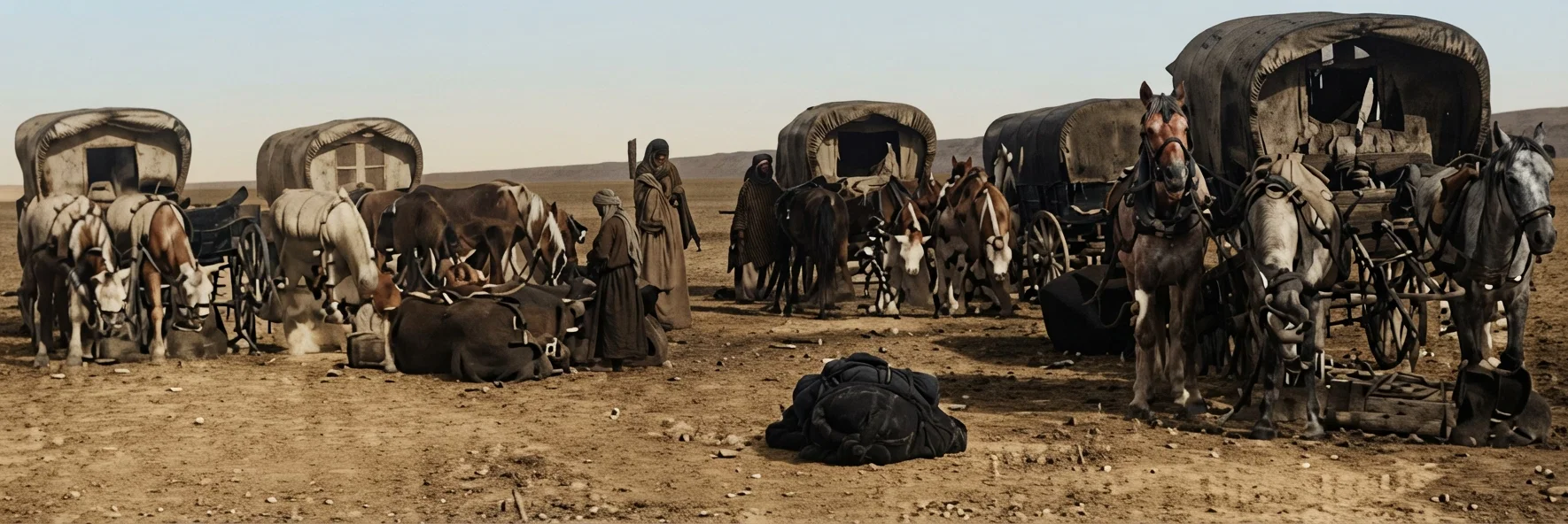
THE CARAVAN IN WHICH I TRAVELED FROM MOSUL TO ALEPPO
IT was the privilege of the writer to make a missionary itinerary from Beirut, Syria, through Mesopotamia, touching especially the cities of Bagdad and Mosul. The purpose of this trip was to inquire into the conditions of those regions, with a view to opening up missionary work and extending the gospel message of the soon coming of Christ. This work had already been started there by a faithful brother who, having graduated some years ago as a master of pharmacy, proceeded to Mosul, the site of the ancient city of Nineveh, and also to Bagdad, to engage in work as a pharmacist.
AN INTEREST AROUSED
This brother, being a firm believer in the great message of the soon coming of Christ and the truths connected with it, has been seeking to do faithful missionary work. As a result, there has sprung up among some of the people an interest to hear more of the doctrines he has been teaching.
At Port Said I took a freight steamer that was going directly to Basorah, in the Persian Gulf. Basorah, a city of some five thousand inhabitants, with only a few Christians, is the capital of a vilayet. It is the port of transshipment from river craft and caravan to ocean steamers, or vice versa, and has a large trade, especially in dates, of which there are annually shipped somewhere about eighty thousand tons to all parts of the world. A Turkish and English company runs two steamers a week between Basorah and Bagdad. The trip up-stream takes five days; and during the summer months, when the river is very shallow, it is not at all unusual to be delayed on a sand-bank. The banks of the Tigris are low, and now and then a village of mud huts may be seen.
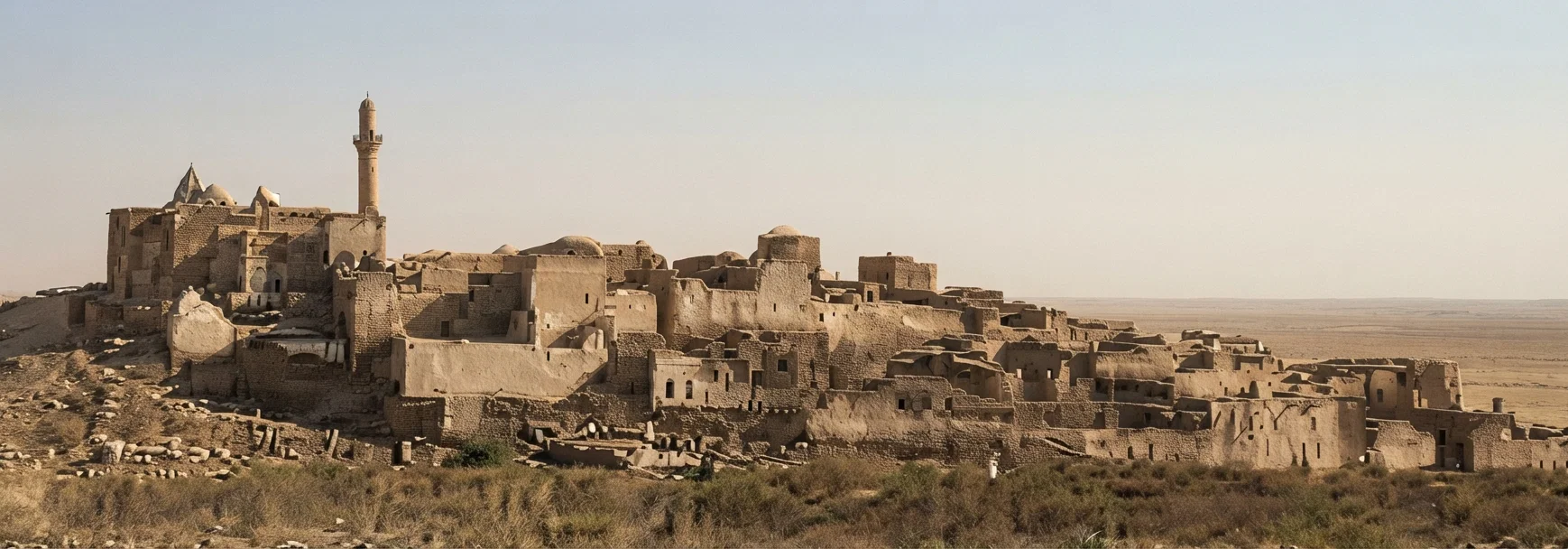
NEBI YUNUS, OPPOSITE MOSUL, ANCIENT NINEVEH. THE MINARET MARKS THE SUPPOSED BURIAL PLACE OF THE PROPHET JONAH.
GERMAN ENTERPRISES IN OLD MESOPOTAMIA
I was glad to be met by our brother at Bagdad, and to find the medical work in which he was engaged in a prosperous condition. The Protestant community here is very small. The European community, however, is increasing of late, because of a number of new enterprises launched by the Germans. Among these enterprises is the building of the railway, which is now completed as far north as Samara, a distance of some eighty miles.
At the Hindia Barrage is a very interesting family of our people. One of the sons is preparing to attend soon our college at Watford, England.
RUINS OF BABYLON CONFIRMING THE WORD
At Babylon I had one of the most interesting experiences of my trip. Professor Koldewey, at the head of the German expedition, gave me a cordial invitation to visit the excavations they are conducting in the ruins of old Babylon. Between three hundred and four hundred men are employed here throughout the year. Aside from the scientific value of these researches, it is with much gratitude and profound interest that the student here finds many of the Bible narratives corroborated by the facts brought to light after many centuries.
One is struck with amazement as he finds himself confronted with the tremendous works done by King Nebuchadnezzar. Nearly all these monumental ruins refer to him as their builder. His name, which is found on every brick, has certainly made it the most prominently fixed in Babylonian history. Well might he, on viewing his achievements, in his selfish heart say, in the language which the Scripture puts in his mouth, "Is not this great Babylon, that I have built for the house of the kingdom by the might of my power, and for the honor of my majesty?" Dan. 4: 30.
ARABIAN WILL NOT PITCH TENT THERE
One is also reminded, while here, of the prophecies in Isaiah and Jeremiah concerning this place. No soul is living on the site of ancient Babylon; and whatever Arabs — chiefly helpers for the excavators — do live in that vicinity, have built their mud huts in the bed of the ancient river, which at the present time is shifted half a mile farther west.
God's word says: "Babylon, the glory of kingdoms, the beauty of the Chaldeans' pride, shall be as when God overthrew Sodom and Gomorrah. It shall never be inhabited, neither shall it be dwelt in from generation to generation: neither shall the Arabian pitch tent there; neither shall shepherds make their flocks to lie down there. But wild beasts of the desert shall lie there; and their houses shall be full of doleful creatures; and ostriches shall dwell there, and wild goats shall dance there. And wolves shall cry in their castles, and jackals in the pleasant palaces: and her time is near to come, and her days shall not be prolonged." Isa. 13: 19-22. This prophecy is most strikingly and most literally fulfilled in the ruins of old Babylon, even to the minute detail that the "Arabian" would not "pitch tent there."
IT FOLLOWED HIM MORE THAN THIRTY YEARS
At Mosul I met an old man, a weaver, who is the son of a Jacobite priest. Something over thirty years ago, this man came across an article concerning Seventh-day Adventists which appeared in an Arabic magazine published in Beirut, Syria. This was his first acquaintance with the Sabbath question. Six years ago he made a journey to Aleppo, and when going to church on Sunday, his attention was called to the place of worship of the Sabbath-keepers. Four years later he was again in Aleppo. This time he engaged in conversation a boy who was shining his boots. The boy told him he was a "Sabti," that is, a Sabbath-keeper. From this boy he secured a few Arabic tracts, such as "Which Day Do You Keep, and Why?" "Sunday Not the Sabbath," and a few others in the same line. He took these back to Mosul, where he and others studied them carefully. He told me that he had taken ink and paper four or five times to refute the arguments of the tracts; but when he compared his writings with the tracts, he was convinced, every time, that he had better give it up, for his arguments could not stand the test of the Scriptures.253
Land of Abraham's Boyhood
(Continued from page 12)
CATHOLIC ACTIVITIES
In Mosul the Catholic Dominicans are putting forth strong efforts, through their schools and otherwise, to win the non-Catholic Christians over to their church. During the last century, they have had remarkable success among the Jacobites, and especially among the Nestorians. It is said that some one hundred thousand Nestorians and Jacobites have been converted to Catholicism.
In the mountains a few days' journey from Mosul, the English High Church, in connection with the Presbyterians, who are laboring in Urumiah and that district, are endeavoring to stem the Catholic propaganda. They have several schools in operation, and their work seems to be favored by the community.
THE TOMB OF JONAH
On the other side of the river may be seen the little village Nebi Yunus, under the mosque of which is said to be located the grave of the prophet Jonah.
I remained in Mosul for some two months, and found many people there who were deeply interested in our work.
I proceeded by wagons to Aleppo, in northern Syria, a distance of four hundred miles. On the day of my departure, the first automobile entered Mosul from Bagdad, and it was certainly a great sight for the people. It only used eighteen hours, against the nine days of my journey.
THE SKEPTICAL THEOLOGIAN
On my return to Beirut, a student from one of the theological schools visited me, stating that he was greatly troubled over the positions their theological professor was taking concerning the Bible. The text, "And greater works than these shall he do" (John 14: 12), was interpreted by the doctor as meaning that the Christian church has a right to add to the Scriptures just as modern research and development of science may prove necessary, thus leading to the conclusion that the Bible is not reliable, and is out of harmony with the so-called facts of science. In one of the studies before the whole class, when the doctor again advocated his claims, this young student openly opposed him. A long controversy ensued, in the which the majority of the students took the part of their fellow student.
This young man is a descendant of the Jacobites, but has not yet taken his stand as a Christian. He said to me, "I know that your teachings are fully in harmony with the Bible." And he said also that of late he had passed through experiences that made him tremble. He said he knew he was not a Christian, but that he must follow the whole Bible. He said he desired to follow the Lord, for he could not remain in his present condition.
It is one of the sad commentaries on these times, that the Bible should have to be defended by non-Christian students against the doctors of divinity who are working to overthrow it while pretending to teach it.
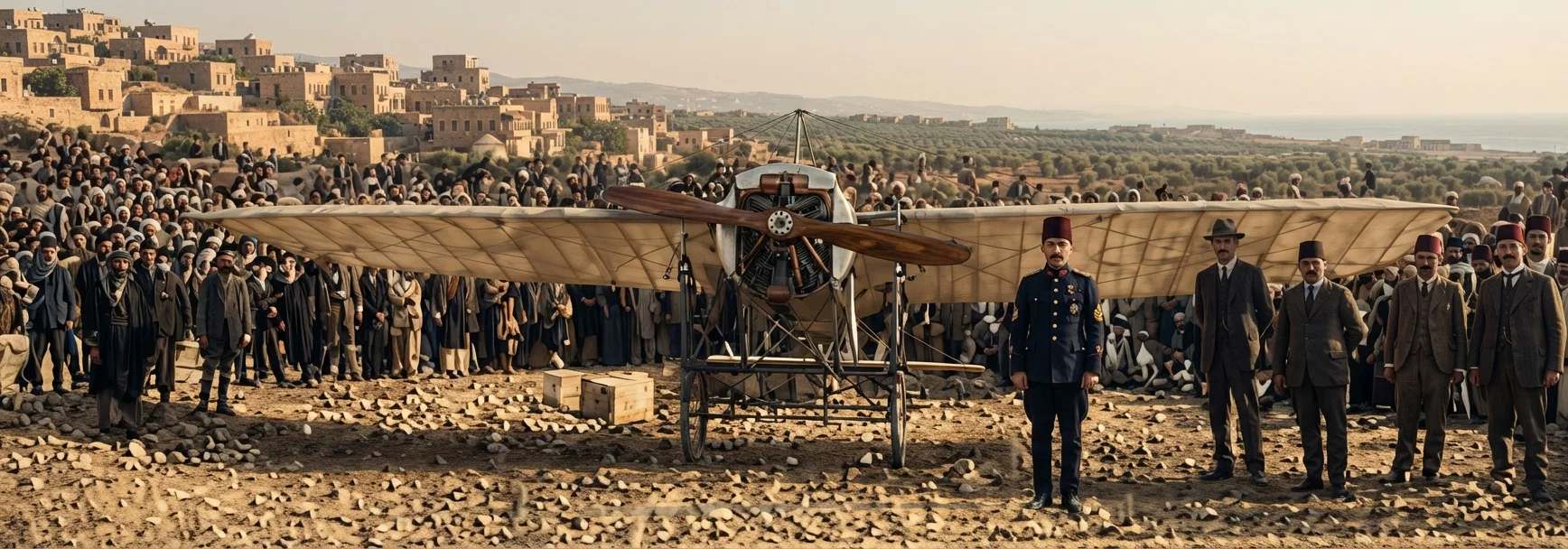
TURKISH AVIATOR IN BEIRUT, SYRIA — THE FIRST AEROPLANE TO BE SEEN IN THESE PARTS