SAM ATWOOD AGREES TO STAY OFF HIS FARM ONE DAY OUT OF EACH WEEK
CURIOSITY IS THEREBY AROUSED
By T. E. Bowen
"I HEAR, Sam, you have rented your place."
"Yes; and in signing the contract, I must say one clause has caused me considerable thinking of late, and that is, I am bound for one year not to do any repair work on my own farm, such as fixing fences or working on buildings, on Saturday."
"That's strange. What did you sign such an agreement as that for, anyway?"
"Well, it was imperative with Mr. Jones. He has the record of being an honest Christian man, one who can be trusted, and I wanted him on the place, and so signed up. Guess I can manage to get along for a year without working on Saturday out there, but somehow the way Mr. Jones reasoned about it has set me to thinking. That man certainly believes the Bible and proposes to live by it. I wish we had more such men these days. I confess it is refreshing to run across a man that lives out his religion when it comes to business."
"But it's so peculiar, Sam. I suppose Mr. Jones does nothing himself on that day," Peter Underwood went on, as he and Sam Atwood walked along toward their offices together.
"Surely not, and he puts some conscience and life into his Sabbath-keeping, too. I tell you, Peter, it made me ashamed of my pretended Sunday keeping. And both of us, you know, have been church-members here in Middletown all our lives nearly, and pride ourselves that we are good Sabbath-keepers. Do you know, that man stumped me the other day! While I was acting strange, as you now are, about that clause in the contract he was so particular to have in, bringing over that word 'peculiar' several times, I know, Mr. Jones finally looked me straight in the eye in his honest way, and asked,
"'And, Mr. Atwood, would you be kind enough to tell me why you keep Sunday?'"
"Now, Pete, before I tell you what I said, I should like to know what you would have told him."
"Why, I would have told him it is because the Bible said Jesus rose from the dead on Sunday, of course," said Mr. Underwood. "That's all the reason there is for keeping Sunday. What did you tell him?"
"Well, I stammered out something like that. Then Mr. Jones asked me where I found that in the Bible, at the same time handing me a little pocket Bible he had with him. I took it and fumbled away until I know I got red in the face, for two or three others were there at the time, and by this time were looking on interestedly. Finally he suggested it might be Luke 24:1 that I was hunting for. I turned there and said, 'Yes, this is the place.' So I read it out: 'Now upon the first day of the week, very early in the morning, they came unto the sepulcher, bringing the spices which they had prepared, and certain others with them. And they found the stone rolled away.'"
"What did he say on your getting this strong proof?" Peter broke in.
"He simply remarked, 'But I can not see how that has anything to do with the Sabbath.'"
"Then what did you do?"
"Well, while he was saying that, I caught the word 'Sabbath' right by this text, and hurried to say I had the text now, so commenced reading aloud again: 'And that day was the preparation, and the Sabbath drew on. And the women also, which came with Him from Galilee, followed after, and beheld the sepulcher, and how His body was laid. And they returned, and prepared spices and ointments; and rested the Sabbath day according to the commandment.'"
"You surely had him then, didn't you?" Peter interjected.
"Well, I thought so at first; but when he asked me, 'What day was that they rested according to the commandment?' I began to wonder where I was coming out to, especially when he so politely asked me, now that I had his Bible, to read that text referred to here. And so I turned to Ex. 20:8, and went on reading, as a smile began going round the circle: 'Remember the Sabbath day, to keep it holy. Six days shalt thou labor, and do all thy work: but the seventh day is the Sabbath of the Lord thy God.' Mr. Jones said, 'That will do,' and then added, 'Now, Mr. Atwood, from these texts, which day shall we decide upon for the Sabbath, the resurrection day or the day preceding it?'"
"He certainly had you, didn't he?" ventured Peter.
"I certainly think he did have me out in deep water so far as my showing him from the Bible why I kept Sunday is concerned. I was quite willing to sign the contract, and get out by myself where I could think it over. But I felt sure of one thing as I signed up, and that was that this man Jones would not be lying about things, nor stealing out of my part out there on the farm, and so I was glad to turn things over to him. I'd like you to meet him some time, Peter."
The men here separated. They had been so interested in their conversation that they had stopped a while on the corner of the street to finish up before separating for their offices.
“I WANT YOU TO TELL ME YOUR REASONS.”
About three weeks after this dialogue, Sam Atwood one Sunday morning tooted his automobile horn in front of Peter Underwood's fine residence. Mr. Underwood came out to see what was wanted, and in reply to his "Hello, Sam! What's wanted?" Mr. Atwood said, "It is such a nice morning, wife and I called around to see if you and Julia wouldn't like to run out to the farm for an airing."
"Well, I don't know. I'll run in and see her." In a minute he put his head out of the door, and said, "All right! We'll be out in a minute."
As Mrs. Underwood was helped to her seat in the big car, she remarked, "Peter and I had planned on going to church to-day, but guess the pastor won't miss us for once, as there will be plenty there to-day, it's such a nice morning."
"I was reading last night in the newspaper," Mr. Underwood went on, "that preachers are raising quite a fuss these days about automobiles cutting down the attendance at church."
"That may be," Sam replied, "but I think there is something back of that. I had planned on going to church myself to-day until I happened to learn what the Rev. Mr. Stillwater was going to talk about,—'The Moral Lesson of the Panama Canal'; and as I thought I was pretty well read up on that subject myself, I decided to run out to the farm."
"Why don't the preachers preach as they used to, anyway?" Mrs. Atwood put in, as the machine, with its charming purr, glided through the fresh morning air over the smooth country road this fine spring morning. "I must confess I get hungry for a good gospel sermon," she concluded.
"So do I," said Mrs. Underwood. "I have been expecting our new minister, every Sunday morning since he came, would give us some old-fashioned Bible talks; but after the text is read, scarcely275any reference is made at all to what the Lord says in the good Book."
But before they were aware of it, Mr. Atwood was slowing down in the farmyard. Mrs. Jones came out from the back kitchen, where, it was plain by her dress and the suds on her arms, she was busy with her week's wash. Mrs. Atwood glanced knowingly at Mrs. Underwood as she in surprise spoke out before she knew it, "Why, you're not washing to-day, are you, Mrs. Jones?" which was really a queer question for a stranger to ask. But Mrs. Jones laughed it off as she gave them a warm welcome. Mr. Jones and his man were just coming out of the horse barn with team, stone-boat, and plow, to go into the back pasture to begin plowing for corn and potatoes.
"You don't suppose anything will grow, do you, Mr. Jones," Mr. Atwood jokingly called out, as his eyes twinkled, "if you plow up yonder on Sunday?"
"It did not seem to make any difference back in Constantine's time; for the folks out in the country, you know, went ahead with their farm work on the 'venerable day of the sun,' lest the commodities of heaven be lost," replied Mr. Jones, coming along toward the shining machine to greet his new landlord.
Putting out his hand, Mr. Atwood said, "Mr. Jones, I've brought along my friends Mr. and Mrs. Underwood. I wanted them to meet you. And here is Mrs. Atwood also."
After shaking hands all around, the women went into the house, while Mr. Atwood started up the machine slowly toward the horse barn, where they sat for a time chatting and looking around, watching the hired man up through the lane. After talking over business affairs a while, Mr. Atwood worked the conversation around to a place where he thought both of them, especially as Mr. Underwood had been a Sunday-school teacher at times in the past, might be able to meet Mr. Jones on this "peculiar" feature of keeping a day different from everybody else. So he ventured:
"Then you go right on with your work on Sunday just the same as any other day, eh?"
"Well, yes, and no. I always try to respect the feelings of my neighbors. I do not desire to disturb them, and so try to plan my work in such a way that it will not be noisy on Sunday. That is why we were going back yonder by the woods to plow to-day."
"And how did you observe yesterday?" interestedly asked Mr. Underwood.
"Well, brother, after doing up the morning chores, we all drove to meeting over near Sanderson's Mill, about three miles from here, where two other families live who keep the Sabbath. There we had a Sabbath-school and meeting in Mr. Jacobson's private home. Then we came back, had dinner, and read the Bible and our church papers a while, and then went out over this fine farm for a little walk. At sundown we had a season of prayer about our family altar as the Sabbath was closing."
"I thought Sunday began at midnight," said Mr. Underwood.
"Now, Mr. Jones," Mr. Atwood began, "I've been thinking about that conversation we had down-town that day we fixed up our papers; and really, I am in earnest now. I want you to tell me your reasons for all this 'peculiar' way of doing. I want to know. And I am sure my friend here does. I have heard considerable about you folks in different ways, and have always wanted to come into close range with a real Seventh-day Adventist. Now tell us all about it."
"Very well," said Mr. Jones. "While there is much to the subject, I'll try to tell you the main points briefly. I keep the seventh day because that is the day the Lord Himself set apart for the Sabbath. The Creator rested on that day back at creation. He blessed that particular day, because in it He had rested. He reserved that particular time as His own. He never gave that day to any of us in which to do our own work or find our own pleasure. Then I read in the Bible that the Son of God made all things. You will find that in the first verses of the book of John. So it must have been Jesus" Himself back there at creation who rested and made the Sabbath, for the verses in John say, 'All things were made by Him.' You know He said He was Lord of the Sabbath; and that was because, I take it, He made it. And further, I think the example of Jesus Himself a safe one to follow. Don't you?"
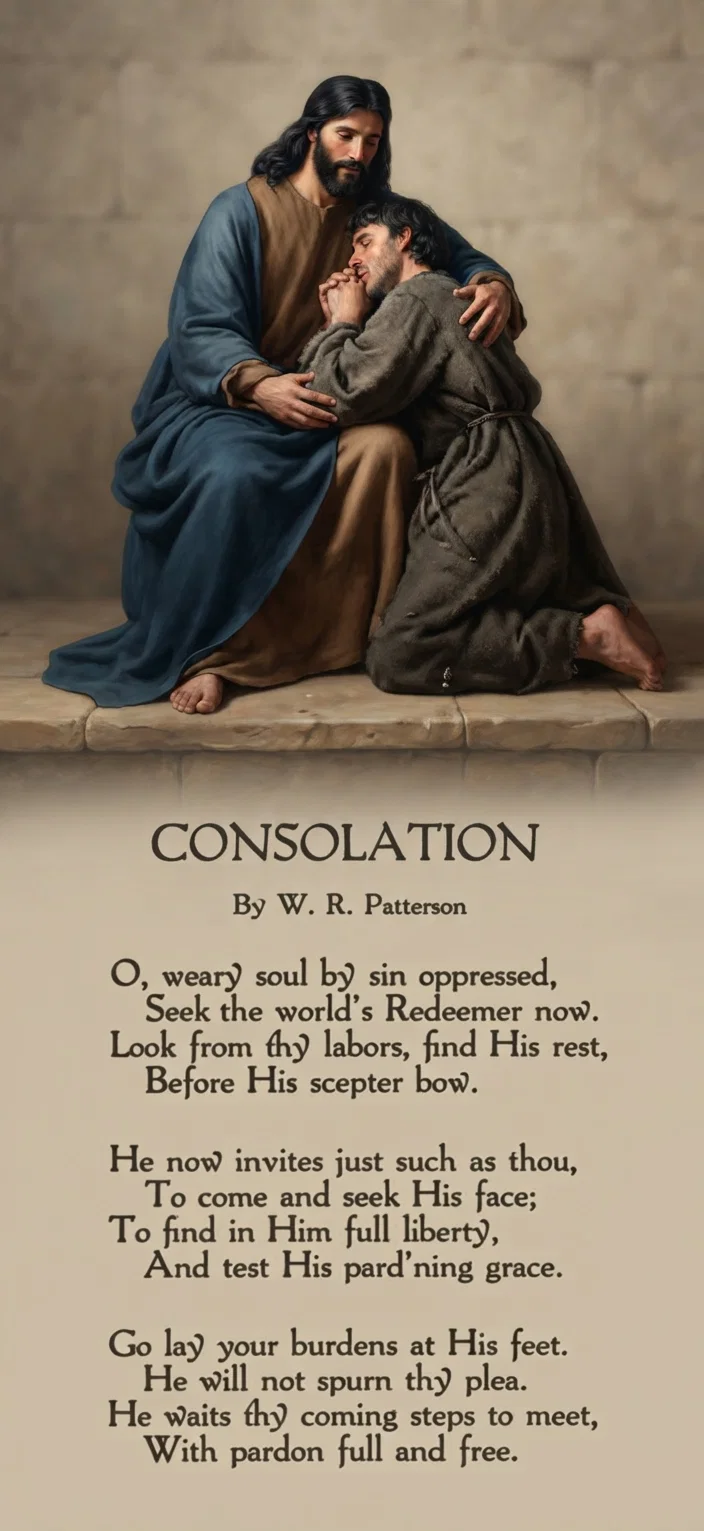
CONSOLATION By W. R. Patterson O, weary soul by sin oppressed, Seek the world's Redeemer now. Look from thy labors, find His rest, Before His scepter bow. He now invites just such as thou, To come and seek His face; To find in Him full liberty, And test His pard'ning grace. Go lay your burdens at His feet. He will not spurn thy plea. He waits thy coming steps to meet, With pardon full and free.
"Surely," chimed in both men.
Just then, in their looking about, the women had strolled out near the automobile, about which the men were lounging comfortably in the morning's sun.
"Well, Jesus Himself kept the seventh day," Mr. Jones went on.
"How do you know?" Mr. Underwood asked.
"How do I know? Why, from the very fact that in all His controversy with His own people, we have no record that they accused Him of keeping the wrong day, or teaching His disciples to keep any other day than the recognized Sabbath, or seventh day. This is clearly shown, Mr. Atwood, by those texts you read the other day. Those women, very near disciples of the Lord, went home and kept the Sabbath 'according to the commandment,' and you must recognize that this particular Sabbath was the first Sabbath after Jesus died on the cross. Now if those women had not been taught to keep Sunday, and if Jesus Himself had made no change in the law, of which the Sabbath commandment forms a part, before He died, then what authority has any one else for changing it? Let me ask you a question: Have you yet made your will, Mr. Underwood?"
"Yes, I have attempted to make one," coloring a bit as he caught a glance from his wife, "but haven't made much headway yet."
"I suppose you still reserve the right to revise some paragraphs," Mr. Jones remarked.
"I certainly do."
"But in case that before you reach home to-night some accident to this auto here should end your life, what then?"
"Well, I suppose it would have to stand as I left it last week," grayly answered Mr. Underwood.
"Exactly. And so, too, must that law Jesus died to ratify. While He lived, we know, He did not change it, for He plainly said, 'Think not that I am come to destroy [or change, for to change it would virtually be the same] the law, or the prophets: I came not to destroy, but to fulfil [keep].' And surely after He died no one had the right or authority to change it. So, I take it, it must stand as Mr. Atwood read it out of the Bible himself the other day—'The seventh day is the Sabbath of the Lord thy God.' And so, friends, because the 'seventh day is the Sabbath,' and because the Lord Jesus Himself kept it, and did not change it, this, in a word, is my reason for keeping it now, even though by doing so I know very well I am considered very 'peculiar' and 'strange.'" And a tear that had started added to the testimony that the farmer's words had come warm from his heart.
"But, Mr. Jones, why should you compel my friend Atwood here to keep the day you do?" Mr. Underwood asked.
"I guess he must have been telling you about our farming contract," Mr. Jones queried with a knowing glance over at his landlord.
Both smiled for an answer.
"Well, it is this way, Mr. Underwood: That contract does not interfere with Mr. Atwood's personal liberty at all in his own home or business. But when it comes to this farm, I now consider this my jurisdiction so long as I am in charge of it. In other words, it is 'my gates' now that I have rented it and agreed to pay a certain sum for occupying it this year. Had Mr. Atwood read on in that Sabbath commandment a little further the other day, he would have found what God has said on this point. Perhaps, Mr. Underwood, you would like to read it to him," politely queried Mr. Jones, handing him the same pocket Bible Mr. Atwood fumbled over down-town.
"Let's see, where are those commandments found, Julia?" stammered Mr. Underwood, with an appealing look at his wife. "I thought I could turn right to them. O, yes, here is the place. Six days shalt thou4
That Peculiar Clause in the Contract
(Continued from page 3)
labor, and do all thy work; but the seventh day is the Sabbath of the Lord thy God: in it thou shalt not do any work, thou, nor thy son, nor thy daughter, thy man servant, nor thy maid servant, nor thy cattle, nor thy stranger that is within thy gates.'"
"There, Mr. Underwood," Mr. Jones went on, "that last expression gives you the reason for that 'peculiar' clause in our contract. While Mr. Atwood owns this farm, I have it rented of him for one year, and during this particular time this place is under my control so far as the work on it is concerned; and if I were to permit work on it by Mr. Atwood, I take it that I should be accounted a Sabbath-breaker, the same as though I were to permit any other man outside my family, here termed 'a stranger,' to do work upon the farm. Hence the clause in our contract."
"I thank you for these straightforward statements, Mr. Jones," said Mr. Atwood, as he stepped up and extended his hand; "and as we already have kept you quite a time from your work, we must be going. I am sure I shall the better be able to keep my part of the contract for this morning's talk." And as Mr. Jones caught the knowing twinkle of his eye, he fully understood what Mr. Atwood meant.
"Perhaps you would like to read this little leaflet," said Mrs. Jones, as they were leaving, handing each one a little tract headed, "Which Day Do You Keep? and Why?"
As they were by themselves speeding out toward the pike in a roundabout spin for home, Mr. Atwood turned to the rest of the group, and asked, "What do you think now of my new tenant and his 'peculiar' clause in our contract?"
"One thing is sure," Mrs. Underwood replied: "we heard some sound Bible reasons put forth as to why he does as he does; and while they do seem 'peculiar,' I have decided to do one thing, and that is, I'm going to look into this matter for myself. I could not tell anybody why I keep Sunday. All I could say would be, 'Because everybody else keeps it, or at least pretends to.'"
They reached home safely, but somehow the scene of Mr. Jones, with his earnest face, out there by the barn telling them why he kept the Sabbath of the Bible, and especially those words, "I think the example of Jesus Himself a safe one to follow. Don't you?" lingered in the hearts of at least four persons of Middletown as they tried to go to sleep that night. And more, each heard a voice whispering to his conscience, saying: "Mr. Jones is right. It is safe to follow in the footsteps of the Lord Jesus."