Progress in These Lines in South America — A Remarkable Work among the Indians of That Continent
By H. H. HALL
LAST week Mr. Hall gave us a general view of his trip through South America in the interests of our publishing work. He took us hurriedly from place to place, mentioning matters of interest, and concluded by giving a brief account of our union conference meeting that he attended at Montevideo, Uruguay. This week his article deals more specifically with some of the branches of our growing work there. It is remarkable when we consider the self-sacrifice and the earnestness of human effort that are causing schools, publishing houses, and sanitariums to spring up in every part of this world for the one purpose of promulgating the great message of Christ's soon coming. Nothing short of a marvel of divine power will inspire men to such deeds.
This article is really a continuation of the one last week, although it is independent of it, in that it treats a phase of the subject that may be readily understood without knowing anything that was in the article a week ago.
Next week Mr. Hall will have an article on his visit to the Panama Canal Zone, in connection with which he will tell something of what he saw in regard to the progress of our work in that field.
OUR Argentine publishing house is located at Florida, some thirty minutes' ride from Buenos Aires. It owns its own property. The building is quite roomy for their present necessities, and contains the offices of the union and local Argentine conferences.
CIRCULATION OF LITERATURE
They print three periodicals,—Salud y Vida, or Life and Health; El Atalaya, or Watchman; and La Revista Adventista, or the Advent Review,—all in Spanish. They also issue a number of tracts and pamphlets, but thus far find it more economical to purchase their books from our house in Mountain View, California, or from Barcelona, Spain.
Under the able field direction of Brother E. M. Trummer, who came here from Union College less than five years ago, this branch of the work has gone forward in a marvelous manner. Books and periodicals to the amount of about $100,000 have been sold during that time. To appreciate fully what this means, one must come in contact with the terrible indifference to everything religious, or the worse prejudice against everything evangelical, which everywhere exists.
THE FIELD WELL ORGANIZED
The union and local conferences recognize the value of this department, and each field has a man giving his whole time to its interests, as follows: E. M. Trummer in charge of the union, A. R. Sherman in Argentine, J. T. Thompson in Uruguay, J. D. Lorenz in Chile, A. G. Nelson in Strait of Magellan, R. B. Stauffer in Peru, O. H. Schulz in Bolivia, and Enrique Mangold in Ecuador. With this strong organization, and the continued blessings of the Lord, they will approach $50,000 in their 1914 sales.
Their publishing house has an investment of about $30,000 and is in fairly good financial condition, its present worth being $22,000.
Progress in These Lines in South America — A Remarkable Work among the Indians of That Continent
By H. H. HALL
EDUCATIONAL WORK
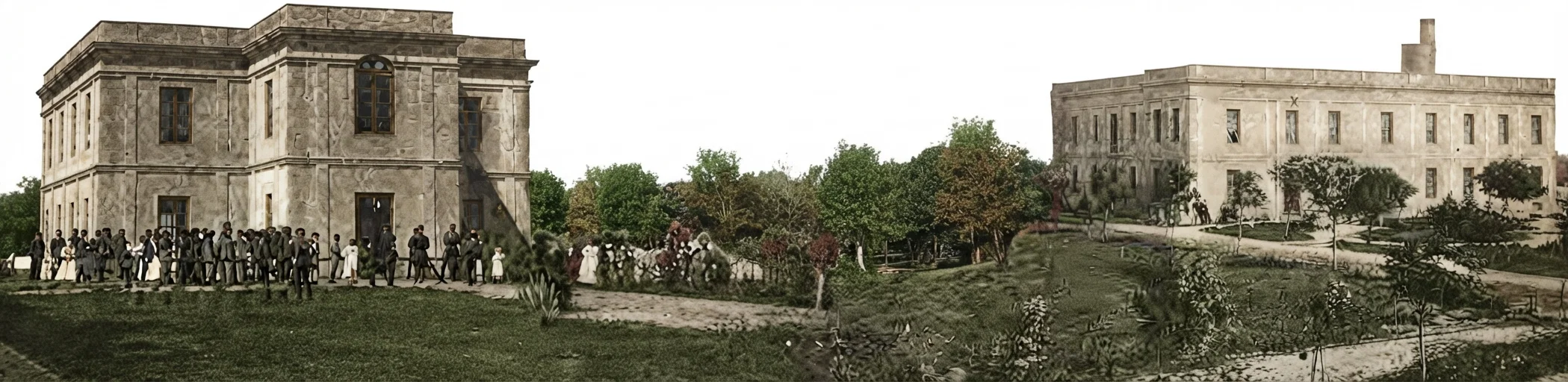
One of the beautiful trips in Argentine is by boat from Buenos Aires up to the port of Diamante, on the River Plata. Twelve miles inland is the academy, a view of the main building being here shown. There is also a series of rooms partially surrounding a quadrangle, where the kitchen, the dining-room, and the girls' dormitory are located at present.
These are among the first buildings erected; and as they, like most of the homes in this vicinity, are built of adobe, they are cracking badly, and some of them can not be used much longer. Thanks to the recent thirteenth Sabbath offerings by our Sabbath-schools in the states, a new two-story brick building is nearing completion, to which the girls, the dining-room, and the kitchen will be transferred. This will give some of the added space required in the main building, as the boys will remove from it to the rooms vacated by the girls.
WISHED HE HAD GIVEN ANOTHER DOLLAR
One can hardly look over their facilities and the work to be done without wishing he had given another dollar when the contribution envelope went around on that thirteenth Sabbath occasion. As the brick are made on the ground, it is hoped that the new building can be brought within $10,000. A central boiler house is being erected, but this is paid for by local subscriptions.
Prof. H. U. Stevens, of Union College, and his wife, formerly Miss Inez Hoiland, of Oakland, California, are in charge, assisted by Elder W. W. Wheeler, also of California, Otto Heyde, Camilio Gill, R. H. Habenicht, Miss Almeda Kerr, and one or two others whose names I do not remember.
The school was just opening when I was there in early March—they are on the other side of the equator, you see—and the enrolment was nearly one hundred, which is quite an increase over any previous opening. The investment in land, buildings, and furnishings is nearly $25,000, practically all of which is paid.
As the school at Pua, southern Chile, had not opened when I visited that field, I did not see it. That school also received a share of the thirteenth Sabbath offering mentioned, and is therefore securing some of the added facilities of which it stood in great need. Of the educational work among the Indians, I will speak under another heading.
HEALTH AND SANITARIUM WORK
Besides several nurses in different portions of the South American field, who are exerting an excellent influence, we have a good sanitarium just across from the school property, under the direction of Dr. R. H. Habenicht, assisted by Dr. G. B. Replogle and a corps of efficient nurses. This sanitarium, which began in the home of Brother and Sister Habenicht, has now grown into the institution shown in the accompanying cut, to which the people for many miles around flock for physical help.
THE STRENUOUS DOCTOR
Situated as it is, in the country, people come in wagons and on horseback, both for help themselves and to summon the doctor to their homes. He has a cot that he puts into the rear of a wagon when called out on a long night trip; and sometimes for a week about all the sleep he gets is that taken as he is bumped over the country roads on this cot.332The corral near the sanitarium was well filled with wagons the day I was there, each one of them bringing its particular case needing the assistance the sanitarium could give.
The institution can care for thirty-five or forty patients; but as it is often filled, the building of an additional wing is considered. The total investment is a trifle over thirty-five thousand dollars, and the present worth a little above twenty-two thousand. Long may it continue to extend its kindly Christian help to the sick and suffering in Argentine.
INDIAN WORK
Unfortunately I failed to meet Brother and Sister F. A. Stahl while in Bolivia and Peru, and therefore can not give as much information as I otherwise could. But that there is a wonderful and seemingly unlimited field opening before us among the Indians of these countries is admitted even by our bitterest opponents. This is particularly true of the section around the shores of Lake Titicaca, near which is Cuzco, the old capital of the Inca empire, the descendants of which are now for the first time becoming interested in Protestantism.
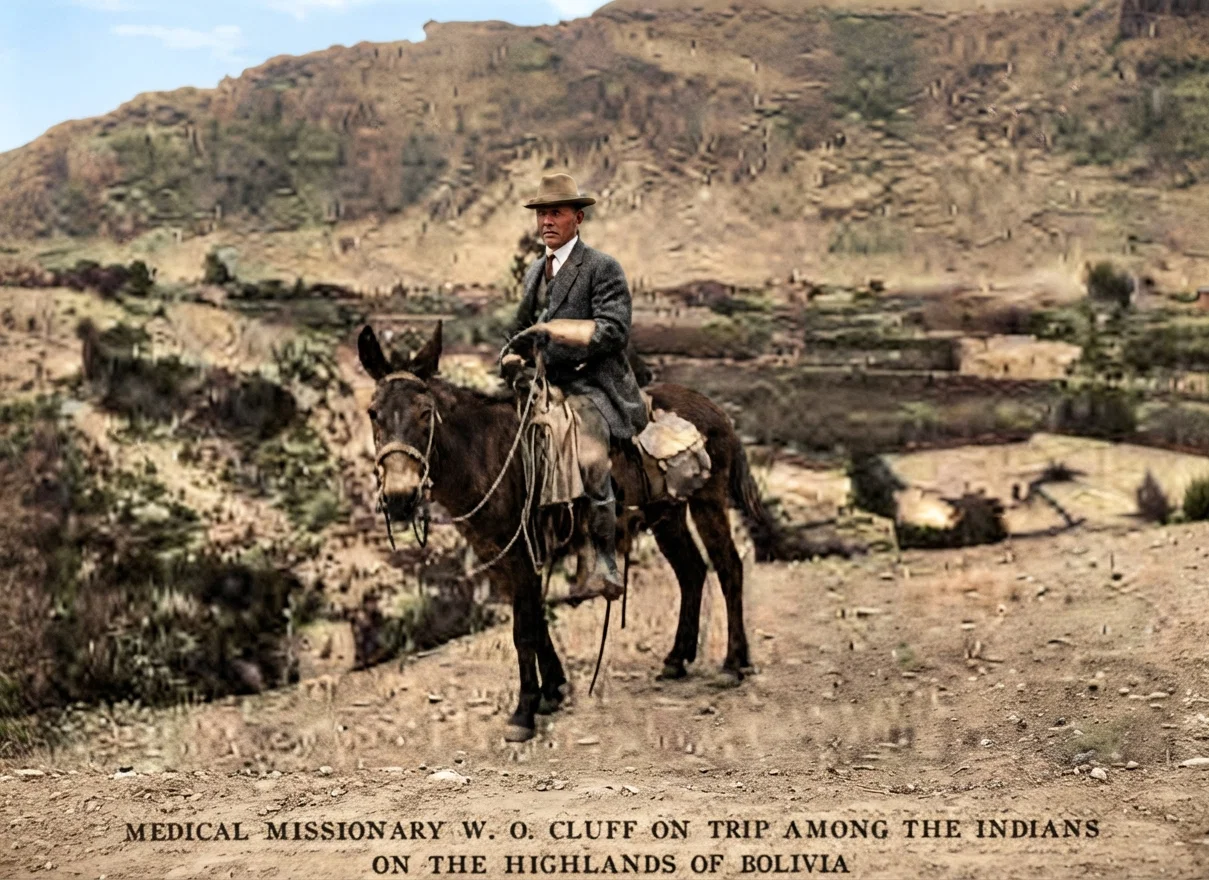
MEDICAL MISSIONARY W. O. CLUFF ON TRIP AMONG THE INDIANS ON THE HIGHLANDS OF BOLIVIA
Amidst bitter opposition and even persecution, Brother Comacho, an Indian who accepted the message we hold, some five years ago began a little school. The Indians were eager to learn, and flocked to it. Brother Stahl and others began work among them, and the interest in both the school and our message grew.
ATTACKED BY BISHOP AND ARMED MEN
A little over a year ago, Brother and Sister B. Rocas, of Argentine, were sent over to take charge of the school work. But some months later, the Catholic bishop, with two hundred armed men on horseback, fell upon them. Eight were finally arrested because they had been baptized and kept the seventh day, and were driven on foot twenty-two miles to Puno, where they were imprisoned for a week.
As there was no case against them, the jury released them; but Brother Comacho and seven or eight of his companions went to Lima, the capital, and presented their cases to the president and to other leading men as well. The result of their visit, so far as the repealing of the law forbidding Protestant service is concerned, has not yet fully materialized; but the president paid their fares home, and gave each of them a pound sterling.
A leading lawyer of the republic has taken the case up on his own responsibility, and is suing the bishop for imprisoning these Indians without cause. The affair has got into all the papers, and is bringing us and our work before the people throughout the republic.
Schools seem to be the medium through which we may reach these Indians. While the union conference has done what it could for them in the way of a schoolhouse and a mission building, and furnishing a teacher for this one school, more schools can be opened as soon as we find just what legal requirements are necessary in the way of teachers and facilities.
I met Brother and Sister Rocas at Arequipa, where he is finishing some normal work, the lack of which enabled our enemies to declare him incompetent and therefore close the school for a time. He has already completed his preliminary examination, and has every assurance that the finals will be as easily passed, and then the school will be opened once more.
SEVENTY-ONE IMMERSED
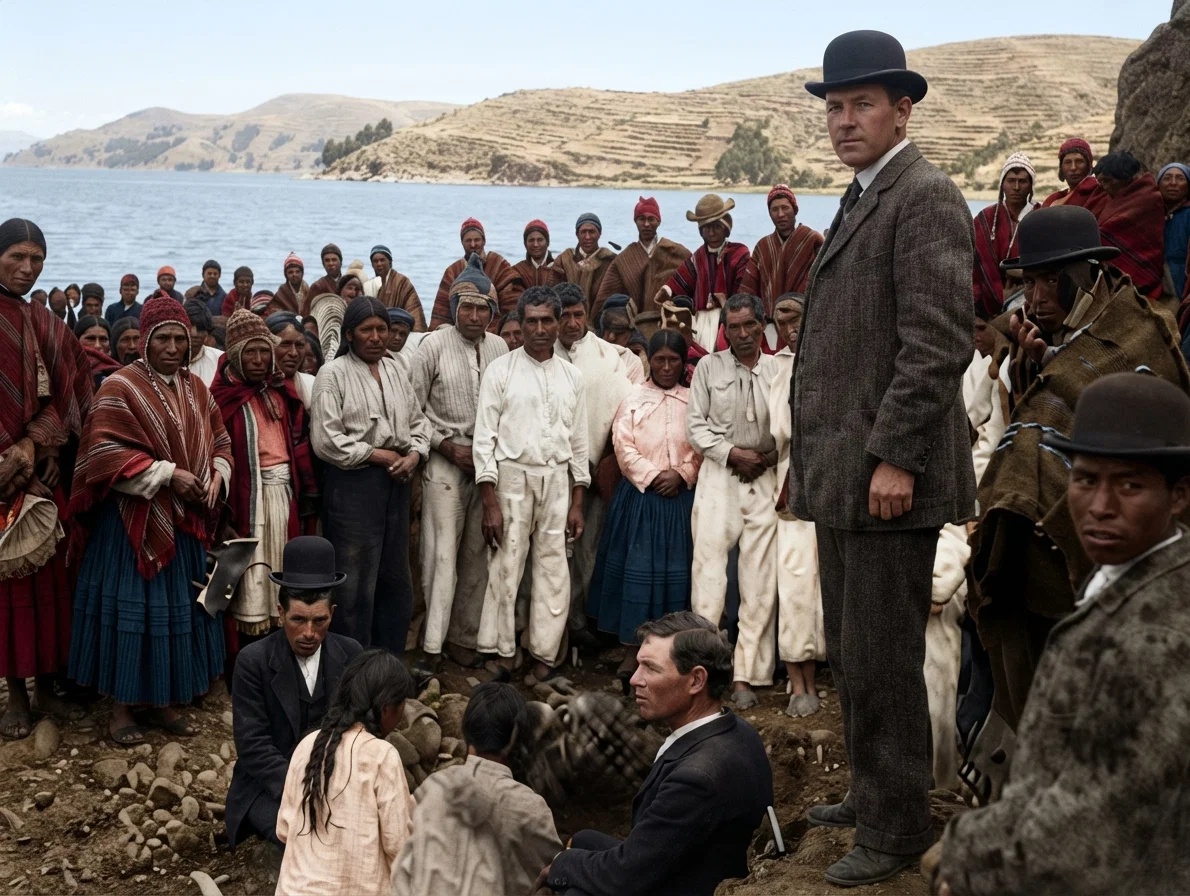
Brother Maxwell gave me a kodak view, which is here reproduced, of a recent baptismal scene, in which he and Elder Pohle baptized seventy-one of these people. Following this, a communion service was held on the shores of the lake, and one hundred sixty-eight took part.
A village near here Brother Stahl visited recently; and on his telling the people of the soon-coming Saviour, they pleaded for him to return and tell them more. This he could not promise; but the village chief pressed him until he said, "If I do not return, some one else will." The chief replied, "But how am I to know that some one else will teach us the same things?" Brother Stahl says: "I thought a moment, and then took up a small pebble and broke it in halves. I gave him one half, and told him that whoever would come to teach him and his people would have the other half. He took his half and put it away carefully, and said, 'It is well.'"
At La Paz we met Brother and Sister W. O. Cluff and Sister Wightman, recently from the States. Sisters Cluff and Wightman have been nursing among the Europeans of the city, but Brother Cluff has been doing medical missionary work among the Indians, and he is very enthusiastic over the possibilities before him. He says they seem wonderfully disposed to accept the message of a soon-coming Saviour, and are singularly faithful to it. He refers to those about the lake, as no special results have thus far been seen in the other sections of the country; but no doubt there will be, as soon as our force is sufficient to connect the teacher with the preacher and the medical evangelist. In the accompanying picture Brother Cluff is shown on one of his trips among the high Andes and table-lands of Bolivia.
THEY CAN NOT READ
As Brother Trummer and I rode for two days in almost continuous sight of this people, with their tiny ranches, many of them surrounded with stone walls, and saw their mud huts, with little wooden crosses stuck into the roofs, he said to me, "We can do nothing for these people with our literature, for they can not read."
And yet there are two and a half million of them in Bolivia and333Peru alone. Shall we not send to the South American Union sufficient means to enable it to secure instantly the necessary facilities and teachers to give the bread of life to this waiting people, who for long centuries have been downtrodden and persecuted? Shall not these simple folks, who have been taught to trust in the symbol of the cross, be acquainted with its real significance and saving power?
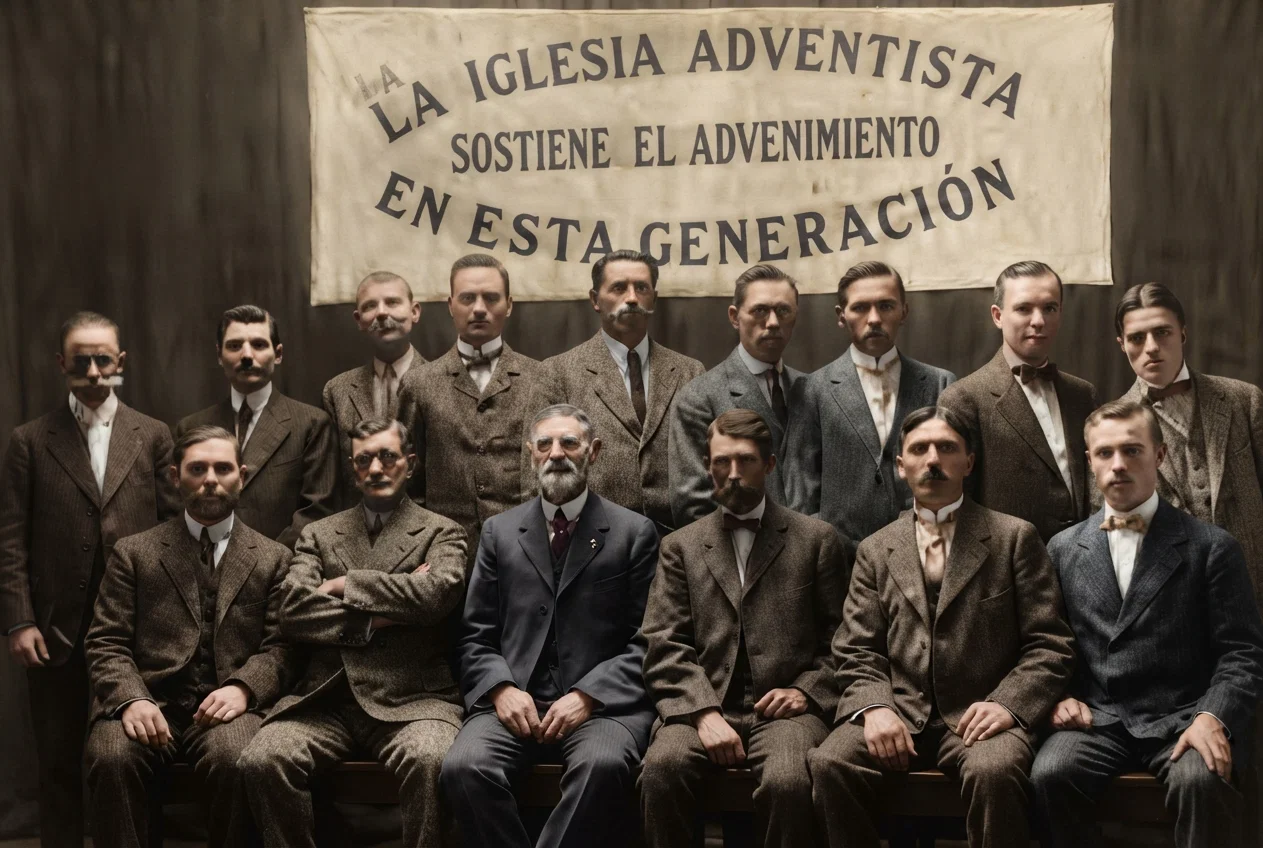
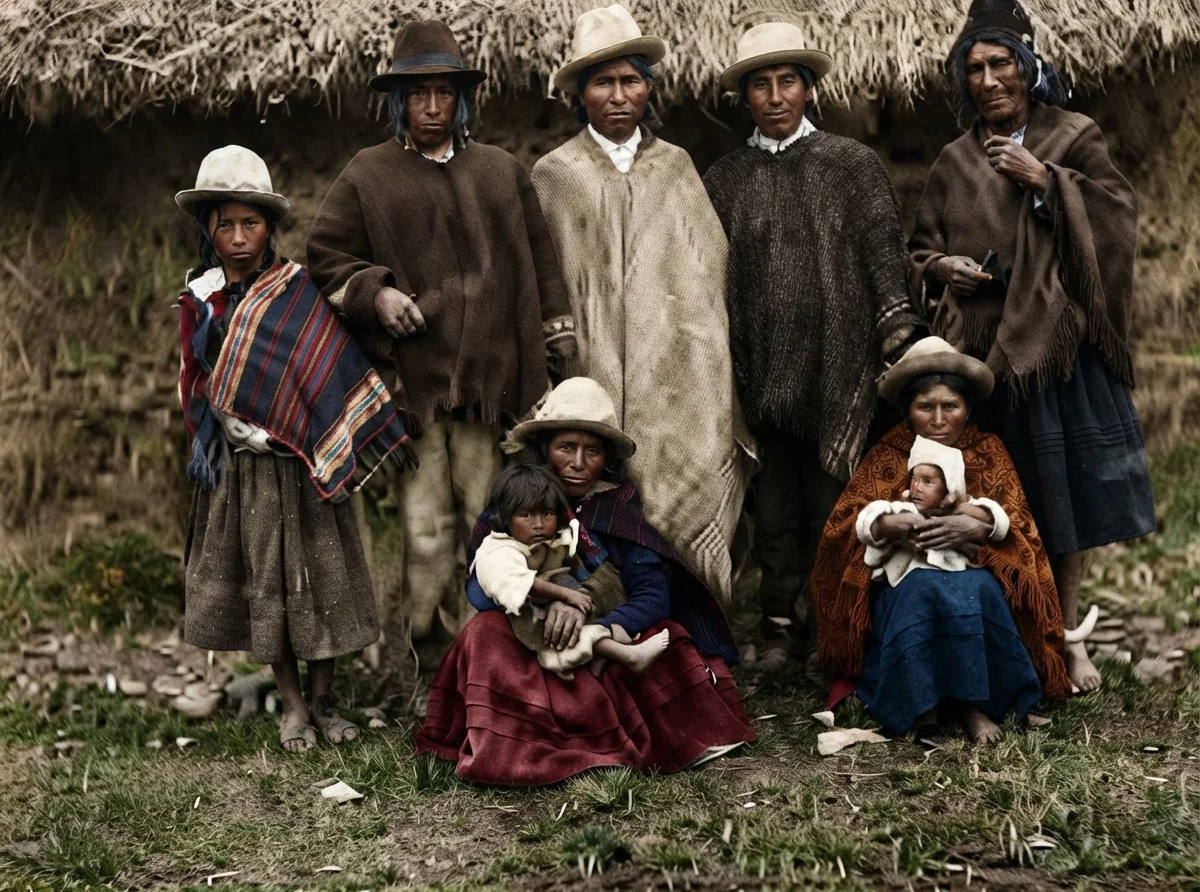
NO. 1. DIRECTORS OF COLPORTEUR WORK IN THE SOUTH AMERICAN UNION CONFERENCE. FIRST ROW FROM LEFT TO RIGHT ARE: J. D. LORENZ, OF CHILE; G. E. HARTMAN, MANAGER BUENOS AIRES PUBLISHING HOUSE; ELDER J. W. WESTPHAL, PRESIDENT SOUTH AMERICAN CONFERENCE; H. H. HALL; E. M. TRUMMER, DIRECTOR COLPORTEUR WORK, SOUTH AMERICAN UNION CONFERENCE; A. R. SHERMAN, ARGENTINE. NO. 2. INCA INDIAN GROUP NEAR LA PAZ, BOLIVIA. NO. 3. A RECENT BAPTISMAL SCENE IN LAKE TITICACA, NEAR PUNO, PERU, IN WHICH SEVENTY-ONE INDIANS WENT FORWARD IN THAT ORDINANCE