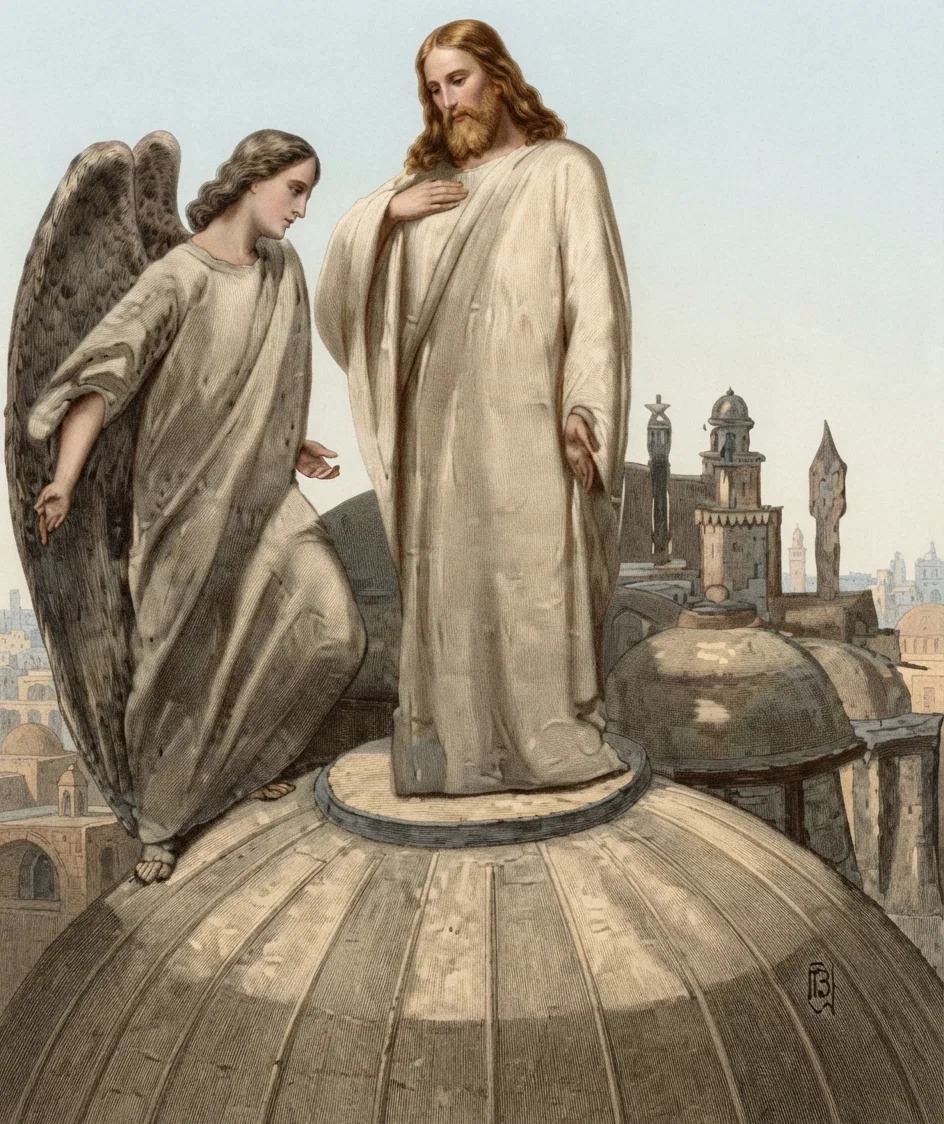
Satan Quoted Scripture to Christ—The Purpose Was to Deceive—The Lord Quotes a Text That Exposes the Satanic Interpretation—Principles of Interpretation Thereby Made Plain
WHEN seeking to tempt Christ, the devil deliberately quoted Scripture to sustain a false position. He suggested that Christ cast Himself down from the pinnacle of the temple, by way of asserting His inherent divinity; and to sustain this evil suggestion, he repeated the scripture, "He shall give His angels charge concerning thee: and in their hands they shall bear thee up."
SATAN'S PRESUMPTUOUS SUGGESTION
God never gave the promise for any such presumptuous conduct as Satan suggested that Christ take at this time. So the verse is entirely perverted as the evil one quotes it. He presents it as an evidence that presumption would be proper, and that God's care would be continued under the circumstances suggested. This was a lie, an entire perversion of the intention of the promise.
Every promise of God is upon conditions, and these conditions are plain and explicit. If one violates the conditions of the promise, he thereby forfeits the promise. It is just as Jesus said,—that it is not he who says, Lord, Lord, that shall enter the kingdom of heaven, "but he that doeth the will of My Father which is in heaven."
THE CONDITIONS MADE PLAIN
In this particular promise which Satan quotes, we have the condition very plainly laid down: "Because thou hast made the Lord, which is my refuge, even the Most High, thy habitation, . . . He shall give His angels charge over thee, to keep thee in all thy ways." "Because he hath set his love upon Me, therefore will I deliver him." And the very first verse of this ninety-first psalm tells who it is to whom God has made this marvelous promise. It is "he that dwelleth in the secret place of the Most High," the one who says of the Lord, "He is my refuge and my fortress: my God; in Him will I trust."
Far different from this trust, this making God a refuge, this dwelling in the secret place of the Most High, this setting the love upon God, was Satan's suggestion that one do a presumptuous act, that which would have doubt in it, that which would question God, that which would see if God would preserve when man goes his own presumptuous, headlong way.
MISUSE OF SCRIPTURE CORRECTED
This misuse of Scripture, Christ clearly corrected; and He shows, to the end of time, the way in which all perversions of Scripture are to be met. When the evil one quotes the Scriptures to sustain his evil principles, his evil suggestions, his rebellious, presumptuous ways, the remedy is, to use the words of Christ, "It is written again." Matt. 4:7. While Satan could find a scripture that, wrested from its context, seemed to bear him out in his evil plan, Christ could find another scripture that struck squarely across the way suggested by Satan.
Satan is still at work giving men scriptures separated from the context, changed from their intention, that seem to bear out the doctrines men desire to teach or believe; but the remedy, every time, is to turn to the other passages of Scripture that throw the full light of God's lamp upon the problem.
"IN THE SPIRIT ON THE LORD'S DAY"
For example, the observer of Sunday will read Rev. 1:10, "I was in the Spirit on the Lord's day," and offer it as an evidence of Sunday sacredness; but there is not in this scripture one whisper of Sunday, and there is not a scripture anywhere that teaches that the Lord's day is Sunday. This text is just as foreign to Sunday observance as the scripture Satan quoted was foreign to the idea he suggested; and the answer to those who quote Rev. 1:10 in support of Sunday is the answer that we get by following Christ's example: "Again it is written," "The seventh day is the Sabbath of the Lord thy God." Ex. 20:10. And "again it is written," "If thou turn away thy foot from the Sabbath, from doing thy pleasure on My holy day." Isa. 58:13. Thus the Bible tells us, as we find the places where "it is written again" that the seventh day is the Lord's day, it "is the Sabbath of the Lord thy God." Ex. 20:10.
CHRISTIAN SCIENCE INTERPRETATION
Another example: The system of religion known as Christian Science, quotes texts of Scripture which seemingly support some of its doctrines. True, some of these quotations have to be only partial quotations, for the whole quotation would deny the statements which Christian Science makes. For example, Christian Scientists love to quote, "Work out your own salvation"; but I never yet knew of one quoting the whole of it.—"Work out your own salvation with fear and trembling." The words "fear and trembling" are absolutely out of harmony with the self-complacency of the Christian Scientist. Nevertheless, they are a part of the text; and wo to him who takes from the word of God, or adds thereto. Rev. 22:18, 19. "I know that, whatsoever God doeth, it shall be forever: nothing can be put to it, nor anything taken from it: and God doeth it, that men should fear before Him." Eccl. 3:14.
"IT IS GOD THAT WORKETH IN YOU"
In quoting the text, "Work out your own salvation," the very scripture that follows it (for here once more we must adopt the example of Christ, and say, "Again it is written"), explains it: "It is God which worketh in you both to will and to do of His good pleasure."
Let us remember that "no prophecy of the Scripture is of any private interpretation"; and when any person sets himself up to give private interpretations of the Bible, he is not following the divine plan. When we discover the scripture that seems to bear a certain construction, we should at once look for other scriptures; for "again it is written." And thus by comparing spiritual things with spiritual, we shall be led by the Spirit into all truth.