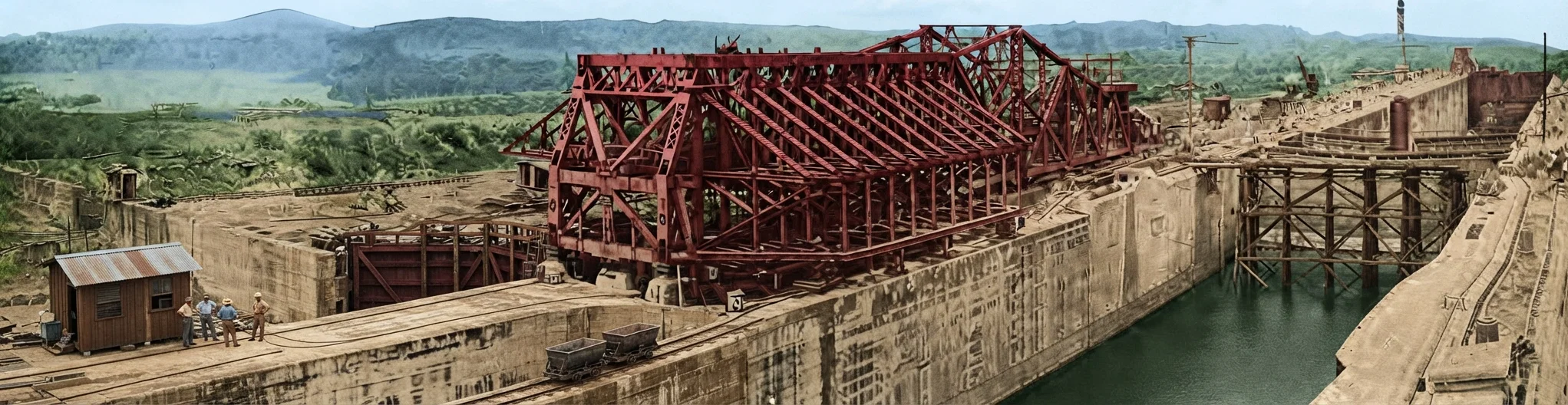
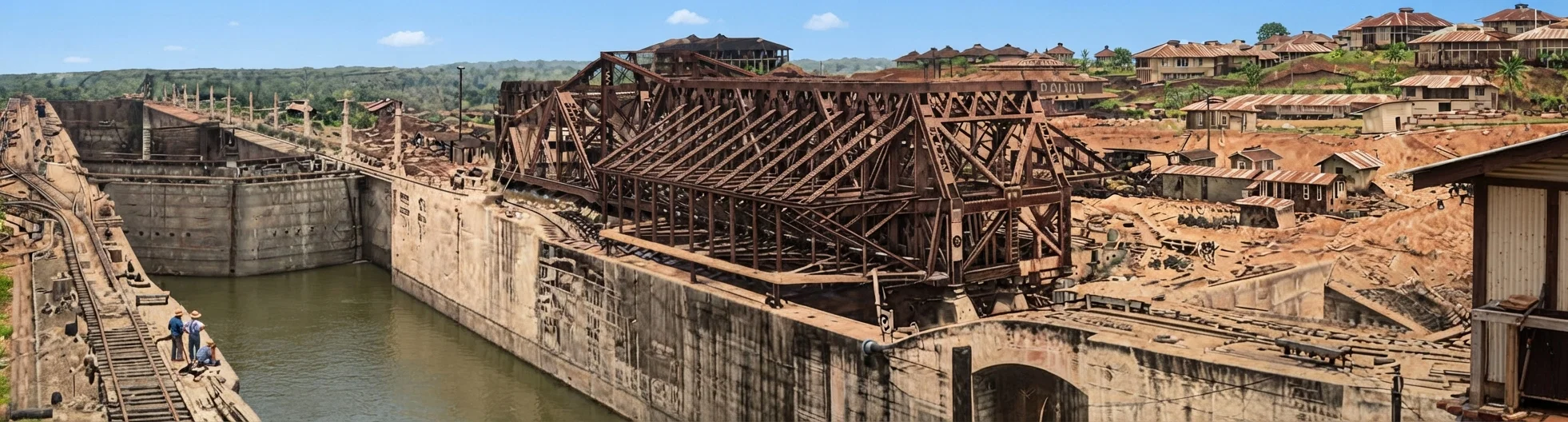
A PANORAMIC VIEW OF GATUN LOCKS, LOOKING DOWN TOWARD THE ATLANTIC OCEAN, AND The emergency dams shown at the right and left of the lock chambers may be swung across the channel, and the series of gates lowered, the
The Meeting of the Oceans
By H. H. Hall
A Dream of Two Centuries Is Realized—“Many Shall Run To and Fro” Was Predicted
A Growing Work on the Isthmus
H. H. HALL
THIS article presents the last lap of Mr. Hall’s trip, as he has visited England, Scandinavia, Germany, Spain, Switzerland, and other European countries, as well as South America. His articles have given something of an idea of the organization and extent of our work in the limited portion of the world he has visited. The work is under way in the same strong manner in every country on earth and in the islands of the seas. Our people are not very strong in point of numbers, and we are not a wealthy people; but we do most sincerely believe that the prophecies of the Bible make it emphatically clear that the second coming of Christ is right at the doors. This great truth brings us such joy, such soul rest and delight, that we desire to carry the good news into all the world, and urge it upon each and every heart. To this end, thousands of our young men and women, along with older ones, are forsaking everything that this transitory world holds as dear, so that they may, even amid dangers, privations, and hardships, tell the glorious news of the Coming One.
FOR several hours preceding our anchoring off the Pacific end of the Panama Canal, we seemed to be sailing in the traditional mill-pond, so smooth was the ocean’s surface. On consulting the map, the reason for this is quickly made apparent. Although we had been out of sight of land, we had really been in a great natural harbor, surrounded by land on three sides, and known as the Gulf of Panama.
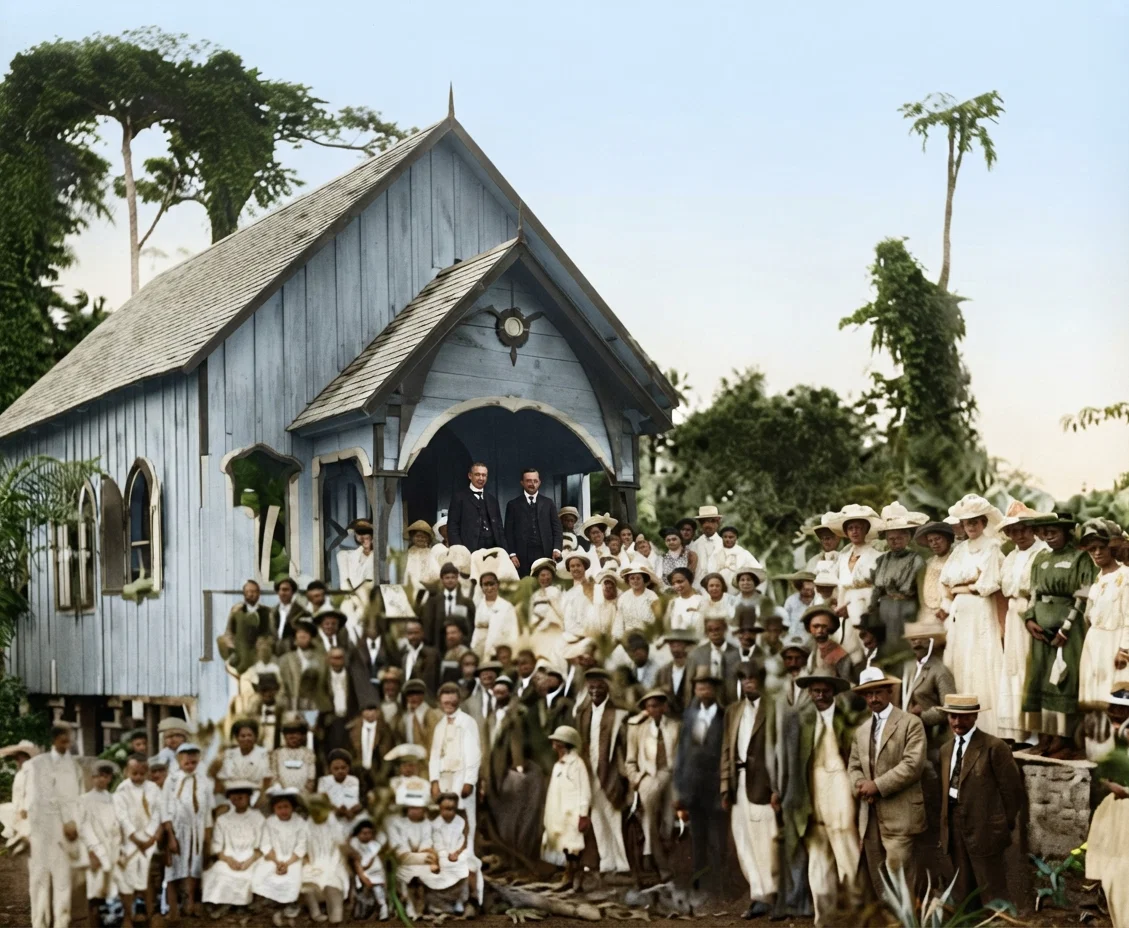
Dedication of a church forty miles interior from Bocas del Toro, Panama. The United Fruit Company ran a special train to accommodate those who wished to attend the service. The president of the conference, Elder H. C. Goodrich, and the minister who raised up the church, are standing in the entrance.
BALBOA THERE FOUR CENTURIES AGO
As the ship swung around on her anchor, we looked right into the entrance of the canal, as well as upon the hill where Vasco Nunez de Balboa stood four centuries ago, after emerging from the jungles of the isthmus. How bewildered the intrepid explorer would be if he could awake to see the changes wrought since that twenty-fifth day of September, 1513, when he waded into the “Southern Ocean,” as he named it, and took possession of all the lands bordering upon it! Not the least of these changes is the railroad, which whisked us across the isthmus in an hour and fifty minutes, while he took twenty-six days.
THE FORTIFIED ISLANDS
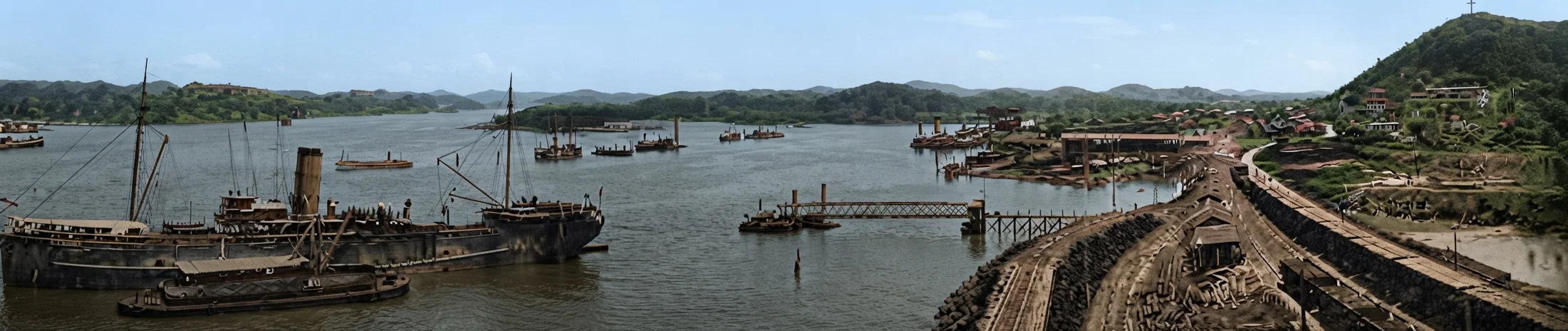
At the right are the islands that are being fortified with enormous guns, one of these guns having a range of twenty miles. The islands are connected with the mainland by a breakwater more than three miles long, ranging from twenty to forty feet above sea-level, and from fifty to three thousand feet wide at the top. It is formed for the most part of material taken out of the Culebra Cut, and much of its surface is covered with railway tracks. The illustration shows a portion of this breakwater, as well as the nearer section of the American city of Balboa.
A bird's-eye view of Balboa and the Pacific coast entrance to Panama Canal, showing the canal entrance to the left, and a part of the American city of Balboa to the right. Beyond the hill, and under the cross, is the proposed location of a new chapel. A portion of the breakwater running out to the fortified island is in the immediate foreground to the right. This breakwater is largely made of rock taken from the Culebra Cut. The amount of rock and earth deposited in the cut in one slide would build a wall seven feet wide and seven high, extending from New York to San Francisco.
Some two miles to the right is the city of Panama, which belongs to the Panamanian republic. The United States, as you will remember, absolutely owns and controls a strip ten miles wide, five miles each way from the middle of the canal, the only exceptions being the cities of Panama on the Pacific and Colon on the Atlantic, over which it exercises sanitary control only. Therefore in writing the address of any one on the zone, outside of these two cities, you need not add the word “Panama,” but simply say, for example, “Mr. John Jones, Balboa, Canal Zone.”
COMMERCE BEGINNING TO FLOW THROUGH
Near Balboa the permanent isthmian administration building is being built, at a cost of $375,000, while huge piers and a dry dock a thousand feet long and a hundred ten feet wide are being constructed for the commerce that is even now beginning to flow through this waterway. All this, together with the sheltered entrance, indicates that the Pacific end may rival the Atlantic end in importance.13The two ends of the canal can not well be distinguished as the east and the west, for the Pacific end is twenty-two and one half miles east of the Atlantic end.
COMBINED CHAPEL AND MISSION HOME
We have a nice church here in Balboa and Panama City, and the members stand greatly in need of a chapel. They have entirely outgrown their old rented quarters, and have searched in vain for a new place, at a rental within their reach. After counseling with the conference officials, all came to the conclusion that if possible, land should be purchased and a combined chapel and mission home erected. This would become a very much needed base for our work on the west coast. The president, Elder H. C. Goodrich, was there the day I landed, and secured option on a lot under the cross in the Balboa view here given. According to their plans, the lot and the building will cost only about $2,250. The conference committee is hoping that some liberal-hearted lover of foreign missions will assist in setting such a memorial on the hills of Balboa.
THE ROAD REBUILT AND RAISED
I crossed the isthmus on the Panama Railroad, which is the property of the United States; and to my surprise, I learned that with the exception of seven miles, its entire forty-seven miles had been relocated and rebuilt. This has been made necessary by the flooding of the Gatun Valley to secure head waters for the locks. In some places, the road has been raised forty feet. The cost of this rebuilding work has been nearly nine million dollars.
Seven miles from the Atlantic end are the Gatun locks, dam, spillway, and electric power plant. Sufficient power is to be generated to operate all the lock machinery, and for lighting, towing locomotives, and later for running the trains on the Panama Railroad itself, which is to be electrified. Everything seems to be as perfect as brains and unlimited money can make it.
SHOWING TWO SETS OF LOCKS AND THREE SETS OF GATES AND THE EMERGENCY DAMS flow stopped, and the locks drained. A small portion of the Gatun dam appears to the left of the section of the photograph on the opposite page.
VESSELS NOW PASSING THROUGH
Although the canal was not formally opened, I had the privilege of seeing a small vessel take the three steps of twenty-eight and one third feet each from the sea-level to the surface of the lake. As it entered the lower lock enclosure—a gigantic thing a hundred ten feet wide and a thousand feet long—two steel gates seven feet thick, sixty-five feet long, eighty-two feet high, and weighing seven hundred and thirty tons each, closed behind it, and water began to boil up from the numerous culverts located in the floor bottom and supplied from the lake above by eighteen-foot culverts in the center and side walls. In but twenty minutes, this giant bath tub was filled even with the imprisoned water in the lock above. Another set of gates opened, and the operation was repeated. In twenty minutes more, the third step was likewise taken, and the boat floated eighty-five feet above sea-level. During this time, one man up in the signal house had handled eighty-two switches, which had operated as many motors, and the electricity had done the rest. Bear in mind also that there are two sets of locks located side by side, therefore a ship could have been taken down at the same time if desired.
Headquarters of Seventh-day Adventist Conference in Cristobal, Panama. Chapel, book depository, and offices below, with living-rooms for workers above. This building is located on the site of one burned some three years ago, and is just across the street from the Panamanian city of Colon.
Truly it was a great sight, and one I will never forget. For two hundred years, men have dreamed of it; but it remained for this time, which the pen of inspiration describes as “the time of the end,” when men “shall run to and fro, and knowledge shall be increased,” for this dream to become a reality.
THE LOSSES OF THE FRENCH COMPANY
There remain many reminders, in the form of old dredges, steam shovels, rusty engines, and tools of all kinds, of the $260,000,000 spent by the French company under De Lesseps. I was interested to know that according to the official estimate, the United States has realized a little over $42,000,000 out of the French work, for which we paid $40,000,000. The French stockholders lost the staggering sum of $220,000,000, and have seen the glory of the achievement go to another. What a tremendous lesson on the advisability of counting the cost when one launches an enterprise, whether great or small!
OUR MISSION HEADQUARTERS
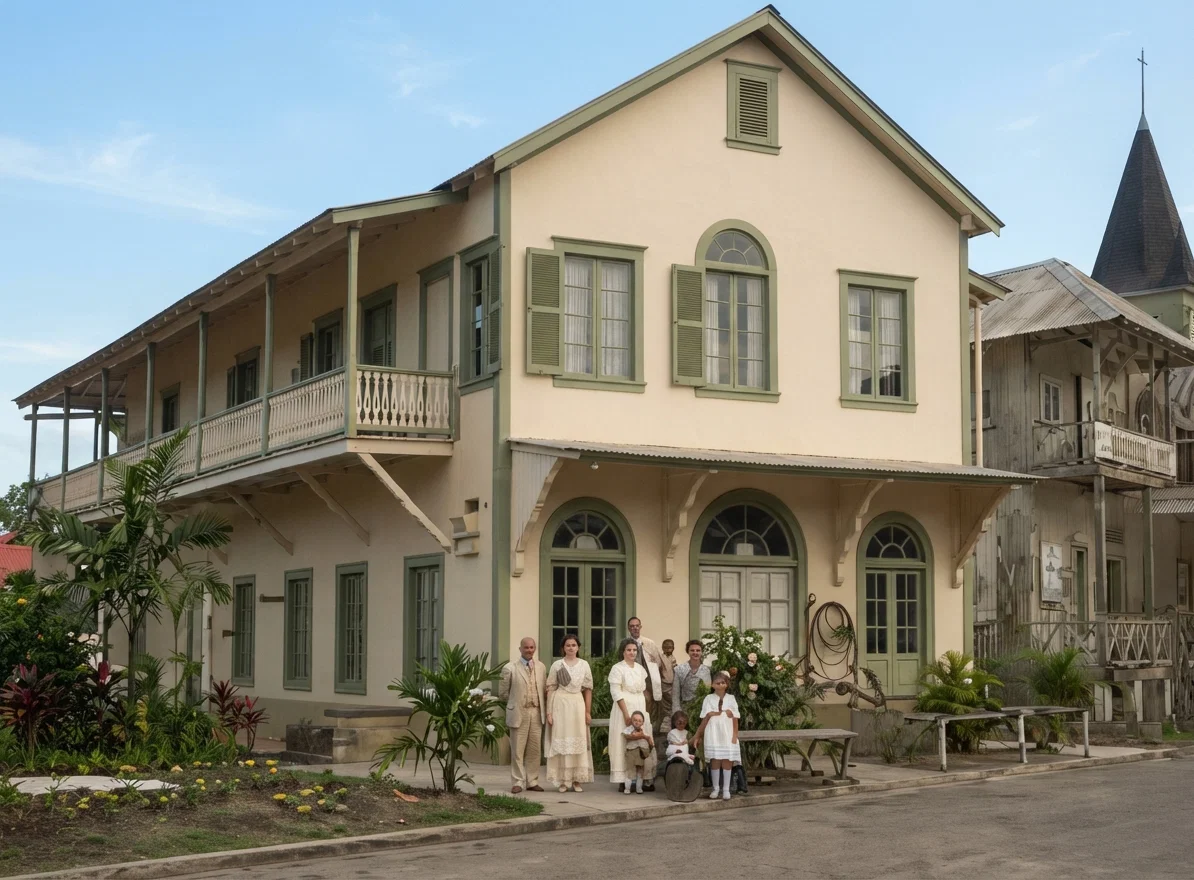
Cristobal, the American city, and Colon, the Panamanian, at the Atlantic entrance, form one city really, for they are only separated by street centers. Our mission headquarters are located just across the street from Colon, in Cristobal, and on the site of the former printing office and mission building, which was destroyed in the great Colon and Cristobal fire of three years ago. The chapel occupies the front, and the offices the rear, of the building in the center of page 13. Above are the living-rooms of the secretary-treasurer, who with his wife stands at your left; the president, Elder H. C. Goodrich, who with his wife stands in the center; and Elder W. G. Kneeland, whose family have not yet arrived. Immediately in front of Elder Kneeland, with her hand on the baby-buggy, stands Sister A. N. Allen, wife of Elder Allen, who is superintendent350of the Cuban Mission. She was visiting her parents, Elder Goodrich and wife, when I was there. The church numbers a little over fifty, and there is a good interest manifested in the meetings held nightly in the chapel.
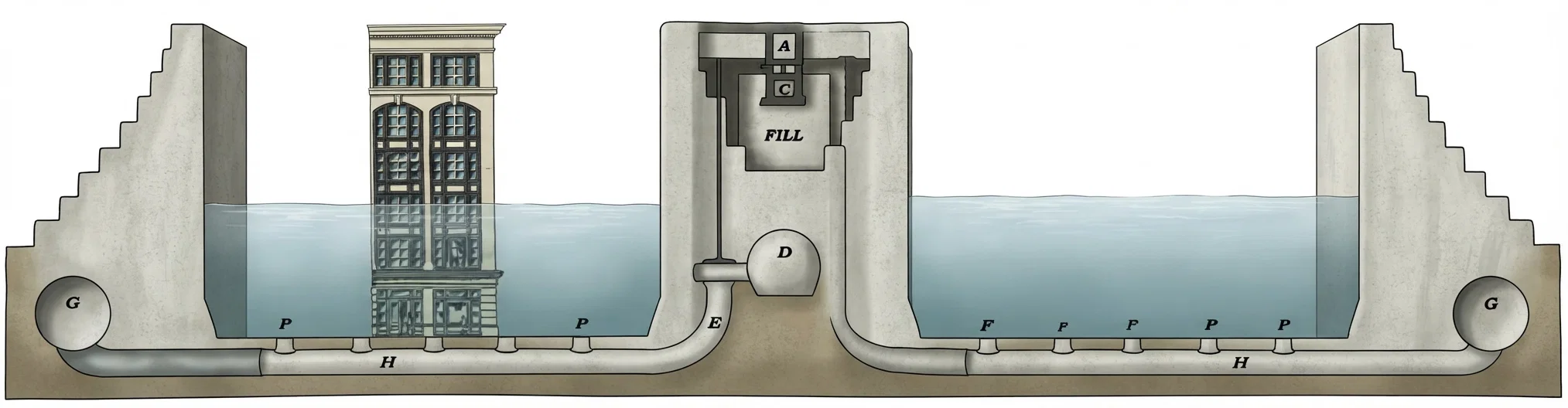
The water from Gatun Lake is admitted through culverts D and G, which are larger than average railway tunnels, and from them through the smaller laterals E and H and wells F into the bottom of the lock chambers. The laterals extending from the middle wall feed in both directions, thus permitting passage of water from one twin lock to the other. The six-story building shown gives another idea of the depth of these lock chambers.
TO BE SOON TAKEN DOWN
We have several small churches on the zone, one of which is at Empire, near Panama. This building is only a temporary one, and will be taken down soon, as that station is to be abandoned by the railway company. The lumber will be taken to Panama, and used in the proposed chapel to which reference has already been made.
A cut on page 12 shows a church dedication scene inland forty miles from Bocas del Toro, which is up the coast from Colon. This company was raised up by our colored minister, Elder J. A. Reid, who stands at the left of Elder Goodrich, in the entrance. The building is 22 x 38 feet, and was dedicated free from debt, although the struggle to accomplish this was a hard one. One sister sold her watch for $25, and gave the entire amount to the fund. The United Fruit Company despatched a special train from the port of Bocas, which helped to make the occasion of the dedication a pleasant and encouraging one.
HEALTHY GROWTH OF YOUNG WORK
Brother Charles Degering, the secretary-treasurer, who, with his wife, was formerly a student at Walla Walla College, gave me the following statistics concerning this conference, which is known as the West Caribbean. They have eleven church buildings, valued at $7,000, with a membership of 560, of which 85 were baptized during 1913. Their sales of gospel literature amounted to $10,407.78 last year. Their field covers the republic of Panama, the Canal Zone, Costa Rica, Nicaragua, and some adjacent islands. It is one of the four conferences and six mission fields in Central America, their membership being 3,947. The total membership in South and Central America is 6,645. Their tithes and offerings for 1912 were $64,675.88. We do not have the complete reports for 1913 as yet. Their combined sales of gospel literature were about $60,000 during the past year.
This closes my three months in the countries south of us. Truly they form a great and needy field. A large work is being done by self-sacrificing men and women, but far more must be done as this message of the soon-coming Christ is carried into all the world. Both money and workers are demanded. Let us send both.