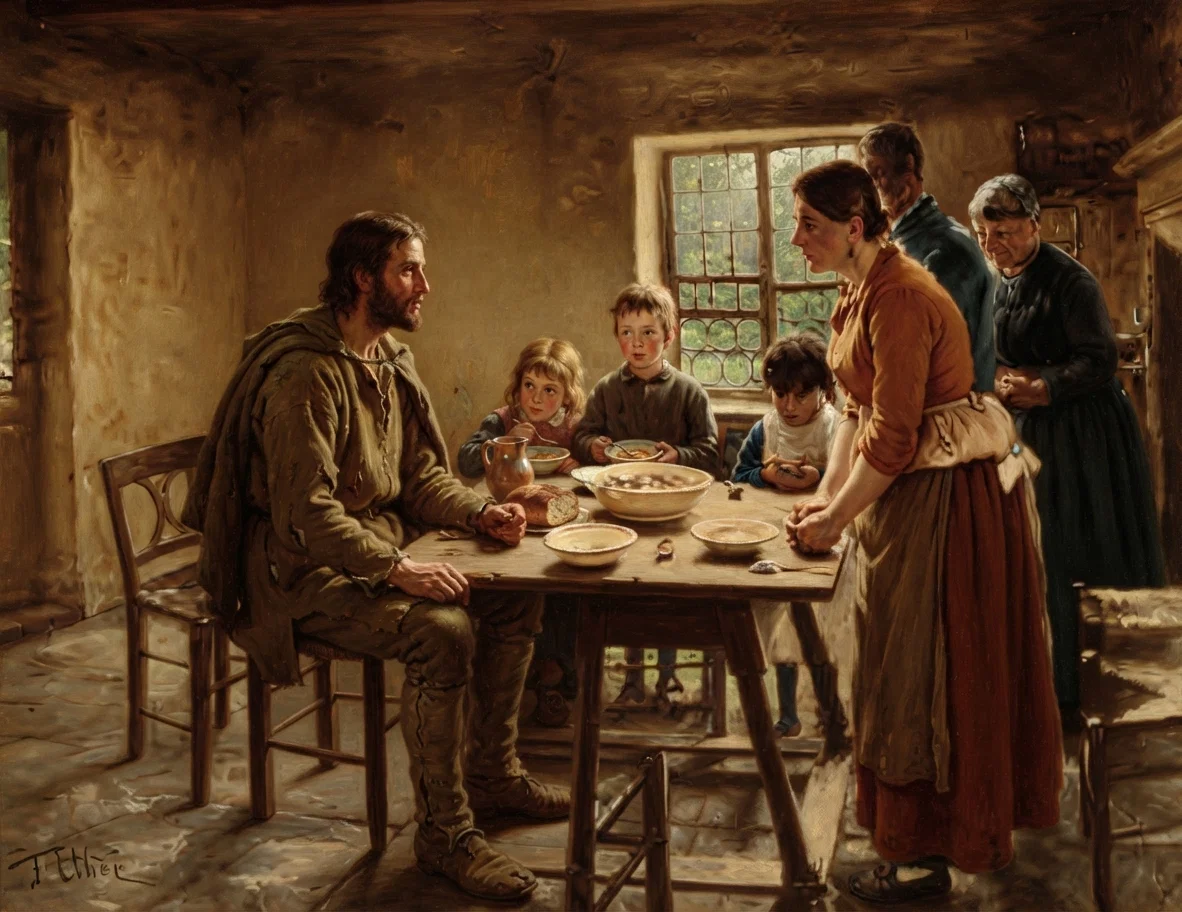
The Grace of Hospitality

3%

Pacific Press Publishing Association · Mountain View, California · Jun 16, 1914

FromSigns of the Times, Vol. 41, No. 23.

Read the full edition

The Grace of Hospitality

How Long Are You Going to Stay? The "Great Woman" and Her Guest
"How Long Are You Going to Stay?" The "Great Woman" and Her Guest
DID you ever enter a home where you had reason to expect a hearty welcome, and have your hostess in an unequivocal manner say to you during your introductory conversation with her, "How long are you going to stay?" If you never did, you have missed an experience that you can well afford to do without; for one thing that is indispensable to the happiness of every guest, whether an old-time friend or a new acquaintance, whether the visit be of one day's duration or of many, is a sincere welcome.

NOT SUFFICIENT TO SATISFY

Roomy apartments, lavish furnishings, elegant table appointments, of themselves are not sufficient to satisfy the inmost longings of that soul who for the time is separated from the hallowed associations of home, with all that is dearest on earth, and who longs for the blessed communion of friend with friend. The one thing that finds a responsive chord in the heart of an individual under such circumstances, is the sweet assurance that his presence is esteemed, and that he need not commit himself as to the exact time of his departure.

THE COIN OF FRIENDSHIP AND THE HEART OF STONE

Yes, "How long are you going to stay?" is the unpleasant echo that one sometimes hears when the coin of friendship drops unexpectedly upon the stony heart of a selfish, pessimistic hostess. The atmosphere in which she dwells is so close and so devoid of the health-giving oxygen of hospitality, that her guest, as well as herself, regrets the evident intrusion of a visit. But O, the sweetness of the association of friends where —
The twining rose of love so softly clambers About the threshold, while the ivy green Of happiness there delicately wanders, And spreads o'er all its magic emerald sheen!
The morning-glories bloom just as beautifully on the lowly cottage as on the palace of a king; and the cordial welcome so necessary to the happiness of every guest is just as sweet in the little mountain cabin as in the more pretentious home of the fashionable city suburb.

A GREAT WOMAN AND HER GUEST

I have found myself much interested in reading the fascinating and instructive story of "a great woman." The setting of the story is at the little ancient town of Shunem, between Jezreel and Mount Tabor, in that land so sacred to every lover of Holy Writ, which lies adjacent to the Jordan and the sea. This "great woman" and her husband were friends of the prophet Elisha, an itinerant missionary of those days, who had a standing invitation to share in the hospitality of their home; so as often as he passed that way, in company with his servant, Gehazi, he "turned in thither to eat bread."
“O, THE SWEETNESS OF THE ASSOCIATION OF FRIENDS”

BUILT A ROOM ON PURPOSE

Realizing that she lacked a room suited to the needs of her "sometime guest," this "great woman" said to her husband, "Let us make a little chamber, I pray thee, on the wall; and let us set for him there a bed, and a table, and a stool, and a candlestick: and it shall be, when he cometh to us, that he shall turn in thither." Her husband granted her request, and Elisha greatly appreciated the little room built especially to supply his need. We can imagine him after the day's travel, tired and footsore as he neared this haven of rest, where it was his privilege to find a temporary home, and to enjoy the blessedness of Christian hospitality.
In reading the brief story of this "great woman" of twenty-eight centuries ago, one is forced to conclude that one element of her greatness consisted in cheerful service to others. One can not be great as measured by the divine standard, without this beautiful characteristic.

PRIZED HER OPPORTUNITY

This "great woman" was willing to work as well as pray, for she improved the opportunities that came to her for Christian service. She did not "weary in well-doing," and say: "Elisha, I think you would better go to the inn, or find some other stopping-place where you may eat bread. I am very busy now, caring for figs and grapes, and a little later the olives will need attention. Besides, I think that I have done my part in caring for you, and that it is about time some of the other Israelites did their duty along this line."
No, she did not talk in this strain, nor did she go among her neighbors, to gossip about how much Elisha ate, or how many candles he burned. On the contrary, we are assured that he was always a welcome guest at mealtime, and we have no record that a meter was ever placed on the candle-box. This "great woman" was willing to sacrifice to supply the needs of the "man of God," and her husband gave his support to the blessed work. He was not of the lazy, selfish type, whose circle of service includes only "me and my wife, my son John and his wife, us four, no more," or he never would have consented to build the little room on the wall just for the accommodation of guests.

THEIR OWN SON WAS SAVED

This "great woman" and her husband later experienced the joy of having their son restored to life through this same prophet Elisha. Were no further reward in store for them, that surely repaid them for all their kindly service. But to those whose lives are filled with loving ministries to Christ in the person of His saints, the promise is sure, "Come, ye blessed of My Father, inherit the kingdom prepared for you from the foundation of the world."
"Let us make a little chamber, I pray thee, on the wall." That ancient guest-room was ideally located up in the sunshine and fresh air, just where sleeping apartments should be. The "great woman" did not assign her guest to a mustyroom, nor did she doom him to spend his nights in damp sheets. How do I know this? — Because Elisha would not have accepted repeatedly hospitality that at any time might result in fatal illness.

THE HOSTESS AND THE DEATH CHAMBER

That hostess who does not place any higher value upon human life than to provide death-dealing sleeping apartments for guests, need partake of this sort of hospitality but once in order to become convinced that this is not a pleasant death to die. It requires little stretch of the imagination to believe that many an epitaph might truthfully be written after the style of the ancient churchyard, something like this:
Here lies a poor man who thought it quite clever To sleep free of charge—alas the endeavor! The bedclothes were damp, They gave him a cramp, And now he is sleeping forever.
The world needs hospitality now just as it did in the time of ancient Israel. And where a "great woman" resides to-day, she is imbued with the same self-sacrificing spirit that was so manifest in the life of the hostess at Shunem. She, too, is a believer in fresh air; and she advocates not only a "dry state," but dry, health-giving sleeping apartments.

NO DUST-CATCHERS

There is no record that the little sunny guest-room at Shunem had any proverbial dust-catchers in the form of tapestries, curtains, or carpet. But in these days of more civilization and less health, those who entertain ministers usually have guest apartments furnished with those things which may become harbingers of disease. However, this need not be the case. If one has no vacuum sweeper, tapestries and curtains may be removed during the process of sweeping, and with gentle dusting before being replaced, they need not become a serious menace to health. Rugs are preferable to floor carpets from the standpoint of health, being easier to keep sanitary.
California is blessed with a climate much resembling that of the Holy Land. And it is gratifying to know that here and there in this garden spot on the shores of the "Sundown Sea," is a "great woman," a modern Shunammite, who loves to dispense hospitality, and the atmosphere of whose life is fragrant with the aroma of little deeds of loving service to others. O, the blessedness of such a home! And when the time arrives to "eat bread," it is the welcome that rejoices the heart of the weary traveler now just as it did that of the prophet of old. And the blessed assurance remains to-day, "The liberal soul shall be made fat: and he that watereth shall be watered also himself." Try it, and you will never have just cause to regret the experience.