A Ridiculous Classification — Quite as Absurd as the Evolutionists' Theories of the Flood
GEORGE McCREADY PRICE
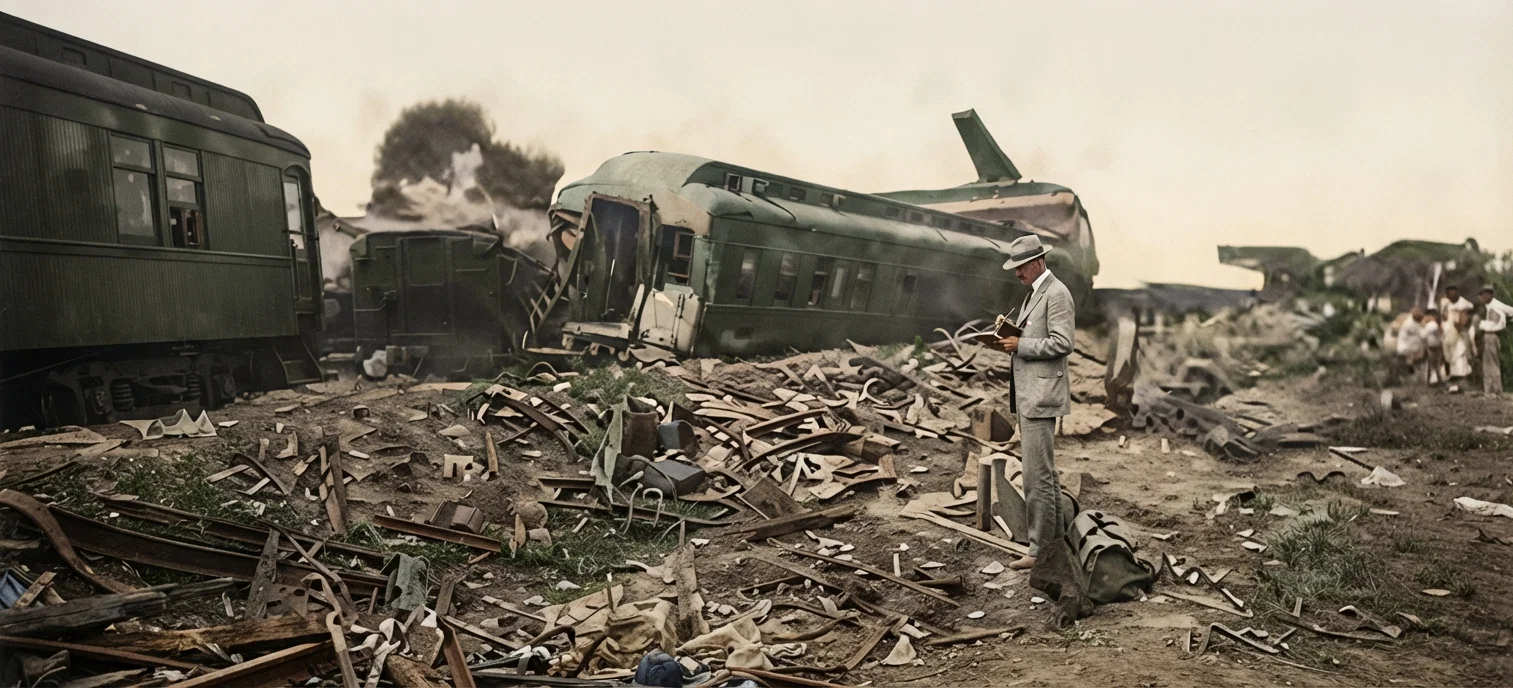
WHEN we heard of the horrible railway wreck at —, only five miles down the line, all our pupils were eager to see it.
Most of us teachers decided that we would have to stay home and keep things level at the school; but in small parties of six to ten the pupils were going and returning all that afternoon and evening.
As usual, I had been reading geological literature quite closely during the day, and this may have had something to do with my rambling thoughts while sleeping. At any rate, that night I had a strange dream, which, however, seemed to illustrate the peculiar methods employed by the popular geologists in classifying the fossils into the various ages.
THE CURIOUS DREAM
I dreamed that I visited the scene of the railway disaster, and saw the improvised morgue, composed of a large tent hastily erected by the railway people, where nearly half a hundred marred and mangled bodies were arranged side by side for ease in inspection and identification. They were all numbered, and so far as possible the names were attached.
While we were standing there in melancholy silence, thinking of the sad uncertainty of human life and human plans, we were startled by the noisy entrance of three men. One tall, scholarly looking fellow with a very professional air carried a note-book and a pencil, and gave jerky, peremptory orders to the other two, who seemed to be merely his subordinates, and did without question what they were told.
'Now, it is very important for us to do this just right,' he was saying, in his rapid, excited manner; 'for on the results of our work will be based the awards for compensation to be paid to the surviving relatives of the deceased.'
He walked up and down the line of dead bodies two or three times, looking here and there with his sagacious, piercing eyes.
CLASSIFICATION MUST NULLIFY THE WRECK
'Humph! What a senseless method of classification!' he muttered. 'This doesn't show anything at all about the order in which these people died; for it would almost seem, from the way these bodies are placed, that they were all killed at once. We'll have to bring them all over here on this side and arrange them properly.
'This Italian seems to be the smallest; and I see, by the record, that he is right from Italy, and has no friends or relatives in this country. We'll put him here and call him No. 1. This girl, also, has no relatives, and we don't even know her name. She will be No. 2.
'All these Italians will go in a group by themselves; for they have few relatives or friends in this country, and doubtless they were the first to die — or the first to be killed, as some would say.
'Then these Armenians ought to come next; for I see, by the record, that each one has two or more relatives in this country. But they are almost as poorly dressed as the Italians, and we will number them 11 to 20 inclusive. Just five pairs, even, and all men! Very significant — very!
HARD TO PASS UPON
'But these Scandinavians are harder to classify. They are all larger and better dressed than the Italians and the Armenians, and they have lots of relatives in this country, who will insist on heavy damages. I really suppose we ought to arrange them in three subgroups, according to whether they came from Sweden, Norway, or Denmark; but we will let that go for the present. You can number them from 21 to 32.
'But now we come to the hard part. These native Americans have hosts of relatives, and they are all well dressed in modern clothes. There are twenty-three of them all together. We'll simply have to arrange them on the percentage plan as best we can.'
HE GOES OVER HIS WORK CAREFULLY
After this general classification had been adopted, the learned doctor spent a considerable time in going over each group again and examining minutely the record of each individual. Often he would find occasion to change the order of two or three bodies in the group of Armenians or Scandinavians, as the case might be; for he insisted on getting them arranged so as to show the proportion of surviving relatives each had left behind in this country. But as the matter of size and complexion, of quality and style of clothing, was also to be considered, it often became a very perplexing matter as to just how certain individuals ought to be placed.
HIS SATISFIED AIR AND ABSURD CONCLUSIONS
Finally it was all done, and he looked them over once more with a satisfied, pompous air.
'Well, there! I fancy the work is all done as well as any one can do it.
'These Italians were certainly the first to die. Their bodies are all weak and badly nourished, and there is every evidence that they died of slow starvation — progressive anemia. Doubtless they were all dead before they got here — they had been gradually dying all the way from New York. Nobody ever heard of so many people dying of anemia all at once, so they at least were not affected by the little accident that occurred here to this railway train.
'But these Armenians are very different. They are all quite full-blooded, and so did not die of anemia. But Armenians are notoriously pugnacious and quarrelsome. And two or three of them still have guns or knives or other weapons on their persons. Doubtless they all carried such things to begin with, but in many cases these have been lost, so that we can't find them. Thus we see that the many wounds they all have were mutually inflicted. But it is unreasonable to suppose that they all fought together and killed one another in a pitched battle all at once. Universal experience is against such a supposition. No; the quarrel doubtless started soon after they left New York, and354involved a few of the most aggressive. After these had killed one another, others took part, until finally there were left but two, and these, like the famous Kilkenny cats, were at last mutually destructive.
THE ACCIDENT NOT RESPONSIBLE
"Thus this little railway accident was in no way the cause of their deaths, and the company can not be held in any way responsible for damages in these instances either.
"These Scandinavians are somewhat different. They are probably all suicides. For papers have been found on several of them indicating that they thought they were being brought out here against their will; and being resolute, desperate characters, they had resolved never to reach California alive.
"But these native Americans are more perplexing. Numbers of them lived at places only a short distance back on the road, some of them in Arizona and New Mexico, and some here in California.
"But several of them are badly burned or scalded. These were quite obviously violating the rules by riding in the cab with the fireman, and the engineer, and had only themselves to blame for their injuries. Ten others all have their heads badly crushed, which shows that they had carelessly exposed themselves in going through the various tunnels or in crossing the numerous bridges along the road.
"Only eight individuals are left, and they are all badly crushed and mangled. It is not quite clear how they met their death; but one of their number may have been carrying a quantity of dynamite or other high explosive concealed about his person or in a suit case, and the jar of the car set it off with disastrous results. At all events, even if it should turn out that some of this group were injured by the train itself, it does not follow that the railway wreck was the direct cause of their death. You know that the engine and the cars all ran into a big sand heap; and it is absolutely certain that the soft sand could not damage—"
AS RIDICULOUS AS EVOLUTION
The alarm-clock woke me up and cut short this ingenious lecture, so that I never knew whether the old doctor intended to explain away all the deaths as due to natural causes, or whether he intended to admit that possibly one or two had been killed by something that happened to the railway train.
But all that day I could not help thinking of the analogy between this old doctor's reasoning and the methods employed by evolutionists to explain away the plain marks of a great world catastrophe that are to be found in the rocks of every country on the globe, and which show that we have had a universal flood.
"For this they wilfully forget, that . . . the world that then was, being overflowed with water, perished." 2 Peter 3:5, 6.