Emphasizing the Social Message Rather than the Religious — The Kings of Finance in the Pews of the Church
Turning to the Labor Leaders — The Church and Economics — Is there Not a Far More Important Question?
By B. G. WILKINSON
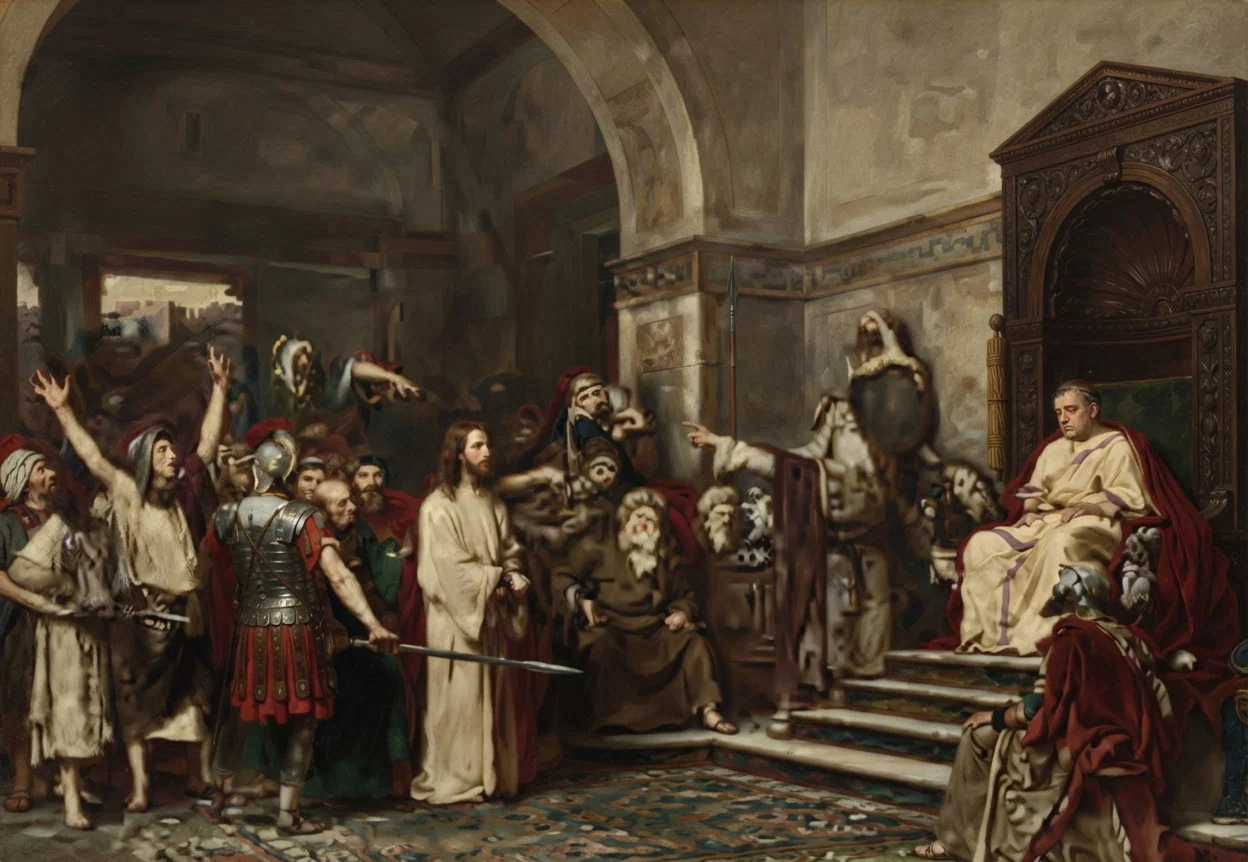
"Pilate . . . delivered an innocent man over into the hands of a howling mob."
THIS is the second of some five or six articles by Elder Wilkinson on the subject of church federation. Last week he recounted the steps in the formation of the movement, called attention to some dangers that are lurking in it, and spoke of the tendency to domination that is threatened by such a large ecclesiastical body. Later articles will discuss more fully the purposes and methods of the federation, the threat of its tendencies, and the menace to religious freedom.
EDITOR.
"I was during the epoch when there were sects and heresies that Christianity made the conquest of the world." — The Hon. Camille Pelletan, French statesman.
If church federation means a social message as the mission of the churches, then the churches have stepped down from having a religious message as a denomination, to having only a social message as a federation.
SIGNIFICANT SIGN OF THE TIMES
If this is so, it is strikingly significant as a sign of the times, for religion is God's agent for the uplifting of the world. The decadence, then, of religion is a great sign. It is the very sign emphasized by Christ when He said, "And because iniquity shall abound, the love of many shall wax cold"; and by Paul when he said: "This know also, that in the last days perilous times shall come. For men shall be lovers of their own selves, . . . having a form of godliness, but denying the power thereof."
There can be no real reform unless led by a religious reform. Convictions from God put backbone into men. Pilate, because he had only the worldliness of paganism to lean upon, delivered an innocent man over into the hands of a howling mob. When a mob set upon the apostle Paul, he begged of his friends to be allowed to go out and face the raging populace rather than bring the misfortunes of the hour upon his friends. William Lloyd Garrison, laying upon the consciences of Americans the crime of slavery, raised up an army of men to fight behind Grant, and a legion of voters to support President Lincoln. There could be no real social reform aside from religious reform.
The churches had it, and have had it in their power to produce an effect upon the great commercial leaders who sat in their pews; but what have they done in this direction for a Rockefeller, Carnegie, and others?
Let us hear what the Federal Council of the Churches of Christ in America says:
"Multitudes are deprived, by what are called economic laws, of that opportunity to which every man has a right. When autonomic movements cause injustice and disaster, the autonomy should be destroyed. That to these impersonal causes are added the cruelties of greed, the heartlessness of ambition, and the cold indifference of corporate selfishness, every friend of his fellow must with grief and shame admit. . . . The homes of the wage-earners in our great cities are an indictment of our civilization. The meager income, which is easily reckoned sufficient by the fortunate who are not forced to live upon it, is without warrant of reason. The helplessness of the individual worker, the swift changes in location of industrial centers, the constant introduction of labor-saving appliances, the exactions of landlords, add uncertainty to privation. The hazard of the mine, the monotony of the shop, the poverty of the home, the sickness of the family, the closing of the doors of higher opportunity, react with dreadful precision upon the temperament and mar character."—"The Church and Modern Industry," page 11.
MANY EXACTING LANDLORDS IN THE CHURCH
Yet many of these landlords of whose exactions complaint is made, and many of the wealthier mercantile kings whose systems are here indicted, sit in the pews of these churches. To such an extent is this fact recognized that some economic writers have classed the churches — the Christian churches — along with oppressive monopolies and selfish corporations.
It is a sorry confession that the church has failed to reach the heart. She has been unable to convert the leaders of these oppressive systems who sit in her pews. There is therefore a confederation, and a turning to the support of the law, to do by physical force what they have not accomplished by spiritual persuasion.
TURNING TO THE LABOR-UNIONS
Having failed to lead an economic reform, the church now turns to the labor-unions, which organized to protect themselves. And this is done with the manifest intent that the church might keep, by federation, the supremacy which she lost by spiritual leadership. Thus we read again the following recommendation of the federation:
"That the church in general not only aim to socialize its message, to understand the forces which now dispute its supremacy, to stay by the people in the effort to solve with them their problems, but also modify its own equipment and procedure in the interest of more democratic administration and larger social activity."
In other words, the labor-unions have gone ahead without the church; hence now it is necessary for the church to come over to their program and ideals if the church is to maintain its supremacy.
HOW DIFFERENT FROM CHRIST!
How different does this sound from the record of Christ! Jesus might have been at the head of the social order if He had been willing for the crowd to make Him king. The Saviour, however, understood full well that reform in men and reform among men could not be accomplished simply by study and attention to material things and industrial problems. This is His authoritative statement: "Seek ye first the kingdom of God, and His righteousness;
and all these things shall be added unto you."
When a young man came to Christ petitioning that He command this young man's brother to divide the inheritance, the Saviour caused it clearly to be understood that His message was not to deal with material problems and so equalize economic conditions. He refused to enter into even the discussion of such a question. The Church Federation, however, proposes to do the opposite.
THE THEOLOGICAL SEMINARY AND ECONOMICS
The denominational college, which heretofore has been set apart for such studies as would equip the ministry for its spiritual task, must now carry into its class rooms the debates and the problems tossed backward and forward between the capitalist and the laborer. Even the church itself is to become a forum for the pros and cons of industrial arguments. Listen to the following recommendations from the Church Federation:
"That to this end, in all theological seminaries, and so far as practicable in other schools and colleges, there be established, wherever they do not now exist, courses in economics, sociology, and the social teachings of Jesus, supplemented, wherever possible, by investigation of concrete social facts, and —
"That study classes and reading courses on social questions be instituted in connection with the churches and their societies, to foster an intelligent appreciation of existing conditions, and to create a public sentiment through which relief and reform may be more effectively secured.
"That the churches, with quickened zeal and keener appreciation, through their pastors, lay leaders, and members, wherever possible,387
enter into sympathetic and fraternal relations with working men, by candid public discussion of the problems which especially concern them, by advocating their cause when just, by finding the neighborly community of interest, and by welcoming them and their families to the uses and privileges of the local churches."
And as if the above methods would not be invasion enough, by the church, in the social and industrial fields, it is further recommended that in order to do this, the church "modify its equipment and procedure in the interest of more democratic administration and large social activity; that more generally in its buildings provision be made for the service of the community as well as for the public worship of God."
MORE FACILITIES FOR SOCIABILITY AND PLEASURE
That is to say, if there are not now enough pool-rooms, assembly halls, kitchens, and dining-rooms, connected with the church buildings, more must be added. No matter how many of these things the church has already had, it is apparent that she has failed to maintain the social supremacy, and therefore more of them she must add.
It is clearly evident, then, that church federation means the endorsement of whatever social activities the church has already been conducting; and wherever there has been a lack of these, it means more completely the socializing of the functions and activity of the pulpit. It is an adaptation of herself to what has already been going on round about her rather than a bringing up of that which has been going on round about her to that which has been taking place within her. Spirituality is practical, every one knows; but spirituality is not material. Spirituality works upon human forces, but does not look toward them. It is "not by might, nor by power, but by My Spirit, saith the Lord of hosts." Zech. 4:6.
ANOTHER SIGN OF THE TIMES
Another great meaning of church federation which is also another significant sign of the times is that the movement does not emphasize the Biblical solution of the present-day strife between capital and labor. Let us hear what is said upon this in James 5: "Go to now, ye rich men, weep and howl for your miseries that shall come upon you. . . . Behold, the hire of the laborers who have reaped down your fields, which is of you kept back by fraud, crieth: and the cries of them which have reaped are entered into the ears of the Lord of sabaoth. . . . Be patient therefore, brethren, unto the coming of the Lord."
The present social unrest was not unforeseen by God. Neither did He leave His servants in ignorance of "things which must shortly come to pass."
Now, if we have a correct understanding of James, what God wants His people to see in the present great strife between capital and labor is that it is going to wind up shortly in the second coming of Jesus Christ. That great event, when our invisible Leader shall return to this earth as our visible King, is absolutely more worthy as a theme of study for the true children of God than all the vast ramifications and perplexities of our modern social and economic conditions.
There will be many astonished people when the great realities of the future ma-
terialize before our eyes. They will then understand that Jesus meant what He said, when He commanded His followers to preach the gospel to every creature, baptizing them in the name of the Father, the Son, and the Holy Ghost. Church federation has turned the trend of modern church thought toward a social message, or toward socializing its message. But if we understand the gospel aright as spoken by Christ in His last great discourse in Matthew 24, and by the apostle James in chapter 5, the present external facts in the industrial and social world demand that the trend of modern church thought should distinctively and altogether be toward the second coming of Jesus Christ.
Is not this a sign of the times? Is not this again another evidence to be added to all the others that that second coming is near at hand?