Cannibalism Still in Some Parts — Persistent and Earnest Work of the Presbyterians — Ancestral Worship — Very Peculiar Burial Customs — Premium on Hogs
By C. H. PARKER
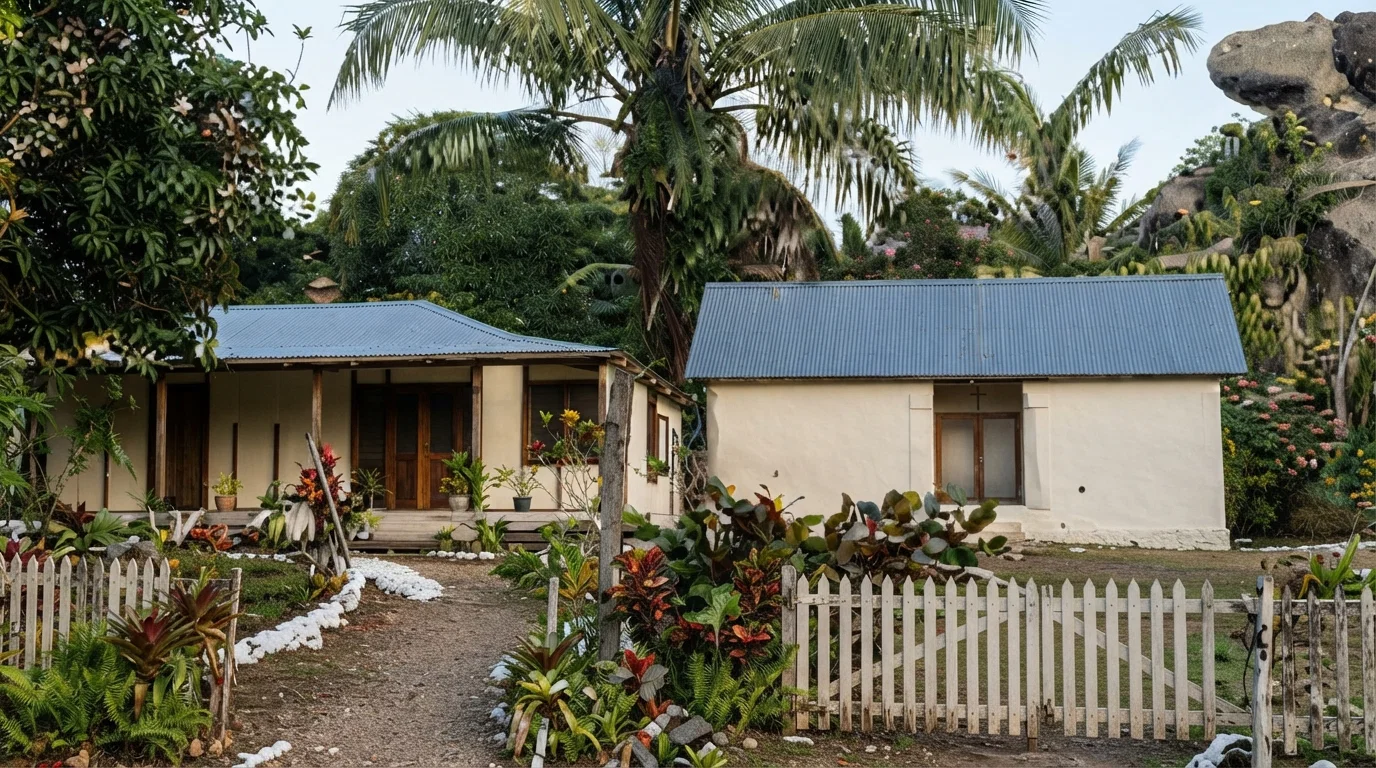
SEVENTH-DAY ADVENTIST MISSION HOME AND CHURCH, ATCHEN, MALEKULA, NEW HEBRIDES
LAST week Elder Parker described the country and the climate of the New Hebrides Islands. This week he devotes himself to the people and their grotesque customs. He has promised to send us, in later weeks, more in regard to the specific work our people are doing in that field.
THE New Hebrides have been and are a very interesting field from a missionary standpoint, and have called forth a great deal of heroic effort and sacrifice on the part of the Presbyterian mission, which has operated here for the past sixty years. The work has been hard, and many lives have been given as foundation-stones for the gospel structure to be reared thereon.
STILL SOME CANNIBALS
All of the southern islands of this group have nominally accepted Christianity, with the exception of Tana, where a large proportion of the population is still held in the darkness of heathenism.
Few of the people of Ambrym, Malekula, and Santo, which are the largest islands of the northern division, have exchanged their heathenism for Christianity. Malekula is the backbone of heathenism and cannibalism. Not more than five weeks ago, a boat's crew were killed and eaten; and about a week later, seven native teachers were shot, roasted, and eaten, almost in sight of our mission.
The men of the heathen population go about perfectly nude, with only a bark belt, which serves as a place to put their pipes, matches, knives, cartridges, etc. The coast women wear a narrow strip of calico around the loins, while those inland wear a sort of grass skirt. The children, until they become quite large, wear the dress that they are born in.
If an injury is done to any man, he retaliates upon the first man he meets.
THEIR HUTS
The houses are thatched roofs set on the ground, with a hole left through which the occupants crawl in. There are no mats to cover the dirt floor. The people lie in the dirt like the beasts. As a result, their houses are plague spots of vermin and disease.
THEIR ESTIMATE OF PIGS
In building a house, they have to make a feast, at which they kill a number of pigs. The person who kills the pigs can not go down to the salt water for ten days. The owner of the house can not go down for forty days. All this time, they must keep their faces blackened, and of course water does not come in contact with their bodies.
Pigs are at a premium — that is, tusked pigs. We are told that as high as three hundred dollars has been paid for one. These pigs are used in making sacrifices to the dead.
Women are exchanged for pigs. Often wives are bought when they are mere children.
WORSHIP THEIR ANCESTORS
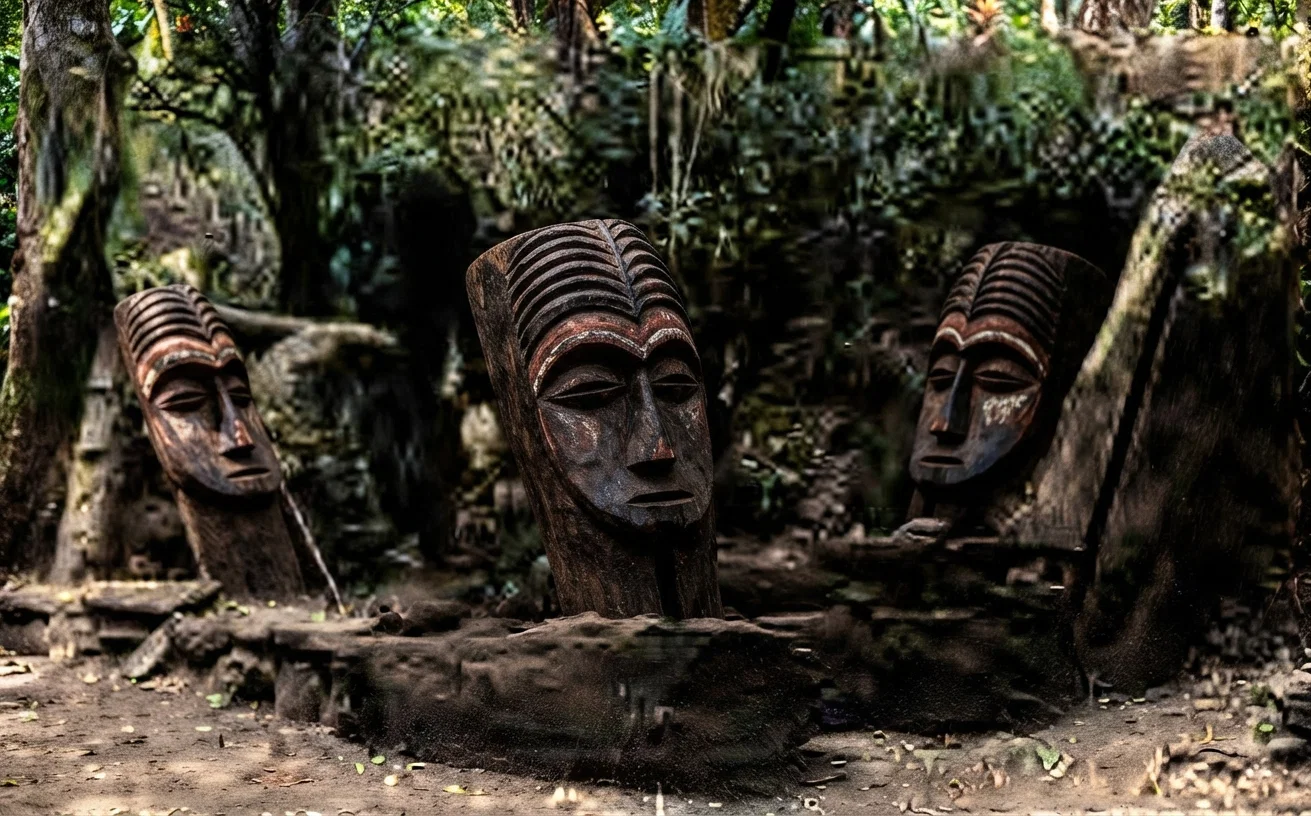
In their heathen dancing grounds, the people set up carved figures of their departed friends, before which they place stone altars. Upon these altars their pigs are killed, and there all food is offered before it is eaten.
Their worship is ancestral. The carved figures in memory of their dead are very grotesque. Over each of these figures is placed the form of a bird, like an albatross, with outstretched wings. In the bush, the natives have houses where they go to talk with their dead, asking them to help them, and to give them good seasons, plenty of yam and rain, and to make them strong in war with other tribes.
KILL A PIG AND CHANGE THEIR NAMES
Every time a man kills a pig, he receives a new name. It is very difficult to keep informed as to the names of the people, as they change so often. If a person is called by his old name, he stolidly replies that that is not his name. He can not tell you his own name, but some one standing by must speak it for him. I suppose this is New Hebrides etiquette.
Mr. Pig is king-pig here, and he is waited on hand and foot. His food is prepared and cooked from the best, and the women must feed him before they prepare their own food.
TOM-TOMS USED BY THE NATIVES IN ATCHEN, MALEKULA, NEW HEBRIDES
When his tusks complete the circle, pierce again the jaw-bone, and come through, then he is considered very valuable, and is kept tied to a pole, for fear that he might break his tusks while fighting with other pigs. Female pigs are never offered in sacrifice.
BUY WIVES WITH PIGS
Polygamy is practised, and a man can have as many women as he has pigs to buy with. Thus some men have several women, while others have none.
The men and the women do not eat together, and in most instances the men cook their own food, and the women theirs, on separate fires. The men will not take food from a woman, not even from a white woman. When they work on plantations, they are compelled to eat food prepared by white people; but when they return to their own people, they have to kill a pig so that they can be restored to caste.
The women are the burden bearers, while the men stalk on before, carrying guns, or bows and arrows, and clubs. If a woman runs away, the sinew of one of her legs often is burned, so that she will not be able to repeat the offense.
At the death of a man or a woman, a great wail is set up by the men. To one not acquainted with it, it would be mistaken for the howling of dogs. The ones that will profit by the land or other possessions of the deceased, howl loudest and longest.
The body is buried almost immediately, and generally in the house in which the person died. Sometimes, I am told, the face is left exposed to view. In the event of the death of an old man, three young men have to stay for one hundred days in the house where he is buried. During this time, they can not leave the premises nor see a woman.
WARMING THE DEAD
One rainy day, when passing by a house where an old woman was buried, we noticed a fire burning at the entrance, and a covering of palm leaves above, to convey the heat inside. We asked what it was for, and were told that the old woman was cold. Some may laugh at this as ridiculous; but there are customs practised by white people in the home land that are just as puerile.
NO WRITTEN SPEECH
The heathen people of whom I have been talking, have no written language; but it is wonderful how exact and concise they are in talking. Upon this we will have more to say at another time, as we are to reduce one of these heathen languages to writing. Later, no doubt, we will be required to do the same with other languages, as there is such a babel of tongues in these islands. We find it very interesting to hunt for the different persons, numbers, cases, genders, articles, etc. With perseverance, faith in God, and the controlling power of the Holy Spirit, the tongue of the dumb shall speak.