The Second Coming of Christ an Apostolic Doctrine—The "Falling Away" Obscured It
False Views of the Kingdom Sought to Supplant It—Yet It Is Still the Blessed Hope
By LEE S. WHEELER
THE second coming of Christ was not the first event the church in the days of the apostles was instructed to expect. "For that day shall not come, except there come a falling away first, and that man of sin be revealed, the son of perdition." 2 Thess. 2:3.
From the time of Christ's resurrection and ascension, the anticipation of His glorious return and the resurrection of all believers to a life of immortality was ardently believed and taught as "the blessed hope." Titus 2:11-13; Acts 1:9-14, 22; 4:2, 33; 1 Corinthians 15; 1 Thess. 1:9, 10.
GREEK MYSTICAL INTERPRETATION
The pernicious influence of Greek philosophy, however, in its tendency to attach a mystical interpretation to the fundamental doctrines of Christianity, particularly those connected with the resurrection and the future state, is frequently mentioned in the writings of Paul. Acts 17:18, 32; 2 Tim. 2:18; Col. 2:8; 1 Tim. 6:20; 2 Tim. 1:10-15.
From the opening of the second century onward Gnostic mysticism in the Eastern church, and Neo-Platonism in the West, ate like a canker at the teachings of the church; and in this "falling away" from the truth as it is in Jesus, the way was prepared for the establishment of that spiritual despotism in which the church supposed itself to be the kingdom of God, and man ruled in the place of Christ. Notwithstanding, "everywhere the Scriptures point to the kingdom of God as a thing of the future." ("Schaff-Herzog Encyclopædia of Religious Knowledge," article "Kingdom of God.") Dan. 7:27; Matt. 19:28; 1 Cor. 6:9; 15:50-53; Gal. 5:21; Revelation 20.
THE GLORIOUS KINGDOM
"In the West the expectation of a glorious kingdom of Christ found adherents for a long time."—"Catholic Encyclopædia," article "Millennium."
"The earliest Christians had been second adventists. This belief gradually died down, and was no longer fundamental at the time of the conversion of Constantine. That event and the subsequent triumph of Christianity [as a state religion] resulted in its complete eclipse."—"The Holy Christian Church," by R. M. Johnson, M. A., page 193.
A CHRISTIAN THEOCRACY
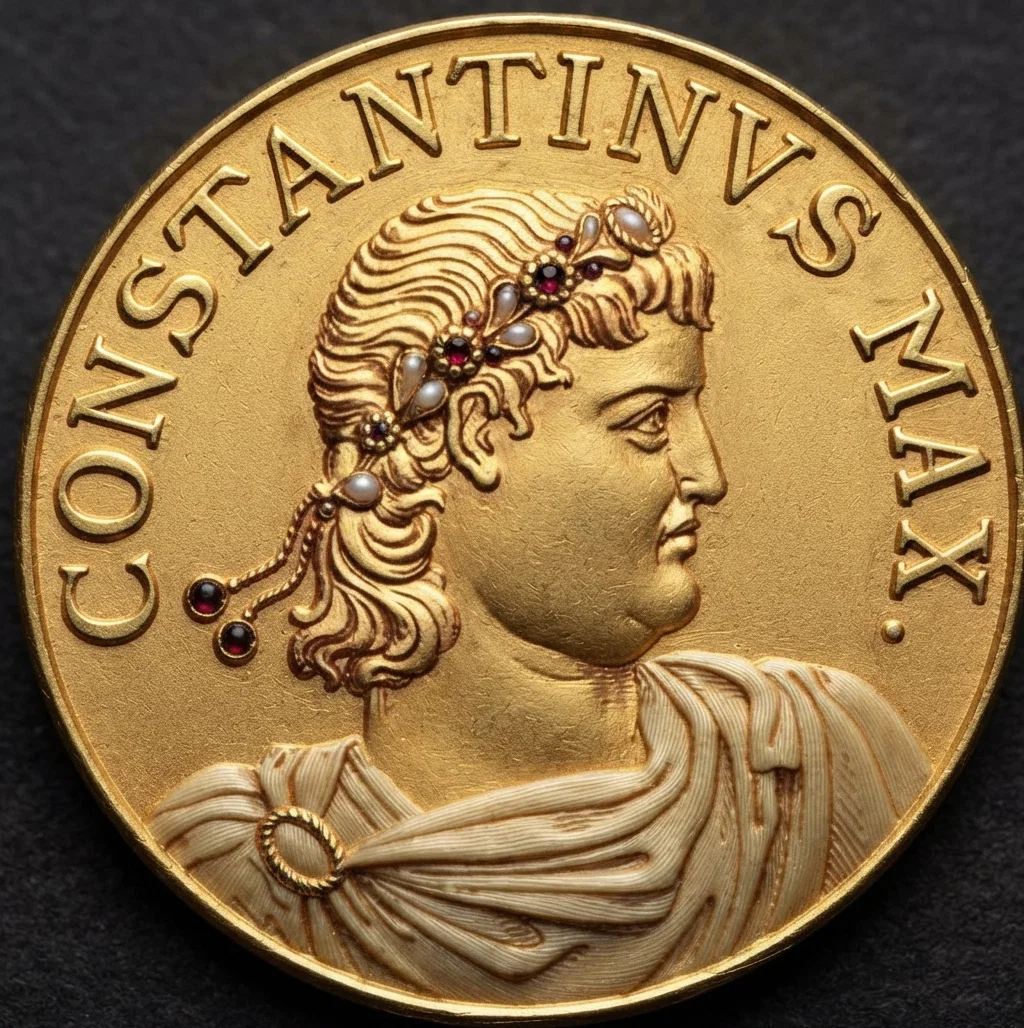
"Constantine, the first Christian Cæsar, . . . was the first representative of the imposing idea of a Christian theocracy, or of that system of policy which assumes all subjects to be Christians, connects civil and religious rights, and regards church and state as the two arms of one and the same divine government on earth."—Schaff's "Church History," third period, volume 1, page 12, paragraph 2.
"In the year 330, the emperor Constantine transferred the seat of government from Rome to Byzantium, which from that time was styled Constantinople. The temporal influence of the popes commenced to increase, nor did the emperors complain; nay, they were too willing to be relieved of the weight of government in Italy."—"Studies in Church History" (Catholic), by Parsons, volume 1, page 502.
THE CHERISHED TITLE "PONTIFEX MAXIMUS"
Still, however, the Roman emperors, to whom, since the days of Augustus, had descended the cherished title of "Pontifex Maximus," had not relinquished the prerogative6of supreme jurisdiction in religious affairs, by virtue of which Constantine, upon his conversion to Christianity, assumed all the authority of Moses, assembled the General Council of Nice, dictated the policy of the church, and attempted the suppression of heresy and the unification of the church under his own sovereignty.
From Constantinople, for more than two centuries, the Roman emperors continued to exercise such authority, until "with the decay of the empire the title [Pontifex Maximus] very naturally fell to the popes, whose functions as administrators of religious law closely resembled those of the ancient Roman priesthood, hence the modern use of 'pontiff' and 'pontifical.'"—"Encyclopædia Britannica," article "Pontifex Maximus."
THE CHURCH STEPPED IN
"The old Roman Empire was tottering to its fall; the church stood fast, ready to step into its inheritance. It was not simply that the world power, the enemy of Christ, had been vanquished; the fact was that it had gradually abdicated its political functions in favor of the church. Under these circumstances Augustine was led, in his controversy with the Donatists and as an apologist, to idealize the political side of the Catholic Church,—to grasp and elaborate the idea that the church is the kingdom of Christ, and the city of God. Others before him may have taken the same view, and he on the other hand never forgot that true blessedness belongs to the future; but still he was the first who ventured to teach that the Catholic Church, in its empirical form, was the kingdom of Christ; that the millennial kingdom had commenced with the appearing of Christ, and was therefore an accomplished fact."—"Encyclopædia Britannica," ninth edition, volume 16, page 317.
THE "DIRECT DIVINE RIGHT"
"According to the system of the 'direct divine right,' the pope has received immediately from God full power to govern the world, both in spirituals and temporals. The temporal ruler is only an official of the pontiff, and as he receives the temporal sword from the pontiff, to be used in conformity with the order of God, he may be deprived of it by the pope when he uses it against that order."—"Studies in Church History" (Catholic), by Parsons, volume 2, page 203.
This view is said to have first been taught by John of Salisbury, 1159, by Thomas a Becket, and by Henry de Suza, compiler of the laws of Swabia (1365), who asserted that "since the coming of Jesus Christ, all the dominions of the infidel princes were transferred to the church, and are vested in the popes as the vicars of Jesus Christ, the King of kings."—Ib., page 203.
IS THE CHURCH THE KINGDOM?
Cardinal Gibbons, in "The Faith of Our Fathers," page 23, furnishes us the following: "The church is called a kingdom: 'He shall reign over the house of Jacob forever, and of His kingdom there shall be no end.' Now in every regulated kingdom, there is but one king, one form of government, one uniform body of laws, which all are obliged to observe. In like manner, in Christ's spiritual kingdom, there must be one Chief to whom all owe spiritual allegiance; one form of ecclesiastical government; one uniform body of laws which all Christians are bound to observe; for every kingdom divided against itself shall be made desolate."
ARE PAPAL CLAIMS EXTRAVAGANT?
To the rest of the religious world, the claims of the papacy have seemed most extravagant and wicked. Yet it must be evident to any reflective mind, that if the assumption that the church is the kingdom be granted, the whole system appears logical and Scriptural; for of the kingdom of Christ it is said: "I shall give thee the heathen for thine inheritance, and the uttermost parts of the earth for thy possession. Thou shalt break them with a rod of iron; thou shalt dash them in pieces like a potter's vessel. Be wise now therefore, O ye kings: be instructed, ye judges of the earth." Ps. 2: 8-10.
Again it is said, "The nation and kingdom that will not serve thee shall perish; yea, those nations shall be utterly wasted." Isa. 60: 12. Consequently, if this interpretation is to be allowed, all the decrees of intolerance, and the crusades of extirpation waged against infidels and heretics, must be conceded to be but the exercise of the legitimate authority of the church, over the state. Protestantism has no defense, free governments have no ground for existence, by any system of religious teaching which assumes that the kingdom was set up at the first advent of our Lord, or that the prophecies of the kingdom should have a mystical interpretation.
APOSTOLIC DOCTRINE STILL MAINTAINED
On the other hand, those who, in the twentieth century, maintain the apostolic doctrine of the future coming and glorious kingdom of Christ upon earth, and who cherish still the "blessed hope" of the primitive Christians, see clearly, in the rise of the papal sovereignty and its long and persecuting career, a fulfilment of Paul's prediction of the "mystery of iniquity," the "falling away," and the development of the "man of sin," who, assuming to sit in the temple of God and to reign over the church as God, has, instead of the kingdom of Christ, developed the despotic monarchy of antichrist. Dan. 7: 17-26.