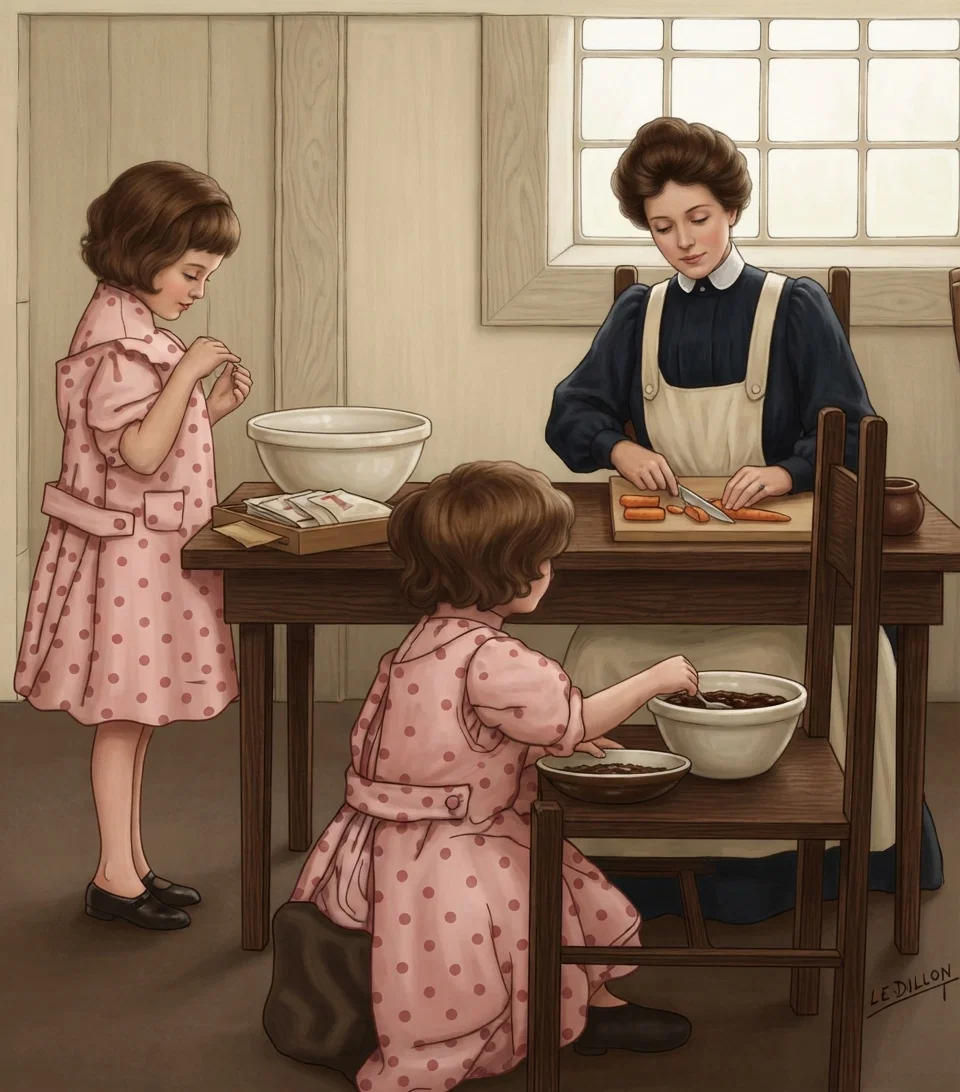
Creating an Appetite for Alcoholic Drinks — Unwitting Accessories to the Saloon — Fond Mothers Often Unintentionally and Ignorantly Join in the Ruinous Work
By DAVID PAULSON, M. D.
Medical Superintendent Hinsdale Sanitarium, Hinsdale, Illinois
Scientific cookery should be regarded as an important part of the education of our young people.
LITTLE advancement can be made in the great battle for temperance until we recognize some of the immediate causes of intemperance. Dr. Brunton, the eminent English physician, tells of a drunkard who complained because the temperance people were forever reminding him of his drinking, but never telling him how to get rid of the thirst that compelled him to drink. What would we think of a farmer who spent his time trimming the tops of his troublesome weeds instead of pulling the weeds up by the roots?
A CAUSE FOR HIS THIRST
There is a cause for the drunkard's thirst, just as there is a cause for the fever patient's temperature. Divine Writ declares that "the curse causeless shall not come." If our modern dinner-tables could be cleared of those things that create a craving for liquor, there would be more vacant places at the bar table; for the saloon, instead of being the first step in the drunkard's career, is frequently the devil's hospital, sought out by those who already possess abnormal tastes created by a fond mother's cooking.
AN UNQUENCHABLE CRAVING
Our high pressure life is developing a people of weak and sensitive nerves. The mucous membrane of the stomach is as delicate as the lining of the eyelid. Many who are fed on veritable mustard plasters in the form of condiments and highly spiced food, find that these arouse a thirst the town pump can not quench. And a certain number of these unfortunates soon discover that the saloon-keeper and the patent medicine vender alone dispense the stuff that satisfies the craving created at the table.
It has been said that the kitchen is often the vestibule to the saloon. When a boy's delicate nerves are irritated by a dietary composed of juicy beefsteaks, doughy bread, and pasty mush that is almost certain to ferment before it can be digested, shall we wonder that he often craves the temporary felicity of the cigarette or the paralyzing influence of alcohol?
IN PARTNERSHIP WITH THE SALOON-KEEPER
That mother who prepares such food for her boy is unconsciously the best friend of the cigarette dealer and the saloon-keeper, for she is developing business for both. It is useless for her to implore Providence to deliver her boy from the curse of the cigarette evil and the liquor traffic, while she daily places before him a dietary that must create a demand for these things just as surely as the eating of a large quantity of salt develops a desire to patronize the water bucket. The divine declaration, "Whatsoever a man soweth, that shall he also reap," is as unerring in its operations as is the law of gravitation.
Our experience in dealing with multitudes of drunkards has thoroughly convinced us that partaking of an extensive variety of indigestible foods, saturated with substances that blister, burn, and sting as they are swallowed, and that are added for the purpose of giving the palate a twist, also twists the nerves, and even the temper and the character, almost dragging the poor, struggling victim of the drink habit into the saloon's open door.
SOWING FOR TEMPERANCE
We have not done our duty toward these sad wrecks of humanity until we have shown them how to sow for temperance instead of intemperance; for the ax should be laid at the root of the tree. Feed these men on a simple, nutritious, non-irritating, wholesome dietary, gathered from the lap of nature and properly prepared, and fully half the battle is won.
Scientific cookery should be regarded as an important part of the education of our young people. Indeed, some one has declared that cookery should rank highest among the fine arts. Yet the enterprising business man who demands an accurate stenographer, a well-informed lawyer, and a discreet manager, is fully satisfied that the woman in his kitchen is a competent cook if she can flavor and put together half a dozen food ingredients so that they please his taste, even though she may have no intelligent conception as to whether they will build up or destroy the brain, blood, and other tissues.
DISGUISED INTEMPERANCE
Children frequently have the seeds of intemperance sown within them by the patent medicines given to them in their infancy. A widely advertised soothing sirup, which has undoubtedly killed more children than Herod ever slew, contains one half a grain of morphin to every two ounces of the drug; and infants are particularly susceptible to the influence of narcotizing drugs.
The estimate that there are a million morphin and cocain fiends in this country is not surprising when we reflect that myriads of children are introduced to the bewitching effect of these drugs,2and their nervous systems are trained to demand it, even before they are old enough to speak. "Train up a child in the way he should go: and when he is old, he will not depart from it," sets forth a principle that is just as true when the child is trained in wrong habits as when he is trained in correct habits.
Disguised intemperance in the form of the patent medicine evil has become a formidable rival to the saloon itself. It is astonishing that clergymen, statesmen, and other eminent men will furnish glowing testimonials of patent medicines that contain in some instances more alcohol than does ordinary whisky. These men evidently forget that the alcohol sold over the drug counter is as harmful as that sold over the bar.
Dr. Osborne, of Yale, in his paper read before the last meeting of the American Medical Association, spoke of one patent medicine firm as reported to be using five hundred barrels of whisky each week.
THE GREAT DECEIVER
The idea that alcohol is a food is a thinly coated scientific sophistry which has furnished a desirable excuse for thousands of moderate drinkers. It is true that a small quantity of alcohol will burn or oxidize in the body; but it ruins the body while it is burning, just as a quantity of gunpowder will burn in a stove, but will blast it in the process of combustion.
Professor Kraepelin, of Heidelberg, Germany, one of the world's greatest authorities on experimental psychology, has recently made two thousand experiments, in which he has scientifically demonstrated that as little as one third an ounce of alcohol will appreciably depress sight, hearing, feeling, and the various mental operations.
THE BEST MEDICAL MEN RECOGNIZE IT
The best men in the medical profession are beginning to recognize the fact that genuine and permanent healing can not be put up in bottles and bought and sold at so much an ounce. It is primarily the result of harmony with nature's laws, and the intelligent use of such physiological remedies as exercise, air, proper food, hydriatic measures, electricity, and a simple confidence in an all-wise God.
The physician who intelligently and skilfully brings these influences to bear upon his patients, uses fewer and fewer drugs; and of all the drugs he handles, he has the least use for alcohol.