Her Revised Constitution — The Republic of China in Reality Only a Name
By ROSS C. PORTER
Editorial Correspondent, Shanghai
SOME weeks ago, in an article on "China Reacting Toward Heathenism," I stated that China was in the throes of a reaction that would prove to be both anti-republican and antichristian. The antichristian demonstrations since that time have abundantly confirmed that phase of what was anticipated.
THE CONSTITUTION REVISED
The revised provisional constitution was promulgated May 1. In it China is still called a republic, and the "sovereignty" of the nation is said to be vested in the whole body of the people. Yet the provisional constitution confers all power on the president. He is responsible only to the citizens of the republic. He will convene the senate, and can dissolve it. The dissolution is dependent only on the consent of the new administrative council, and the condition that another senate will be convened within six months from the time of dissolution.
THE PRESIDENT IN EFFECT A DESPOT
In times of great distress, if the senate can not be convened, the president is authorized to issue regulations which, when approved by the administrative council, will be enforced, subject to approval of the senate when it convenes. The president is commander-in-chief of the army and the navy, declares war and martial law, and closes peace. He appoints the officers, and confers orders and titles. He is authorized to mitigate punishment and grant pardons. The concurrence of the senate is required to grant a general amnesty.
If the president becomes guilty of high treason, four fifths of the members of the supreme court will be constituted a committee, or special court of justice, for his trial. Three quarters of this court must concur in conviction in order to establish guilt. He can declare sessions of the senate secret, which otherwise would be public; and he publishes all laws. The national assembly chooses the committee of ten for the revision and redrafting of the permanent constitution. When it has been announced by the president, the present provisional constitution becomes void.
THE END OF THE EXPERIMENT
Commenting on the provisional constitution, the China Press speaks editorially, in its issue of May 8, as follows:
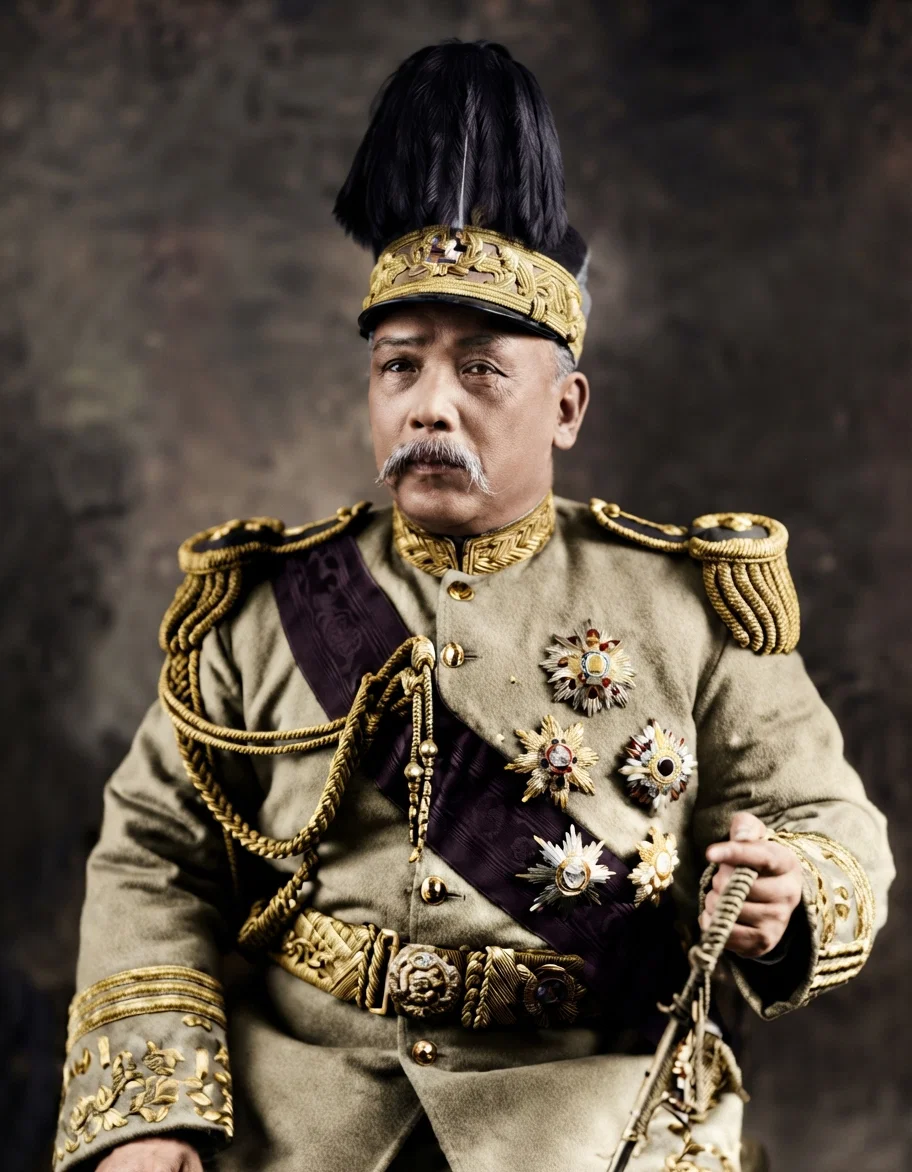
YUAN SHI KAI, PRESIDENT CHINESE REPUBLIC
"China's new constitution . . . marks the end of the experiment of representative government in this country, and the formal inauguration of a dictatorship. . . . In terms similar to those of the original Nanking constitution, certain rights and privileges, such as freedom of speech and publication, immunity from arbitrary arrest and domiciliary search, secrecy of correspondence, and freedom of religious belief, are guaranteed to the Chinese people. But a perusal of the whole constitution intimates that these guarantees are not worth the paper they are written upon. Freedom of publication has already received a severe blow from the recently promulgated press law, which was issued by the president without its even undergoing the formality of passage through the political council."
The evidence accumulates, as time passes, making it plain that China is preparing to act her despotic part in the closing drama of earth's history, when awakened heathen nations shall assemble for the Armageddon battle.