Army Organized, Equipped with Guns, and Trained, in Violation of Law — Men of Powerful Influence back of the Movement
A Counter-Catholic Army — Labor Organizations Combining with Threat of Armed Resistance
The Government in Perplexity and Powerless
By W. T. BARTLETT
Special Correspondent, London, England
It was often said, a year or two ago, that there was no excitement in the country over giving home rule to Ireland, that the issue had lost all the interest it possessed in Mr. Gladstone's day. No one has talked that way during the past few months. We have been passing through a succession of dramatic crises, of hairbreadth escapes for the government, of sudden and striking developments.
At the present writing, the bill is safely through the House of Commons, and is now, in company with an amending bill, under the consideration of the House of Lords. The peers can not do anything more with the original bill; but they may prolong the controversy in the parliamentary arena by raising a fresh contest over the government's amending bill, and out of this stage of the proceedings no one can tell what fresh surprises may spring.
If the government, however, is able to hold its own against the various forces that are working for its downfall, the bill must, in the course of a few weeks, receive the royal assent, whatever course the lords may take.
Sir Edward Carson and His Army
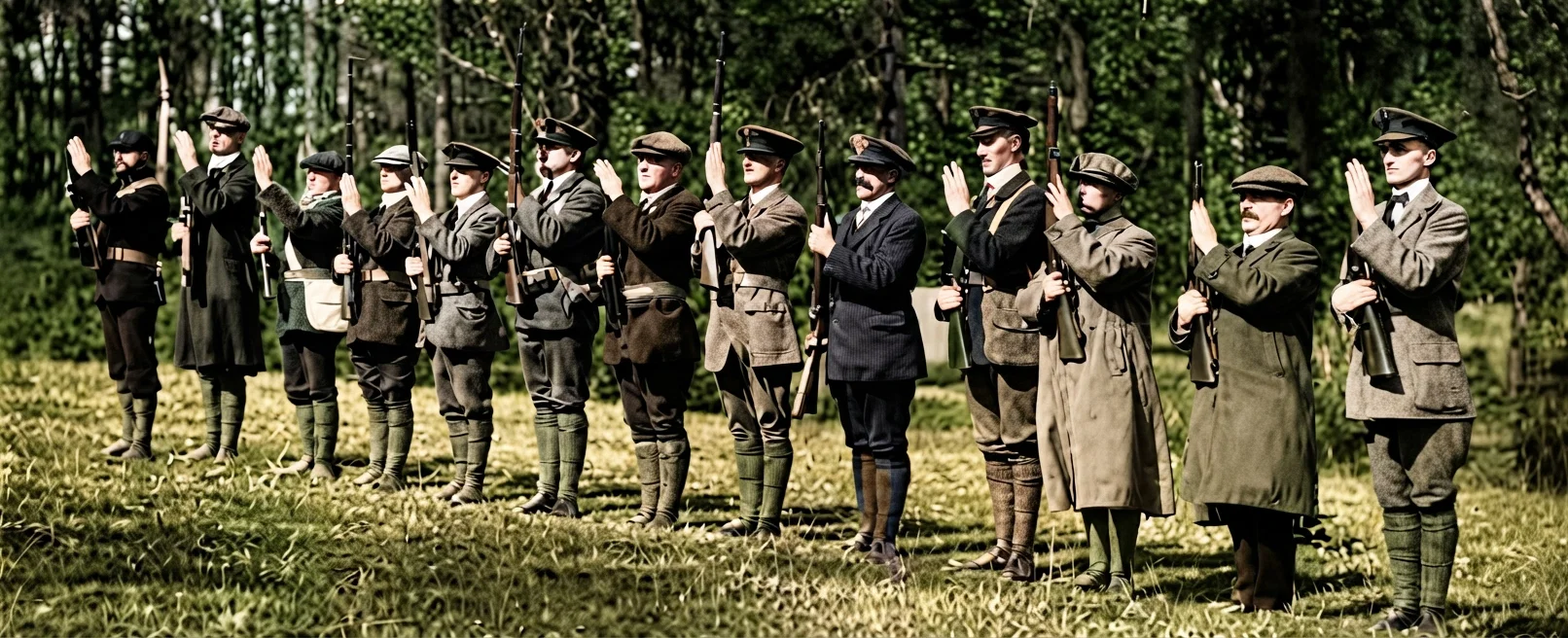
The Irish difficulty began first to wear a formidable appearance when Sir Edward Carson organized the Ulstermen into a volunteer army, sworn to resist to the death the authority of any nationalist government that might be established in Dublin. Still, no one knew what this really amounted to. In the north of Ireland everybody was certain that it meant civil war if the Ulstermen were driven to that extremity; but elsewhere people were inclined to think that when it came to cold steel and gunpowder, Sir Edward Carson's army would melt away.
Many Army Officers in the Plot
The situation took on an altogether different aspect when the fact was discovered that many officers in the regular army sympathized with the cause of the Ulstermen and would resign rather than bear arms against them. Through the maladroit handling of the problem at the war office, the kingdom was thrown into a ferment over the crisis that was supposed to have arisen. Was parliamentary government to be subordinated to the army, or was the army the servant of the government?
Mr. Asquith carried his cabinet safely through this crisis by taking up himself the office of secretary of state for war; the former secretary, Colonel Seeley, having felt compelled to resign his office.
For a few days the excitement in the country was intense. Bitter things were said in the most public way about the king, who was supposed to be behind the army revolt, encouraging an attitude of refusal to coerce Ulster, if coercion should be deemed necessary. Mr. Asquith explicitly cleared the king from this suspicion, but it was still repeated in certain quarters.
The Government Seems Helpless
The next step in the drama was the famous gun-running exploit of the Ulster volunteers, who managed to defy the forces of the crown, and, in spite of the vigilance of the navy, land a large cargo of guns and ammunition near Belfast. The government talked in dignified language about dealing appropriately with the authors of the outrage, but nothing was done. Mr. Asquith seemed to be weakly making one concession after another to the opposition, without satisfying them in the least, allowing them to talk sedition publicly without check or hindrance, taking no steps to punish the open infraction of the proclamation forbidding importation of weapons and ammunition.
What could be the explanation of this supine policy, unless the prime minister knew that he was powerless to enforce law and keep order, by reason of a wholesale military defection?
Catholics of Ireland Arming Too
Thus events drifted along for a while, and then a new phenomenon appeared. Suddenly England awoke to the fact that the nationalists of the south and west of Ireland had also been raising a volunteer force, which had grown to be one hundred and twenty thousand strong, and bade fair in time to reach three hundred thousand. Included in this body of men were thousands of old soldiers and officers. The Irish question had assumed still another aspect. All Catholic Ireland was rising in arms. The Ulstermen were likely to be many times outnumbered if it came to a contest. The men of Ulster themselves recognized the change that had taken place. The specter of armed resistance had called forth another specter. Force was to be met with force.
Photograph by Paul Thompson. CAMP OF VOLUNTEERS ORGANIZED UNDER THE DIRECTION OF SIR EDWARD CARSON. OBSERVE THAT THE MEN ARE DRILLING WITH REAL GUNS.
The result is that just now public opinion is calling on all sides for an amicable settlement. The question is not so much, What will England grant? but, What attitude will armed Ireland take? The two forces may amalgamate, it is thought. They are expected to form the nucleus of a territorial army under a new national government. The Irish parliamentary party has succeeded in obtaining control of the nationalist volunteer force, and has thereby been powerfully reinforced as a commanding factor in the controversy.454
An Object-Lesson to Labor and a New Peril
Mr. Asquith's government is still, however, traveling a perilous road. As I write, there is doubt as to whether they will receive the support of the labor members over certain questions that arise on Mr. Lloyd-George's latest budget. That gentleman has brought forward fresh proposals for the further taxation of the wealthy classes, and is as usual the object of their strenuous hostility. Some wealthy members of his own party seem not unwilling that his career in this direction should receive a check. The relations between the labor party and the liberal government have not always been close and friendly of late. The two parties are frequently in conflict in by-elections.
The labor members in the House of Commons have demanded again and again why it is that Sir Edward Carson and his friends can make seditious speeches, and arm themselves in open defiance of law and government proclamation, while working men must conform strictly to the law or go to prison. Some of the labor members have given notice that they and those whom they represent are taking note of the license granted to wealthier offenders, and that no government need ever expect again that hungry strikers will show such a submissive and law-abiding spirit as they have usually manifested in the past. They see that others depend upon threats and force, and find these the most successful methods; and henceforth they also will rely more on the same weapons.
The Most Ominous Ever Known
We are likely to see, before long, how much this intimation means. Three of the largest groups of unions in the country, representing the miners, the railway men, and the transport workers, have lately amalgamated. These three organizations together have a membership of about 1,500,000; and all three of them intend to present demands early next year, simultaneously, for a considerable increase in wages. Unless the demands are granted to all three, simultaneous strikes will be ordered, and in that case the country will be face to face with an industrial crisis such as it has never before had to meet.
The Militant Desperadoes
The sex war continues with unabated ferocity. Here also the agitators seem to rely on nothing but force for the accomplishment of their purpose. The militant suffragettes have been successful in committing a considerable amount of damage lately without detection. Old parish churches have been burned to the ground, disturbances have been created in places of worship, and even the royal court has not been exempt. At a recent reception, a lady of good position attempted to address the king on the subject of "votes for women."
A bomb was exploded in Westminster Abbey, and a portion of the coronation chair, on which every king of England sits at his enthronement, was shattered. Public opinion has been greatly exasperated by this continuance of outrages, and many suffragettes have fared ill in their open-air propaganda.
The militants made a great mistake one Sunday when they attempted to disturb the worship in two well-known Roman Catholic churches. Catholics have no scruples about employing the arm of flesh. The congregation promptly set upon the offending militants and treated them roughly. One of the suffragettes was just escaping in a cab, when she was dragged out by one of the indignant women of the congregation, and soundly beaten before she was allowed to depart.
The government thinks that in time it will wear down the movement by means of its "cat and mouse" act; and it declines to allow the militants to die in prison of starvation, although much urged thereto whenever they adopt the hunger strike. The government is hoping to proceed by legal process against wealthy supporters of the militant movement, and obtain large compensation from them for damage wrought.
Impending Break-Up of Civilization
It will be seen, from the foregoing, that one need not look very long in this country for signs that indicate the danger of an impending break-up of civilization, and a return to comparative barbarism, unless some strong influence shall operate upon the existing confusion and restore order and tranquillity. There is a chorus of lamentation on all sides that we are fast reverting to paganism.
Philip Snowden, M. P., himself a prominent socialist, speaks thus of the outlook:
"It is obvious to every one that we are approaching one of those historic epochs of revolution when, either by peaceful movement or violent change, the old order must give place to the new. There is a real danger that unless the true lessons of the labor and social unrest are understood, and unless wisdom and experience are brought to bear on the treatment of the problems involved, blind ignorance, class hatred, and a burning sense of injustice on the one side, and on the other, fear of the dispossession of property and the loss of social position, may lead to violence, bloodshed, and inconceivable suffering."
Anglican Church Too Weak for the Situation
It is the special function and privilege of the church, many acknowledge, to act as a moderator at such times as this, and impose, by a supernatural authority, its controlling will on popular passions. But the church is, at the present time, in no position to speak with authority. Its own ranks are divided between those who still hold its creeds and charters to be valid, and those who have criticized these almost out of existence.
Bishop Gore, a few weeks ago, published a demand that a firm hand be exerted by the episcopate of the Anglican church to exclude from its ministry those who have ceased to respect its standards of doctrine. To the general surprise, the challenge was taken up by Professor Sanday, who has been regarded in the past as a pillar of orthodoxy, but who now expresses the opinion that the critics have not been answered, and he fears, can not be. This unexpected declaration has greatly strengthened the critics, and startled those who would still like to cling to the Bible.
Rome Sees Reason for Her Advancement
The organ of the Roman Catholic Church sees in the circumstance another welcome evidence that the Church of England is breaking up, and asserts that the Church of Rome will soon be left as the one champion of the Christian faith. This is what it says on the present situation:
"Every man believes what is good in his own eyes. There are creeds and standards, but criticism has wrought havoc upon both. What the rust could not devour, the moth destroys. . . . No church can abandon tradition and Scripture and creed, and live as a church. The choice is fast becoming this: Criticism or church? And unless all the signs of the times bewry us, we shall see, in the days approaching very quickly, that where there is no pope there is no church, no Christ. The world will lapse, is speedily lapsing, into paganism, from which it may be the lot of the Catholic Church, centered in the see of Peter, to restore mankind once again, and build up the temple of Christ on the corner-stone of the pope. Who crushes error, saves truth. Who will save truth, must crush error. There seems to be in Europe to-day no power except the papacy capable of preserving the doctrines of Christianity and maintaining belief in Christ."—Catholic Times, June 19, 1914.
Roman Church Is Jubilant
The Roman Church is jubilant over the prospect that unrolls before its vision. With religion disintegrating in England, and home rule about to be realized in Ireland, why should it not hope for a revival of its ancient power in the United Kingdom? I quote from the same journal just mentioned, the issue dated June 12, as follows:
"Ireland is mostly Catholic. In the years to come, under home rule, the fact of so many Catholics in Ireland being in the government of that country will certainly influence the counsels of England. It is scarcely possible to conceive of a gross injustice being done to English Catholics while such numerous Irish Catholics are so near. No doubt we shall have to fight our own battles, but we shall not fight without friends. And if, united in England, and befriended in Ireland, we can not prove ourselves to be a match for any attack on our religious or educational life, the fault will be our own."
Defeated a Sunday Bill
A bill for the enforcement of Sunday observance came before the House of Commons a few weeks ago, and was thrown out by 117 votes to 105. This is a setback to the Imperial Sunday Alliance, which has been working very hard for the passage of Sunday legislation. But the alliance does not intend to drop its efforts.
The Irish members did not favor the bill, on the ground that Ireland would prefer to deal with such matters in her own parliament, soon to be set up; and the alliance hopes that when the imperial Parliament is reduced in size by the withdrawal of the bulk of the Irish representation, this bill can be brought forward again with better success.455
Din of War Throughout Europe
The din of war preparation still resounds throughout Europe. France is in trouble over the three years service law, and no ministry that stands for the strict enforcement and maintenance of this act can at present obtain a working majority in the French Chamber.
Russia and Germany face each other with greatly increased forces, and animated by a bitter spirit, which is allowed to find frequent expression in the press of each country. In the course of the next three or four years, the peace establishment of Russia will be raised to about 1,700,000 men, or almost double that of Germany.
The recent German attempts to secure an overwhelming preponderance in armed strength have only succeeded in raising up against her on both frontiers vastly larger armies than she before confronted. The other countries of Europe outside these mighty rivals are not exempt from the obsession that condemns them to waste their substance on fevered preparations for a day of slaughter.
Armaments Increasing Everywhere
Dealing with the state of Europe, the Times recently said: "Austria steadily adds to her effectives on land, and is committed to an ambitious and costly naval program, which is already paralleled, and will probably be surpassed, by that of Italy. The Balkan States are borrowing as much as they can get, and are organizing special forces — for example, the twelve divisions of Servia — as fast as their state of exhaustion permits. Spain has plans for an army of 450,000 men and a field army 21,000 strong. Sweden is developing her defensive preparations. The Netherlands, hankering after Dreadnoughts, are also busy with their coast defenses, and expect higher expenditure upon their field army. Finally, Belgium is working up to a field army of 178,000 men. Look where we will, armaments are growing, and there is no symptom anywhere of a change of course."
England is also to be privileged to play her full part in this most discordant "concert of Europe." Says the same writer: "The great sacrifices made by France and Russia to obtain this balance can not leave us unmoved. We can not reasonably expect to enjoy for long the advantages of association with any great military states — and not the least advantage of such association is the preservation of peace — without making constant effort to support, when necessary, diplomacy by arms."
A Veritable Reign of Paganism
Look where one will to-day, he sees evidences that we have entered upon a veritable reign of paganism. In the craze for pleasure, the immodest dress of so many women, the appeal to violence, the arming of the nations, the embittered struggle between capital and labor, the decay of religion, we witness traces of the growing influence of the powers of darkness.
True Christianity in this world is still a pilgrim and a stranger, and he who looks for a reign of peace and righteousness need never hope to see it here below. Only one development can set the crown to the work begun by Jesus of Nazareth, and that is His promised return to destroy the works of sin, and set up His own glorious and everlasting kingdom.