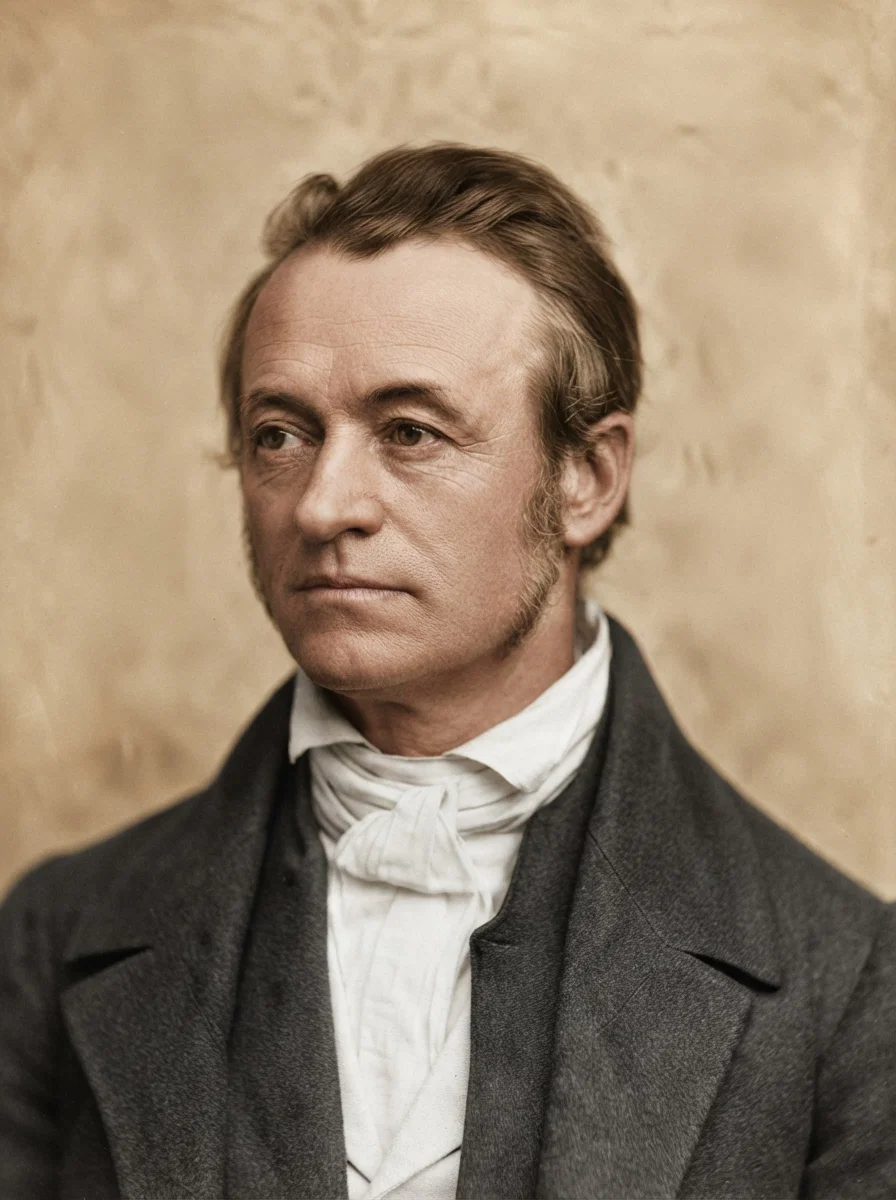
A Pioneer Missionary to India — Sent Out a Congregationalist, Became a Baptist en Route — How It Came About
THE Baptist Foreign Missionary Society has been celebrating the hundredth anniversary of its founding. Because of the part Adoniram Judson had in the founding of this society, the celebration was named the Judson Centennial.
A hundred years ago Judson, the pioneer of North American foreign missions, reported from India that though he had gone out under the Congregationalist society, his convictions had led him to become a Baptist. Under the inspiration of this call, the Baptist Missionary Society was quickly formed, later to stand by Judson in his work for Burma, which was so wonderfully blessed of God.
ADONIRAM JUDSON
HOW HIS VIEWS WERE CHANGED
The Baptist missionary organ, Missions, reprints a letter which Judson wrote from Burma in 1815, telling of his change of views. During the long journey from Boston to India, he was led to give special study to the question of baptism, because of the fact that William Carey and his associates, who had opened mission work in India, were Baptists. Judson knew that he would meet them, and wished to have his own position thoroughly grounded in the Scriptures.
A STRUGGLE, A CRISIS, AND A DECISION
But as he studied the Scriptures on the journey, the conviction came to him the rather that there was no other Scriptural teaching on the subject than that of adult baptism by immersion. On reaching India, where he was to begin work for the Congregationalist body, he was brought to a crisis in his experience, and his first attention was given to settling the question of his own faith in this matter. He wrote:
"Alone at Calcutta, without the least conversation on the subject with any Baptist friend; with the Bible and Dr. Worcester [a work by Dr. Worcester on baptism] in my hand, and much on my knees in prayer for the influences of the Holy Spirit, who is promised to guide erring creatures into all the truth, I felt the convictions which had been gaining on my mind for several months, ripen into a full persuasion, that I was in an unbaptized state. I read on the inspired page, 'He that believeth and is baptized shall be saved.' The former, I hoped, through the rich grace of God, I had been enabled to do; and I felt necessity laid on me with regard to the latter. This single consideration, I repeat it, forced me into the baptismal water. On the one side was everything to allure; on the other (God is my witness!) everything to repel, except the sweet consciousness of doing His will, and pleasing Him who laid down His life for me.
"In professing religion in the divinely appointed way, I continue to rejoice to this day, and hope it will afford me consolation and joy in that hour which tries men's souls.
"I have thought that the cause of truth required me to say this much concerning my motive in being baptized."
In that day, Judson's change of faith in this matter led to a considerable stir. One of the lessons for our time is that the man whom God so abundantly blessed in Burma as the pioneer of American missions was a man whose only question was, "What saith the Book?" Where the Scriptures led, Judson would follow, cost what it might.
In a later generation, there has come too generally a sentiment that after all it does not matter so much what the Bible says. Still the call of God to all men is to believe His word and follow it. And sure it is that no one has ever yet been able to find within the pages of God's book any authority for infant baptism, or any trace of baptism by any other form than that which the Word itself commands, namely, immersion. "He that believeth and is baptized shall be saved," is the ringing call of the gospel message. And surely every Christian who hears that call, who has not been baptized, should give earnest attention to this Bible doctrine. W. A. S.