An Independent People, Kind and Generous — Their Attendance at Divine Worship — Their Response to the Soul Winner
By W. B. WHITE
Superintendent of Our Work in South Africa
BASUTOLAND, Africa, is located in the south central part of this country, and because of its beautiful scenery and healthful climate, is called "the Switzerland of South Africa."
The Basutos are among the strongest and most progressive of the African tribes, having a well-defined country, and in a large measure making and administering their own laws. When the Union of South Africa was formed, shortly after the Boer war, the Basutos were not willing to enter the federation, and to-day have a direct relation to the imperial government of Great Britain.
DIVISION AND OWNERSHIP OF LAND
The land is divided into districts governed by prominent chiefs, and subdivided into smaller sections governed by petty chiefs. The natives live in small villages, or kraals, in houses made of sun-dried bricks and thatched with grass, many of which are very comfortable.
They have no furniture in their houses, and at night lie on their blankets or on skins on the floor. With this tribe, the blanket is indispensable, the men wearing it with trousers, and the women with skirts. Nothing else is worn. Small children, unless in the schools, dispense with clothing, while older boys and girls simply wear the blanket.
Each family receives from the chief a portion of ground, which they can improve and cultivate, but this can not be sold. The people do not own the land. It is only granted to them for their use as long as it is needed, and then reverts to the chief. On this land they raise their corn, or mealies, as it is termed here, and this is the staple article of food. The kernels are ground into flour by crushing them between two stones, and from this a porridge is made that is universally used by the African tribes.
THEIR MANNER OF EATING
The family meal is prepared in one large pot, under which the fire is placed, outside the house. When the food is sufficiently cooked, the family surround the pot, and with flat wooden spoons convey the food to their mouths, each one helping himself. As they keep flocks and herds, they also have some meat, of which they are very fond.
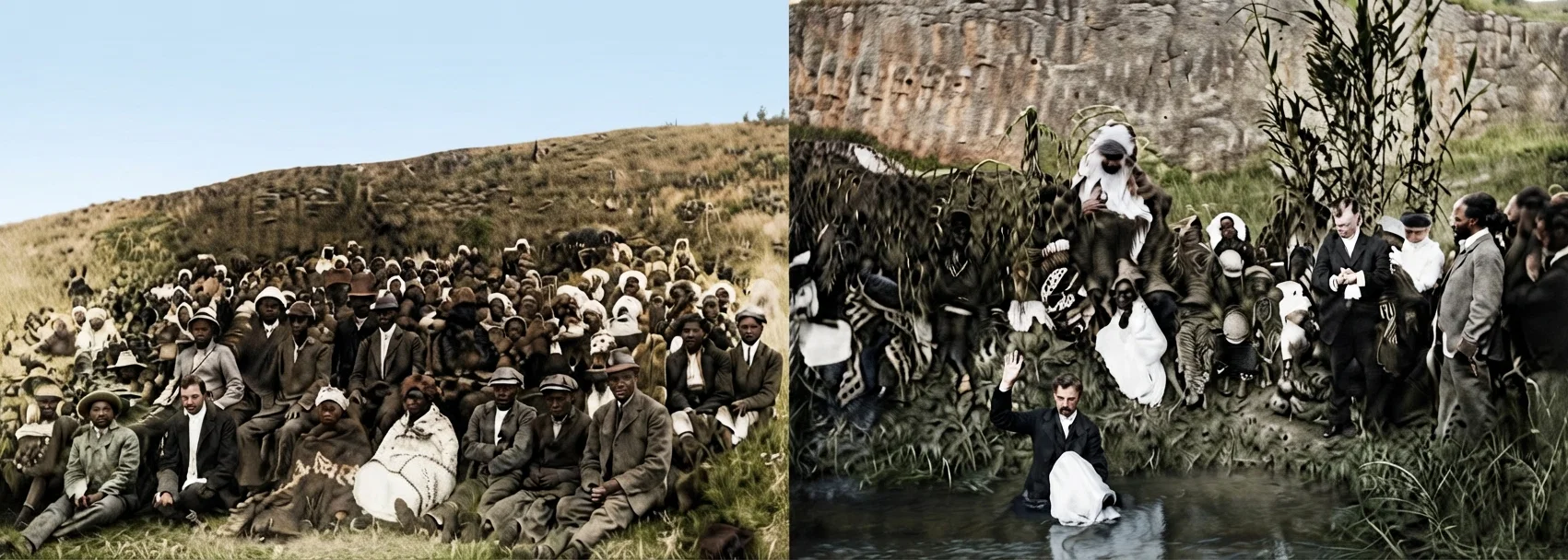
The picture on the left is a congregation of Basutos assembled on the river bank to witness a baptismal service. On the right is the baptismal scene. Elder O. K. Butler is performing the ceremony. Elder W. B. White, superintendent of our South African Mission, is the white man on the shore.
These people live a free outdoor life, and the writer has no hesitancy in saying that they are far better off and have many more comforts than the majority of colored people in the large cities of America. They are quite illiterate, few being able to read even their own language. This is especially true of the adult class; but the rising generation have more advantages, and many of the young people and children are in the schools, and are acquiring the rudiments of an education.
COURTESY AND KIND MANNERS
They are a very kind and well-mannered people, respond quickly to kindly treatment, and love those who love them; but if they discern that the missionary does not care for them nor have an interest in them, his influence over them for good is gone, and he can do nothing with them.
ATTENTIVE TO DIVINE SERVICE
They are a people who love to attend divine service; but as they have no clocks or watches, it puzzles them a little to know just when to come. So it may be that an hour or so before service, they begin to gather about the church, and in their bright colored clothing, present a unique appearance. When the bell rings and the doors are opened, the building is quickly filled; and if there are not seats enough, the people seat themselves on the floor.
During divine service, they are most attentive and well-behaved, and have their children under good control. The writer never addressed a better mannered people than a houseful of Basutos. The accompanying illustration shows a large crowd of these people who recently attended services held by him in North Basutoland. The men seated in chairs are chiefs. The five seated on the ground at the front are a baptismal class; and the European seated at the left is Pastor O. K. Butler, who administered the rite. Gradually these people are yielding to the claims of the gospel, and among them can be found many devoted Christians.
PLEASURE IN LABORING FOR THEM
To those who love the souls of men, it is a pleasure to labor among them, but Basutoland is no place for the professional minister. Only those who are indeed soul winners can hope to succeed in laboring among them. We are sure that in the great gathering day some representatives from this country will be found before the throne of God.