TRAVEL IN INDIA

2%

Pacific Press Publishing Association · Mountain View, California · Nov 10, 1914

FromSigns of the Times, Vol. 41, No. 44.

Read the full edition

TRAVEL IN INDIA

The Country a Network of Railroads—The Great Developing and Civilizing Effects—Preparation for a Mighty World-Embracing Message
By G. W. PETTIT
THIS article is of special interest to men engaged in commerce, or any of the industrial pursuits, because of the reliable information it gives in regard to the material developments of India. On the other hand, it is deeply significant to those who are studying the facilities provided for a speedy proclamation of the great message that the prophets have declared is to be heralded to "every nation, and kindred, and tongue, and people" in all the world.
Next week the same writer will tell of the telegraph and postal service of India.
EDITOR.
DEVELOPMENTS in the railway world during the past half century in India have been most marvelous. The facts concerning this mighty movement in heathen India are so stupendous as to seem almost unthinkable. Where only a short time ago the traveler had to spend long, weary hours, days, and months in making a trip of a few hundred miles, by use of donkey, bullock cart, camel, or elephant, to-day he may make the journey in a few short hours, with modern comforts, by the mighty modern civilizer, the railway train.

A TIMID BEGINNING

In the year 1847, a bill was introduced into the English Parliament to allow certain capitalists to organize a company to be known as the "Great India and Peninsular Railway Company," to build and equip railways in India. This was thought to be so great an undertaking that the bill was killed by that law-making body. However, it was sanctioned the following year, after many limitations and rigid regulations had been made, for fear it result in disaster tothe empire, and great financial loss to the promoters, who were English financiers. The first act passed, allowed them to construct thirty-four miles of railway under government supervision.

FIRST RAILWAY OPENED TO TRAFFIC 1853

The first section of railway built in India was on the west coast, from Bombay to Thana. It was twenty-one miles in length, and was opened to the public for travel in April, 1853, with great ceremony and public display. This was recognized by many as a great event, and the day was declared to be a public holiday in all offices of the Bombay presidency and contiguous districts. The commander-in-chief of the British army placed the leading garrison band at the disposal of the railway authorities, and made arrangements for a salute by his majesty's guns. It was the greatest enterprise ever launched for the benefit of the masses, save the one by the British when they took over the protectorate of the empire.
The first line of railway constructed was built over a section of country almost perfectly level, and only a few feet above the sea; yet the acting governor of Bombay had so little faith in the success of this enterprise on India's soil, that he left the city of Bombay the day before the demonstrations, in great disgust, and not without expressing in no uncertain terms his utter indignation, and refused to take any part in the memorial day which meant so much to India's future.

SUCCESS FROM THE START

Although the English Parliament and the governor of Bombay had shown their lack of faith in the movement, yet at the end of the first year of railway operating, the balance-sheet showed a net gain of over fifty per cent in operating the first railway ever constructed in Asia.
The latter part of 1853, the remaining portion of the thirty-four miles that had been authorized, was completed, when passengers could travel with comparative comfort from Bombay to Kalyan. Even the governor, who before had both expressed in words and shown by his actions his lack of interest, had become so friendly toward the enterprise that he often ventured his life into the hands of the railway builders when he wanted to make a quick trip out of Bombay.

FIFTY-SEVEN MILES IN 1854

The next railway built in the empire was at Calcutta. This city lies to the extreme east of the country, and 1,350 miles from Bombay. The reader will observe that railway building began on the two extreme coasts. This second piece of railway was completed and opened to traffic in August, 1854. It was twenty-three miles in length. Thus at the end of the year 1854, India could proudly boast of having fifty-seven miles of railway open for use.

RAPID EXPANSION WHEN STARTED

From this small beginning, there has been a great era of railway building, which almost eclipses the record of far more favored climes, civilized lands, and even Christian nations. The administration report on railways in India, which has been compiled by the India Railway Board of 1912, gives the following, which may be relied upon as authentic: "During the year 1912 there were opened to traffic 668 miles of line, bringing the total mileage open, after minor corrections of mileage due to realinements, remeasurements, disbandments, up to a total of 33,484 miles." The same page of this official report gives the following: "At the end of 1912 there were 2,455¼ miles of line sanctioned or under construction, thus bringing the total up to 35,939¼ miles."

EVERY SECTION REACHED

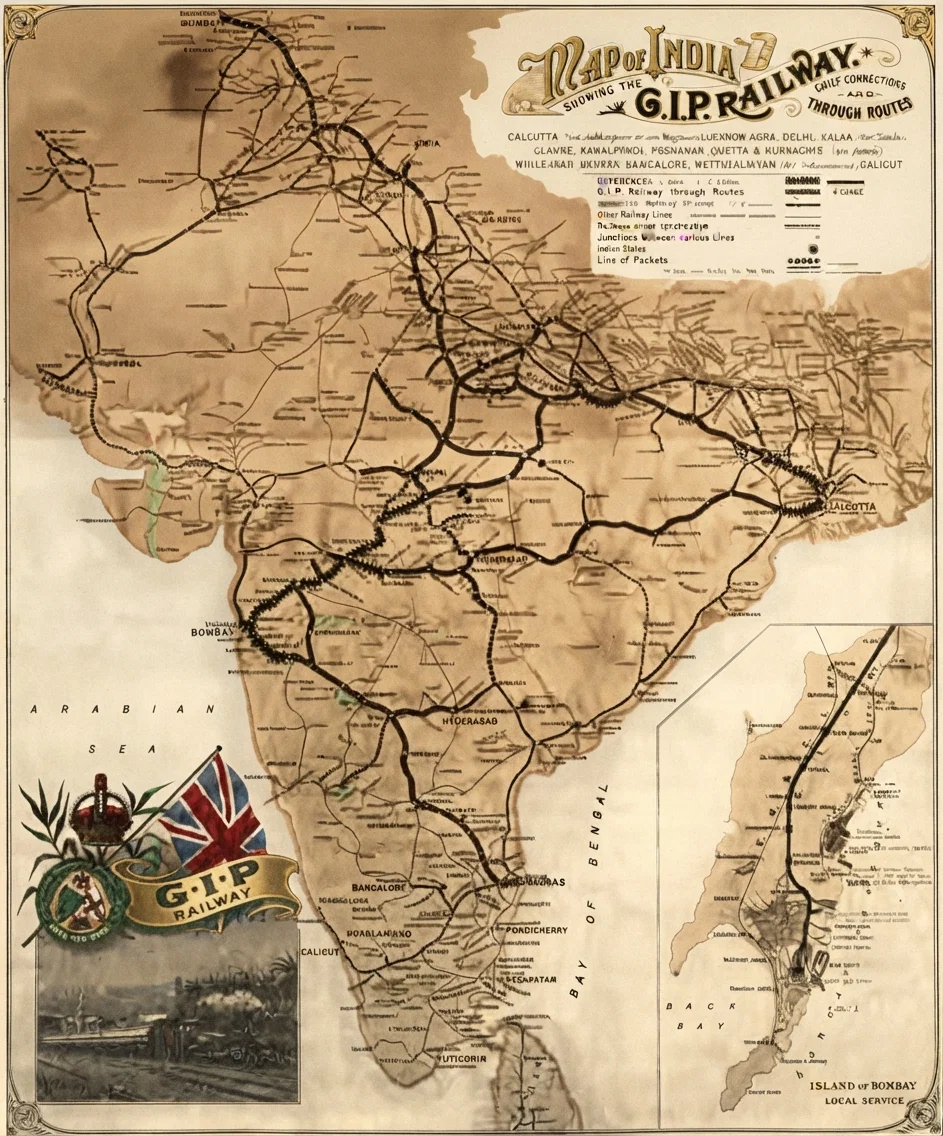
The accompanying railway map of India will show how this land is becoming literally webbed with lines. There has been constructed during the year 1913 and the first part of 1914 almost two thousand miles more of railway. Thus the total mileage in May, 1914, was nearly 38,000 miles.
The reader, by careful study of the map, will observe how nearly every section of the empire is reached by rail. The most numerous lines will be found in the north, where lie the great Gangetic plains. After careful study of the railways of India, I shall venture to give the reason for the numerous railways in the north.
In west India, the early company succeeded in reaching nearly all the larger populations, and thus acquired so strong a hold that with great difficulty have other companies been able to secure a footing. The same is true in south and central India. These companies soon learned of the many advantages to be enjoyed if they could penetrate the rich plains of the north, which produce millions of bushels of wheat and other grains, as well as having large forests in places, which would soon give very large returns in shipping. Therefore they pushed their way on to this section, where lies much of the empire's wealth, so they might share in the riches of this northland.

TOURIST TRAVEL

Too, at certain times of the year, the passenger traffic to the mountain hill stations, where the dwellers on the plains may enjoy a comparatively cool climate away from the blasting heat of the sun, has made tremendous demands on the various railway companies. To this trade they have been catering, and it is no small item during the seven or eight very trying months on the lower plains. Thus the railways having no outlet to those rich plains, and not affording travelers an opportunity to get away from the heat would stand but little show. Consequently north India has the most congested system of railways.
Last and not least in importance is the fact that this very section where railways are seen to be the most numerous, has been in days of only the recent past the scene of great rebellions, uprisings, and massacres. Thus this modern civilizer has had a most important part to play, and has made a tremendous impression on the hearts and lives of those various tribes, and enables the government, which has the interests of its subjects at heart, to give the best of protection. Throughout this region, where hundreds of loyal Europeans have been slain by the unmerciful hand of the savage, may be found everywhere railway facilities.
Where railways are scarce, or where there are none, is to be found least population, or a section that is not very productive. However, railways are extending rapidly to these.

CEYLON TO MAINLAND BY RAIL

The last railway to open to traffic, and perhaps the most important of recent years, was
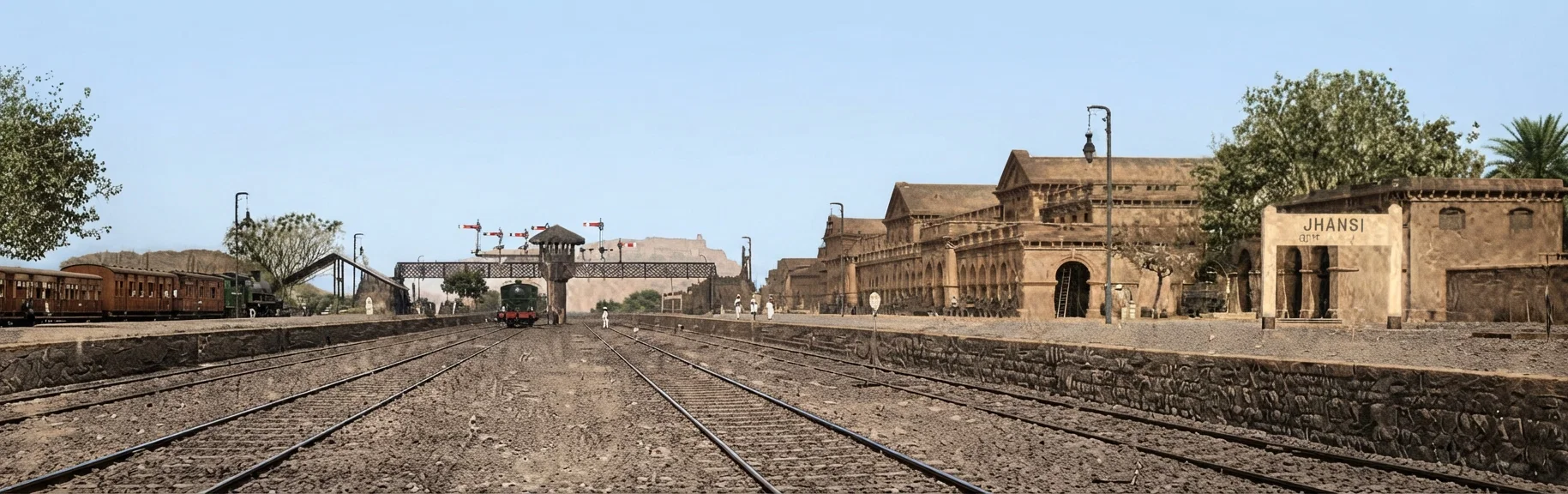
RAILWAY STATION AT JHANSI

Travel in India

(Continued from page 2)
opened in February of this year, and connects the beautiful island of Ceylon to the mainland of India. With the exception of a short distance where the train is carried on a large ferry, one may go from the southernmost part of that island to the far north of the empire of India without encountering the perils of sea which have been heretofore so much dreaded by many.
Plans are under way to build what will be called "Adam's bridge," across the narrow place now traversed by ferry-boat between the mainland and the island of Ceylon. When built, it will be by far the largest steel bridge in the world. This will serve as another evidence of the awakening of the East.

ROLLING-STOCK AND EQUIPMENT

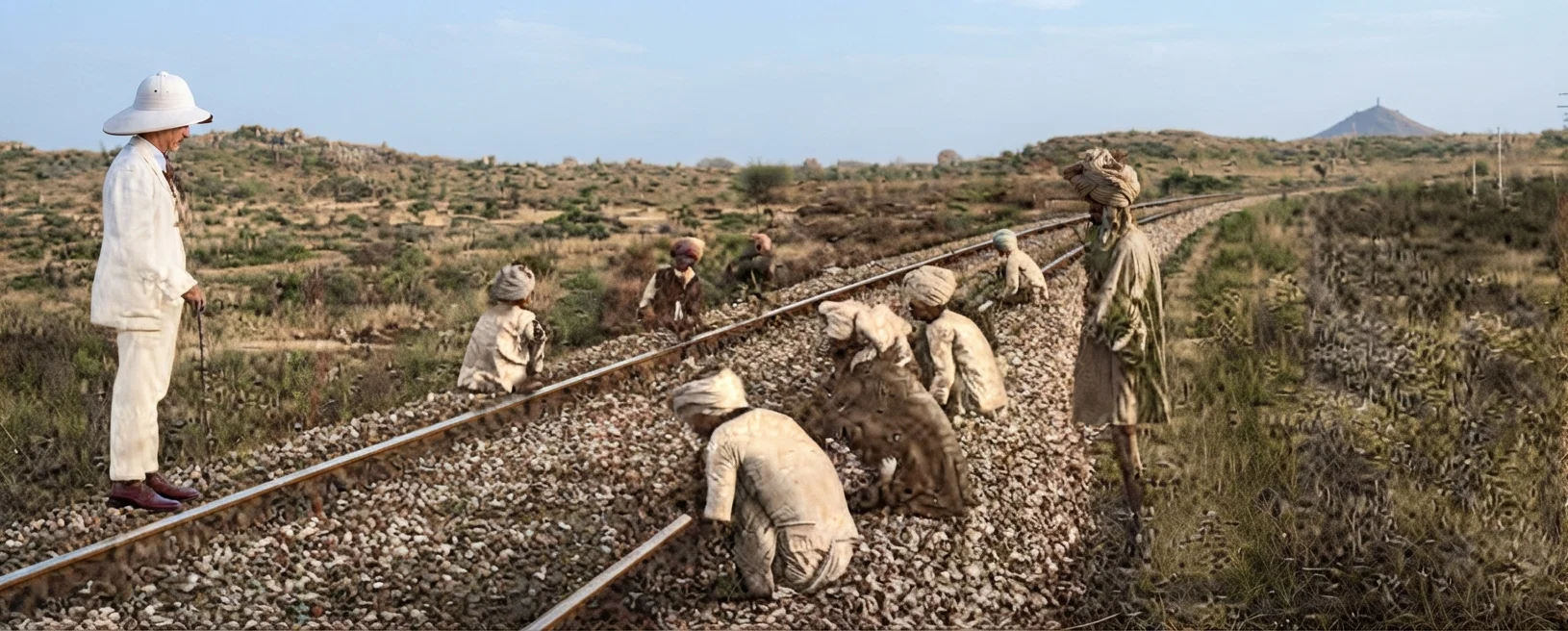
The railway beds of India are among the best in the world. Often American tourists ask how such perfection of railway construction is obtained. The lines are mainly built of 100-pound steel rails on a road-bed of the best of stone heavily ballasted, and with drains on either side, usually of cement, stone, or brick masonry. Thus the possibility of washouts or wrecks is reduced to a minimum, and they are seldom known.
There are about 2,000 miles of double trunk line, and others are constructed as fast as material may be gathered. The rolling-stock is usually quite different from that used in America, for both the freight and passenger traffic. The freight-cars are built of steel, and are smaller in size than those used in the home land. Passenger coaches are of great variety.
At the end of 1912 there were in use in India 7,612 railway engines, 21,985 passenger coaches, and 156,761 freight-cars. Of this number, 6,063 engines, 18,159 passenger coaches, and 64,657 freight-cars were equipped with automatic breaks. Of passenger coaches, 18,355 were equipped with gas and electricity for lighting purposes and for operating fans on the cars.
The latest devices are now in use in nearly all parts of the empire for protecting the traveling public, such as the blocking systems and the interlocking devices. Where these are not now in vogue, the government is hastening on the work by bringing pressure to bear upon the various companies, and as a result of this, soon every railway of the country will have those devices in use for the saving of life and property. In the last five years, there have been less than one dozen wrecks in all India with loss of life.

ENORMOUS PASSENGER TRAFFIC

In 1912 the total number of passengers carried by India railways reached 417,230,000. The average number of miles traveled by each of the 417,230,000 people was 37 miles. This was an increase of 60,000,000 over the year 1911. The years 1913 and 1914, according to railway authorities, will show even a larger increase of travel.

CHEAP RATES

The average rate of fare paid a mile for all classes of travel during the year 1912 was forty-five one hundredths of one cent—less than one half of an American cent. The official records of the government of India say, "There has been but little change in this average rate per mile since the year 1884." From this the reader can better appreciate the cheapness of travel in India.
There are four general classes of fare maintained on most of the railway systems, aside from a lower rate which is called pilgrims' rate. These four classes are as follows: third, which is the cheapest for all ordinary purposes, then what we call intermediate, followed by second, then first. It costs half as much to travel second as first, and half of second to travel by intermediate, and half of intermediate to go third class. The rates for special reserved compartments by first class are cheaper than tourist or ordinary day coach in America. Second and first afford excellent accommodations for the public, including fans, upholstered seats, baths, etc.; while third and intermediate, which are usually traveled by missionaries, are left for the reader to conjecture as to their nature.

SPEEDY TRAINS

An excellent average of speed is maintained, and the mail and express trains are usually very nearly on exact schedule time. The express trains average about forty-seven miles an hour, or make one thousand miles in twenty-four hours. The ordinary train makes an average rate, on long distances, of twenty-seven miles an hour.

MIRACLE OF GOD'S PROVIDENCE

The belting and webbing of the Indian empire with railways is for a far higher purpose than to serve the convenience of the ordinary traveler, or to throw money into the hands of corporations and companies seeking trade. The student of God's word sees in it the awakening of the country for the last gospel invitation of mercy to be given to the world. He sees in it the fulfilment of that inspired prediction uttered by Daniel the prophet, "Many shall run to and fro, and knowledge shall be increased." Dan. 12:4. Think of railways so numerous that the millions of this land can travel within the bounds of Hindustan at the rate of over 400,000,000 a year, and that at an average cost of less than one half cent a mile.
God has surely gone before the missionary of this century, and wrought in a miraculous way. He has prepared safe and rapid transit to all this vast empire, where have been almost unsurmountable difficulties to conquer. He has caused the country to fall into the hands of a nation that fosters and supports the advance of the Christian missionary. That nation has had to sacrifice its men, women, and children in order to accomplish under God this mighty achievement. It has expended its great wealth on the empire to extend civilization, and combat disease, and prepare a highway for God's last warning message. If it were not for the protection of the strong, progressive nation that to-day holds a rigid grasp on the empire, the gospel messenger's life would be suddenly blotted out. Revolt, sedition, and various uprisings are speedily punished.
Half a century ago it took six months to cross India from Calcutta to Bombay by the slow method of bullock cart, camel, or elephant. To-day it takes only thirty-six hours. Where the missionary could not get protection for weeks, to-day it comes in an hour. All India is heavily garrisoned for the safety of her subjects, both Indian and European.

BREAKING DOWN THE SUPERSTITION

Tourists frequent India. They are getting a new glimpse of the land in such dire need. God is working upon their hearts to stir up their friends, and the churches of which they are a part. This is resulting in more money, more missionaries, more prayers.
This running to and fro is bringing the millions of this land, the vast native community, in contact with those who have been changed by the power of the gospel. The light is shining through the midnight darkness of Mohammedanism and the mighty walls of Hinduism.
The railways are doing more to break down caste than is any other factor in the land. This is common ground on which all castes are brought together under the influence of modern civilization. While the darkness is very dense, and the conflict with it is most stubborn, yet these agencies are fulfilling God's desire in preparing the way through the country and through this darkness to the hearts of men.

PREPARING FOR HIS COMING

The writer of this article, who represents the message as delivered through the columns of the SIGNS OF THE TIMES, is actively engaged in pioneer missionary work in India. He believes that rapid developments in the construction of railways, and the increase of knowledge which comes as a result of these modern conveniences, are only secondary signs of the end of all things. They are all given in the word of God as signs of that approaching day. He believes that the most important work is the giving of the message of God to India, for which the things mentioned above are only a preparation. A work is now going on which in itself is the first of all signs—the preaching of the everlasting gospel of Rev. 14:6-12.
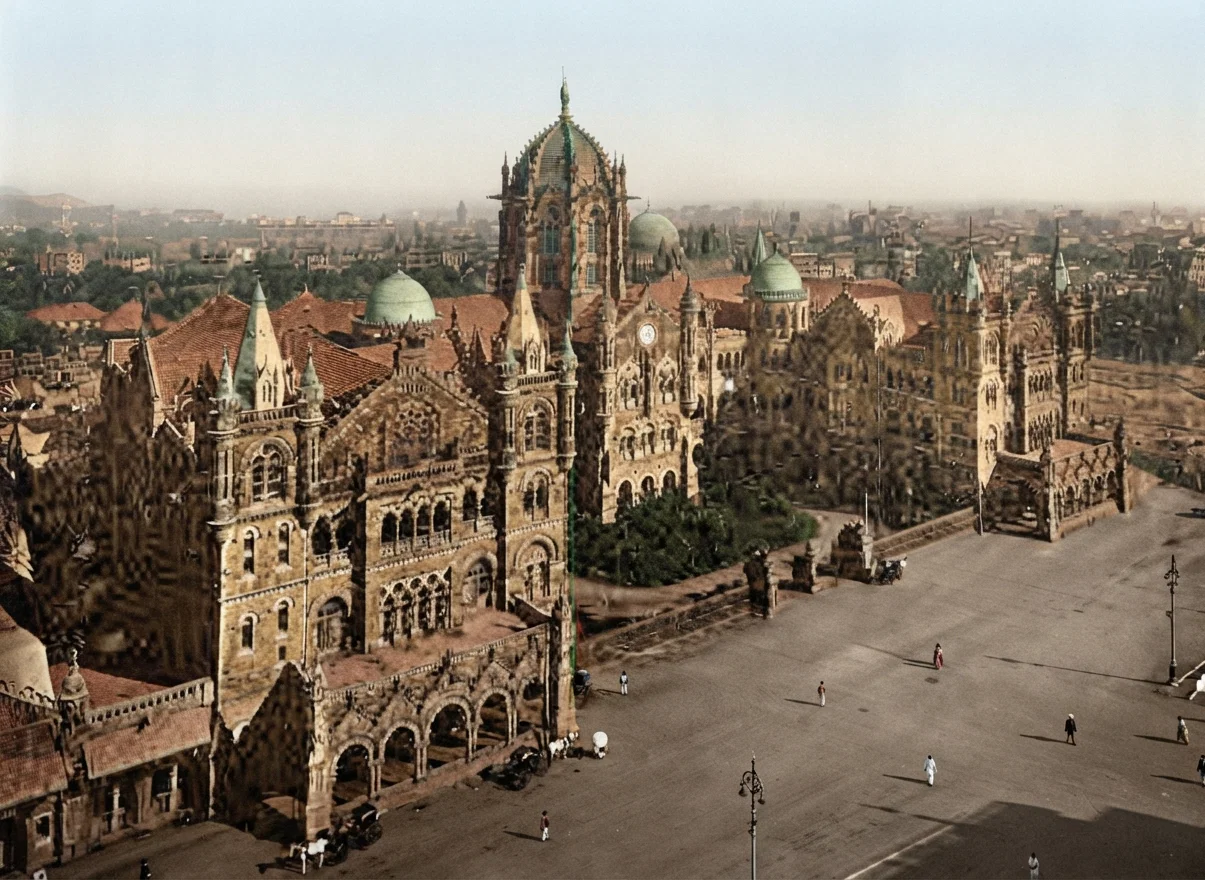
"Victoria Terminus"—the Central Railway Station of Bombay, India
This mighty movement was seen going to every nation, kindred, and tongue. This includes India. There are people of over one hundred different languages in this field, to hear this message. God has gone before us, and prepared the way for a quick work to be done, both by enabling us to reach those of every tongue, and by preparing the soil of the heart for the sowing of the seed. To-day the people who publish this paper have many faithful missionaries giving their lives for the accomplishing of this very task. In many mission stations established for the heathen of India in representative parts of the empire, they are carrying on work to uplift the native. Scores of schools are established. Children are taught for the first time of the name of Jesus. This blessed name is doing for them what it has done for others.
To this name of Jesus, chapels, churches, schools, dispensaries, hospitals, and larger training centers are established. Thousands are relieved of sickness, disease, and misery which can not well be described. This sympathetic ministry for souls often causes the missionaries to be isolated from all European associations; yet they labor on, and God is giving the increase to His word.
Books, papers, leaflets, as well as a number of well-prepared magazines, are published in many different languages, and distributed by the thousands. Over here in Hindustan, hundreds of precious blood-bought souls are beginning to look away from the darkness and blight of this clime to a brighter land, a better country, which will be theirs at the coming of our Lord and Saviour Jesus Christ.