The Distress of Nations and Their Perplexity—How Quickly the Whole World Was Stirred—A Comforting Climax to End the Strife and Turmoil of This Old Earth
By William A. Spicer
DURING the opening days of the struggle in Europe, the London Daily Telegraph thus described the situation: “Every man in every capital looks with feverish anticipation for what the next few hours may bring forth. Human imagination is stunned by so sudden and so unexpected a catastrophe.”
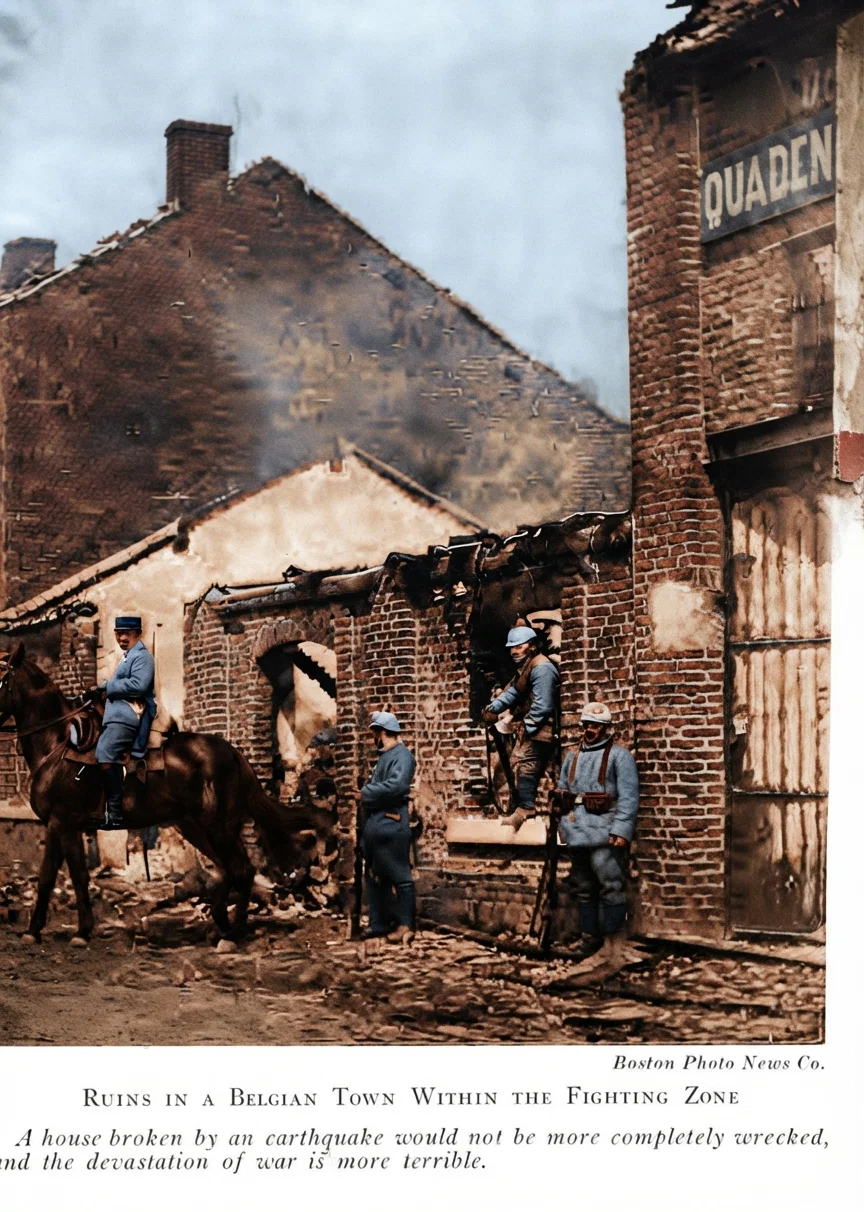
RUINS IN A BELGIAN TOWN WITHIN THE FIGHTING ZONE A house broken by an earthquake would not be more completely wrecked, and the devastation of war is more terrible.
On the outbreak of the trouble in Europe, the feeling of dread and apprehension spread swiftly through the world. It is significant of the greatness of the struggle and the compactness of the world under modern conditions that the most remote places of the earth were set at once in agitation, if not in dismay.
THE QUIET ISLAND STIRRED
Writing to the British journal the Near East, from Mount Troodas, a summer resort in the island of Cyprus, an English lady gives us this picture:
“On Troodas a handful of English people look down on the placid sea which circles the island. . . . The weekly mailboat from Egypt has ceased to run, and telegrams from Aden contain but meager information. . . . A blue sky shines like a burnished mirror; the pine-trees stand in maddening, quiet serenity; . . . birds twitter and call, the woods are green aisles of peace. But Armageddon has cast its shadow. Startling rumors fly about, though Cyprus is under martial law, and a strict censorship exists. A wild-eyed Turk whispering in the kitchen tells of how the German fleet has been annihilated; the Greek cook implores the panayia (mother of God) to send victory to the arms of England; all the servants concur. Boy scouts, with red bands round their necks, are having a lesson in first aid; babies of six and seven learn how to tie up an artery; they go about with serious, important faces, and childish games are forgotten. . . . Two weeks ago it was a joy to wake on Troodas. . . . Now the mind is jerked back into reality by the stern rein of memory. . . . Such waking is a nightmare, a nightmare that does not fly. . . . So the great tide of war stirs the remotest corners.”
That attitude was reflected over half the world within a few days’ time. Surely in these things we may see the beginnings, at least, of those times of apprehension which the Saviour described as one of the signs of the end: “And upon the earth distress of nations, with perplexity; . . . men’s hearts failing them for fear, and for looking after those things which are coming on the earth.” Luke 21: 25, 26.
In those first days of the war, the president of our West Russian Conference, Elder J. T. Boettcher, was traveling among Seventh-day Adventist believers in far eastern Siberia. It was at the little town of Iman, evidently in the Amur River district. After telling of a blessed meeting on August 1, with five believers baptized, Brother Boettcher wrote:
“This was the day when the war broke between Germany and Russia. We knew nothing about it, only heard rumors. But next day train loads of soldiers were passing the station. Even though we were thousands of miles from the front, the word to mobilize had reached the uttermost part of the empire. Telegrams were read at the station, and every one asked what it all meant. There was a hush upon the people. At the railway station, thousands of people gathered, making patriotic demonstrations.”
FEAR AND APPREHENSION EVERYWHERE
Workers in the far East Indies wrote of agitation among the Oriental peoples. “There is a general feeling of unrest all over our field,” wrote Elder F. A. Detamore, of the Malaysia Mission; and a worker in Java reported wild rumors786among the natives, many fleeing to the mountains. The fears were groundless, of course, for Holland was not involved in the conflict, nor her East India possessions brought into danger. But from one end of the world to the other, fear and apprehension came into the hearts of millions.
MOSLEM WORLD SEIZED WITH FEAR
The Beirut correspondent of the London journal Near East wrote on October 6 concerning fear and agitation among the Moslem people:
“The Moslem population, anticipating a foreign occupation of the coast, and still laboring under the false belief that the French soldier and sailor do not respect the Moslem woman's privacy, sent all their women folk into the interior. The women themselves were seized with such unreasonable fear that, in order to make sure of room in the crowded morning trains, they spent the night huddled together at the station. The panic soon spread to the Christian element when a mischievous rumor was circulated that the exodus of the Moslem women was the result of preaching in the mosques, and was meant as a preparation for setting the whole town on fire. The educated and enlightened classes finally succumbed to the epidemic when they learned that the German subjects in Beirut were advised also to leave. The Christians fled to the northern part of the Lebanon, which is inhabited almost exclusively by Christians.”
And now from day to day in Europe itself, and in portions of Asia and Africa, men and women are meeting all the dreadful scenes of war itself. True, this is the inevitable story of war. It has always broken like a terror from beneath upon men.
NEVER WAS SO MUCH INVOLVED
But never before were conditions such as to involve so many millions in the conflagration. And never before, as the public generally recognizes, were there such world-shaking possibilities involved in any struggle. Multitudes who have been lulled by the peace and safety cry are anxiously inquiring what light the word of God has for the times that they see breaking over the world.
WORDS OF COMFORT FOR THIS TIME
It was for these days that Christ's words of comfort were especially spoken in that sermon giving the signs of His second coming: “And when these things begin to come to pass, then look up, and lift up your heads; for your redemption draweth nigh. And He spake to them a parable; Behold the fig-tree, and all the trees; when they now shoot forth, ye see and know of your own selves that summer is now nigh at hand. So likewise ye, when ye see these things come to pass, know ye that the kingdom of God is nigh at hand. Verily I say unto you, This generation shall not pass away, till all be fulfilled. Heaven and earth shall pass away: but My words shall not pass away.” Luke 21: 28-33.
Above all the tumult, God lives and reigns. And the promises of God are sure. To an anxious and distressed world, the Lord sends the message of His “everlasting gospel” with the same call to men to put their trust in a living Saviour; and now with the blest exhortation to us to look up and lift up the head with joy, even amidst sorrow or distress or peril, knowing that our redemption draweth nigh.