Plans for Education — Railway Extension — Army and Navy — Foreign Trade — Development of Natural Resources — Suppression of Opium Traffic
By F. E. STAFFORD
This is the second of four articles Mr. Stafford has furnished on the great and very rapid developments in China. Last week he spoke more particularly in regard to the revolution that so quickly introduced a modern form of government and opened the way for civilization and progress. In the next paper, he will offer some very interesting suggestions in regard to the meaning and outcome of all this. Mr. Stafford's long residence in China, and his opportunities for study, have contributed to make his articles valuable.
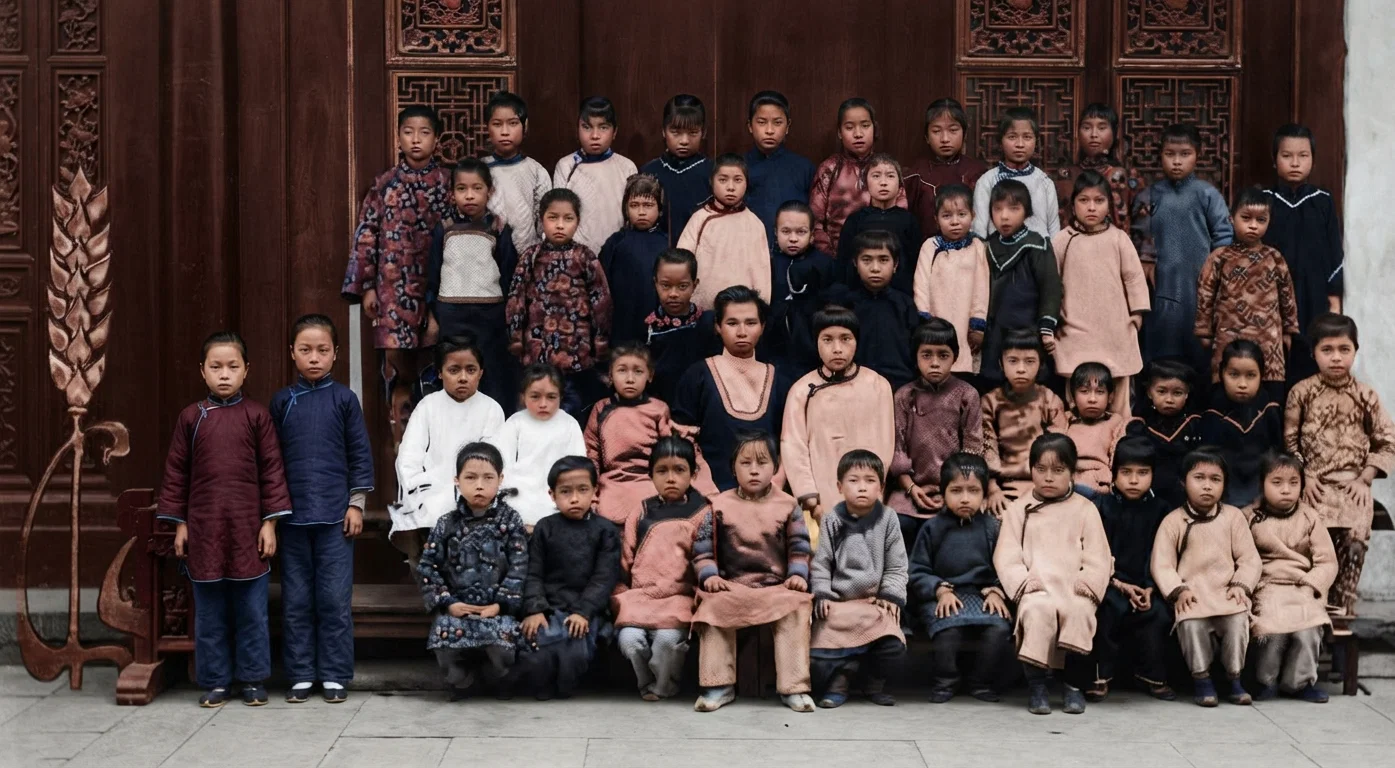
WHEN the Pacific Mail steamship China left Shanghai August 15 on her way to America, there was an enthusiastic crowd of Chinese assembled at the jetty to speed the parting guests. The reason for this was the departure of about fifty picked students to be educated in American colleges, according to the agreement whereby America allows China to pay part of her Boxer indemnity in this manner. As this custom has been followed now for about five years, it in itself would not have been the occasion for so much enthusiasm; but there was a special reason this time, and that was that among the students going were ten girls.
BETTER OUTLOOK FOR WOMEN
This indeed is a new procedure for China, and speaks well for the future of Chinese women. It is only a matter of a few years since girl babies were thrown away, because they were not considered worth bringing up. Until the time of the revolution, there were very few girls in school outside of mission schools. Now we see the old, cruel practise of feet binding nearly abolished. We see girls sitting side by side with the boys in the lower grade schools. We hear, on every hand, of special efforts made to educate the girls of China in sewing, cooking, and the common branches; and it is only a matter of a few years till China's new woman will be prepared to take her rightful place in the home, in the community, and the social life of China's new civilization.
The new minister of education has issued regulations tending to general obligatory education for all children over eight years of age, and has instructed all district officials to procure at once the necessary statistics to carry out these regulations. In some places, they are also organizing free schools for children who are not able to pay tuition; but it is likely to be some time yet before a general system of free education can be inaugurated.
Hsu Shih-chang, secretary of state, in a recent interview, said: "The development of public instruction is now important. The greatest stress must be laid upon the elementary school. The revision of the schoolbooks, aiming at a uniform system of instruction, is now being carried out. The central government has made provision that the number of elementary schools in all districts be greatly increased, and that they fit themselves to the local conditions.
"The furthering of the middle schools has also been taken in hand. Several colleges have been established at various points by the government, and it is the purpose to increase the number just as fast as the necessary means can be raised. A college has been instituted at Canton which aims to perpetuate the best ancient Chinese learning, and also offers courses in the exclusive Chinese arts and trades."
CONFUCIUS AND THE NEW EDUCATION
A great agitation has been carried on, during the last few months, aiming to make the old Confucian classics compulsory as a component part of the present educational system. The president was approached on the matter, and he referred the question to the minister of education. The latter announces that "suitable extracts from the old classical books of Confucius and Mencius will be inserted in the new elementary school-books."
RAILWAYS
During 1913, the four railway lines in the north of China made a profit for the new republic of $13,804,000; while the eleven lines in central and southern China, some of them not wholly completed yet, aggregated a loss of $4,340,000, thus leaving over nine million dollars profit. It is the policy of China to cover the country with a network of trunk lines just as fast as possible, and work is actually progressing on about a dozen different lines to-day. Most of these are built by foreign countries, which take a long-period mortgage on the property, and China has opportunity to pay for the line gradually until it eventually becomes the property of the Chinese government.
MODERNIZING THE ARMY AND NAVY
Early in the year, a big military conference was held in Pekin, and plans were laid for the complete modernization of the army and navy at as early a date as is practical considering the expense involved. The republic was divided into several large districts, each under the command of a military general, who in turn is directly under the command of the president. Thus a practical state of martial law is in effect all the time, although the actual working out of the policy presents many local difficulties. In every important center in the republic where there was doubt of the loyalty of the soldiers, the whole personnel has been replaced with northern soldiers. Thus Shanghai not only had the old soldiers removed, but the entire police force in that part of the city which is not controlled by the International Concession was changed. In front of the house where we live, where there used to be a local policeman who was promoted to that position from the ranks of the peanut venders, there now stands a trim, wide-awake Pekin soldier, with a four-foot club in the daytime, and at night a modern Mauser rifle loaded with real bullets.
The war department has bought several aeroplanes during the last year, and opened a school near Pekin where instruction will be given to aviators, thus aiming to establish a flying corps in connection with the army.
FOREIGN TRADE
The last few years have shown a marked increase in China's foreign import trade, the figures for last year being an increase of nearly one hundred million dollars gold over the amount ten years ago. Of this amount, Japan supplies about twenty per cent, and this notwithstanding there exists a strong prejudice against Japan and Japanese goods.
The fact is, China wants cheap goods, as the great mass of her people are not able to buy luxuries; and Japan excels in the production of a cheap line of almost every article that China calls for, and being situated so near, she always has her goods on hand when there is any one ready to buy.
After the revolution, there was an immediate demand for straw hats, caps, and leather shoes; and Japan has produced these articles for China by the millions, and reaped a rich harvest as a result of improving the opportunity.
Great Britain comes next, supplying fifteen per cent of China's imports. Russia and Germany are about even, but the United States supplies only eight per cent of the total.
BURNING OPIUM PIPES
PETROLEUM WELLS AND STANDARD OIL
Early in the year, an agreement was made with the Chinese government by which the Standard Oil Company secures the right to make a thorough investigation of the fields in north China, which are believed to be among the most important and extensive in the world. According to the terms of the agreement, if oil is found in quantities sufficient to make the working of the fields profitable, a Sino-American company is to be immediately formed, in which the Chinese government will be allotted thirty-seven per cent of the shares, with an option, under certain conditions, on further interests. The controlling interest, however, is to remain in the hands of the American corporation. The agreement is reported to be for sixty years; and during this period, no other foreign country will be allowed to work oils or their products in the districts specified.13A large force of picked oil drillers have arrived from California and Texas, and they have started overland for the scene of the oil fields, taking two thousand tons of drilling machinery with them. They are encountering great difficulty in getting the machinery transported, as there are no facilities for carrying such heavy materials overland. They had assembled four hundred Chinese carts to carry their drills through Honan and Shensi, when the government troops from Pekin in pursuit of White Wolf, the noted robber, came along, and the general immediately commandeered the carts; so at last reports the machinery was still waiting. Now that White Wolf has been beheaded (or at least the Chinese government paid $50,000 for a head supposed to be that of White Wolf), very likely the Standard Oil Company can get through to Shensi and start boring for oil.
THE HUAI RIVER PROJECT
The opening of this project marks, as Dr. Reinsch, United States minister at Pekin, says, a new era in Chinese developments. This new project is expected to reclaim one million acres of fertile soil, and materially improve nine million acres more, so that they will yield two or three crops a year. It will save millions of people from the horrors of continual famine and starvation, and transform a barren wilderness into a garden spot where the natives can live in peace and happiness, supported by the industry of their own hands.
This project is promoted and financed by the American Red Cross Society. Attention was first called to the need two years ago, at the time of the great famine in north China, when the Red Cross Society sent out an American transport loaded with flour to relieve the terrible distress of the thousands who were daily dying. At that time, Mr. C. D. Jameson, a noted American surveyor, was asked to make a survey of the district, and report on the feasibility of undertaking a conservancy scheme which would control the waters of the rivers in that great region, so that instead of destroying the country by periodical floods, they could be made to give life to the vegetation where it was cultivated, and irrigate large sections where nothing was raised.
He made a very full report to the Chinese government; but unfortunately, on account of the revolution and lack of means, nothing came of it at the time. The matter was not allowed to drop, however; and this year an agreement was made whereby the American Red Cross Society is to lend to the Chinese government $20,000,000 gold, at five per cent interest, secured on all the government revenues derivable or now derived from government lands in the conservancy area, and all the additional revenues which may in the future accrue to the government as a result of the conservancy work.
MAGNANIMITY OF THE RED CROSS SOCIETY
The terms of this agreement are quite different from those of the Standard Oil Company. It would be hard to find a more humanitarian project anywhere. The Red Cross Society deliberately gives China twenty million dollars, and carries through a project for her which not only will enable her to pay back the principal with interest, but will give her an enormous permanent revenue, besides saving millions of her people from starvation and the grave. She asks for no mortgage on any of China's territory or sources of income other than that which will be developed by the conservancy work.
That the work will be carried out in the best possible manner, has been assured by the fact that the American Congress passed a bill in May releasing Col. William Siebert, an army engineer who was assistant to Colonel Goethals in the construction of the Panama Canal, to superintend the work of the conservancy commission in China. Associated with him is Mr. A. P. Davis, chief engineer of the United States government reclamation service, and Prof. Daniel W. Mead, a leading American expert on hydraulic engineering, who has had recent experience with the Ohio Flood Commission.
OPIUM SUPPRESSION
On July 30, the minister of the interior announced that the poppy culture will have been suppressed all over China before the end of this year, and that it is hoped the importation of opium can be prohibited after the middle of next year.
The last year has seen increased vigilance on the part of the officials, who seemed determined to stamp out completely from China the growth of the poppy plant. At some places, force of arms has been necessary; but this has been used, and several more provinces have now been declared free from the poppy, and British orders have been issued stopping importation into these provinces.
As Great Britain insists on enforcing her treaty privileges to the letter, and continues to force Indian opium on the people as long as she can find one stalk of poppy in existence, it is necessary for the Chinese government first to declare the province free. The British then appoint inspectors, who, judging by the time they take to go over a province, do their best to find the poppy. When they report favorably, and not till then, a closing order is issued.
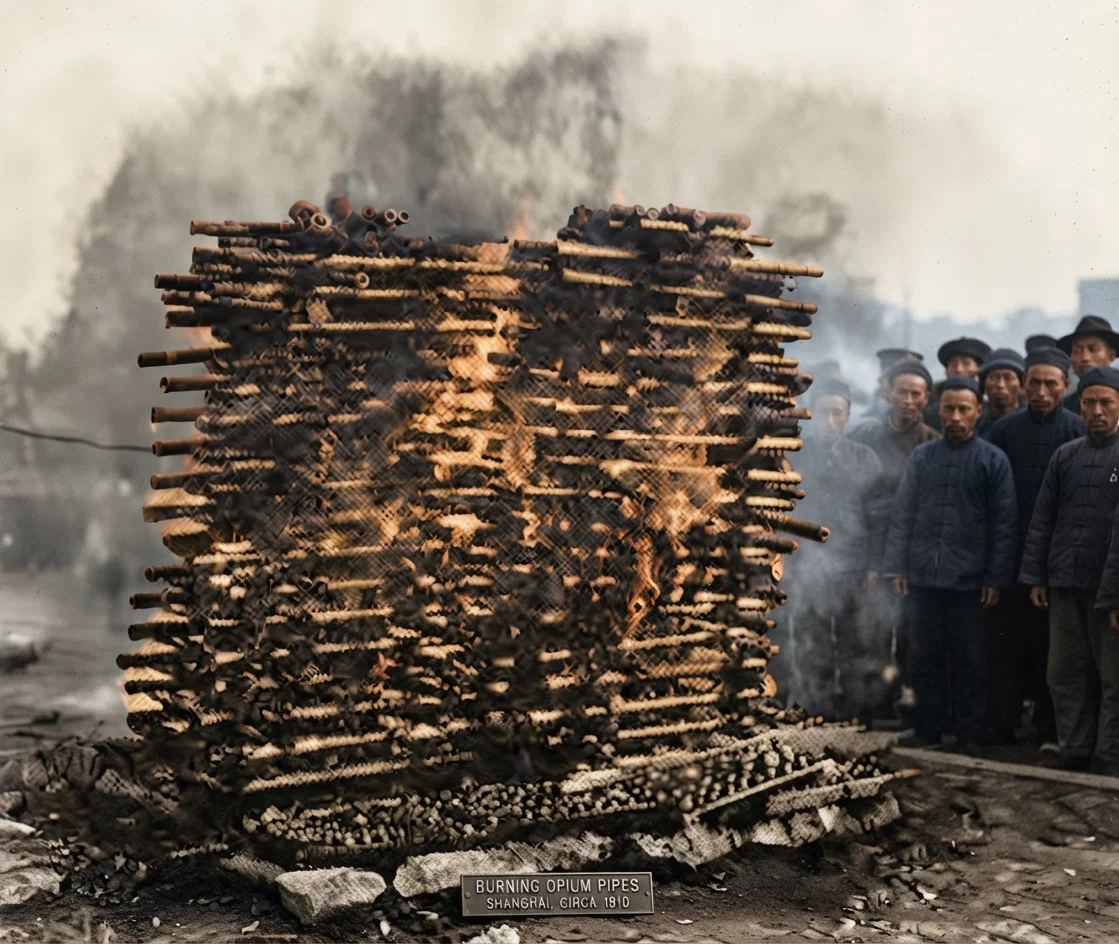
Fukien province was the last to be declared free, and a great celebration was held14at Amoy May 1 to commemorate the event. One thousand six balls of opium, together with pipes and other articles valued at fifty thousand dollars, were publically burned at noon. There was an immense crowd present, including the officials, the gentry, and foreign spectators. The schools closed, and the students marched in uniform to the Antiopium Society headquarters, where they rendered patriotic songs and other music. After this, they paraded through the streets, displaying flags and national banners; and the celebration closed with a speech by Mr. Ding Neng-gong, commissioner of foreign affairs, who was the champion of opium destruction.
A second great opium burning took place at Pekin on May 21, just outside the "Temple of Heaven." At this time, it is said, some of the most beautiful cloisonne lamps, and rare, costly pipes were burned.
SHOULD INSPIRE THE CIVILIZED WORLD
One thing about this opium campaign which impresses every one who has witnessed it, is the sincerity of the Chinese people in their efforts to strike it out root and branch. There is no quibbling about the price, though it means the loss of millions of dollars of government revenue, at a time when China most needs the money. What a wonderful example heathen China has set before the civilized(?) world in the accomplishment of this stupendous task!
Less than ten years ago, word was sent out from Pekin that it was the intention of the Chinese empire to stamp out, root and branch, the opium habit, which had as a mighty octopus fastened its tentacles upon the souls of the four hundred million people of the nation, and was mercilessly drinking their life-blood, and every year dragging them down to a living hell, whose end is the grave and destruction. When she approached the nations of the world for co-operation in the matter of not bringing in any more foreign opium, she was told that they had the right under their treaties, and would continue to import opium as long as the people would buy it, and if she wanted to do any reform work, she should teach her people not to buy the drug.
In the face of these tremendous odds, she went to work to accomplish her task, and is within sight of the goal to-day. This endeavor has been likened by one writer to an effort to stop the liquor traffic in four countries, each with a population equal to that of the United States; but he adds that the United States would not undertake such a proposition, because that is free(?), and her citizens would resent any infringement of their liberty(?). Is it liberty or license?