Stands Fourth in Railway Mileage—Freedom from Fatalities and Accidents—The Imperturbable Missionary
By ARTHUR G. DANIELLS
ONE of the questions that deeply interests and sometimes seriously concerns a traveler whose time in a new country is limited, is the mode of conveyance he may find. Knowing that India, including Ceylon and Burma, is a country of long distances, and knowing that I must needs go to all its extreme parts, I felt some degree of anxiety before taking my first railway journey in that empire. I found, however, that my concern was unnecessary. From the railway guide, I learned that there were very few places I had to visit in India that could not be reached by rail, and my first train ride assured me of good accommodation and efficient management in the railway service.
INDIA STANDS FOURTH
Although railway building in India did not begin until 1860, there are at the present time about 35,000 miles of railway in operation. The system is so planned that all the principal seaports, and the largest cities in all parts of the country, can readily be reached by rail. India holds the fourth place in the world in railway mileage. Three hundred thirty million persons are reported to have traveled on these lines during 1913. With all this traffic, only seven persons lost their lives in accidents. This gives a basis for the claim that railway traveling is the safest in India of any country in the world.
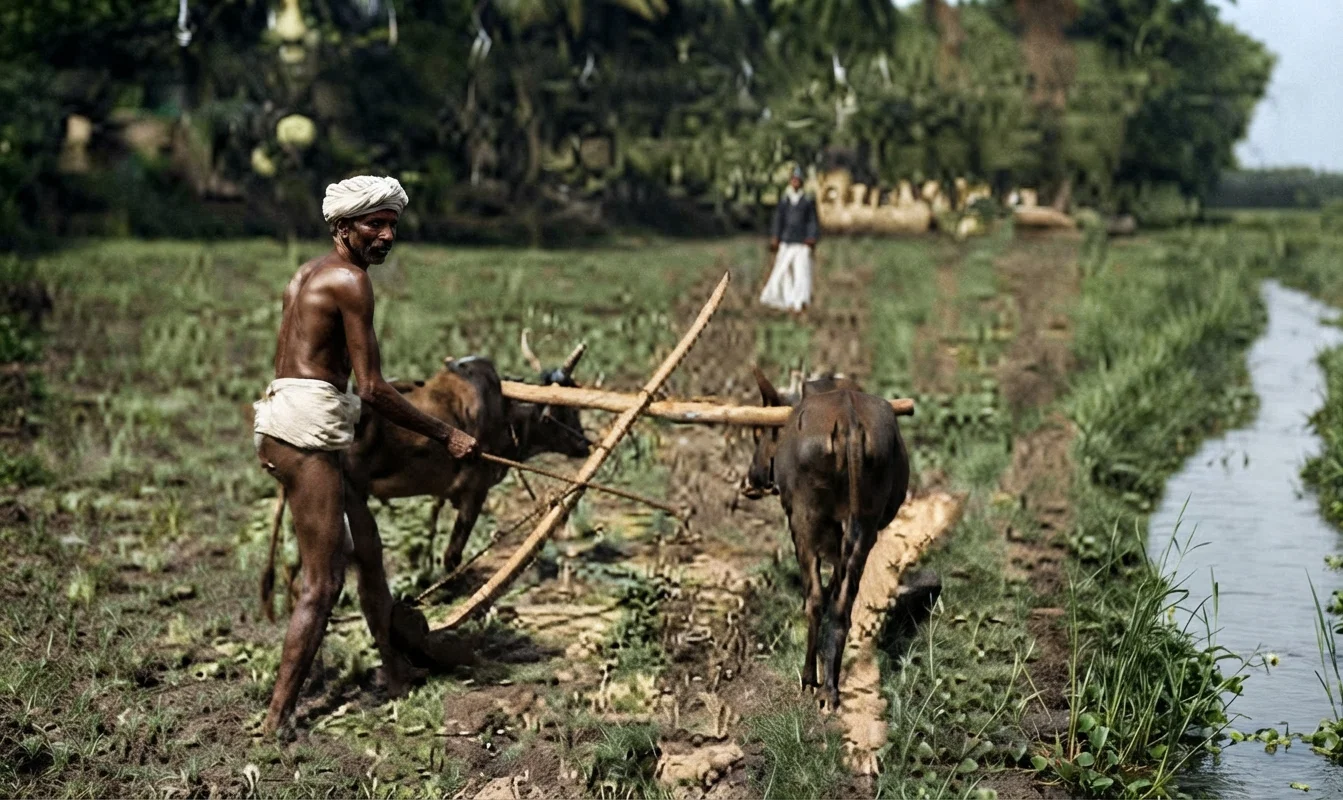
A NATIVE PLOWMAN IN INDIA
Beginning at the extreme southern points of both Ceylon and India, I traveled to the Himalaya Mountains on the north, and nearly to the Afghan border in the west. This made it possible for me to visit all our mission stations in India and Burma in the course of three short months. Professor Salisbury, president of the Indian Union field, had planned the tour so well that in only a few places were we obliged to travel over any part of the road a second time.
Our first visit was to the South India Mission, under the superintendence of Pastor J. S. James. Through the reports that had been placed before our Mission Board, I had felt fairly well acquainted with this mission; but once more I learned how much clearer one's vision becomes, and how much more real and tangible everything seems, when one is on the ground.
This visit had a number of surprises for me. I was aware that the South India Mission embraced the Madras Presidency and the island of Ceylon; but it was not until I traveled over the territory, getting hurried glimpses of the country, the cities, the villages, and the people in their varied conditions, that I obtained anything approaching a true conception of this mission. Its western boundary is washed by the Arabian Sea for a distance of about 500 miles, while the eastern shore stretches 1,200 miles along the Bay of Bengal—farther by 200 miles than from New York City to Chicago. And in this territory there are over 50,000,000 people—equal to more than half the entire population of the United States.
WHERE THE PIONEERS BEGAN
It was in this mission field that Ziegenbalg, Plütschau, and Schwartz, the first Protestant missionaries to all India, carried forward their wonderful work. The two former located near the coast, in the district of Trichinopoli, in 1706. Schwartz located in the city of Trichinopoli, in 1750. These men were missionaries of the apostle Paul's stamp. Great success attended their efforts; and to-day, after nearly two centuries of missionary endeavor in India, more than one half of all the Protestant Christians in this entire land are to be found in the Madras Presidency, where these pioneers did their work.
The program that had been arranged for us included a visit to our Nazareth mission station, in the extreme southern part of the field. An all night's ride from Trichinopoli brought us to Tinnevelli. Here we changed from the railway train to bullock carts, called bandies in this region. A bandy is a two-wheeled cart, with a cover of some sort stretched over a framework, to protect the passengers from the sun. The box of the cart is about six feet long, four feet wide, and six inches deep. The cover, at its highest point, is about three feet above the bottom of the box. As there are no seats in the bandy, the most comfortable way to ride is lying full length in the cart box. Rugs were spread on some straw in the bandies, pillows were provided, the bullocks were attached, and we crawled in for a twenty-four mile ride. There were six in our company. There was also the formidable stack of luggage a company of that number usually carries in India. Four bandies were required for the journey. We started at nine in the morning, and reached our mission at six in the evening.418
WELCOMED WITH THE BAND
When two or three miles from the mission station, we were met by some of the teachers and students and a number of the members of the church. They had come with a native band to welcome us and escort us to the station. After cordial greetings, the band led the way, being followed by teachers, students, and our caravan of bandies. The music and the unusual procession attracted large numbers of villagers, many of whom kept joining us, and our number became quite imposing by the time we reached the station. From the veranda of the bungalow, we gave a brief address, expressing our appreciation of the enthusiastic reception given us. Then all separated to get ready for the evening service.
I was very much encouraged by what I found at this mission station. Pastor James and his wife began work here seven years ago. The response made by the people to the message he presented led to the establishment of a permanent station. A nice block of three acres of land could be secured just outside the village. But before a final decision was made to locate on this site and erect buildings, a well was sunk on the place, to ascertain whether an abundant supply of good water could be secured. The test gave the fullest satisfaction. Then the ground was secured, and the buildings were erected. The precaution to be sure of having plenty of good water, should always be taken by missionaries before purchasing land and erecting buildings for mission stations.
We have three buildings at this station,—the bungalow, the school, and the dormitory. The bungalow is a brick structure well planned and substantially built. It provides a good home for those in charge of the mission. It cost a little less than $2,000. The school building cost only $400, and the dormitory for boarding students but $85. Both the school and the dormitory are too small for the work now carried on at this mission. At the time of our visit, there were 118 students attending the school—87 boys and 31 girls. The regular schoolrooms were full, and one class was held on the veranda of the school building, another in the dormitory, and a third on the veranda of the bungalow.
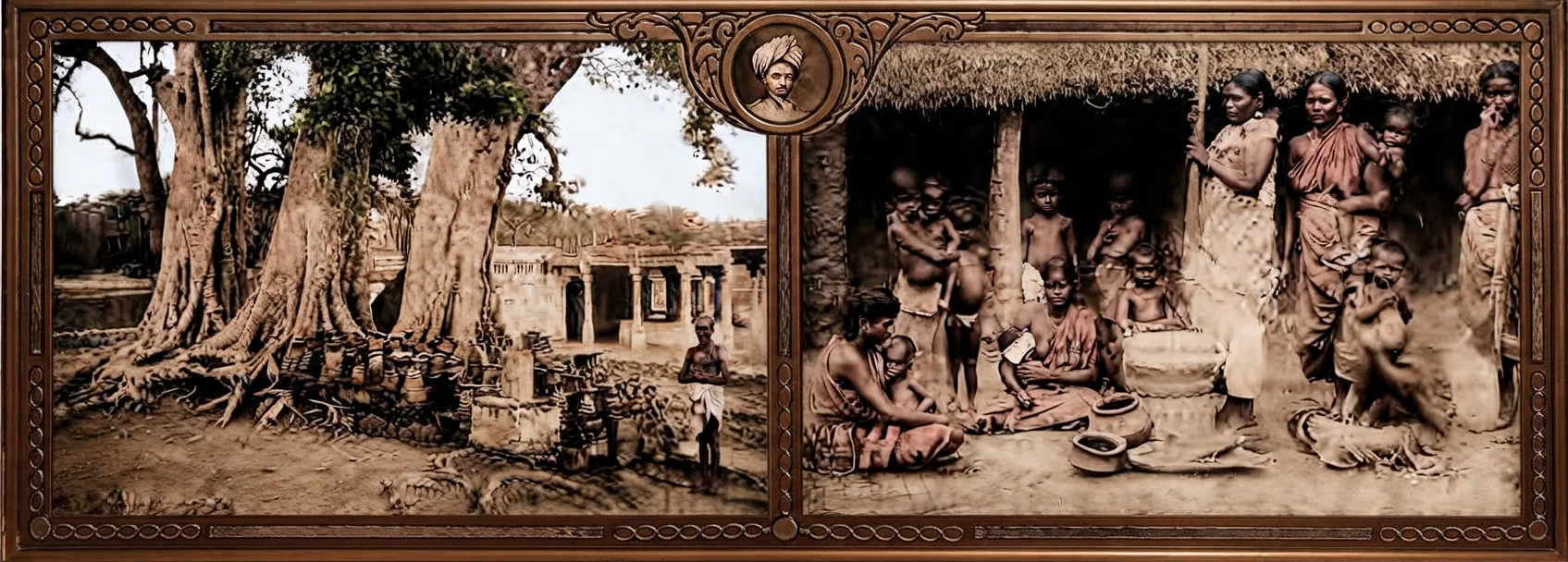
Three "spirit" trees and temple of devil worshipers of South India. Worship of this class is one of the most pitiful of superstitions. Typical group of Tamil people of the poorer class living in one house in the village of Nazareth, South India.
I was greatly pleased with the work done at this station. For two or three years, almost the entire work has been carried on by our Tamil brethren, no European being on the place. Brother E. D. Thomas is in charge, and is assisted by seven teachers, five of whom are our own baptized members. Brother Thomas and his assistants have all embraced the message since Brother James began work in Nazareth seven years ago.
As nearly as I could judge, these teachers are doing excellent work. The students are Hindus, Roman Catholics, Anglicans and other Protestants, while some have no religion. Yet with this medley, we found a strong spiritual influence pervading the school. Thirteen of these students have given their hearts to the Lord and united with the church. They are earnest, wide-awake young missionaries. Every month, they are allowed to go out to the villages to sell papers and tracts. Sometimes they walk twenty miles doing this work. They are making a good impression in all that region, and men are bringing their boys from all directions to place them in the school. When I was there, two men came from villages miles away in opposite directions, to see about getting their boys into the school.
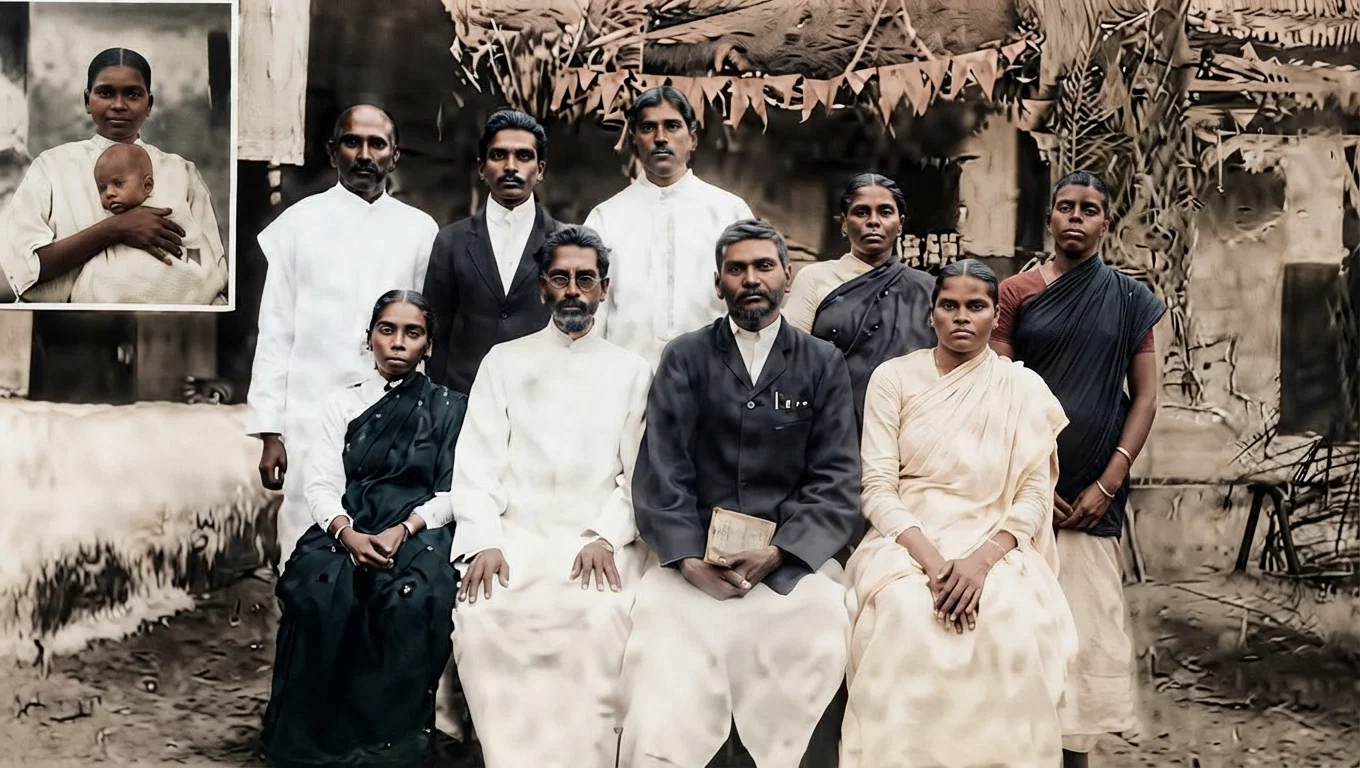
Group of our Tamil workers in charge of the Nazareth mission school, South India. Brother E. D. Thomas, superintendent of the mission, with his wife, are seated at the right. They are natives of India, and were carved out of raw heathenism by the gospel. Sister Thomas, with her first baby, is shown in the upper left-hand corner.
SACRIFICING TO HELP
During the week of prayer, some of these Christian boys gave a part of the rice allowed for their daily food, in order to make offerings to foreign missions. They denied themselves the food they really needed for their growth and work.
None of these boys use tobacco in any form, and they have abandoned everything that savors of heathenism. The girls who have become Christians have shown the same zeal. They have done what is probably the hardest thing for a girl in India to do—taken off all their jewelry,—bracelets, finger rings, neck rings, anklets, toe rings, and all. The ears of some were so disfigured by the heavy rings hanging in them from infancy, that it was necessary to perform surgical operations to restore them to something approaching their natural condition. All this they have done for their Lord and Master. They are good girls, who will make good wives for the Christian boys who are preparing for missionary service.
In an address presented to us by the faculty of the school on the occasion of our visit, they said:
"The object of this work is to lay a true foundation, in the lives of the students, for a future Christian building; to teach them the special truths for which we as a people have been called into existence; to encourage them to practice these truths, and to spread them throughout the sphere of their influence; to develop a thorough Christian experience, and beget in them a lasting desire to become earnest workers for the Lord in carrying this message to the millions of South India.
"Believing the Scriptures to be the foundation of all true education, and recognizing its importance in a school curriculum, much emphasis is placed on the teaching of the Bible. We have already seen some of the results of our efforts in this direction.3
Travel Conveniences in India
(Continued from page 2)
Of our students, thirteen have been baptized. One boy has connected with the office work at Trichinopoli; another boy has taken up duties in the school while continuing his education, and others are being prepared to take up responsible work in connection with this cause at an early period.
We also see a great change for the better in the lives of the Hindu children of our school."
The church membership at this station is close to 70, with a Sabbath school of 135. They are faithful in the payment of tithes and offerings for the support of the cause. The total amount paid in 1913 was $260; and in 1914, $400. This is not a large amount; but they are poor people, and it means much to them.
It was surely a great privilege to visit these dear fellow believers, who are so happy and earnest in the truth. I could but wish that we had hundreds of such stations scattered over India.
ENTERING A FRENCH SETTLEMENT
In August of last year, work was begun in Pondicherry, a French settlement on the coast about one hundred miles below Madras. Brother and Sister V. E. Peugh and a Tamil brother located here to follow up an interest that had been awakened. In November, Brother James visited this place, and baptized seven believers — four men and three women. Others are being taught and prepared for baptism.
Brother and Sister Morrow, who came to India last year, have located in Bangalore. They are studying the Tamil language, with a view to engaging in the vernacular work.
All the workers in the South India Mission, and in all India as well, were delighted to have Brother and Sister Lowry return. They will begin work in a new center. Brother Lowry has a good knowledge of the Tamil language. He loves the field, and it is believed his work will be blessed to the salvation of many souls.
At the recent biennial conference, it was decided to establish the headquarters of the South India Mission in the city of Madras. This will enable Pastor James to carry on evangelistic work among the European people.
THE STUPENDOUS TASK
The task in this mission field alone is stupendous. Besides the 17,000,000 people speaking Tamil, there are 20,000,000 who speak Telugu. Although no direct effort has yet been made by us for the Telugu people, a few have embraced the message and united with us. Great opportunities are now in sight among these people, and we must begin work for them without delay. Plans are laid to have a couple located among the Telugus before this year closes.
Then there is Ceylon with its millions. Every worker in India feels that Ceylon should be entered now. It should be made a separate mission division under permanent leadership. We hope to have a couple located in Colombo in a few months.
Knowing the value of literature in this work, Brother and Sister James are struggling hard to produce and circulate papers and tracts in the five different languages spoken in their field. But their facilities and physical powers seem so limited for this great task! How terribly we need workers and means for this stupendous undertaking! If ever the church of God should pray the Lord to send forth laborers into the field, it is now.