Milk as a Disease Transmitter

3%

Pacific Press Publishing Association · Mountain View, California · Aug 24, 1915

FromSigns of the Times, Vol. 42, No. 33.

Read the full edition
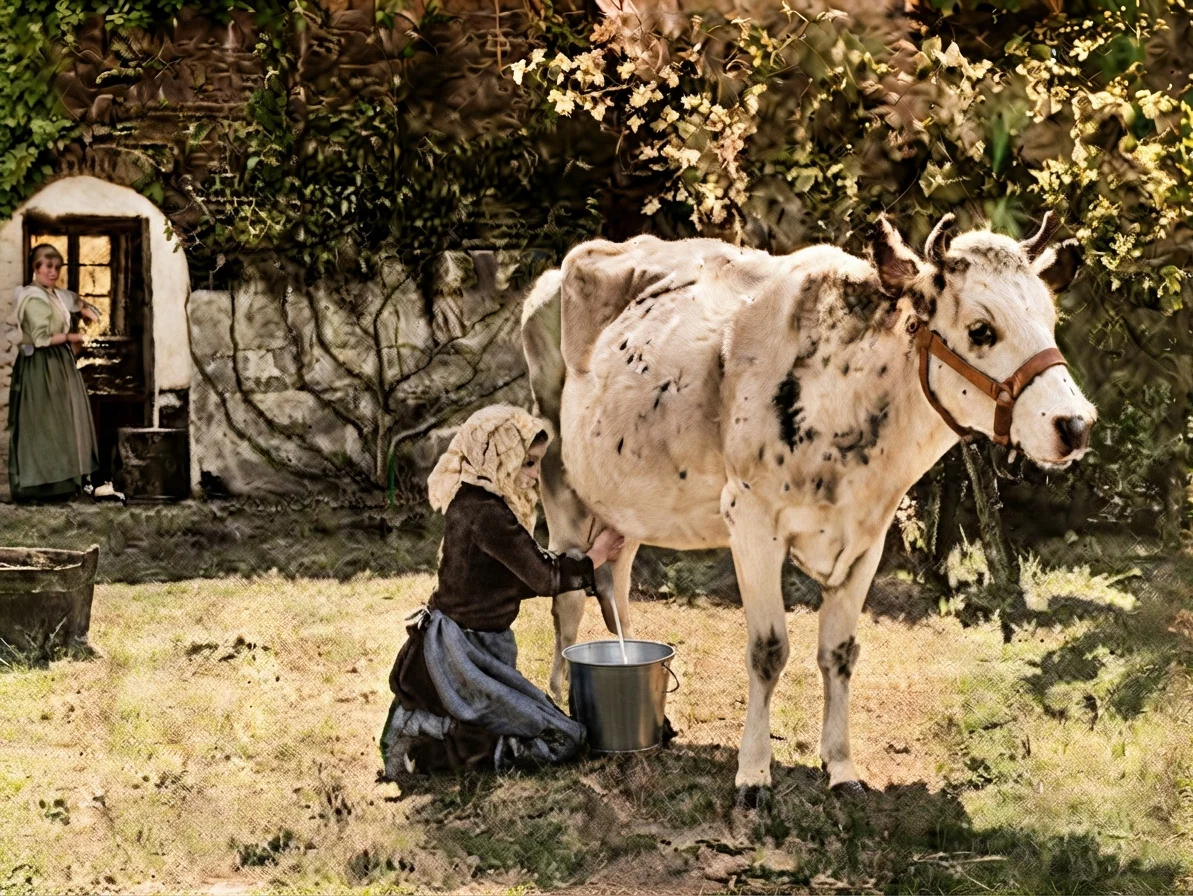
Milk as a Disease Transmitter

The Children Often Wholly Dependent on Cow's Milk — Care Should Be Used in Securing an Article Free from Disease

By DANIEL H. KRESS, M. D.
MILK is a staple article of food upon the tables of civilized nations to such an extent that the cow has been termed the "meek foster mother of the human race." Upon her the younger members of the family especially depend for nutrition. While this vital fluid may be used by mankind, and is of value as a food when pure, no one factor contributes more heavily in the production of disease than a tainted or impure dairy supply. Unfortunately, milk forms one of the best breeding grounds for bacteria of all kinds; and since it cannot be taken as nature designs it should, direct from the udder, every effort must be made to prevent exposure and the introduction of foreign matter.
Unprotected milk is a source of danger. The bacteria which gain entrance, though few in number, multiply with such extreme rapidity that in a few hours, under favorable conditions, they are innumerable.
Few are aware of the amount of filth that finds access to the ordinary unprotected milk pail. It has been estimated that in one large city alone, more than twenty tons of cow manure is consumed by the inhabitants of the city each year by the use of milk.
Great alarm is felt when the water supply of our cities contains bacteria to the number of one thousand to the cubic centimeter, and efforts are wisely put forth to improve, at great expense, the purity of such water. Yet it is not uncommon to find from ten to twenty millions of bacteria to an equal quantity of milk served on the average city table.

GUARD AGAINST AVOIDABLE CAUSES

State laws have been enacted to lessen the dangers arising from impure milk. An absolutely pure milk supply is out of the question. Therefore all that any state law can demand, is that avoidable causes of contamination be guarded against. In Michigan, where water containing five hundred bacteria to the cubic centimeter would not be tolerated, the law demands that the milk shall not contain more than two hundred thousand germs to the cubic centimeter. If water containing five hundred bacteria to the cubic centimeter is dangerous, milk containing one thousand times that many would be one thousand times as dangerous as a carrier of disease.
Dr. Wiley discovered that the ice cream served in the city of Washington contained anywhere from fifty millions to four hundred millions of bacteria to every cubic centimeter. To ascertain the number contained in each teaspoonful, it is needful to multiply this by five, as there are five cubic centimeters to the spoonful. We find, therefore, that ice cream may contain anywhere between two hundred fifty millions and two billions to each teaspoonful.

INFECTED MILK AND INFANT DISEASES

The many diseases of infancy are without doubt due largely to infected milk, which forms the chief article of food for the young. The modern mother either cannot or will not nurse her children. German women are said to be better able, and also more willing, as a rule, than the average mother; yet it has been found that in the city of Berlin, only one mother out of every four now nurses her children, and over two thirds of the babies have to be artificially fed. In American cities it is not better.

COW'S MILK NOT A PERFECT SUBSTITUTE

Cow's milk is not a perfect substitute for mother's milk, no matter how carefully or scientifically it may be modified or prepared; but since it is the food that has to be accepted as a substitute, every effort should be made to furnish it as free as possible from bacteria. As all the milk contains bacteria, the only practical remedy — although there are objections to it — is in boiling, or pasteurization. Wherever this has been carried out, excellent results have been obtained. For instance, in Sandhausen, near Heidelberg, where pasteurization of milk has been enforced by law, the mortality of infants under one year of age has been reduced from forty-six per cent to ten per cent since its introduction.

TYPHOID IN MILK

Dr. John Trask, past assistant surgeon of the Public Health and Marine Hospital Service, called attention to 317 outbreaks of typhoid fever epidemics, 125 scarlet fever epidemics, and 51 diphtheria epidemics, brought about through the agency of milk.
In the past, typhoid fever epidemics were attributed to the water supply; but after improved water supplies eliminated water as a factor, and typhoid fever epidemics still continued, the attention was called to milk as a causative factor of these epidemics. Dr. Harrington, of Massachusetts, reported eighteen local outbreaks of typhoid fever; and of this number, fourteen were traced directly to the milk supply.
Scarlet fever epidemics due to infected milk are not uncommon. In an outbreak in Boston, of 227 cases in four days, 195 were in families supplied by the same dairy. This dairy also sold milk at Cambridge, Somerville, and Everett. In these four places, 717 cases of scarlet fever were reported. Eighty per cent of them were supplied by the same dairyman. In 1906, during a period of three months, twenty cases of scarlet fever occurred at Melrose, Massachusetts. Nineteen of these were customers of one milkman.
At Evanston, Illinois, an outbreak occurred in January, 1907. Out of 157 cases, 153 were in families that received their milk from a dairy which supplied only one eighth of the milk used in Evanston. Many other similar cases might be cited to demonstrate that scarlet fever is spread frequently through the use of milk.

DIPHTHERIA IN MILK

In 1877, an outbreak of diphtheria due to the milk supply was reported in England. In 1886, a similar epidemic was reported at Melrose, Massachusetts. In 1898, an outbreak of fifteen cases was reported in Philadelphia, in houses widely scattered, the children attending different schools, but all were consumers of milk from one dairy.
In 1903, thirty-five cases of diphtheria occurred at Los Angeles within ten days, in thirty-three families, all of whom used milk from one dairy. Diphtheria bacilli were later found in the throats of three of the milkers.
At Hyde Park, Dorchester, and Milton, Massachusetts, in 1907, seventy-two cases occurred within one week. Of this number, thirty-two were reported in one day. Of the seventy-two cases, sixty-nine were in families using milk from a dairy farm where the farmer's grandchild had the disease.
Beginning October 3, 1906, within a few days, thirty-six cases of diphtheria developed in the suburb of Clifton, Ohio, within four squares of each other. Each of the thirty-six patients drank the suspected milk. Where only one member of the family drank this milk, as happened in several families, only that member contracted diphtheria. In two families who took milk from this dairy, but sterilized the milk before using it, no diphtheria appeared. In the case of a small boy who returned from Europe on the afternoon of October 4, and who, on reaching home, at once ran to the cottage of the coachman and there drank a glass of the suspected milk, diphtheria appeared on the evening of October 6. The following day, the coachman, his wife, and their daughter all had diphtheria, all having drunk of the same milk.
At this time, two cases developed in a boarding house in the heart of the city, several miles distant from the other cases. These two, mother and child, had daily visited the boy's grandmother in Clifton, and there had drunk milk. This milk came from a small dairy, and the boy who delivered it had a sore throat.There are a number of other diseases common in infancy and early childhood which can, with a little investigation, be traced to a dirty or infected milk supply.

BOWEL DISORDERS FROM MILK

Summer cholera among infants, dysentery, and other bowel disorders so prevalent in warm weather, when the bacterial growth in the milk is favored, are unquestionably due chiefly to the milk supply.
To deliver milk in sealed bottles is an improvement over the old method; but this does not eliminate the danger of milk contamination, for bacteria gain access to the milk before bottling. The bottles themselves, unless boiled, become a source of danger. Frequently full bottles are carried into a sick room and emptied, and the contaminated air from the sick room rushes into the space that had been occupied by the milk. These same bottles are again filled with milk, and the germs of disease are planted in the milk, where they multiply rapidly. The bottles then find their way to other homes. In this way, germs may be conveyed from family to family.
In view of these facts, it seems almost criminal to serve milk to children without first boiling or pasteurizing it. A little attention given to this will save an unnecessary outlay of means in doctors' fees, and will also save much sickness and suffering.