When We Were Unlovely, God Nevertheless Loved Us—He Imparts This Power of Love to Those Who Will Receive It—No Grudges Taken to Heaven
By GEORGE B. THOMPSON
(Sermon Preached in the Tabernacle, Battle Creek, Michigan)
"He that loveth not knoweth not God; for God is love." 1 John 4: 8. This text is a definition, so to speak, of God. Atheism is "no god." Pantheism is "all god." Christianity is one God, and He is God of love.
This text gives us, in concrete form, as far as human language can, a statement concerning God's character. God is love, and love only.
He is nothing else but love; and all the acts He ever performed—all His dealings with the human family, with nations as well as individuals—have been acts of love. When He sent the Flood and destroyed the world, that was an act of love. When He destroyed nations and cities because of their terrible iniquity, it was an act of love; and when He casts the wicked at last into hell and blots them out, it will be an act of love—the best thing that a God of love could do.
A LAW OF LOVE
God's law is called a law of love. Every precept of that law is an expression of God's character. And the highest expression of love that we can render is obedience to that law of love.
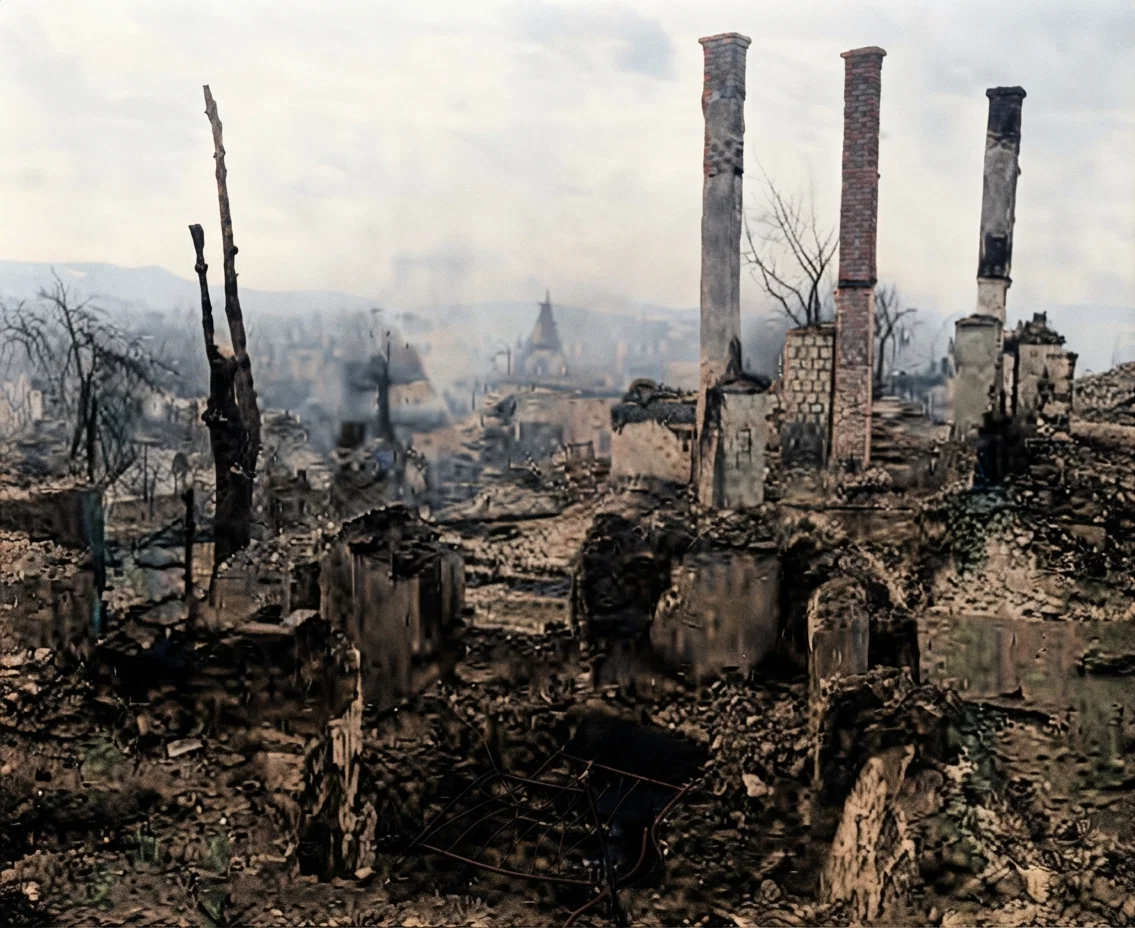
Boston Photo News Company. Town of Shawle, in the eastern battle field, showing the condition in which the country was left by the retreating Russian army. The broken hearts, the ruined lives, the sighs and the groans of the populace, cannot show in this photograph, but it does graphically present the physical side of the destructiveness of war. In what marked contrast to this sorrow- and anguish-producing destructiveness are the principles and practice of divine love set forth in the accompanying article.
A few texts in reference to this matter: "The Lord hath appeared of old unto me, saying, Yea, I have loved thee with an everlasting love: therefore with loving-kindness have I drawn thee." Jer. 31: 3. God's love, then, is everlasting. Human love may and does change, but the love of God endures on to eternity.
"Who shall separate us from the love of Christ? shall tribulation, or distress, or persecution, or famine, or nakedness, or peril, or sword? As it is written, For Thy sake we are killed all the day long; we are accounted as sheep for the slaughter. Nay, in all these things we are more than conquerors through Him that loved us. For I am persuaded, that neither death, nor life, nor angels, nor principalities, nor powers, nor things present, nor things to come, nor height, nor depth, nor any other creature, shall be able to separate us from the love of God, which is in Christ Jesus our Lord." Rom. 8: 35-39. There is nothing in heaven, or on earth, or in hell, or anywhere, that can separate us from the everlasting love of God. I am glad we have a God who loves us like that.
BRUISED REED AND SMOKING FLAX
"A bruised reed shall He not break, and the smoking flax shall He not quench: He shall bring forth judgment unto truth." Isa. 42: 3. Do you suppose the Lord intended that we should be merely reeds? In Isaiah 61 He says we are "trees of righteousness." That is what the Lord intends us to be—fruitful trees. But because of sin, we are mere bruised reeds. We can hardly stand up. Yet the Lord loves even a bruised reed.
"And the smoking flax will He not quench." When you see a thing smoking, there is perhaps not much light. And in our experience there may be only a spark; but He will accept that. How many there are who are like smoking flax! You cannot see that they have any light, there is so much smoke and darkness. We sometimes think there is not much use in trying to do anything for people like that. But the Lord tries to do something for them. He fans the spark, hoping it will burst forth into a flame of light. How much we all need to be like God!530But whom did God love? Does He love good people only? Sometimes we hear people say: "I just love John Smith. He has been good to me." There is no objection, as far as I know, to loving people who are good to us. But a Pharisee loves people who are good to him. A Christian loves people who are not good to him. That is the difference. "God so loved the world." Whom did He love? — Why, the world. Were there any good people among them? — Not one. "There is none righteous, no, not one," says the apostle; yet the Lord Jesus Christ loved them all.
There is even a stronger statement in Rom. 5:6: "For when we were yet without strength, in due time Christ died for the ungodly." It was love that led Him to do that. The Saviour gave Himself for sinners. He hung on the cross for those who were lost. And if Christ loved the ungodly, what should professed Christians do?
You will remember it is stated in the fifth chapter of Romans that "the love of God is shed abroad in our hearts by the Holy Ghost." When the Holy Ghost is in our hearts, it takes the love that God had, and puts it into your heart and mine, and then we love those who are lost and in need of love. When that is done, we have a burden for lost people, for souls going down into perdition.
TESTING OUR CONVERSION
In Matt. 5: 43-45 we read: "Ye have heard that it hath been said, Thou shalt love thy neighbor, and hate thine enemy. But I say unto you, Love your enemies, bless them that curse you, do good to them that hate you, and pray for them which despitefully use you, and persecute you; that ye may be the children of your Father which is in heaven." What are we to do in order to be the children of God? — We are to love our enemies, love those who despitefully use us and persecute us.
It may be a good thing for us to take an inventory of our religious experience in the light of this Scripture. It says, "Pray for them which despitefully use you." Is that what we are doing? Has some one done you a wrong, or made mistakes? Are you praying for him, or are you talking about him behind his back, and cherishing a spirit of revenge, a desire to get even? May the Lord put His blessed love in all our hearts! We must have the experience that is brought out in this verse, if we ever stand with the redeemed on Mount Zion. Think of the Lord's translating into His kingdom those who are associated in church relationship, and cannot agree. There would be another rebellion. It would change all heaven into pandemonium. I am glad the Lord will not translate such a spirit, but that He stands ready to change it, and make us children of love.
The scripture just read is in harmony with the statement in 1 John 3: 14: "We know that we have passed from death unto life, because we love the brethren." It does not say we know this because we attend church and go through a certain round of ceremony. There is a way to find out whether we are Christians or not.
"I WISH I KNEW"
I have heard persons say, "O, I wish I might know whether I am accepted of the Lord or not!" From this text, we can know whether we are really children of light or children of darkness. "We know that we have passed from death unto life, because we love the brethren." How many of the brethren does that leave out? — It includes every one. And it is not guesswork. "We know." When can we find out whether we have passed from death to life? — Right now. This is a sure test.
CONVERSING WITH THE DEVIL
Many years ago, I reached the place in my religious experience where I did not know whether I was a Christian or not. One Sabbath, I was alone, and was thinking it over; and Satan said, "You might as well give up." I said, "Yes, I think I might as well give up." I got my Bible, and looked it all through, and said: "If I give up the truth, I will not have any more use for this Book. I might as well lay it on the shelf."
Then I thought about some of the brethren — about the brother who was instrumental, as much as any one else, in leading me to the Saviour; and I thought, "I do not know as I will want to see him again." While I was thinking, this text that I have just read came to me: "We know that we have passed from death unto life, because we love the brethren." Then and there I was convinced that I did love the brethren, and that God accepted me; and I have never been tempted, from that hour to this, to give up God's truth. I have had trials, plenty of them; but I have always had hope of triumphing at last through Christ.
This is a sure test; and it is useless for any man to go along with an old grudge in his heart, and bitterness in his soul, and expect to be accepted of the Lord at last. He will make a mistake. He will be lost. Some of us may be in a lost condition, although belonging to the church. I am thankful that the Lord Jesus Christ can take this wicked thing out of the heart.
You remember that the Saviour, when on the cross, prayed for His enemies, for those who were crucifying Him — asked the Father to forgive them, for they knew not what they were doing.
The apostle Paul, in Rom. 9: 1-3, states: "I say the truth in Christ, I lie not, my conscience also bearing me witness in the Holy Ghost, that I have great heaviness and continual sorrow in my heart. For I could wish that myself were accursed from Christ for my brethren, my kinsmen according to the flesh." There are not many who pray that prayer. I do not know that any of us can.
Paul loved his brethren, his kinsmen; loved those who were stoning him, hunting him from place to place; loved them so much he said he could wish himself accursed for their sakes. He would be willing to be lost, to give up eternal life, if in doing so he might save his brethren. With that spirit in the hearts of God's people, there will be no strife among them. When we love each other so much that we can truly say, "Lord, I yield up my crown of glory, if need be, in order that my brother can be saved in the kingdom of God," that is true religion. And it can only be had by the power of the Spirit of God bringing into our souls the love that Jesus had.
WOULD DIE FOR THEM
The same was seen in the life of Moses. You will remember that one time the people made an ox, and set it up, declaring it to be their god, to lead them back to Egypt. They would rather have an ox than Moses. They rejected him, and went into sin and apostasy. How did Moses feel about it? — He said to the Lord, "If Thou wilt forgive their sin —; and if not, blot me, I pray Thee, out of Thy book which Thou hast written."
Moses loved those who had rejected him, to such a degree that he was willing to give up eternal life if they could be saved. He did not say: "O, these people make so many mistakes, I think I will start another denomination! I will create an organization of my own." No; he said he would stay with them, he would perish for them.
HIS LOVE HAS WON US
"We love Him, because He first loved us." 1 John 4: 19. The Revised Version reads, "We love, because He first loved us." We never would have loved Him if He had not loved us first. Keep that thought in mind. He loved you, and by and by you began to love Him.
There is a principle here that we will do well to consider. "We love, because He first loved us." Love begets love. We sometimes find people who say: "I went to church last Sabbath, and O, it was such a cold place! I think I will not go any more."
A BUNDLE OF SELFISHNESS
What a bundle of selfishness, to stand around to be loved! If you want somebody to love you, start out and love somebody, and do not ask, "Why doesn't somebody love me?" It is supreme selfishness that will lead a person to act in that way.
You can take hold of an icicle, and hold on to it till you thaw it out; and you can go to a church that is as cold as an ice box, and begin to love everybody, begin to be kind, and to speak to people. Do not wait for somebody to introduce you. Begin to love people. Shake hands with them, and show them that you have some love in your own soul. Then everybody will love you. This idea that you cannot love people until they love you, is a strange kind of Christianity. "We love, because He first loved us."
In James 1: 27 we have a definition of pure religion. We talk a great deal about pure food and pure air these days, and I do not know that we say too much about them. But a man may eat pure food, drink pure water, breathe the purest air that blows, and yet have a corrupt heart all the time. While we are getting pure food, pure water, and pure air, we want to be sure that we get pure religion. "Pure religion and undefiled before God and the Father is this, to visit the fatherless and widows in their affliction, and to keep himself unspotted from the world." That is the genuine religion.
SAVED HIM FROM SUICIDE
You have perhaps heard of the man who was weary of life, and said, "I will go to the lake and drown myself." On the way, he saw a ragged urchin crying in the street, and asked, "Sonny, what is the matter with you?"
The child replied, "O, I am hungry, and my mamma is hungry!"
"Where is your mother?" the man asked.
"I will show you where she is," said the boy.
So he led the man through a dark, dirty alley, up a rickety flight of stairs, to a garret, and there lay a poor sick woman on a pallet of straw. This man interested himself in the case—got a physician, a nurse, and the things the woman needed; and when he left that place, he said: "I don't want to drown myself. I was never so happy in my life."
That which brings joy to the heart is pure religion, and the keeping of ourselves unspotted from the world. That means a great deal—to be unspotted from the world. The real Christian is always found where he will want to be found when the Judgment comes. When a man's case comes up in the Judgment, will he want to be found in the nickelodeon, or some other questionable place? Will he want to be sitting in some theater? Will that pass muster? — No, sir. "Pure religion and undefiled before God and the Father" is to keep "unspotted from the world." Christians do not live like the world. They belong to another world.
THE COATS AND GARMENTS SHE HAD MADE
Here is another scripture along the same line—Acts 9:39. It tells of the death of Dorcas. We do not have the record of very many funerals, in the Scriptures; but we have a few. Dorcas had died, and the friends had sent for Peter to come and raise her to life.
"Then Peter arose and went with them. When he was come, they brought him into the upper chamber: and all the widows stood by him weeping, and showing the coats and garments which Dorcas made, while she was with them."
Did you ever attend a funeral like that? I have attended funerals, and so have you, where there were great banks of flowers brought as tokens of love. That is all right, but the kind of funeral Dorcas had is far ahead of that. If, when you die, not a flower is placed on your grave, but many poor souls stand around it, and one says, "I was in great need at one time, and on a cold day, this brother put a ton of coal into my cellar;" and another says, "I lacked food, and this brother sent me a sack of flour;" and still another says, "I had not enough to wear, and one day I received a coat from this brother" — O, to have people standing around a coffin and making statements like that is worth more than flowers!
You do not see many such funerals. Dorcas, while alive, did not ask, "Why doesn't somebody love me?" She went about loving souls, and a great flood of tears flowed when she was lying cold in death. That kind of love is needed to-day in the church of God.
Mark 14:6-8: "And Jesus said, Let her alone; why trouble ye her? she hath wrought a good work on Me. For ye have the poor with you always, and whensoever ye will ye may do them good: but Me ye have not always. She hath done what she could: she is come aforehand to anoint My body to the burying." Mary brought her token of love and affection before the funeral.
How many times we have failed to do that! When the mother is lying cold in death, the daughter will weep, and say, "O, I had such a good mother!" But perhaps she never told her that. The husband will speak of the virtues of his wife, when probably he never said a word to encourage her while she lived. He will bring great wreaths to lay on the coffin, when he never gave her a bouquet while she was living.
I tell you, my friends, the time to speak kind words is while the ear is open to hear them. The time to be kind, to bring flowers, is when your friends can see and enjoy them. I am of the opinion it would be better to have them then, even if the coffin is bare. There is a great example set forth in this text.
PHYSICAL ENDURANCE THROUGH LOVE
Just think what a power there is in love. It is a mighty agent. It is a tremendous power. It even gives physical endurance. It transforms what might otherwise be drudgery into delightful service.
I remember saying to a lady some time ago, "You look as though you had been sick."
"No," she said, "I have not been sick, but my daughter has, and for eleven weeks I have stood by and seen typhoid fever preying upon her body, and I have hardly left her bed."
Why did she do that? — Because she loved her. The love she had for her daughter gave her endurance.
I was reading, the other day, about an explosion in a coal mine. A number of miners were entombed, and many persons were standing around the shaft, and relatives were praying. Soon they saw an aged, decrepit man come and begin to dig with extraordinary strength. They said to him: "What are you doing there? Come away." But he said: "Let me alone. I have two boys down there, and I must rescue them." The love he had for those boys gave him remarkable power.
THE POWER IN THE MARTYRS
It was love that enabled the martyrs to face the stake. The love of God in their hearts was stronger than all the pressure that could be brought to bear upon them. Liberty was offered to some on condition that they recant — if they would simply kiss the crucifix, and thus betray the Lord; but they preferred to suffer death.
When I was in Rome, I climbed to the top of the Colosseum, and looked down into the place where so many martyrs — fathers and mothers, sons and daughters — had awaited the opening of the underground passages from which Numidian lions would come up and devour them. What gave them courage to face such an ordeal? — It was the love of God in the soul. Something more than a theory of truth is needed to keep a man. The love of God in the heart is required. This is what strengthens God's people in all the hours of trial and persecution.
"Sing, O heavens; and be joyful, O earth; and break forth into singing, O mountains; for the Lord hath comforted His people, and will have mercy upon His afflicted." Isa. 49: 13. Zion is the church, representing you and me. "But Zion said, The Lord hath forsaken me, and my Lord hath forgotten me."
Did you ever feel that you were forsaken, that nobody cared anything for you? We may not have said these words, but sometimes our actions indicate it.
"Can a woman forget her sucking child?" Can she? — Yes, she may, though a mother's love lasts a long time.
I remember one night seeing a young man cast out of a saloon, ragged, dirty, homeless, friendless; and I thought, "If that young man has a mother, she will take him in." The Lord says she "may forget, yet will I not forget thee." His love goes beyond even the tender love of a mother.
LIKE HIS MOTHER'S TOUCH
I read, some time ago, of a young man who had been wounded in battle and was taken to a hospital, and in his delirium he was crying for his mother. The surgeon said that it would be dangerous for her to go in and see her boy, but permitted her to sit at the door and watch him, and watch the nurse care for him.
She sat there, and heard him groan, and watched the nurse caring for him; and after a while, she said: "Doctor, I must go in. It will kill me to stay here. Let me go and do what the nurse is doing, and I will not speak a word to him." So the doctor permitted her to go in, and she took the nurse's place, putting on the cold cloths, and doing what there was to do. Finally she put her hand on the young man's fevered brow; and immediately he turned, and said, "That feels like my mother's touch."
What made the difference in that touch? — O, it was the love in the mother's soul! That is what constitutes the difference between a Christian doctor or nurse and one who is not a Christian. When I am sick, unconscious, and cannot pray, I want somebody then to care for me who knows how to beseech God, who has the love of God in his soul.
ENGRAVED BY HIS LOVE
The Saviour says, "I have graven thee upon the palms of My hands." He carries the marks of the nails in His hands and as long as He sees those scars, He will remember you and me, for we drove those nails. I am glad we have such a long-suffering, compassionate Christ, who never forgets, but remembers all through eternity.
1 Cor. 13: 1-3: "Though I speak with the tongues of man and of angels, and have not charity, I am become as sounding brass, or a tinkling cymbal. And though I have the gift of prophecy, and understand all mysteries, and all knowledge; and though I have all faith, so that I could remove mountains, and have not charity, I am nothing. And though I bestow all my goods to feed the poor, and though I give my body to be burned, and have not charity, it profiteth me nothing."
JUST A CIPHER WITHOUT IT
Without love, you are only a tinkling cymbal. There is nothing to you but a jingle. Even though you understand all mysteries — have gone through the university, and have all knowledge — if you do not have love, you are just a cipher. You may engage in some great humanitarian work — give your life to it; yet if there is no love, but instead, unbelief, cold-heartedness, selfishness, it will amount to nothing.
The supreme test is love. May the Lord help us to search our hearts, and see if we have the love of God burning in our souls.