The Garden Beds Alone Were Neglected—The Boys Yielded to the Tempter—Is the World at Large Yielding in Like Manner?
By TYLER E. BOWEN
MR. HENDERSON was leaving home for the day; but before going, he laid out for his two sons that which he desired them to do while he was gone. He carefully measured their tasks, estimating the length of time required for accomplishing their work. He also provided for some time for play after their work was over.
THE WORK TO BE DONE
The usual morning chores at the barn and about the house were to be attended to, then a patch of beans back of the barn was to be hoed. This would take until about 10:30. A tree of cherries over by the horse barn was to be picked; and easily, the father knew, the boys could have this done by dinner time. Then the three beds in the garden, which badly needed weeding and hoeing, were to come in for attention, to take until two o'clock. With three or four minor duties laid out for them on the program between two and three o'clock — the old family horse to be brought from the little pasture near, and hitched up for mother and Sadie to make an afternoon call at Aunt Mandy's — this, with one or two other things to do about the horse barn, and their work would be over.
SOME TIME FOR PLAY
From three to six, the boys were to have the time for play — either a visit to Cousin Frank's, about a mile away, or a fishing excursion up through the woods for trout, as they might choose, both of which father knew the boys had been anticipating for several days.
Before leaving, the father carefully went over the day's program again, explaining to the boys how each piece of work was to be done, in his usual kind, painstaking manner, and Fred and Jamie both assured him they fully understood it all.
A CIRCUS AT MIDDLEBORO
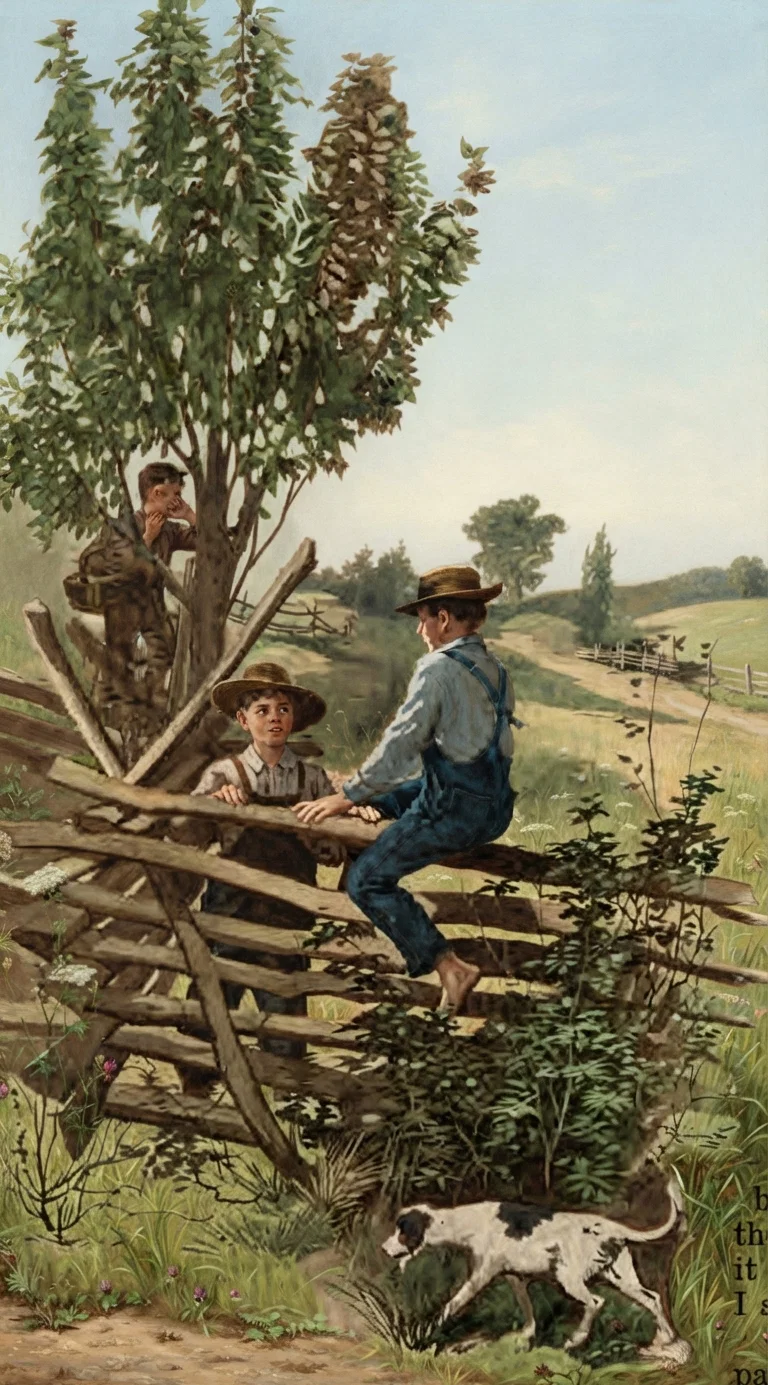
Everything went well until just before dinner. As they were finishing the cherry tree, Bill Jones, a near neighbor's boy, happened over, and from the rail fence where he had just climbed up and sat watching the boys, called out:
"Say, Fred, aren't you about through with that cherry picking business? I've got somethin' to tell ye."
"O, is that you, Bill? Didn't know you were about. Why, yes, we're nearly done. What's up now?" Fred replied.
"I'll tell ye when ye come down."
When Fred, who was three years older than Jamie, came down, Bill beckoned for him to come over by the fence. Then, in a low, confidential tone, he excitedly went on:
"I've just heard from Tom Wilson that a circus is booked for Middleboro, and because of a storm yesterday they couldn't show at Grand Junction, so they will get to Middleboro this afternoon about half past two, and will unload and have an evening circus. Let's go down. It'll be big fun to see 'em unload."
"Yes, but—" and Fred began thinking over his program.
"Why, what ye puzzling over?" Bill inquired, in his dry, half teasing tone of voice.
"O, I was thinking of what father laid out for us to do to-day. We get through at three o'clock, and then have the day to ourselves."
"O, that's easy; leave out something, and" "tell him you forgot, and get off at two. You can make it all right then."
But Fred still looked puzzled. "I am afraid that won't work. Father knows we know, and he will be looking things over when he comes home. He seems to see into things without any one's telling him."
"Well, you're a fool," Bill sneered, "if you miss that sight of unloading. That's all I have to say." Then he put off for home.
After dinner, the boys slipped out to the horse barn, and Fred let the secret out to Jamie. They did some very earnest, low talking.
"We might leave out those garden beds, and get the horse now," Fred said.
"Yes; but father will see those beds as he comes up the road to-night and turns in; and you know, Fred, just what he will say. I think we better let the unloading go. We have no permission to go to Middleboro, anyhow."
"But I want to see them unload those big wagons, and put up those tents. If father knew about it, maybe he wouldn't care. We can weed the beds when we get back. Maybe we'll get back before father comes, anyway. Come on! Let's go."
So they hustled around, and hitched up old Sallie, and left her tied in the horse barn, and were off at about two o'clock.
It was an exciting afternoon for the boys. Wagon after wagon came down the long planks at the switch. The fine horses were hitched to them, and away they went for the show grounds. By and by, the boys joined the crowd, and were soon watching the men driving stakes and stretching the canvas; and presently up went the cotton
house, into which the wagons were hauled, or rather pushed by a great elephant that got his big head behind them, and so easily walked along with his load, which took six or eight horses to draw. Before the boys were aware of it, the sun was about down; and somehow — they couldn't quite explain how — all at once it came over them that they were not where they ought to be. Jamie looked it, and Fred's face told the same story, as they happened to look into each other's face. Neither spoke, but they started for home.
"I wish we had not come," Jamie panted out after they had been running for a while without saying anything.
"It wasn't such a sight, after all, was it?" Fred got out between breaths. "Somehow all I can see now is those beds in the garden, and father's face."
Many like expressions passed back and forth as they kept on hurrying toward home.
They slipped up through the orchard, and came into the horse barn door just as father was closing the stable door after putting out his team, and was starting for the house.
"Well, boys, just getting back from fishing, eh?" But somehow his tone and face said something else.
The boys looked at each other, each waiting for the other to say something.
"Yes, we're just getting back—but—" Fred got thus far, and somehow the rest stuck in his mouth; so father finished it for him by saying, "But not from fishing, I see."
Then slowly he went on: "I notice the bean patch is hoed in good shape, and the cherry tree has had a good job done in it; but something must have dropped in about here, for I see those beds yonder," pointing out toward the garden, "are just as they were this morning. You remember how we went over the program, Fred, and your work was to end by dressing out those beds."
Yes, Fred remembered; and two very sober boys slowly walked along toward the house, as it was clearly evident father was sorrowfully meditating what punishment must be meted out to his two disobedient boys, who themselves knew they merited what was coming, whatever father should decide that to be.
Let us here leave the boys a moment, and think of how, in like manner, nearly a whole world is doing precisely the same thing.
ANOTHER PROGRAM IS CHANGED
The heavenly Father has outlined certain requirements. He has been very explicit in making each point in our program very plain, so that all shall understand. Two, three — yea, seven, eight, and nine points in it are carefully carried out and obeyed, let us say; but one — just one — is fixed up a little — changed, if you please — to suit the children. A tempter has come along, and has suggested that it certainly will not make any difference with the Father if we change the program in just this little particular. After we have been so careful in all the specifications thus far, surely for just one to be done a little unlike the program, would result in no harm.
The subtle reasoner goes on: "It cannot be that in so slight a matter as the choice of a day, the Father would care. Sunday is as good a day as the day before it; and we can534use that for His Sabbath just as well as to be so particular, and go to all the trouble and inconvenience of resting upon the specific day He so long ago indicated in the Book; specially now that everybody, nearly, has discarded that old day.
Friend, this is as thousands upon thousands reason to-day. But it is the reasoning of a wily foe. Trouble will result for every one who listens to the artful tempter, as surely as it did for Fred and Jamie.
WE MUST BE LOYAL
It does make a difference. The leaving of the garden beds unweeded was a clear case of disobeying a loving father's directions. While the duties performed were all right, so far as they went, these could not atone for the one disobedient act. Neither will the loving heavenly Father accept a spurious sabbath for loyalty to Him, when He has made clear to His children His will upon this particular point, in the Book He has given us.
The fence may be ever so high and strong; but if one length is down — only one — the crop is at the mercy of invading stock. One weak link in the chain is enough to hurl a man to his death, if it breaks while he is being hauled up over the precipice.
One broken commandment in God's law is sufficient to make a person guilty before God of all.
Jesus kept them all. And so can we, in the strength and grace provided us through Him.
Let us not be deceived by the subtle voice of the tempter, for soon we shall have to meet our God face to face; and as the boys had learned, the Father knows all about what we have been doing, and what we have been hiding away back in our hearts where we may think no one sees.
Ah, how much better it will be, in that day, to have lived out the Father's reasonable program all the way through! How much better to hear His words, "Well done, thou good and faithful servant [yea, son or daughter]: . . . enter thou into the joy of thy Lord." For "blessed are they that do His commandments, that they may have right to the tree of life, and may enter in through the gates into the city."