THE heading to this article is a part of a scripture that tells of a time when certain ones will think that they offer service to God when they kill certain other ones of their fellow men. The scripture verses giving the text and context are the following:
"These things have I spoken unto you, that ye should not be caused to stumble. They shall put you out of the synagogues: yea, the hour cometh, that whosoever killeth you shall think that he offereth service unto God. And these things will they do, because they have not known the Father, nor Me. But these things have I spoken unto you, that when their hour is come, ye may remember them, how that I told you." John 16: 1-4.
The worst and the bitterest religious persecutions that the world has ever known are those of the "Christian era," and consequently after Christ had spoken the foregoing words. For when good things become perverted, the counterfeit is the worst that can be devised.
These words of the Teacher are both a warning and an encouragement. They warn us against being among those that will kill people, and still think that they are offering "service unto God." And on the other hand, if we find ourselves persecuted, and threatened with death, because of our faith in the God of the Bible, we may be assured that this is a part of the privilege that comes to the Christian.
It is generally considered that we have reached such an "advanced state of civilization" that we will never have any more religious persecution, and especially so in this country, "the land of the free and the home of the brave," "the land in which every man may worship God according to the dictates of his own conscience," or where he may refrain from any worship, just as he sees fit.
But the great civilization of the old Roman empire did not stop it from persecuting those who differed from it in matters of religion. And after the "civilization" of that empire had been nominally baptized into a profession of Christianity, it did not prevent it from plunging into the worst and the bloodiest persecutions of which history furnishes any records. Of course the worst of these persecutions occurred after the empire of Rome had been broken up into the kingdoms that succeeded it. But all the seeds for that persecution were sown during the time that Rome was a nation entire, and at the time when she was in the noonday of her civilization. Civilization alone is not enough to keep peoples from lapsing into the intolerance of persecution.
Trusting to the civilization of the time to protect us is the very thing that will prove the ruin of those who place their trust there, and who do not look continually to the principles that are the basis of all true civilization. The "fathers" of this republic laid down the foundation principle that "eternal vigilance is the price of safety." And while this phrase was uttered by Patrick Henry at the ushering in of the war of the Revolution, yet it was the foundation for the slogan that has been a principle with the nation, that "eternal vigilance is the price of freedom," as well as the price of safety.
This "eternal vigilance" must be exercised in keeping the real principles of freedom before the mind; because when these principles are lost sight of it is very easy to drift, amid all the glare of the light of civilization, into the worst forms of bigotry and persecution. Hence it is always proper to raise the question as to whether or not there are any tendencies in our time looking toward the drifting away from the old principles of liberty that allow us the freedom of worship. For freedom to worship, or not to worship, just as the individual may choose, is one of the dearest of our rights, and it is the one target at which all the artillery of intolerance is aimed.
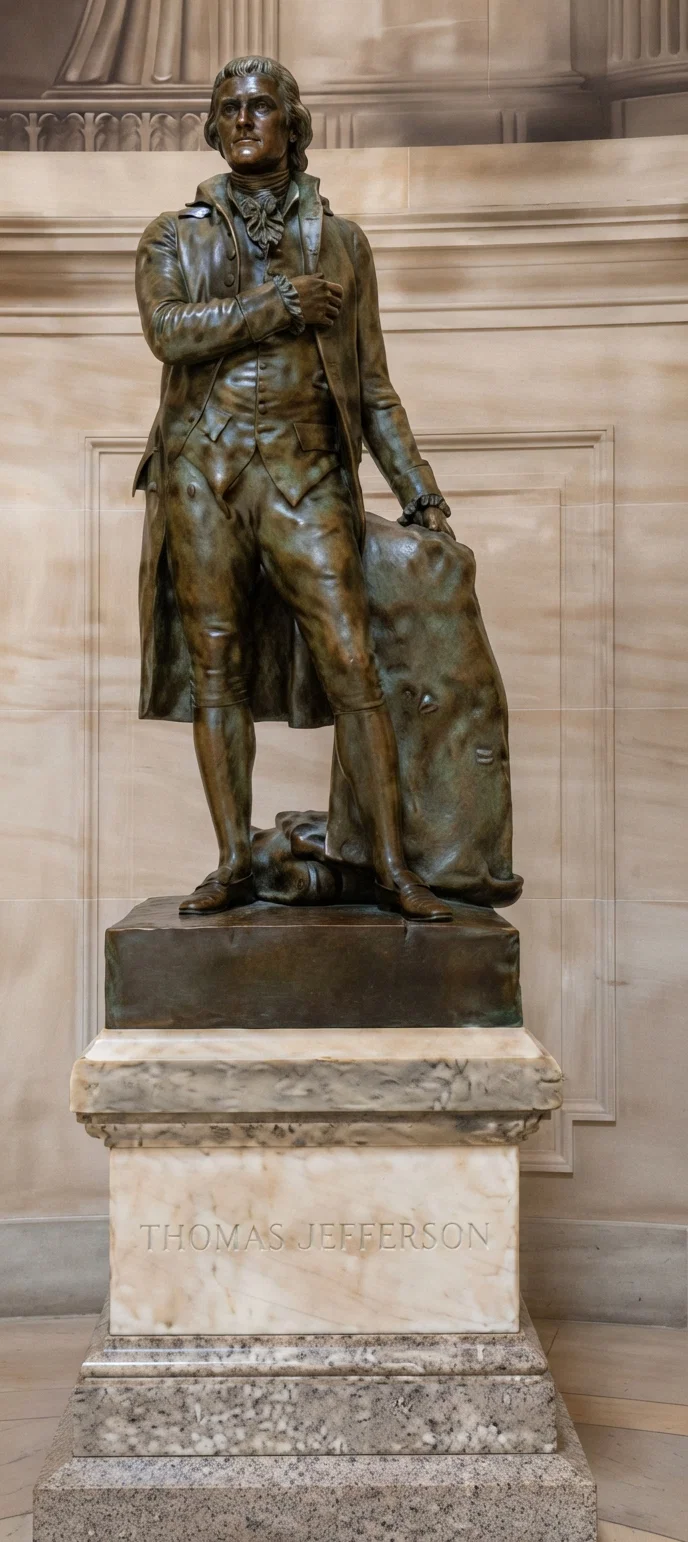
Statue of Jefferson at the Capital, Washington, D. C.
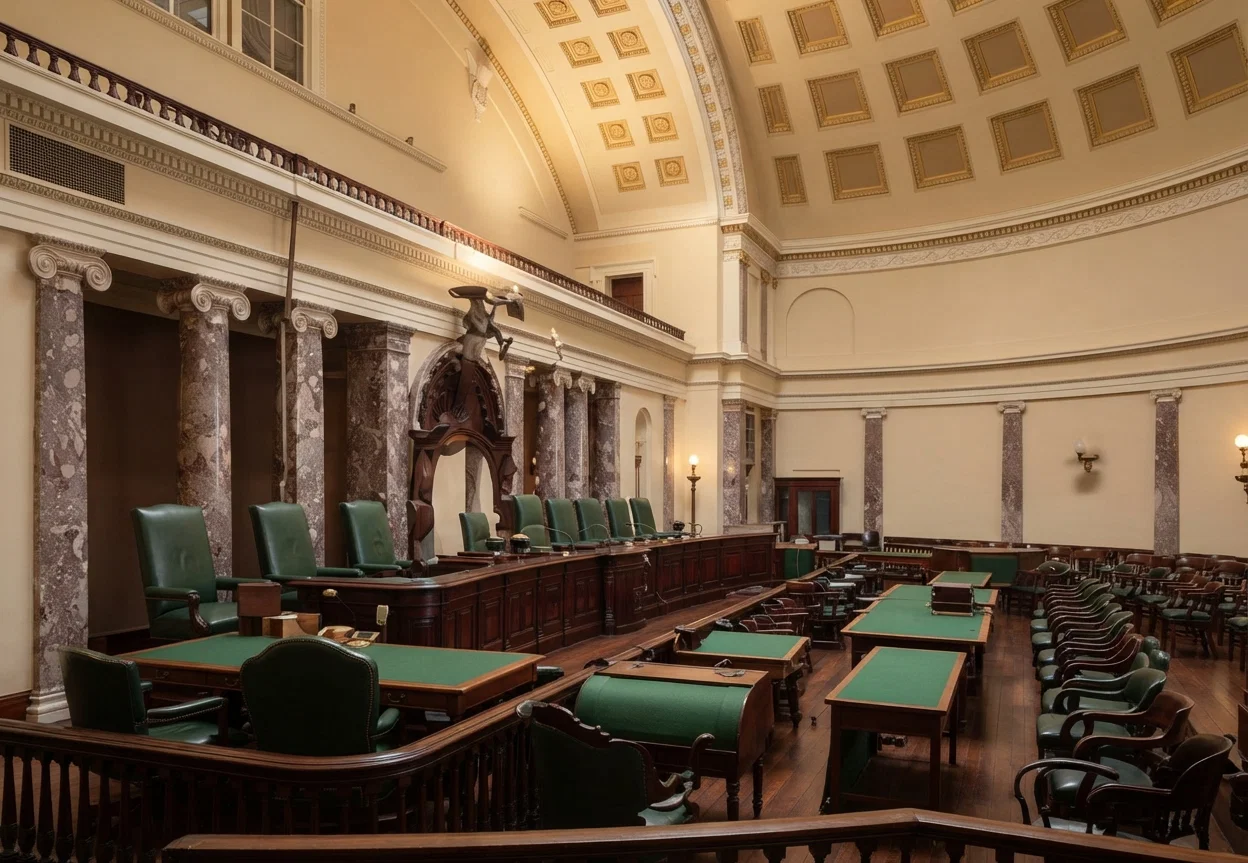
Interior View of Supreme Court Room, Washington, D. C.
It is recognized that this is an age of intensity, and mighty issues are surging in the minds of the populace. And in this time of intensity it is clear that when a wrong movement is set in motion it will rapidly develop mighty results. Hence all the greater necessity of looking well to the ground on which we are standing.
A Most Perplexing Issue.
One of the most perplexing issues of this time is the conflict that is being waged between capital and labor. There is constant agitation everywhere, and strikes and rioting are very common in numerous places. It has been frequently suggested, and particularly by the heads of the Catholic Church, that religionists will have to step in to act as arbiters and guides before the social malady can be healed. This may seem like a small straw, but in the intensity of these times there is no telling what may come out of it in a very few months when once the thing is well started.
Most closely allied with this notion that religionists will have to intervene to settle the labor and capital difficulties, is the further contention that we must have strict Sunday laws in order "to give the laboring man his right to rest one day in seven." On this latter contention there has been the most persistent propaganda kept up for the last half century. Notwithstanding the fact that every state in the union except California has a Sunday law, we find that at the meeting of every legislature there are always those on hand who want still further legislation in favor of the observance of the day.
The national legislature at Washington has not had a session for years during which there have not been numerous bills presented, asking for legislation to enforce the observance of Sunday. The present Congress had but just convened when there were introduced three separate bills asking for Sunday legislation.
Widely Extended Sunday Ordinances.
Very many of the cities and towns of the country have their ordinances prohibiting Sunday labor, and providing penalties of fine and imprisonment for their violation. During the last few months there has been a big agitation in New York City because of the enforcement of one of these ordinances there. The decision of a district judge made it obligatory for the police to close all places of amusement in the city on that day. The order of the judge was rigidly enforced for a few Sundays, when the general clamor for amusement on Sunday rose so high that a way has been found by which the theaters, concert halls, etc., are again opened. But the agitation has developed the fact that there is a strong sentiment in favor of making strict Sunday observance obligatory under the pains and penalties of the civil law.
In Kansas City there was a similar agitation to the one in New York, for here, too, the judge of one of the courts lent his influence to the Sunday cause. He gave discourses upon the subject to the church people and told them that he was with them to make Sunday rest a rigid reality.
Then there has been the agitation of the subject in Chicago, Los Angeles, and many other large cities, during the very recent months. Disciples of the movement are already lecturing in different places in California, preparing the public, as they suggest, for some definite action at the meeting of the next legislature a year from now. They say that it is a shame to have California stand out alone without any law to enforce the observance of Sunday.12
A Religious Question.
Superficial thought might not suggest anything significant in this Sunday-law agitation that is becoming stronger and stronger thruout the country. But closer thought should show any one that the whole history of Sunday is the history of a religious institution. It began its history as a pagan holiday dedicated to the worship of the sun. The first law in the Christian era proclaimed in its favor was the Sunday law of Constantine, who was called the first Christian emperor, but who was in fact never more than a nominal Christian, for many of the acts of his life show that he was not a follower of the Nazarene. It is said that he even postponed his baptism till he felt sure that he was on his death-bed, so that he might indulge freely in the excesses and ambitions that were his controlling power.
The whole history of the Sunday institution from that time to the present is associated with religion. And therefore when it is sought to secure Sunday legislation, the effort is wholly in behalf of religious legislation. The statement is frequently made by those in favor of it that they are not working for a religious Sunday; they say that they want a civil Sunday for the working man. But the mere calling of a religious institution by a civil name does not make it anything else but religious. It would be just as sensible for those who believe that sprinkling is the correct form of baptism to ask for a law that everybody should be sprinkled, and then say that they are not asking for a religious sprinkling; they only want a civil form of baptism. This may seem an absurd illustration, but if we yield to the Sunday law, then may not the next step be to get a law requiring everybody to be baptized? Nations have had such laws, and it is not out of the question to have them again. And as there is the same lack of agreement in regard to the correct mode of baptism that there is in regard to the day that should be observed as the Sabbath, it would be necessary for the state to make a law telling us how to be baptized. The same spirit that will make and enforce the Sunday law is the spirit that all thru the centuries has required whole multitudes of people to be baptized, or else suffer the penalties of the law of the state.
The Lord Jesus Christ, in the verses quoted at the beginning of this article, told us that the time would come when men would think that they were doing a service to God when they killed His followers. He did not say that His teaching would apply only in the middle ages; indeed He did not say when it would apply. He merely stated that the time would come when such persecutions would arise, and we know that all of it that does come will be brought into the world thru religious intolerance, and religious intolerance is usually based upon some form of religious legislation.
But There Is a Direct Prophecy
of the Lord that tells us specifically of religious persecution that will arise in this very generation in which we live. It would not be consistent with the length of this article to consider that prophecy in this connection, so we defer that part of the subject for next week. Let it be said in this connection, however, that there is an abundance of evidence to show, both in the prophecy and in the events of the time, that the work that was done by Madison and Jefferson and Washington and the rest of the founders of the republic is in great danger of being lost sight of thru the greed for gain and the lust for both civil and ecclesiastical power. And because of these things it is highly important that we give close heed to the portents of the time.
A Unique View of the Capitol.
As already suggested, the direct prophecy that bears upon the subject will be considered next week. T.