What Law

2%

Pacific Press Publishing Association · Mountain View, California · Sep 12, 1916

FromSigns of the Times, Vol. 43, No. 36.

Read the full edition

What Law

Did

Christ Abolish?

By Carlyle B. Haynes
Is There But One Law, or Are There Two? The Proof Offered A Series of Striking Contrasts
III
III
THE doctrine of the abolition of the law of Ten Commandments is in direct opposition to both the spirit and the letter of the whole gospel of Christ. But in this connection, it is urged that there are passages of Scripture which very plainly teach that some law has been abolished by Christ. And this is true.
It is claimed, moreover, that there is but one system of law revealed in the Bible, and therefore these verses which speak of a law's being done away must have reference to the Ten Commandments.

Two Laws in the Bible

THIS claim is a great mistake, and it arises from a failure to discern the difference between the moral and the ceremonial law of God. A failure to comprehend the difference between these two systems of law leads to the attempt to blend them by making the verses of the Bible which speak of the abolition of the ceremonial law refer to the moral law of Ten Commandments.
The verses used to show that the law has been abolished are the following:
"Having abolished in His flesh the enmity, even the law of commandments contained in ordinances; for to make in Himself of twain one new man, so making peace." Eph. 2: 15.
"Blotting out the handwriting of ordinances that was against us, which was contrary to us, and took it out of the way, nailing it to His cross; and having spoiled principalities and powers, He made a show of them openly, triumphing over them in it. Let no man therefore judge you in meat, or in drink, or in respect of an holy day, or of the new moon, or of the Sabbath days: which are a shadow of things to come; but the body is of Christ." Col. 2: 14-17.
"One man esteemeth one day above another: another esteemeth every day alike. Let every man be fully persuaded in his own mind." Rom. 14: 5.
"For the priesthood being changed, there is made of necessity a change also of the law." Heb. 7: 12.

Christ Changed a Law

IT is true that by the death of Christ, a law has been changed and abolished; but it was not the moral law of Ten Commandments, nor any part thereof. This will be made clear from a close study of the subject of the two laws.
There are many religious teachers who deny that there are two laws in the Bible. This is a mistake which a little study will correct.
"Moreover Thou leddest them in the day by a cloudy pillar; and in the night by a pillar of fire, to give them light in the way wherein they should go. Thou camest down also upon Mount Sinai, and spakest with them from heaven, and gavest them right judgments, and true laws, good statutes and commandments; and madest known unto them Thy holy Sabbath, and commandedst them precepts, statutes, and laws, by the hand of Moses Thy servant." Neh. 9: 12-14.
In this passage, it is declared that the Lord Himself came down upon Mount Sinai, and gave them "true laws," and that He also commanded them "precepts, statutes, and laws, by the hand of Moses." Here, then, are two systems of law; one that God did not inspire a man to speak or write, but which He both spoke and wrote Himself, and another which was given to Moses by inspiration, and which Moses spoke and wrote.
This distinction between the two systems of law is made clearer in the following passage: "Neither will I make the feet of Israel move any more out of the land which I gave their fathers; only if they will observe to do according to all that I have commanded them, and according to all the law that My servant Moses commanded them." 2 Kings 21: 8.
There can be no question that two laws are mentioned in this verse, for the distinction between them is made broad and clear. One, God says, is that which "I have commanded them," and the other is that which "My servant Moses commanded them." If this distinction were always kept in mind by the student of the Bible, the confusion that exists on the subject of the two laws could not prevail.

Two Distinct Systems

THERE is one law that deals only with moral duties. Exodus 20. The other law is wholly ceremonial. Heb. 9: 10.
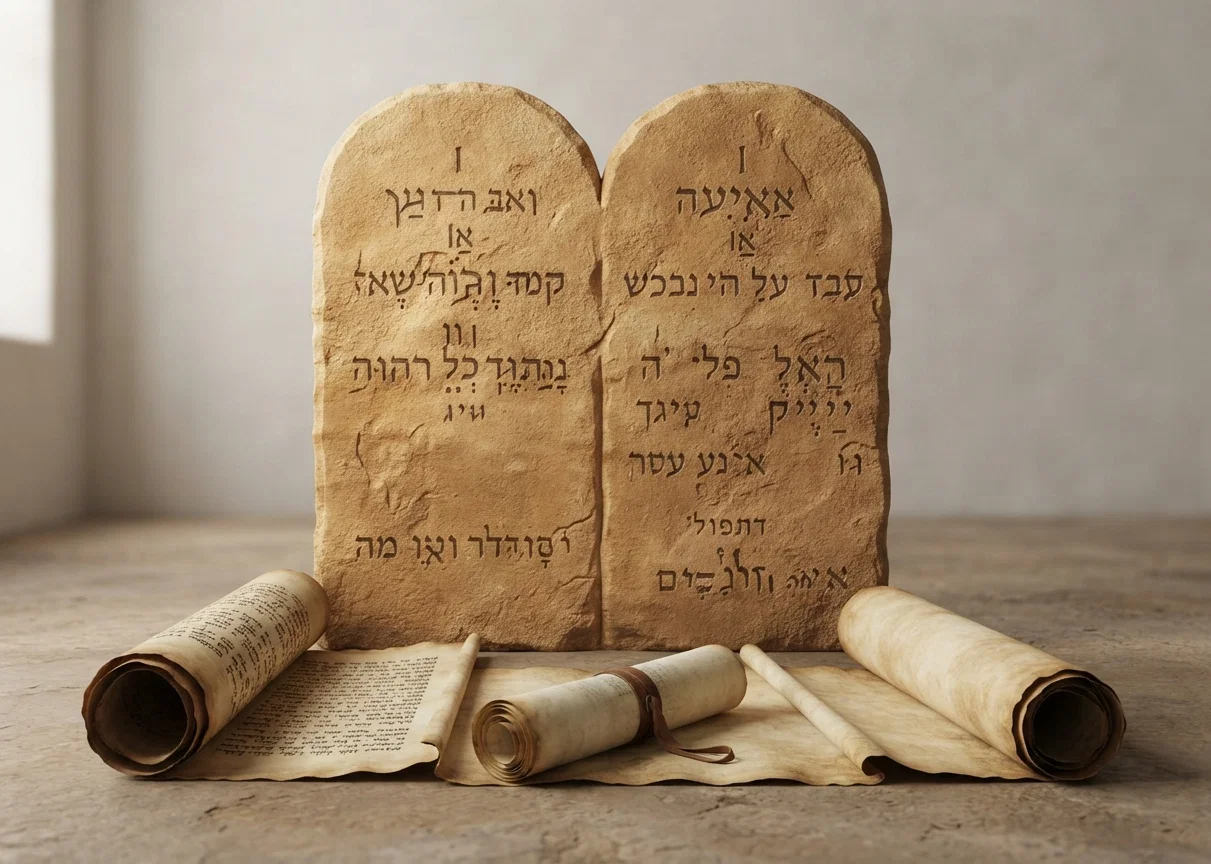
The moral law is contained in the Ten Commandments. This law was spoken by the Lord Himself. Deut. 4: 12, 13. The ceremonial law related to the rites and ceremonies of the sacrificial system given to the Jews, and this was spoken by Moses. 2 Kings 21: 8.
The moral law of Ten Commandments was written by God. Ex. 31: 18. The ceremonial law, relating to the priesthood, the sacrifices, and the offerings, was written by Moses. Deut. 31: 9, 24.
The moral law was engraved by God upon stone. Deut. 4: 13. The ceremonial law was written by Moses in a book. Deut. 31: 24.
The moral law, on stone, was placed in the ark. Deut. 10: 5. The ceremonial law, in a book, was placed by the side of the ark. Deut. 31: 24-26.
There was a law which was "right," "true," and "good." Neh. 9: 13. There was another law, which was "not good." Ezek. 20: 25. These two could not possibly be the same.
There was a law "which if a man do, he shall even live in" it. Ezek. 20: 11. There was another law, whereby a man should "not live." Ezek. 20: 25.
One law was "perfect." Ps. 19: 7. The other "made nothing perfect." Heb. 7: 19.

The Two Differentiated

ONE law Christ did not come to destroy. Matt. 5: 17. The other He abolished. Eph. 2: 15.
The moral law will endure while heaven and earth stand. Matt. 5: 18. The other has been taken out of the way by Christ. Col. 2: 14.
Of the one law, Christ said that whoever should break one of its least precepts should be condemned. Matt. 5: 19. Of the other law, the apostles gave no commandment that Christians should keep it. Acts 15: 24.
One law is "the law of liberty." James 2: 12. The other was a "yoke of bondage." Gal. 5: 1. Two things so entirely opposite cannot be the same thing.
One law Paul took "delight" in. Rom. 7: 22. The other was an unbearable yoke. Acts 15: 10.
One law is established by faith in Christ. Rom. 3: 31. The other was abolished by the cross of Christ. Eph. 2: 15. There must be two laws; for could one law be abolished and not abolished at the same time?
One law is "spiritual." Rom. 7: 14. The other is "carnal." Heb. 7: 16.
One law is "holy, and just, and good." Rom. 7: 12. Another is "the enmity," "that was against us, which was contrary to us." Eph. 2: 15; Col. 2: 14.

Other Striking Contrasts

THE moral law contains "the whole duty of man." Eccl. 12: 13. The other "stood only in meats and drinks, and divers washings, and carnal ordinances." Heb. 9: 10.
The moral law was by nature written in the hearts of the gentiles. Rom. 2: 14. The other became a wall of partition between Jews and gentiles. Eph. 2: 14, 15.
One was "the royal law." James 2: 8. The other was "the law of Moses." Acts 15: 5.
The moral law Jesus came to make honorable and to magnify. Isa. 42: 21. The other He disannulled. Heb. 7: 18.
The moral law is that by which the world will be judged. James 2: 12. The other will judge no man. Col. 2: 16.
Thus it is clearly seen that the Bible teaches two laws, one of which is to endure forever, the other being temporary, and meant to continue only until the sacrificial system should be done away by the great sacrifice on Calvary. Christ's death did not abolish the Ten Commandment law, a part of which is the Sabbath; but it did abolish the ceremonial law, which governed the sacrificial system.

Second Law Dependent on First

THE sacrificial system was established as "a shadow of things to come," and it pointed forward to Christ and His sacrifice. It was made necessary by sin, and was brought into existence to provide a typical remedy for sin. It was governed by a law, the law of the priesthood; and this law was changed when the priesthood was changed.
Let it be remembered that sin, which gave rise to the sacrificial system, "is the transgression of the law." 1 John 3: 4. Then before sin a law existed, the violation and transgression of which was and is sin. A priesthood was established to "offer both gifts and sacrifices for sins." Heb. 5: 1. This priesthood was established because the law of God had been broken, and to provide a remedy, in type, for the transgressions of the law. Sin was before the priesthood, and law was before sin.
The offering of "gifts and sacrifices" was done "according to the law." Heb. 8: 3, 4. That is, there was a law to govern the sacrificial system, the system that provided a remedy for the transgression of a preceding law. Then it can be put this way: Priesthood before the law which governed the priesthood; sin before priesthood; and law before sin. Now the question is, Can the law which governed the priesthood and regulated the offerings for sin be the same law which existed before sin, and to transgress which is sin? — Most assuredly not.

Which Law Reveals Sin?

BUT can it be determined which law it is that reveals sin, and to transgress which is sin? — Very easily. "What shall we say then? Is the law sin? God forbid. Nay, I had not known sin, but by the law: for I had not known lust, except the law had said, Thou shalt not covet." Rom. 7: 7.
The law, then, which is the standard of righteousness, and reveals sin, and to transgress which is sin, is the law that says, "Thou shalt not covet." This is the Ten Commandment law, the law which declares the seventh day to be the Sabbath of the Lord.
The Ten Commandment law was not abolished by Christ. The sacrificial law, the law of the priesthood, the ceremonial law, was the one which the death of Christ brought to an end. Therefore the Ten Commandments still exist, are still in force; and every Christian is under obligation to God to observe every one of them faithfully by the power of the commandment-keeping life of the Saviour, which is given freely to all who will accept it.