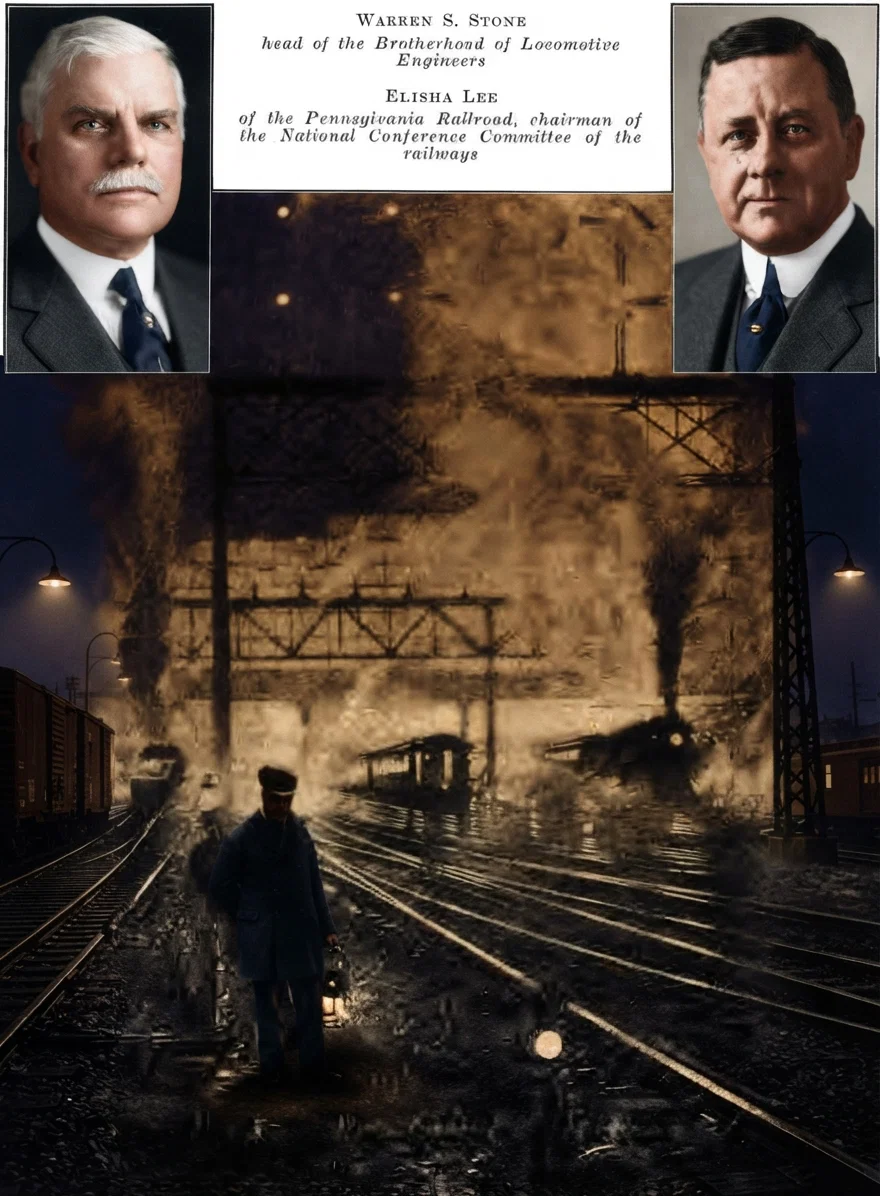
WARREN S. STONE head of the Brotherhood of Locomotive Engineers ELISHA LEE of the Pennsylvania Railroad, chairman of the National Conference Committee of the railways
The Strike and Its Portent
By Editor
A STRIKE that promises to tie up all the railroads of this nation may be in operation by the time our readers get this paper, unless President Wilson and his advisers are successful in adjusting the differences between the officials of the great railway lines and their employees that are involved in the controversy.
The differences that lie at the foundation of this threatened strike have been in acute controversy for something like a year. There seems to be a determination on both sides that the industrial war shall be waged in order that the strength of each of the contending parties may be fully measured. This strike is only one of the things that appear on the surface to show the tremendous depth of the spirit of unrest that has taken almost complete control, not merely of this nation, but of the civilized world.
The late Charles Lenz, Ph. D., in his book "Cassock and Sword," spoke of the unrest particularly in this nation, and the struggle that is on between capitalism and labor. He affirms that the United States Constitution will be no guarantee of safety in case of an outbreak, but that the people will assert their authority, regardless of the constitution, and then he adds:
The Time Is Nigh
"If the signs on our political firmament do not belie us, the time is nigh when the people will exercise this authority."
The bitter class feeling is of long standing. Class hatreds have been generated; they are much more extensive than outwardly appears, and a struggle that bids fair to become so general as this railroad strike that is now under consideration may result in widespread revolution, violence, and anarchy that would be even worse in point of individuals killed and property destroyed than would result from actual war with another nation.
The conditions in society are becoming more and more tense and violent, and anything that has occurred in the past is not a proper precedent by which to judge the social combats of the immediate future. If the men who are at the head of this struggle between the railroads and their employees could get a clear vision of the possibilities that are just ahead of us, there would be found among them many pale faces and palpitating hearts.
We are in the rising tides of the great ocean of discontent and violence that God's word so clearly tells us to characterize the last days. We are in those times when there is to be violence in the land, as it was in the days of Noah, only this, in this time, will be far worse.