"And the Lord said unto Moses, come up to me into the mount, and be there; and I will give thee tables of stone, and A LAW and commandments which I have written, that thou mayest teach them." Ex. xxiv, 12. "And he gave unto Moses, when he had made an end of communing with him upon Mount Sinai, two tables of TESTIMONY, tables of stone, written with the finger of God." Ex. xxxi, 18. "And he wrote upon the tables the WORDS of the covenant, the TEN COMMANDMENTS," Ex. xxxiv, 28. See also Ex. xxii, 15, 16; Deut. iv, 13; v, 22; ix, 9—11.
From these texts we learn that the law of God was the ten commandments, written on tables of stone by the finger of God. These tables of stone were put into the ark made purposely for them, and the ark was placed in the Most Holy Place of the earthly Sanctuary, within the second vail. This ark was called the ark of the covenant, and the two tables of stone, were called the tables of the covenant, because they contained the moral conditions of the covenant made in Horeb.
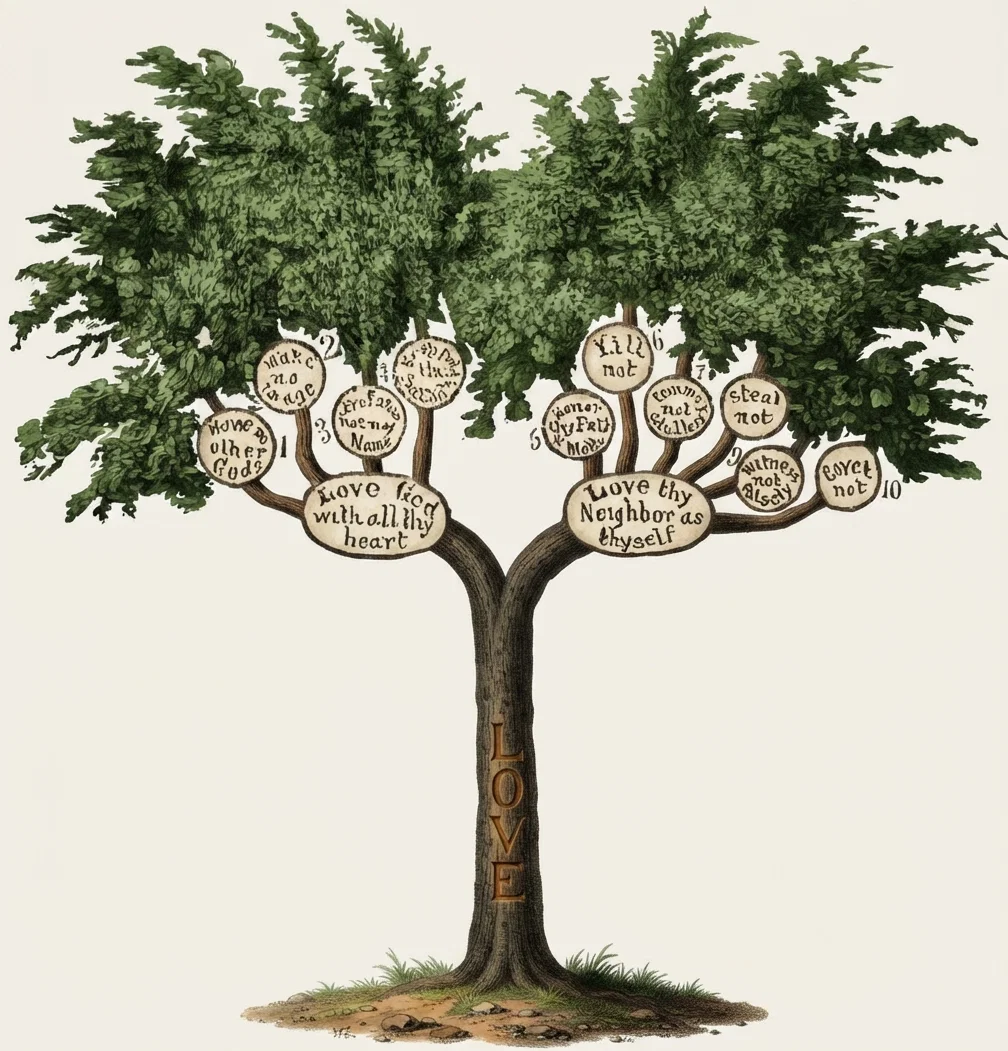
There were two tables of stone. One containing the first four of the ten precepts of God's law, which pointed out their duty to God; the other contained the last six precepts, pointing out their duty to each other. Then the law of God may be fitly represented by a tree with two large branches, and from these two.
ten small branches. One large branch represents love to God, the other, love to one another, [see Deut. vi, 5; Lev. xix, 18,] and the ten branches growing out of the two, represent the several articles of God's law as they are given in Ex. xx. The body of the tree represents the great source, or principle of LOVE out of which the ten precepts of the law grew; LOVE being the foundation of God's law, and the ten articles his form of government.
I will now illustrate the law of God, under the new covenant, as contained in the "ark of his testament" to be "seen" when "the temple of God" should be "opened in heaven," under the sounding of the seventh angel."
Jesus, in his sermon on the mount, says, "Think not that I am come to destroy the law or the prophets; I am not come to destroy, but to fulfill. For verily, I say unto you, till heaven and earth pass, one jot or one tittle shall in no wise pass from the law," &c. Fulfill, here means to obey, not to abolish. So James understood it; for he says, "If ye fulfill the royal law according to the scripture, thou shalt love thy neighbor as thyself." Chap. ii, 8. To fulfill the royal law according to the SCRIPTURE (the decalogue) can mean nothing else than to keep its precepts. Says Jesus, "I have kept my Father's commandments." John xv, 10.
It is said by some that Jesus, in fulfilling the law, released us from its obligation, and that we have nothing to do with it. But let it be understood that he mentions the prophets as well as the law; and if Jesus has released us from the law, he has from the prophets also, and we should have nothing to do with them any more than with the law. But it will be seen that we have to do with both. Let us see how Christ has illustrated this subject.
"Then one of them which was a lawyer asked him a question, tempting him, and saying, Master, which is the great commandment in the law? Jesus said unto him, thou shalt love the Lord thy God with all thy heart, and with all thy soul, and with all thy mind. This is the first and great commandment. And the second is like unto it, thou shalt love thy neighbor as thyself. On these two commandments, hang all the law and the prophets." Matt. xxii, 35—40.
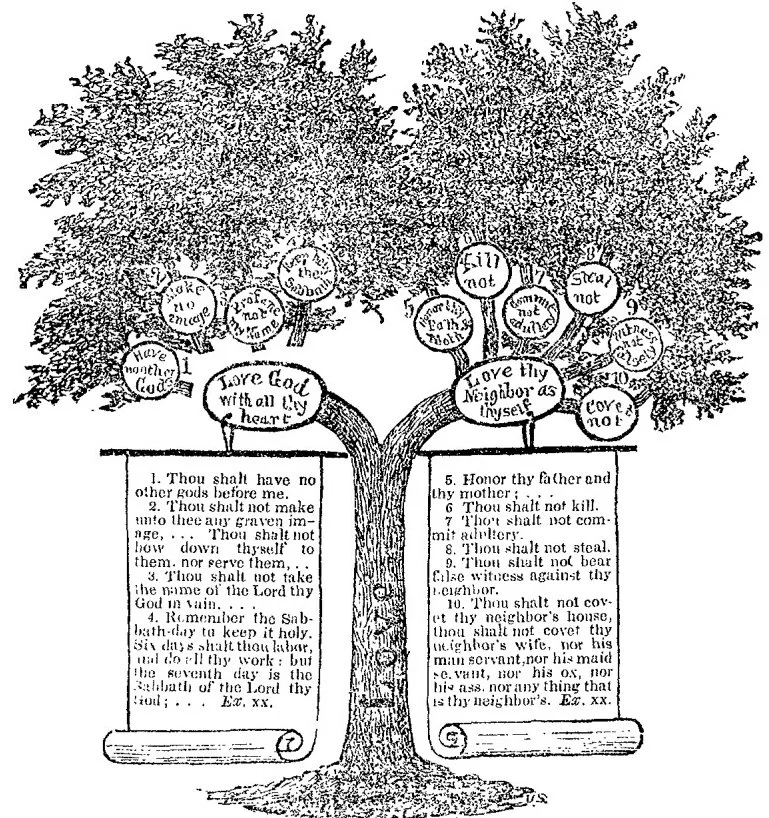
Now let the two great branches represent the two commandments mentioned by Jesus. And if God's law hangs on the two great commandments, let the two scrolls, which are hanging on the two branches, represent it. The two branches representing the two great commandments, and the scrolls representing the two tables of stone. Read the precepts written in the scrolls. Then we have the whole law here. The several precepts of the decalogue grow out of the two great commandments mentioned by Jesus. It cannot be otherwise; because they were given to secure our love to God, and our love to each other. Therefore, the whole law hangs on the principle of supreme love to God, and love to our neighbor as ourself.
It is thought by some that Jesus, in his reply to the lawyer, taught that the ten precepts of the royal law were then done away, and that two new commandments had been instituted in their place. There are several serious objections to this view.
First, in the two great commandments there is nothing new. God has always required of his people supreme love to their Creator, and love to one another. This the following texts prove.
"Hear, O Israel; the Lord our God is one Lord: and thou shalt love the Lord thy God with all thine heart, and with all thy soul, and with all thy might." Deut. vi, 4, 5. See Chap. x, 12. This is the first and great commandment quoted by Jesus.
"Thou shalt not hate thy brother in thine heart; thou shalt in any wise rebuke thy neighbor; and not suffer sin upon him. Thou shalt not avenge, nor bear any grudge against the children of thy people, but THOU SHALT LOVE THY NEIGHBOR AS THYSELF: I am the Lord." Lev. xix, 17, 18. Here is the second commandment quoted by Jesus.
Second, no one teaches that any change whatever took place in the law prior to the crucifixion or resurrection of Christ; then how absurd to suppose that Jesus taught that the ten precepts of the decalogue were then done away, and that the two had taken their place, at the time of his conversation with the lawyer!!
"Which is the great commandment in the law"? was the question of the lawyer; not what it would be in the next dispensation, after the crucifixion. "This is the first and great commandment," replied the Son of God. He did not teach that supreme love to God, and love to our neighbor were duties for the gospel dispensation alone. Therefore, the ten commandments THEN hang on supreme love to God, and love to our neighbor as ourselves, EVEN HAD hung there, and hang there now, as the scrolls hang upon the two great branches of the tree.
Christ speaks of the two great commandments; he also quotes precepts [Matt. xix, 18, 19.] that hang on the smaller of the two, viz: "Thou shalt love thy neighbor as thyself." Then we will represent the six commandments on the second table, as growing out of that one branch. We see in the figure that all the branches are joined on that side. But for the sake of the representation we will leave the branches on the other side disjoined. It is said that Christ110quoted those commandments that are binding, and as he omitted the fourth, we are not to keep the Sabbath. But it is a fact that he did not positively quote any of the first four commandments, represented by the disjoined branches.
But we are required to love God more than our neighbor. Love to him should be supreme, while we should love our neighbor as ourself. To love God supremely is the FIRST and GREAT commandment, therefore those precepts given to secure our supreme love to him must be obeyed, and the branches representing the first four commandments should be joined, not excepting the Sabbath branch. In the next illustration the branches are all joined. Said Jesus, "The Sabbath was made for man." If we reject the Sabbath commandment, and break off that branch, we may the other three, by which we show supreme love to God, and in fact love to God is utterly destroyed!!
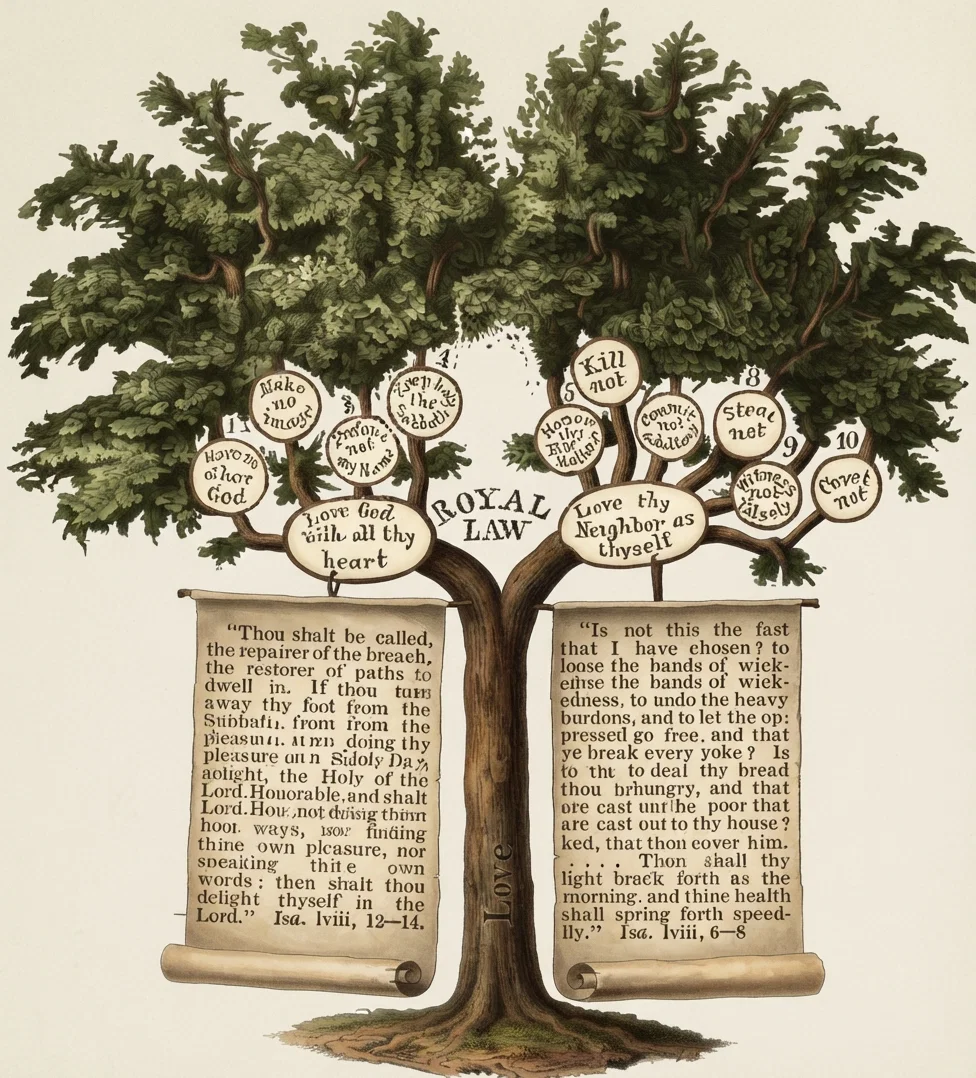
In the third illustration we wish to show that the prophets also, hang on the two commandments mentioned by our Lord. They speak the Law from God. But for want of room we can quote from but one prophet, Isaiah, as is seen in the scrolls.
We shall now quote from the words of Christ, for we can find nothing better. "Thou shalt love thy neighbor as thyself?" None will deny that this is a gospel text purely. To love our neighbor is it not to feed the hungry, to clothe the naked, to undo the heavy burdens and to loose the bands of wickedness? And more, is it not the work under the gospel to break the tyrants yoke and let the bondman go free? Certainly, it is. Then we have brought a gospel text, and it is no more nor less than the law, on the second table of stone. Then we ask, has this all been fulfilled so that we have nothing to do with it? or, is it not now claiming a fulfillment? Then this prophet is not all fulfilled; but he still speaks this law as plainly as ever he did. Hear him:
"Is not this the fast that I have chosen, to loose the bands of wickedness, to undo the heavy burdens, and to let the oppressed go free, and that ye break every yoke," &c. Isa. lviii, 6. Does not this hang on the second great commandment? It certainly does; therefore, as Christ said, the prophets, as well as the law, hang on the great commandments. Then we can represent the prophet in the scroll hung on the second branch, or commandment. Read his words in the scroll.
Inasmuch as the words of the prophet hang on the second branch, they hang on the first branch. Hear Christ's words: "Thou shalt love the Lord thy God with all thy heart, and with all thy soul, and with all thy mind." If we love God we shall wish to honor his institutions, and obey him in all his requirements. Then hear what the Lord says by the same prophet from which we have quoted.
"And thou shalt be called, the repairer of the breach, the restorer of paths to dwell in, if thou turn away thy foot from the Sabbath, from doing thy pleasure on my holy day, and call the Sabbath a delight, the holy of the Lord, honorable; and shalt honor him, not doing thine own ways, nor finding thine own pleasure, nor speaking thine own words; then shalt thou delight thyself in the Lord; and I will cause thee to ride upon the high places of the earth, and feed thee with the heritage of Jacob thy father; for the mouth of the Lord hath spoken it." Isa. lviii, 12-14.
As the above from the prophet, spoken by the mouth of the Lord, is embraced in the first and great commandment, we will represent it in the scroll hanging upon the first of the two great branches of the tree. Now we may see how that the prophets, as well as the law of God, hang on the two great commandments mentioned by our Lord.
In ministering to the wants of the needy, and breaking every yoke, [Isa. lviii, 6, 7,] the Lord says our light shall break forth as the morning; and the glory of the Lord shall be our rere-ward. And if we draw out our soul to the hungry, and satisfy the afflicted soul, then shall our light rise in obscurity, and our darkness be as the noon-day. In doing this, the Lord has promised to guide us continually, and satisfy our soul in draught, and we shall be like a watered garden, and like a spring of water, whose waters fail not. Yet, still more God promises, if we are obedient, yea, he promises that they that shall be of us shall build the old waste places, and shall raise up the foundations of many generations; and shall be called the repairers of the breach. Then if we are to raise up the foundations of many generations, the foundation must have been thrown down; also, there must have been a breach made, in order to have one repaired. And what is this breach that has been made? Ah! the Prophet has informed us, "Thou shalt be called the repairer of the breach the restorer of paths to dwell in, if thou turn away thy foot from the Sabbath, from doing thy pleasure on my Holy Day, and call the Sabbath a delight, the Holy of the Lord, honorable," &c. Isa. lviii, 12, 13. Those that desecrate the Holy Sabbath and tread it underfoot are making a breach in God's holy law. Those that turn away their foot from treading it down, and keep it holy, and call it a delight, the Holy of the Lord, are repairing this breach in the law. It must be repaired by restoring the Sabbath of the Lord our God.
Dear reader, will you notice this fact; God says in the 12th verse that there is a breach made, but does not say in what. The next verse informs us that it is his law, one of the precepts of the decalogue is polluted, and he admonishes us to turn from this transgression of his holy law.