THE natural tendency of the human mind is constantly in the direction of supposed betterment of some sort. The origin of such leaning is doubtless divine, and was implanted in humanity for the purpose of drawing the subject continually upward toward the image of the heavenly Master. Properly directed and controlled, this ambition is, therefore, laudable, but under the management of a perverse monitor, that which was intended for good to all, has been made evil to the greater number.
Strangely enough, the singular part of man's offending is that the major part of it consists in prostituting the gifts of God,—those things designed for his uplifting,—to his own degradation. In fact, the origin of all evil is easily traced to this very source. In the actual courts of heaven itself, one was found who first manifested this wrong tendency. Speaking of this work, and the cause of its appearance, the Lord said of Satan, "Thine heart was lifted up because of thy beauty, thou hast corrupted thy wisdom by reason of thy brightness." Eze. 28 : 17.
In other words, instead of giving God the supreme place in his affections, this being centered upon his own personal advantages, and thus assuming himself to be fitted for a higher station than that in which the gift of God had placed him, he said in his heart, "I will exalt my throne above the stars of God; . . . I will be like the Most High." Isa. 14 : 13, 14. Following the lead of this ambition, others were involved, and "by that sin fell the angels."
From that time to this the God-given desires of man for a higher and better condition have been more or less adulterated by the selfishness and self-efforts of Satan's inspiration. Men have viewed, from some lowly station, a commanding height, when the glow of imagination has gilded its summit with anticipations of greatness and honor, and they have been led to say, "I will climb the heights and gain the coveted position." Once seized with such an idea, they are pushed forward in their ambition, without heeding the just claim of others, or even regarding their safety. Nothing appears to be seen or cared for but the goal of their own ambition.
But when that is attained, tho it may be by great sacrifice of treasure and blood, how unsatisfying is it all! The real element of greatness is still lacking, because the victory was but a worldly gain, which is altogether a hollow mockery. Take, for example, one who rose to the loftiest pinnacle of worldly glory ever reached by man, and who also could say that he had accomplished it all by the force of his own individualism. He waged war more successfully than any other man in history; he influenced the fate of nations, disposing of them according to his will, while kings bowed before him in abject servility. More than this, his immediate power grew from an obscure beginning, until it extended from the Adriatic to the mouth of the Weser, and his opinion ruled throughout Europe.
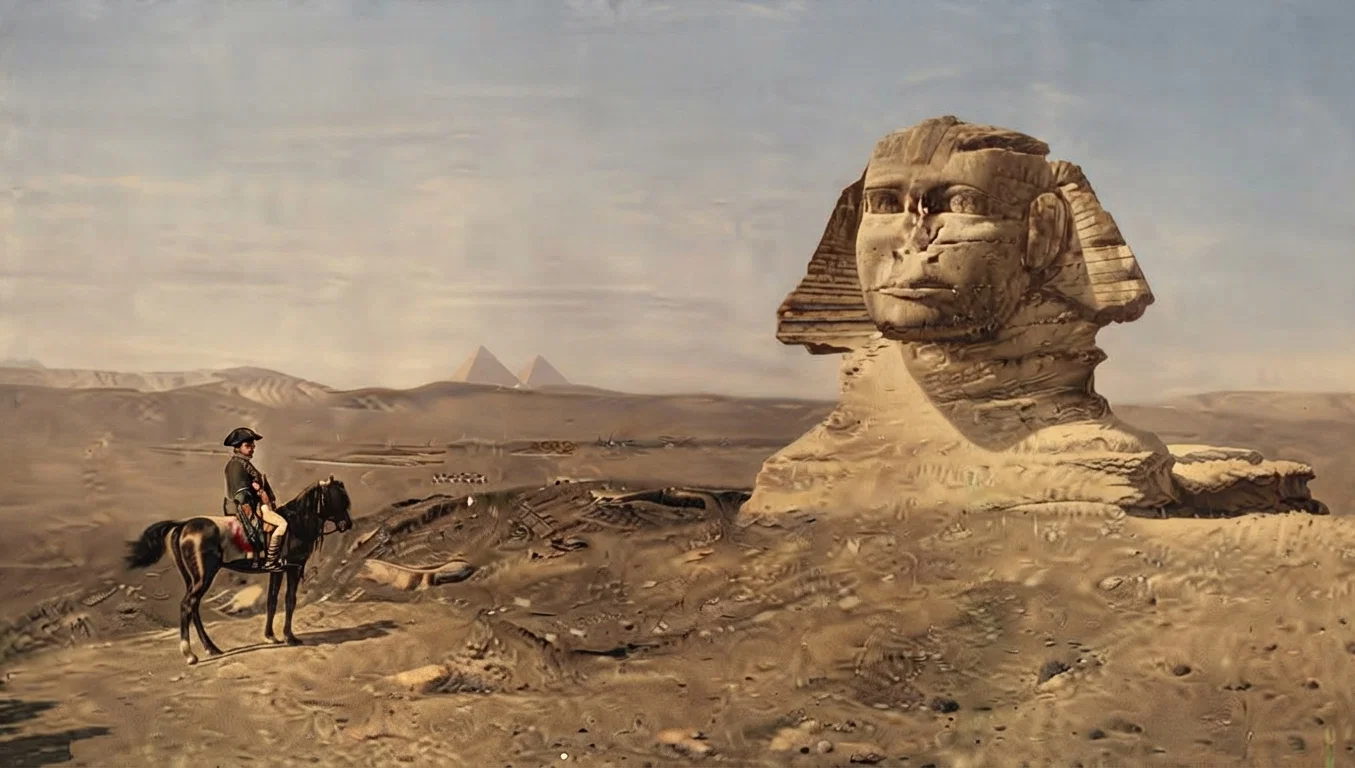
To such eminence rose Napoleon Bonaparte, who, when in Egypt, is said to have ridden before one of the great stone memorials of that country, and, after comparing his fame and greatness with the "dull-eyed sphinx," is made by the poet to console himself with the words:—
"And nations yet to be,
Surging from time's deep sea,
Shall teach their babes the name of great Napoleon."
Yet afterward, when in conversation with General Bertrand, he said: "Alexander, Cæsar, Charlemagne, and I have founded empires; but on what have we rested the creations of our genius?—Upon force. No one but Jesus has founded an empire upon love, and at this moment millions of men would die for Him. It is not a day nor a battle that won the victory over the world for the Christian religion. No,2it was a long war, a fight for three centuries, begun by the apostles, and continued by their successors and the Christian generations that followed. In that war all the kings and powers of the earth were on one side, and on the other side I see no army, but a mysterious force, and who had no rallying point but their faith in the mysteries of the Cross. I die before my time, and my body will be put into the ground, to become the food of worms. Such is the fate of the great Napoleon. What an abyss between my wretchedness and Christ's eternal kingdom, proclaimed, loved, adored, spreading through the world! Was that dying? Was it not rather to live?"
This was far from a satisfying elevation, according to Napoleon's own testimony. It could not possibly compensate, because it was filled with the elements of perplexity and doubt. So every attainment of ambition gained by force, must be of this nature, because the violent efforts by which it is won, must set those from whom it is taken, against the winner. If retained, it must be by the constant application of personal influence and force.
But there is an elevation which, when attained, is eternally secure, because it is not won through sordid ambition. The promise is, "Humble yourselves in the sight of the Lord, and He shall lift you up." James 4:10. Following this, none have to elevate themselves to precarious positions by force of personal influence; but all that is asked of them is to be unpretending and lowly, to claim little for self, and accept the gifts of God as blessings received by the unworthy; and God Himself says that He will lift up all such. How much better to have ambition take this turn than that of the conquerors of the world's power!