A Wonderful Prophecy

5%

Review and Herald Publishing Association · Takoma Park Station, Washington, D. C. · Oct 3, 1912

FromReview and Herald, Vol. 89, No. 40.

Read the full edition

A Wonderful Prophecy

IN the former dispensation the daily round of service during the year typified the work of confessing sins and leaving them with Christ, our great sin-bearer, in the heavenly sanctuary; but Christ will not always bear the sins of the world. There comes a time when he will wipe the last trace of sin from the books of heaven, and lay the sins of the righteous upon Satan, the originator of sin, and will consume sin, sinners, and Satan in the lake of fire. God is a God of justice, and before either the sins of the faithful or the names of the unfaithful are blotted from the books of heaven (Rev. 3:5), there will be an examination of the records, an investigative judgment. The service in the second apartment of the sanctuary was a type of this work. It was called the day of atonement, or the cleansing of the sanctuary. The record states: "On that day shall the priest make an atonement for you, to cleanse you, that ye may be clean from all your sins before the Lord." Lev. 16:30.
When men and angels were placed on probation, a time was appointed when they should be judged. The resurrection of Christ is a pledge, or assurance, of the judgment. God "hath appointed a day, in the which he will judge the world in righteousness by that man whom he hath ordained; whereof he hath given assurance unto all men, in that he hath raised him from the dead." Acts 17:31. The day of judgment is a definite time set apart in which to perform a definite work; it is a period of time. "God shall judge the righteous and the wicked: for there is a time there for every purpose and for every work." Eccl. 3:17.
God did not leave the world in darkness in regard to the time of the antitype of the cleansing of the sanctuary, or the day of atonement, but through the prophet Daniel foretold when that event would take place. In the eighthchapter of the book of Daniel, in the last days of the Babylonian kingdom, the prophet was given a view of the history of the world from that time until the end of all earthly kingdoms. He saw a ram having two horns; and then a rough goat with a notable horn between his eyes came from the west and overcame the ram and trampled him underfoot. Then the goat grew very strong; and when he was strong, the great horn was broken, and in its place came up four notable horns. "Out of one of them came forth a little horn, which waxed exceeding great," until "he magnified himself even to the Prince of the host;" that is, claimed to be equal to the Prince of the host.
While the prophet was watching this little horn persecute the people of God on the earth, his attention was arrested by a conversation between two heavenly beings, which he records as follows: "Then I heard one saint speaking, and another saint said unto that certain saint ["the Wonderful Numberer," margin] which spake, How long shall be the vision concerning the daily sacrifice, and the transgression of desolation, to give both the sanctuary and the host to be trodden underfoot? And he [the Wonderful Numberer, the Prince of hosts] said unto me, Unto two thousand and three hundred days; then shall the sanctuary be cleansed." Dan. 8:1-14.
As Daniel did not understand the vision, One in command of the heavenly forces commissioned the angel Gabriel to make him understand the vision, and Gabriel gave the following brief explanation: "The ram which thou sawest having two horns are the kings of Media and Persia. And the rough goat is the king of Grecia: and the great horn that is between his eyes is the first king [Alexander the Great]." He then said that the four kingdoms into which Grecia would be divided, represented by the four horns, would not be so strong as Grecia, but that the kingdom represented by the little horn,—the Roman kingdom,—which grew out of one of the four horns, would destroy the people of God, and would even stand up against the Prince of princes himself when he came to the earth. This last view was more than Daniel could endure. When he saw that this power would even take the life of the Prince of princes, he fainted; and when Gabriel said, "The vision of the evening and the morning which was told is true," he found it was useless to proceed, as Daniel was not able to comprehend. Dan. 8:20-27.
Daniel was sick for some days, but soon began to pray for a full explanation of the vision. We have his prayer recorded. It is not long. When he began to pray, God in heaven commissioned Gabriel to go and answer the prophet's prayer; and before Daniel had finished praying, the angel touched him. Heaven and earth are brought very near each other by the prayer of faith. The one who holds on by simple faith until an answer is sent from heaven, is beloved of the Lord.
Gabriel assured Daniel that he was come to give him "skill and understanding," and told him to "consider the vision." All had been made plain except the question asked the Wonderful Numberer, and his reply. When Daniel was told to consider the vision, no doubt the words addressed directly to him came into his mind: "Unto two thousand and three hundred days; then shall the sanctuary be cleansed." Dan. 8:14. As Daniel's mind reviewed these words, Gabriel began the explanation of the portion of the vision he was unable to explain during his previous visit.
The two thousand three hundred days of Dan. 8:14 constitutes one of the grandest prophecies in the entire Bible. There are other lines of prophecy that foretell the rise and fall of nations, but the two thousand three hundred days definitely locates two of the greatest events in the history of all mankind; namely, the time when Christ would come to the earth and offer himself as a ransom for the lost race, and the opening of the great tribunal in heaven when the Judge of all the earth will decide the eternal destiny of every soul that has ever lived upon the earth.
During Gabriel's first visit to Daniel, he explained the symbols of the ram, the rough goat, the four horns, and gave an account of the work of the little horn; but Daniel fainted before he had explained the two thousand three hundred days; therefore when he returns to give Daniel skill and understanding and asks him to consider the vision, he immediately introduces the subject of time. His first words are, "Seventy weeks are determined upon thy people and upon thy holy city." The word determined signifies cut off, as from some longer period of time. The only period of time under consideration is the two thousand three hundred days. Therefore seventy weeks are cut off from that period for the Jews and their holy city.
In prophetic time a day represents a year of real time. Num. 14:34; Eze. 4:6. Seven years make a week of years. Gen. 29:27. Seventy weeks would make four hundred ninety prophetic days, or literal years. Four hundred ninety years were determined, or cut off, upon theJewish people to accomplish six things: (1) "To finish the transgression," commit the crowning act of all transgression,—take the life of the sinless Son of God; (2) "to make an end of sins." Christ partook of death "that through death he might destroy him that had the power of death, that is, the devil" (Heb. 2:14), and thus forever end all sin; (3) "to make reconciliation for iniquity." Christ "made peace through the blood of his cross," and reconciled "all things unto himself." Col. 1:20; (4) "to bring in everlasting righteousness." The death of Christ opened the way by which every son and daughter of Adam could obtain everlasting righteousness; (5) "to seal up the vision." Events took place within those four hundred ninety years that sealed, or established, the entire vision of the two thousand three hundred years; (6) "to anoint the most holy." When the time came to begin the service in the earthly sanctuary, the sanctuary was anointed (Ex. 40:9); and when Christ entered the heavenly sanctuary to perform the work of which the earthly service was a type, the heavenly sanctuary was anointed.
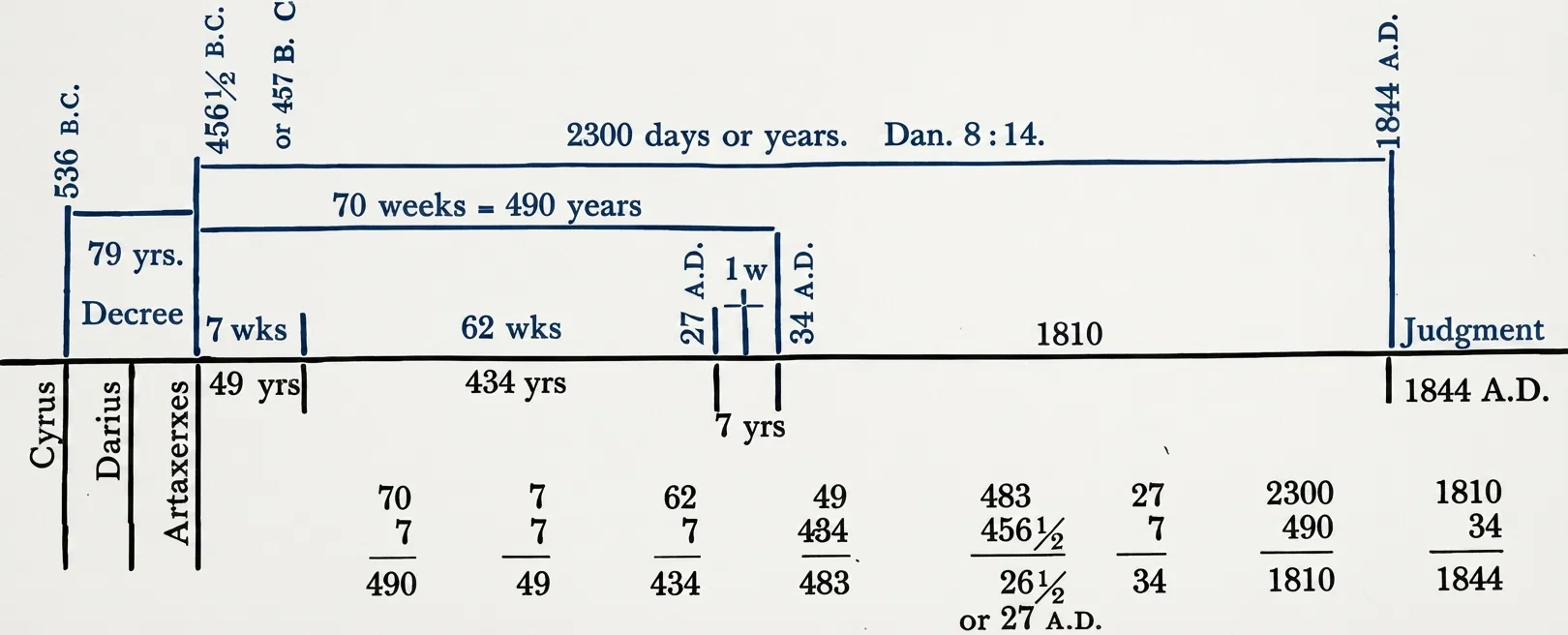
Wonderful changes were wrought in the history of the church during that four hundred ninety years. After the angel enumerated the events to take place during that period, he tells Daniel where to locate it in the history of the world, by announcing the date of the beginning of the period: "Know therefore and understand, that from the going forth of the commandment to restore and to build Jerusalem unto the Messiah the Prince shall be seven weeks, and threescore and two weeks: the street shall be built again, and the wall, even in troublous times." Dan. 9:24, 25. The long period of two thousand three hundred days, from which the seventy weeks, or four hundred ninety years, are taken, began with the going forth of the great threefold commandment (Ezra 6:14) to restore and build Jerusalem, which went forth in 457 B. C. This decree did not go into effect until about the middle of the year (Ezra 7:9), which would make the exact date for the going forth of the decree 456½ B. C.
Gabriel divides the seventy weeks into three divisions,—seven weeks, sixty-two weeks, and one week. Dan. 9:25-27. The prophet Nehemiah gives an account of the rebuilding of the walls during troublous times. The seven weeks and the sixty-two weeks, or sixty-nine weeks, were to extend to Messiah the Prince. Sixty-nine weeks equal (69×7) four hundred eighty-three days, or years. Four hundred eighty-three years from 456½ B. C. bring us to 26½ A. D., that is, to the spring of A. D. 27. Jesus at his baptism was anointed with the Holy Ghost, and henceforth was the Christ, the Messiah, the Anointed One. John 1:41 (margin); Luke 3:21, 22; Acts 10:38.
After the seven weeks and the threescore and two weeks passed, Messiah was to "be cut off, but not for himself." He died to atone for the sins of the world. After stating that the Messiah would be cut off, he adds, "He shall confirm the covenant with many for one week: and in the midst of the week he shall cause the sacrifice and the oblation to cease." Dan. 9:27. Christ's ministry after his baptism continued three and one-half years, or half a week, prophetic time. He was cut off in the midst of the seventieth week, but the entire seventy weeks were determined upon the Jews. Christ directed his disciples to begin their work at Jerusalem, and it was not until the stoning of Stephen, in A. D. 34, or three and one-half years after the crucifixion, that the gospel went to the Gentiles. The covenant was confirmed by the disciples (Heb. 2:3), who confined their labors to the Jews until A. D. 34, the close of the period cut off for that people. Acts 8:1-4.
The seventy weeks, or four hundred ninety years, ended in A. D. 34. Four hundred ninety years taken from the entire period of two thousand three hundred years leaves eighteen hundred ten years of the period remaining in A. D. 34 (2300—490=1810). This, added to A. D. 34, brings us to A. D. 1844 (34+1810=1844).
"Unto two thousand and three hundred days [years]; then shall the sanctuary be cleansed." Dan. 8:14. The earthly sanctuary had ceased to exist long before this date; but the time had come for the antitype of the cleansing of the sanctuary (the work performed on the day of atonement in the earthly sanctuary) to take place in the heavenly sanctuary. In 1844 the great court from which there is no appeal convened in the most holy place of the heavenly sanctuary.
This wonderful prophecy of two thousand three hundred years begins with the restoration of God's people to their earthly possessions and with the rebuilding of the holy city Jerusalem; but the Jews proved unfaithful to the trust, and the land of promise and the holy city passed from them into the hands of others. The coming of Christ and his death on Calvary, like a great seal, fixes definitely the entire prophecy, and insures the inheritance of the earth to the faithful; and the judgment, which opened at the close of that wonderful period of two thousand three hundred years, will give to the faithful a "court title" to the eternal inheritance and the city of God, the New Jerusalem.
Portland, Maine.